Van's Air Force

The definitive Van's Aircraft support community! Buying, building or flying an RV? Join our exclusive family of mentors and enthusiasts!

RV-9 Cabin Heat, but not so much

edclee

Well Known Member
Patron
My RV-9A has a cabin heat issue, that is, very little of it. I have taken apart the heat muff on the Vetterman Exhaust and examined it. Nothing wrong there, the pipes fit tight with virtually no air gap. No gaps where the two halves fit together, no holes in the scat tubes in or out. The cabin heat valve on the firewall works properly and when opened I get good air flow. At idle and taxi I get some warm air through it and some warm air while climbing, not much. Plenty of air but only some warmth. Once at cruise and lean of peak I get lots of air, but almost no warmth????

Anyone have any words of wisdom? With the two crossover pipes through that heat muff I SHOULD get plenty of heat.
Ed
 
Lots of posts on this problem - effective cabin climate control was not an RV design priority, apparently. 🤣

I’ve been down this road with my -9A and the biggest improvements by far have come from (a) sealing the canopy and (b) wearing battery-powered heated clothing (!). These two things have made cold days much more tolerable. Adding some copper wool to the heat muff also helped - you may benefit from heater air moving more slowly and spending more time with more heated surface.

If you can get your -9A to be TRULY warm in very cold weather, please post your techniques! I’m always looking for more ideas!
 
Here I thought I was the only one with a cold cabin...I have filled my muff with stainless wool pads hoping that would work. I have also done as you suggested to partially close the heat valve to slow down the air and while that does increase the temp of the air flow, You don't get any air to speak of either, so that is not very effective.
 
Lots of posts on this problem - effective cabin climate control was not an RV design priority, apparently. 🤣

I’ve been down this road with my -9A and the biggest improvements by far have come from (a) sealing the canopy and (b) wearing battery-powered heated clothing (!). These two things have made cold days much more tolerable. Adding some copper wool to the heat muff also helped - you may benefit from heater air moving more slowly and spending more time with more heated surface.

If you can get your -9A to be TRULY warm in very cold weather, please post your techniques! I’m always looking for more ideas!
Sheepskin covered heated seats.
 
A few things I've done:
If you don't use a crotch strap, put a piece of tape over the 1"x3" opening in the floor pan.
Install boots around the aileron push rods where they exit the fuselage.
Wear thermal underwear.
You can wear gloves if your plane is G3X Touch equipped.

An RV heater is like the one in an old VW bug, where the side of your foot next to the floor vent is toasty, the rest of you - not so much.
 
You may want to study the differences of an RV-14. That heater is so hot, I have it half blocked at the source and only crack the CP side. I did add the aileron boots from Abbey at Flightline Interiors. Probably the best investment you can buy, especially up North.
 
An RV heater is like the one in an old VW bug, where the side of your foot next to the floor vent is toasty, the rest of you - not so much
🤣 What I wouldn’t give for even one toasty foot!!
 
My RV-9A was built in Atlanta so I wasn't expecting much, but I gotta say...my cabin gets pretty toasty here in Minnesota. Not having built it, I can't explain why it bucks the apparent trend, and I'm sorry that I don't know enough about Van's heater design to understand any differences on the way my heater works. To my unknowledgeable eye, the system in my airplane looks pretty conventional according to the plans. I do have a couple of air leaks in the cabin but they only rise to the level of minor annoyance.

1734964056257.jpeg
 
My RV-9A has a cabin heat issue, that is, very little of it. I have taken apart the heat muff on the Vetterman Exhaust and examined it. Nothing wrong there, the pipes fit tight with virtually no air gap. No gaps where the two halves fit together, no holes in the scat tubes in or out. The cabin heat valve on the firewall works properly and when opened I get good air flow. At idle and taxi I get some warm air through it and some warm air while climbing, not much. Plenty of air but only some warmth. Once at cruise and lean of peak I get lots of air, but almost no warmth????

Anyone have any words of wisdom? With the two crossover pipes through that heat muff I SHOULD get plenty of heat.
Ed
Tis the season to be frosty . . . There are some very good posts on this from years (10) back. They address 1. leaks into the cabin, and 2. Leaks of the under cowl system and having two muffs in series. Also, leaning to peak EGT is required for the muffs to work most effectively. The list of leak points is extensive and a search, or many searches will uncover a rich vein of solutions. One item added, I insulated the outside of my muff (1) with a wrap of fiberfrax and aluminum foil. My heating limit is about 5F OAT, and my single muff has studs welded on the pipe, AWI exhaust, the only company that has studs to my knowledge. I have a tip-up that sucks air out the right side, when i stuff it with cord it heats the cabin much better. A tipper has a lot of potential leak area around the perimeter.

On cabin leaks, there are two kinds - negative pressure and positive pressure. Negative are all around the canopy and the most important followed by the positive leaks that supply cold air to replace that which is evacuated. Positive leaks would be inconsequential if the negative leaks are addressed. The heat system is a positive leak with heated air, if you have to muffs in series (insulated) then you can not do better than that, the negative leaks must be addressed.

Scott recommended to take strips of toilet paper use them to find the negative leaks. Make a pile (a lot of strips) and take a friend to help find the leaks.

If your eyes just rolled over, dress warm.
 
You could try cutting down the size of the inlet to the muff at the baffle. It would flow less air to the cabin but it would be warmer air.
 
reducing the flow might work. I get a hefty airflow but it is not warm. For that reason, the more I have the cabin heat valve open, the more cold it gets. ⛄❄️🥶
 
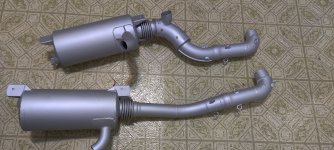
I have an exhaust that may be different than many on an 0-320. It produces almost no heat - even for the carb heat. I have not found a way to get more heat. I have sealed every place I can find - put the aileron boots on and weather stripped the rail and canopy. There is still leakage around the instrument panel that I think comes from the tip up canopy seal along the foreskin. I tape over the exterior of the vents so no air can come through.

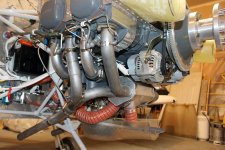
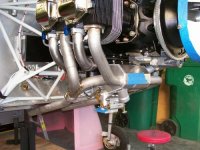
Here is a picture of my exhaust system. If anyone has an idea on how to increase the heat, please let me know. I was going to fly yesterday but it was in single numbers and that is too cold even with heated vest and heated seats. I talked to Clint last year about building a new system and that may be the best answer.
 

Attachments

  • carb intake 1.jpg
    carb intake 1.jpg
    184.9 KB · Views: 148
  • exhaust2.jpg
    exhaust2.jpg
    209.5 KB · Views: 140
I have an exhaust that may be different than many on an 0-320. It produces almost no heat - even for the carb heat. I have not found a way to get more heat. I have sealed every place I can find - put the aileron boots on and weather stripped the rail and canopy. There is still leakage around the instrument panel that I think comes from the tip up canopy seal along the foreskin. I tape over the exterior of the vents so no air can come through.

Here is a picture of my exhaust system. If anyone has an idea on how to increase the heat, please let me know. I was going to fly yesterday but it was in single numbers and that is too cold even with heated vest and heated seats. I talked to Clint last year about building a new system and that may be the best answer.
That is exactly the system I have with the exception that I have fuel injection so the intake heat port is closed off. I get almost no heat out of the heat duct in flight, but plenty of air. If I close off the vent almost completely then I get some warm air, but it is so little flow that it is useless. I have put some stainless scrubbies inside but with little effect. Plenty of air through the system but no heat to speak of.
Ed
 
I have no idea why this is, but if I crack one of my eyeball vents open, it seems to help circulate the warm air from the heat inlet, and the cabin actually feels warmer.
 
Anybody have a pirep on the turbo muff from spruce?
I had one made at a custom length for crossover. It worked better than a stock heat muff, but it was marginal for WI winters. Cleaning up some neg pressure leaks may have improved it, but I ended up changing it during my overhaul last year.
 
My RV-9A has a cabin heat issue, that is, very little of it. I have taken apart the heat muff on the Vetterman Exhaust and examined it. Nothing wrong there, the pipes fit tight with virtually no air gap. No gaps where the two halves fit together, no holes in the scat tubes in or out. The cabin heat valve on the firewall works properly and when opened I get good air flow. At idle and taxi I get some warm air through it and some warm air while climbing, not much. Plenty of air but only some warmth. Once at cruise and lean of peak I get lots of air, but almost no warmth????

Anyone have any words of wisdom? With the two crossover pipes through that heat muff I SHOULD get plenty of heat.
Ed

I now have Vetterman with heat exchanger on a single muffler, and it has so much heat it can get my feet too hot. My cabin has some negative leaks so I get a little draft from the aft bulkhead. My heated vest take care of the cold draft on my neck. I was in -21C OAT and night, and its warm enough to take my gloves off.

The best heat is an exchanger off the Vetterman muffler...nothing comes close.
 
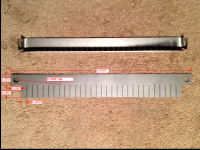
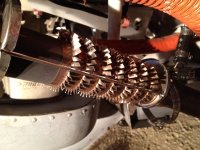
There were a lot of posts with respect to adding either SS wool or springs in an attempt to increase residence time and/or surface area. I tried both and played with trying to get temperature and flow. Finally, I decided to take a total different tack and had some laser cut pieces that were then folded and wrapped around the pipes inside the muffs and then twisted. With this configuration a minor reduction in flow and massive increase in temperature. I could put more rings on, and did for a while, but settled on 7 per side.
 

Attachments

  • IMG_1739.png
    IMG_1739.png
    4.4 MB · Views: 217
  • IMG_0008.jpeg
    IMG_0008.jpeg
    397.5 KB · Views: 223
There were a lot of posts with respect to adding either SS wool or springs in an attempt to increase residence time and/or surface area. I tried both and played with trying to get temperature and flow. Finally, I decided to take a total different tack and had some laser cut pieces that were then folded and wrapped around the pipes inside the muffs and then twisted. With this configuration a minor reduction in flow and massive increase in temperature. I could put more rings on, and did for a while, but settled on 7 per side.
Excellent solution - the pipe is the HX limit. Did you use SS for your fins? 304, 316? Thanks for the template.
 
During the winter months I wrap my heat muffler with high temp exhaust wrap. It isn't perfect but seems to help get another 10deg of OAT vs without it and still be comfortable. I can confirm even with it @ -18 degrees outside, it doesn't work. @ 30 deg outside it works fairly well.
 
I now have Vetterman with heat exchanger on a single muffler, and it has so much heat it can get my feet too hot. My cabin has some negative leaks so I get a little draft from the aft bulkhead. My heated vest take care of the cold draft on my neck. I was in -21C OAT and night, and its warm enough to take my gloves off.

The best heat is an exchanger off the Vetterman muffler...nothing comes close.
Can you buy the Vetterman exchanger seperately?

Is this the part of the exhaust package that Van's sells?
 
I keep wondering why some have little heat. I have a RV-9 with IO-320 and it will heat you out of the cabin. I also have large leaks in wing roots and canopy that I don't bother sealing since I am in Florida where we want all the ventilation we can get.
I fly often at cold altitudes and will use heat but any more than a 1/16" pull on the cable will toast you.
There must be something different, I just don't know what it is.
Heat muff.jpg
 
I keep wondering why some have little heat. I have a RV-9 with IO-320 and it will heat you out of the cabin. I also have large leaks in wing roots and canopy that I don't bother sealing since I am in Florida where we want all the ventilation we can get.
I fly often at cold altitudes and will use heat but any more than a 1/16" pull on the cable will toast you.
There must be something different, I just don't know what it is.
View attachment 77041
You have the newer heat muffler system, which I have only seen not used but by the looks it is probably much better at heating than the old system, downside is a bit heavier and bulky. I also question if anybody in florida can comment on cabin heat. :)
 
That is exactly the system I have with the exception that I have fuel injection so the intake heat port is closed off. I get almost no heat out of the heat duct in flight, but plenty of air. If I close off the vent almost completely then I get some warm air, but it is so little flow that it is useless. I have put some stainless scrubbies inside but with little effect. Plenty of air through the system but no heat to speak of.
Ed

I had made my comment very early in this thread so I missed something you said later. I have an IO320 on an RV-9A, with a vettermans exhaust and using just a single heat muff and have tons of heat so I thought this dicussion would have ended already. But you say above you closed your heat muff air intake. Why?
I don’t have the drawing in front of me but I seem to recall the inlet was taken to the baffle with a screen in front. This is where the airflow comes from. Could you clarify if I’m reading correctly, why you closed the inlet for the heat muff. Is this based on an OP drawing ???
 
I have an exhaust that may be different than many on an 0-320. It produces almost no heat - even for the carb heat. I have not found a way to get more heat. I have sealed every place I can find - put the aileron boots on and weather stripped the rail and canopy. There is still leakage around the instrument panel that I think comes from the tip up canopy seal along the foreskin. I tape over the exterior of the vents so no air can come through.

Here is a picture of my exhaust system. If anyone has an idea on how to increase the heat, please let me know. I was going to fly yesterday but it was in single numbers and that is too cold even with heated vest and heated seats. I talked to Clint last year about building a new system and that may be the best answer.
I have this system in my 9, im very impressed with the heat in the cabin, I have been flying (phase 1 test flights) here in uk with freezing temps and its been super warm in the cabin.

I do have aileron pushrod boots and no leaks around the canopy.
 
I’m convinced that canopy leaks are a major culprit. Even if they seem good on the ground, the geometry can change in flight.
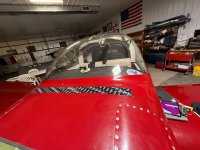
I used to feel a cold draft on my neck in flight. I put a strip of soft-side velcro on the back edge of my (slider) canopy which eliminated that. That was the major source of cold-air discomfort for me on winter flights. I still have some rather focal air intrusion in spots from under the panel but it's only a minor irritation and for me isn't worth crawling around under there.
 
I used to feel a cold draft on my neck in flight. I put a strip of soft-side velcro on the back edge of my (slider) canopy which eliminated that. That was the major source of cold-air discomfort for me on winter flights. I still have some rather focal air intrusion in spots from under the panel but it's only a minor irritation and for me isn't worth crawling around under there.
Velcro under the rear of the slider canopy was a big help for me as well. I put some in the u channel as well. So now I get (almost) no rain sucked up the center rail and falling on my baggage! 😂
 
I had made my comment very early in this thread so I missed something you said later. I have an IO320 on an RV-9A, with a vettermans exhaust and using just a single heat muff and have tons of heat so I thought this dicussion would have ended already. But you say above you closed your heat muff air intake. Why?
I don’t have the drawing in front of me but I seem to recall the inlet was taken to the baffle with a screen in front. This is where the airflow comes from. Could you clarify if I’m reading correctly, why you closed the inlet for the heat muff. Is this based on an OP drawing ???
I guess I should have been more specific. I do not have a carb, I am Fuel Injected, therefore have no need of carb heat. The muff has three ports. One is for the inlet air, one is for carb heat output and the other is for cabin heat output. I have capped off the carb heat output.
 
I guess I should have been more specific. I do not have a carb, I am Fuel Injected, therefore have no need of carb heat. The muff has three ports. One is for the inlet air, one is for carb heat output and the other is for cabin heat output. I have capped off the carb heat output.
Thanks for clarifying. Ok, then lets dissect this a bit further. My vettermans muff only has 2 ports but if you’ve blocked one then it should not be a factor. If you’ve installed it as per the drawings then you have the inlet with a scat tube heading up to the baffle, so you would have a reasonable degree of positive pressure. Maybe there are sources of positive pressure pushing against this. The obvious places are the aileron hole (unless you have a bellows), main gear cutout (unless it’s been sealed) or/and a very leaky canopy. BTW, I have all those and still have a lot of heat.
If you have not already done so maybe it’s worth removing the centre heat baffle inside to see if you at least get some airflow without it there and to confirm the control movement. I suspect you’ve probably done this already.

Cheers
 
I had made my comment very early in this thread so I missed something you said later. I have an IO320 on an RV-9A, with a vettermans exhaust and using just a single heat muff and have tons of heat so I thought this dicussion would have ended already. But you say above you closed your heat muff air intake. Why?
I don’t have the drawing in front of me but I seem to recall the inlet was taken to the baffle with a screen in front. This is where the airflow comes from. Could you clarify if I’m reading correctly, why you closed the inlet for the heat muff. Is this based on an OP drawing ???
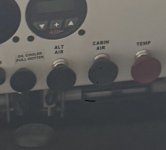
My configuration as well, and I have tons of heat. And I agree about the air. Just pulling the heat knob doesn't put much heat into the cabin. If I pull out the cabin air knob too, well, I don't pull it out all the way or it gets too hot.

1735337558703.jpeg
 
Thanks for clarifying. Ok, then lets dissect this a bit further. My vettermans muff only has 2 ports but if you’ve blocked one then it should not be a factor. If you’ve installed it as per the drawings then you have the inlet with a scat tube heading up to the baffle, so you would have a reasonable degree of positive pressure. Maybe there are sources of positive pressure pushing against this. The obvious places are the aileron hole (unless you have a bellows), main gear cutout (unless it’s been sealed) or/and a very leaky canopy. BTW, I have all those and still have a lot of heat.
If you have not already done so maybe it’s worth removing the centre heat baffle inside to see if you at least get some airflow without it there and to confirm the control movement. I suspect you’ve probably done this already.

Cheers
I get lots of airflow when I open cabin heat valve, it is not hot however. The system is installed per plan .
 
I run the Vetterman exhaust with dual mufflers. Pull the cabin heat off the muffler shroud. RV-9A, O-320, plenty of heat, 10 below zero no factor.
 
I get lots of airflow when I open cabin heat valve, it is not hot however. The system is installed per plan .
Maybe consider contacting Clint. It’s his system. Maybe he has some idea why yours (and apparently others with the same) don’t get adequate heat).
 
The system I have was not built by Vetterman but was sold by Vans. I spoke with Clint a couple years ago and he said he could modify it so I could get better heat. I do have heated seats and they really help.

I flew yesterday and it was warmer than normal, about 40 degrees. I put some tape over the joint where the canopy closes over the foreskin. I have a pretty good fit there but this made a difference in the amount of air leaking from behind the panel. Taping the cowl inlet on the top also helped get the engine oil up to about 170 on my 45 min flight.

I believe some of my problem is not getting enough air going through the heat muff. My inlet is on the bottom of the ramp on the left inlet. I think if I pulled the air from the back of the plenum I would get more air or bot a small scoop at the back of the 2" hole on the ramp to increase the air into the heat system. That is what I will try next.
 

Attachments

  • IMG_8172.jpeg
    IMG_8172.jpeg
    1.9 MB · Views: 45
  • IMG_8171.jpeg
    IMG_8171.jpeg
    425 KB · Views: 46
  • IMG_8168.jpeg
    IMG_8168.jpeg
    460.1 KB · Views: 46
Can you buy the Vetterman exchanger seperately?

Is this the part of the exhaust package that Van's sells?
I believe you can...call Clint at Vetterman. I muff on straight pipe may not be as hot as those with a muffler as there's lees surface area, but Clint would know.
 
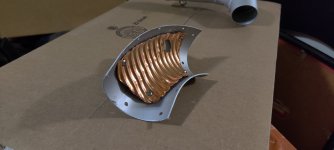
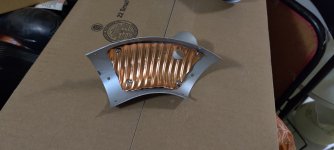
I wonder how this extra wall of corrugated copper (with an air gap off the aluminum shell) would work on a full size muff?

I needed a solution for a very short curvy exhaust with no typical place for a muff.
(I couldn't put it on the long straight exhaust bc of clearance issues).

It's sliced and flattened copper tubing, with an air gap off the metal shelf. Works shockingly well. (Pardon the rough cut copper as i was skeptical that it would work so didn't clean it up). 40hp Hirth 2 cycle engine.

On my plastic plane I made a muff to cover one three into one collector and also studded the exhaust (IO550N). I was tired of freezing on previous planes. It works so well I was worried about melting the carpeting so I ground most of the studs off. (Since I cover welds with the muff, I inspect it annually and also have a CO monitor)
 

Attachments

  • IMG_20230102_203152.jpg
    IMG_20230102_203152.jpg
    816.7 KB · Views: 50
  • IMG_20230102_203140.jpg
    IMG_20230102_203140.jpg
    902.3 KB · Views: 49
  • IMG_20230103_110426.jpg
    IMG_20230103_110426.jpg
    1.4 MB · Views: 49
I think all the main points covered above but:

Reduce air leakage around canopy
Increase heat transfer from exhaust pipe to air (going through heat muff) w/ spot welded studs or other methods.
Increase airflow thru heat muff
Cockpit is "pressurized" from canopy leakage, hot air will not enter from heat muff.​
EXIT cockpit air flow, via vent in aft cockpit and rear fuselage. Helps airflow from heating or cooling vents.​
Other things, increase size if heat muff and insulate cockpit.
 
Anybody have a pirep on the turbo muff from spruce?
IMG_7575.jpeg
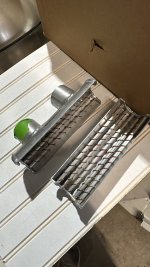
This is what the inside of the turbo muff looks like. They include a restrictor (under the green tape) if you need to slow down the airflow.

You can step drill the restrictor open if you need more airflow.

They’ll make a muff for your exhaust diameter and set it up per your instructions if you need inlets and outlets pointing in different directions.
 
View attachment 77350
This is what the inside of the turbo muff looks like. They include a restrictor (under the green tape) if you need to slow down the airflow.

You can step drill the restrictor open if you need more airflow.

They’ll make a muff for your exhaust diameter and set it up per your instructions if you need inlets and outlets pointing in different directions.
How does it work? Big heat improvement?
 
How does it work? Big heat improvement?
I haven't flown my -7 yet. I bought it with 61 hours on it as a day VFR only aircraft. It is currently at the avionics shop getting the $30,000 IFR upgrade. The Florida based builder did not include any provision for cabin heating. They even mounted the voltage regulator where the heat is supposed to enter the cabin.
 
View attachment 77350
This is what the inside of the turbo muff looks like. They include a restrictor (under the green tape) if you need to slow down the airflow.

You can step drill the restrictor open if you need more airflow.

They’ll make a muff for your exhaust diameter and set it up per your instructions if you need inlets and outlets pointing in different directions.
Well, that hadn’t occurred to me. I have 2 mufflers as part of my vettermans exhaust. The muff in my case is wrapped around the muffer. I only use one of the muffs because it’s quite warm with just the one. I’m guessing the baffling of the muffler would slow down the heated air movement and make for a far better heating system.

So, the question would be if those who have good heat have mufflers and those who have poor heat are muffs wrapped on the exhaust pipe.
 
Back
Top