Van's Air Force

The definitive Van's Aircraft support community! Buying, building or flying an RV? Join our exclusive family of mentors and enthusiasts!

Building an RV for Canadian Winters

Tall_Order

Well Known Member
Patron
For those that do winter flying (say in the neighbourhood of -15C / +5F which is a typical day in the prairies for 1/2 the year), are there any experiences with what you like/don't like or what you would do different with setting up your RV?

- Does the canopy get frosted up?
- Do you use no, ambient, or heated defrost?
- Is standard cabin air/exhaust enough to keep a 2 place cabin warm in this temp range?
- How powerful of heated seats do you use and would you call it optimal?
- Oil cooler size/restrictor plate suggestions?
- Any do's/don't do's with the build to optimize for winter ops?
- etc.

Thanks in advance!
 
Most of my flying has been in the west. A few winters in Pennsylvania I can say that I wish I had two exhaust heat muffs for flying in the cold and overcast. Out west, there was enough sun that I felt ok with one heat muff when OAT was 17F on the ground. When I say two heat muffs, I am talking about two individual ones running into the cockpit.
 
Im in Michigan and I think about as cold as you get. I struggle to keep it warm enough in the winter. I put the boots on the aileron pipes and that helped. I also tape over the side vents. On a flight yesterday I noticed air coming in from behind the panel. Im wondering if it comes in from the joint between the canopy and the foreskin. I think I will put some tape over that joint - but it only will take tape on the top.

The exhaust muff that I have does not give me enough heat to stay comfortable. I will work on improving it this winter a second muff or redesign. I did add heated seats and that really helps. I have the shutter over the oil cooler and use it all winter.
 
Minnesota here…(almost Canada). I get cold weather condensation inside but I’ve never had frost. That said, defroster fans in the glare shield would be a good idea. My cockpit actually stays pretty toasty while flying in winter down to maybe 10 degrees F (I breakout the heated vest at about 20F), but I’ve found that the effort involved in preflighting, de-hangaring, and all the other stuff associated before actual takeoff negatively affects my enthusiasm for sure. I’ve never been uncomfortable actually flying the airplane, but I’ve been really cold getting the airplane ready to fly.

For cold weather flying, I’d recommend a really good cylinder band and sump pre-heater, a good cockpit preheater (like a Hornet 45) and a heated vest. Also some of those charcoal boot inserts. The cockpit pre-heater is useful in not having to rely on your butt to warm up the Confor foam in your seats to become softer than concrete. Some will advocate heated seats. Also, try to minimize or deflect any cockpit air leaks.
 
I have a heat muff that wraps around down pipes 1 & 3. Air for that comes off of the baffling behind #3. Some people suggest slowing the airflow through the muff with stainless steel scrubbers inside the muff. My outlet is above my right knee and puts out a goodly amount of heat, very adequate for Colorado/Montana Winters. The front office of a -4 is tighter (which I really like!) than a -8 which might make some difference. My canopy is very tight, which helps, and adequate weatherstripping also keeps the cold air out. My cockpit air outflow is at the top of the baggage compartment bulkhead and is 1.5 inches which probably allows heated air to push out other places keeping the cold air out.

I have a cockpit-adjustable oil cooler gate that I have to mostly block off in the Winter. I posted pictures of that on a different thread.

There are many heated vests and jackets on the market, some better than others. I currently have a GOBI vest on as I just came in from outside. It has material similar to Carhart fabric. My RIO has a synthetic-filled pleated GOBI vest. I also have a GOBI sweatshirt that works well. Nothing to hook up except the rechargeable battery that runs them. Choose wisely as there are some off-brands that don't heat as well and don't last very long. A friend bought some on Amazon and has since replaced them with GOBI.
 
I fly in New England and consider 0F my personal limit. To do that, I have to preheat the oil and run the heater in the hanger for an hour or two before I plan to fly. If the weather is sunny, solar heating is a huge help. 0F and overcast is tough. I have a muff on the exhaust and a heated front seat (10 amp). The muff is good, but the heated seat is great. The challenge to is to control air leakage into the cockpit. In my -4, the leakage points are the vents (that I tape closed in winter) and the canopy frame to fuselage seal. I also get some significant leakage from the cowl check pieces. I have not had an issue (yet?) with canopy fogging/freezing (possible due to all the air leaks). Finally, as I read long ago in some bush pilot document, I try to dress like I will be walking home.

I have an oil shutter that is indispensable. If the oil is warm at start-up (~70F), I can get the temperature to about 160-170F with the shutter fully closed.
 
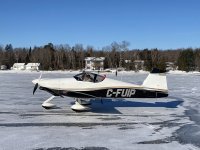
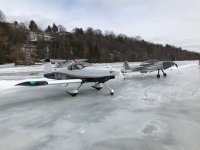
I’m in Sault Ste Marie Ontario and do a lot of flying in the winter. I have the Vetterman Trombone exhaust with the mufflers that have the heat shroud around them. I have the two mufflers, two firewall valves and two control cables.

It works well and tip up canopy stays clear without dedicated defrost fans.

Terry
 

Attachments

  • IMG_3367.jpeg
    IMG_3367.jpeg
    2.1 MB · Views: 53
  • IMG_0269.jpeg
    IMG_0269.jpeg
    82.3 KB · Views: 52
I’m in Sault Ste Marie Ontario and do a lot of flying in the winter. I have the Vetterman Trombone exhaust with the mufflers that have the heat shroud around them. I have the two mufflers, two firewall valves and two control cables.

It works well and tip up canopy stays clear without dedicated defrost fans.

Terry
Do you have a primer on your engine?
 
Haven't flown in cold yet, but living in Minnesota, I planned for it. I have not done the aileron boots, but I did use rigid foam insulation in the gaps of the wing spar. The other thing I did is with the heat muff. I added stainless steal brillo pads to help absorb the heat, I also ran the duct work opposite of the plans. My cold air enters the muff on the cold side of the exhaust and exits the hotter side of the exhaust closer to the engine.
 
For those that do winter flying (say in the neighbourhood of -15C / +5F which is a typical day in the prairies for 1/2 the year), are there any experiences with what you like/don't like or what you would do different with setting up your RV?

- Does the canopy get frosted up?
- Do you use no, ambient, or heated defrost?
- Is standard cabin air/exhaust enough to keep a 2 place cabin warm in this temp range?
- How powerful of heated seats do you use and would you call it optimal?
- Oil cooler size/restrictor plate suggestions?
- Any do's/don't do's with the build to optimize for winter ops?
- etc.

Thanks in advance!
I’m in Minnesota and fly down to zero F. I have the Vetterman trombone exhaust with two 4 inch diameter heat muffs. I route the intake air to the right heat muff and backflow through that muff, and then route that heated air directly to the left heat muff and back flow the air through that one and then directly to the cabin. The air coming into the cockpit is very hot. I rarely have to open the heat valve fully.

I also have the aileron push-pull tube boots. I have the slider canopy and air comes in along the side rails, so I put the round 5/8” diameter foam cord you get at the hardware store along the rails. I cover the oil cooler completely when it is below 40 F. I learned another trick from another RV driver and that is to put a layer of 2 inch masking tape at the outboard edges of both cheeks on the cowl to make the openings slightly smaller. Amazingly it stays in place at 160 kts, and it keeps the cylinder head temps in the 350 degree range.

Best regards,

Bill Wuorinen
RV-7A Flying since 2014
Osprey 2 amphibian Flying since 2001
 
Growing up in Minnesota, I flew a J-3 that got put on skis in the winter, but still sat outside. We drained the oil at the end of a flying day, and warmed it up on a stove the next morning before pouring it in the engine. So an oil quick drain is a good idea! Kidding really - in today’s modern times, an engine heater system will be a whole lot easier, so long as you have electricity on hand.

One thing to comnsider if your plane is going to be pretty cold before starting, is an external power jackal (ala Knuckoll’s) that will give you the capability to jump start the airplane. Why torture a cold-soaked battery (that you might be depending on down the line if your alternator quits) when you can use a start cart or your car’s battery to swing the prop with that thick oil. Just something to think about. (And no - I am not a proponent of jumping a dead battery to start the engine and go fly - just giving the cold battery an assist….)

Finally - heated vests and socks are great technology! I use them in my little jet at 17.5K because there is NO engine provided heat, and just enough excess amps available to power the seated heat. But the toes are way up there in the nose, so the battery-powered socks are a god-send - as is a vest in winter.
 
Best advise I can give you about winter flying (based on over 20 winters in RVs) is get in it & head down to Arizona🤣.
But if that’s not practical, follow all the tips offered above. & below.
Maybe prioritize first with drafts & air leaks:
- biggest culprit is the lower side seals on the canopy, tip up or slider same problem, as the plane gains speed the canopy lifts & opens a gap below the canopy allowing warm air to be sucked out by that low pressure area over the wing. Work on a seal that minimizes this.
- tip up, proper sealing on the rear canopy edge is just as important as the front cowl/canopy edge. Tighten up every potential air leak you can but not so tight that you create problems for hot day flying later (yes, the Prairies have some of them too).
- slider, roll bar sealing is important in preventing water intrusion & heat loss out the top low pressure air flow over the canopy. A large air draft inwards happens along the rear edge & especially the rear track of the slider canopy, so you need to come up with a sealing solution there.
- baggage area (6,7,9,14) rear bulkhead, all those horizontal stiffener ridges are great inward air leaks especially if those lower canopy side seals haven’t been dealt with. A good solution there is little foam wedges glued into each stiffener ridge.
- side NACA vents, small foam plugs fixes these air leaks
- fuselage air leaks, caulk & plug all around wing spar to side skin joints, seal all wing wiring grommets, fuel line to skin grommets, install aileron control link boots, install flap linkage boots, caulk rear spar to side skin joints, elevator push rod boot under baggage floor, tip up canopy hinges, get the idea?
- single heat muff is probably good enough if all the air leaks mentioned have been treated.
- carpeted floor & seat areas help. Interior upholstered side panels help.
- two defrost slots cut into the glare shield with small fans blowing warm air from behind the panel works great.
- electric heated seats will make your butt & back feel good but will not help on warming the rest of your body, try to retain as much of that exhaust muff heated air as possible.
- oil cooler, is a good idea to use some form of airflow restrictor, there are a few choices available or use a restrictor plate, your choice.
- there is a LOT of good local advice about best practices for winter engine operations.Seek it out & heed it.
- SURVIVAL, no matter how comfy you make your plane, DRESS for the unexpected!

Or you could try my first (best) bit of advice & come south…

Enjoy your bird!

 
Last edited:
Best advise I can give you about winter flying (based on over 20 winters in RVs) is get in it & head down to Arizona🤣.


Enjoy your bird
lol yes that is good advise… at the rate my build is going, maybe I will be in a position to enjoy the USA winters by the time I actually finish this thing! 😂

Some really good ideas on this thread… one recurring one is the aileron control boots as part of the draft sealing strategy. Do those come from the shops like Classic Aero and such?

Also in my case, the 2 heat muffs is something to consider for sure. I’ve never held one… are they super light or do they have some weight to them? As with many components, I will be ordering sight unseen…
 
For cold weather flying, I’d recommend a really good cylinder band and sump pre-heater, a good cockpit preheater (like a Hornet 45) and a heated vest. Also some of those charcoal boot inserts. The cockpit pre-heater is useful in not having to rely on your butt to warm up the Confor foam in your seats to become softer than concrete. Some will advocate heated seats. Also, try to minimize or deflect any cockpit air leaks.
Lots of wisdom here. I’ve worked hard to make my RV warmer (even here in balmy VA USA, long story) and the two biggest improvements by far have come from sealing cockpit leaks, and heated vests. Heated clothing has come a long way, is incredibly effective, and works during preflight! 😃
 
biggest culprit is the lower side seals on the canopy, tip up or slider same problem, as the plane gains speed the canopy lifts & opens a gap below the canopy allowing warm air to be sucked out by that low pressure area over the wing. Work on a seal that minimizes this.
This was indeed my biggest culprit. Huge benefit from this mod. It also made my airplane faster!

A large air draft inwards happens along the rear edge & especially the rear track of the slider canopy, so you need to come up with a sealing solution there.
Very true. A few strips of fuzzy-side Velcro on the bottom rear of the slider canopy helped a lot after that.
 
. A few strips of fuzzy-side Velcro on the bottom rear of the slider canopy helped a lot after that.
This was my biggest source air intrusion and the fuzzy velcro worked great in mitigating it. I do note that there's a little cold air stream from somewhere behind my panel, most notably felt when twiddling knobs on my IFR navigator. Those things tend to run hot, so I'm not really trying to track it down. I'm not sure whether or not the OB did that intentionally and is a "feature, not a bug"....
 
lol yes that is good advise… at the rate my build is going, maybe I will be in a position to enjoy the USA winters by the time I actually finish this thing! 😂

Some really good ideas on this thread… one recurring one is the aileron control boots as part of the draft sealing strategy. Do those come from the shops like Classic Aero and such?

Also in my case, the 2 heat muffs is something to consider for sure. I’ve never held one… are they super light or do they have some weight to them? As with many components, I will be ordering sight unseen…
You can use arms cut from an old shirt or legs from pants to make the boots for the push tubes. The second hand store is a good source if you don't have any that you want to part with.
 
RV9A in Thunder Bay, ON. two heat muffs, plenty of heat even for coldest days. Preheat with a Little Buddy heater on a quick mount between the exhaust pipes, heats everything inside the cowl including the battery. The Little Buddy system goes back to my Cherokee years, 25 years+, always worked fine.
 
FWIW, If you have a car with seat heaters you quickly realize that seat heaters are much more efficient at heating the occupants than heating forced air blown into the cabin. My RV came from Idaho and had dual exhaust muffs for cabin heat but i'd gladly trade one of them for seat heaters. The dual muffs are almost too much heat, and air leaks when "shut off" mean you get twice as many warm air leaks from the engine compartment in the summer.
 
All good info. I often fly wintertime, love the crisp air and associated performance, low to no turbulence, less traffic.
I flew once down to -21°C. It was d*#% cold... Operation was ok but I limit myself now to -15C.

Vettermann Trombone with one heat muff only, heated seats. I dress warmly and always carry extra winter clothes/boots as if I would spend the night out.
I also carry a winter survival kit, orange tarp, emergency blankets, candles, hand & feet warmers etc...
I install 4" wide duct tape to block each engine air inlets.
Oil cooler has a cabin controlled shutter that's usually completely closed.
Cylinder heat & oil temps are good.
I'm decently warm in front with a light jacket, wearing light gloves when it's very cold.

However, my girlfriend is not happy in the back, even summertime at altitude when it's 6 - 8°C.
Too much cold air coming from underneath the floor.

Last year, during the annual, I installed aileron boots, but it did not improve much.
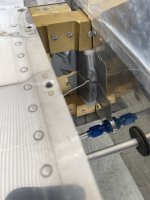
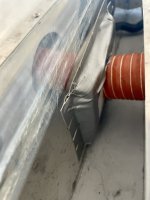
Finishing this year's annual, I blocked off the main spar, the rear spar and around the SCAT tube that comes from the right wing.
I will improve the canopy weather stripping and add the fuzzy velcro to better seal the canopy track and seal the flap pushrods.

Hoping it increases the comfort in the back...
 
Reporting back with findings following blocking the air passages from the front spar and the right side scat tube hole.
The canopy was previously only weather stripped from the middle to the rear. Now it's sealed all its lenght.
My passenger friend in the back reported feeling practically no drafts or close to nothing.
Previously, lots of cold air rushed from below the floor, especially around the rear stick and I felt a good breeze near the throttle quadrant that forced wearing a light glove on the left hand.
Data point, sunny day, 02°C at 3000'.
The sun obviously warmed the cabin, and the heater was completly closed during the entire 1 hour flight.
We were very comfortable the whole time.

IMG_9546.JPG
IMG_9545.jpg
 
A bead of caulking around the top & bottom spar stiffeners to side skins might help with that throttle quadrant draft.
Every place the ‘canoe’ could take in water is a sure air leak.
 
Back
Top