I haven't posted much about my Phase I testing progress, because frankly - there hasn't been much progress.
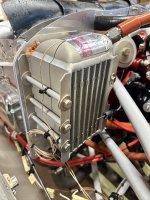
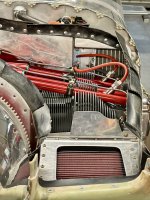
I had an uneventful first flight last year: no significant airframe squawks, a strong-running engine, and satisfactory cooling. My engine installation is about as standard as it gets: IO-360-M1B, dual magnetos, and Precision fuel injection. The oil cooler is a Stewart Warner 8406R, mounted high behind the #4 cylinder. I think my baffles are pretty good, and my CHTs have been great. Oil temperature was also within the normal range on the first flight, 185 degrees.
But then, starting with just the second flight, I suddenly began to have oil-cooling issues. Instead of the acceptable oil temperature I had on flight #1, I saw 230 degrees after only ten minutes in the air, so I made a precautionary landing. Since I knew I'd had good oil cooling a few days earlier, I naturally suspected an instrumentation issue, so I started by checking the temperature sensor and wiring. No issues found there, so I repeated the test flight and had the same results - very high oil temperature after only a few minutes of flight.
Over a period of months, with offline help from some of the brightest minds on VAF, I worked my way down the list of potential causes and solutions, starting with the easiest and most probable and moving towards the weirdest and least likely. I'd tear things apart, change or replace something, reassemble, and fly - and every time get the same result, alarmingly hot oil. Every flight was 0.2 hours in the pattern, with oil temperatures that would climb as high as I dared allow before I chopped the power, and every landing was with a panel full of warning lights.
I knew that I had once had a good cooling setup, so something must have changed. But what? In rough order, here's a partial list of things I tried, all to no avail:
I was really starting to think I had a cursed engine, with some kind of internal problem beyond my ability to fix, and was seriously contemplating pulling it off and having it torn down. But first I resolved to do one more search for things I'd overlooked, things I had previously assumed couldn't possibly be the problem.
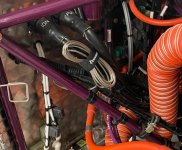
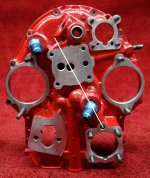
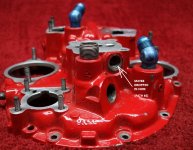
On this list were the four AN elbow fittings in the oil-cooling path: two on the oil cooler, two on the accessory case. I disconnected the hoses again and started poking a probe into each of these fittings, and when I got to the oil-output fitting in the middle of the accessory case... the probe wouldn't go in!
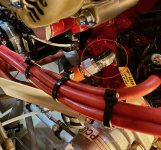
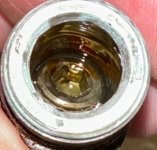
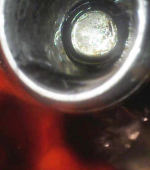
Naturally it would be the least-accessible fitting on the engine! First I took a look at it with my cheapo borescope. There was clearly something shiny at the back of the fitting:
I had to remove some accessories to reach it, and it was a real fight to remove it, but I finally got the fitting out:
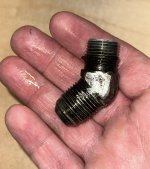
The pictures tell the story. The fitting is almost completely blocked by something that looks an awful lot like a brass pipe plug:
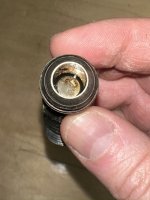
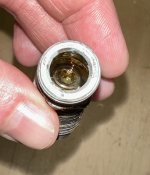
It was really wedged in there, too - no amount of beating on it with a punch and hammer managed to dislodge it.
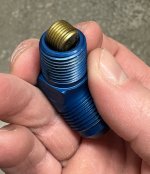
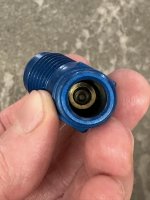
From my parts stash I grabbed a similar pipe plug and #8 fitting to play with. The plug won't go in sideways, but if it's rotated to be coaxial with the NPT side of the fitting, it drops right in:
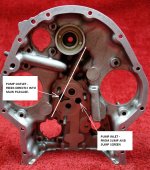
Of course the obvious question is, where did the plug come from and how did it get into my oil fitting? It didn't come from the sump, since it would have been stopped by the oil screen. I don't think it's an internal oil-galley plug, since I still have good oil pressure. The best I can figure is that it somehow got dropped into the oil filter adapter, during either assembly or installation, and only made its way into the fitting after the first flight. It seems likely that it was initially turned sideways, as above, and only later flipped and became lodged inside. I do know that it didn't touch the oil pump impellers, since I had a look at them (and the mag gears) with a better-quality borescope; they still look shiny and new. I'll never know for sure, but it sure seems like I got lucky, in the sense that no permanent damage was done.
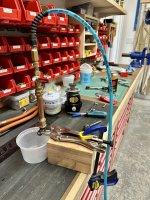
While I was waiting for a replacement fitting to arrive, I did a little science experiment with the plugged fitting, to see how much oil could actually get through it. I filled the pipe with a few ounces of oil, heated it up with a heat gun, and then opened the valve to admit 80 PSI shop air. The result was a weak stream, not any stronger than I personally can manage at three in the morning. The oil was most likely making its way around the spiral leak path of the pipe threads, and was certainly far, far less than a properly-flowing fitting ought to admit. But it was obviously enough to trick me, for months, into thinking that I had good flow to the oil cooler - after all, the hoses had oil in them after a flight, didn't they?
The ending of the story is a happy one: I installed a new fitting, put everything else back together, and went flying. At last, my oil temperature is back to normal - in fact, it was only 170 degrees at altitude, so I might even have to think of installing a shutter when the weather turns cold.
Finally, after spending way too much money on parts and way too much time chasing this one-in-a-million problem, I can get started on a proper Phase I test program. It will be great to actually be able to put some hours on my airplane!
I had an uneventful first flight last year: no significant airframe squawks, a strong-running engine, and satisfactory cooling. My engine installation is about as standard as it gets: IO-360-M1B, dual magnetos, and Precision fuel injection. The oil cooler is a Stewart Warner 8406R, mounted high behind the #4 cylinder. I think my baffles are pretty good, and my CHTs have been great. Oil temperature was also within the normal range on the first flight, 185 degrees.
But then, starting with just the second flight, I suddenly began to have oil-cooling issues. Instead of the acceptable oil temperature I had on flight #1, I saw 230 degrees after only ten minutes in the air, so I made a precautionary landing. Since I knew I'd had good oil cooling a few days earlier, I naturally suspected an instrumentation issue, so I started by checking the temperature sensor and wiring. No issues found there, so I repeated the test flight and had the same results - very high oil temperature after only a few minutes of flight.
Over a period of months, with offline help from some of the brightest minds on VAF, I worked my way down the list of potential causes and solutions, starting with the easiest and most probable and moving towards the weirdest and least likely. I'd tear things apart, change or replace something, reassemble, and fly - and every time get the same result, alarmingly hot oil. Every flight was 0.2 hours in the pattern, with oil temperatures that would climb as high as I dared allow before I chopped the power, and every landing was with a panel full of warning lights.
I knew that I had once had a good cooling setup, so something must have changed. But what? In rough order, here's a partial list of things I tried, all to no avail:
- Checked oil temperature sensor and wiring
- Checked baffles for leaks
- Checked oil cooler for airflow restrictions
- Checked magneto timing
- Checked Vernatherm activity in hot water, suspecting infant mortality
- Replaced Vernatherm anyway, after the new one I bought showed slightly greater activity
- Checked sump screen and filter element, looking for evidence the engine was making metal
- Checked compression, looking for excessive blow-by
- Verified oil was flowing to the cooler, by disconnecting the bottom (input) hose after running the engine
- Installed new oil cooler hoses from TS Flightlines, suspecting the old one could have had a collapsed liner
- Sent oil cooler to be flushed and overhauled, suspecting some kind of internal blockage
- Removed oil filter adapter, looking for blockage or restrictions
- Pulled all four cylinders (!!) - suspecting a ring problem or excessive blow-by that was heating the oil
I was really starting to think I had a cursed engine, with some kind of internal problem beyond my ability to fix, and was seriously contemplating pulling it off and having it torn down. But first I resolved to do one more search for things I'd overlooked, things I had previously assumed couldn't possibly be the problem.
On this list were the four AN elbow fittings in the oil-cooling path: two on the oil cooler, two on the accessory case. I disconnected the hoses again and started poking a probe into each of these fittings, and when I got to the oil-output fitting in the middle of the accessory case... the probe wouldn't go in!
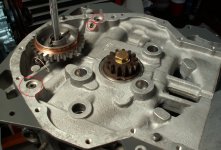
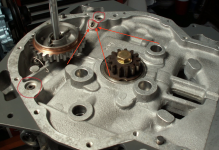
Naturally it would be the least-accessible fitting on the engine! First I took a look at it with my cheapo borescope. There was clearly something shiny at the back of the fitting:
I had to remove some accessories to reach it, and it was a real fight to remove it, but I finally got the fitting out:
The pictures tell the story. The fitting is almost completely blocked by something that looks an awful lot like a brass pipe plug:
It was really wedged in there, too - no amount of beating on it with a punch and hammer managed to dislodge it.
From my parts stash I grabbed a similar pipe plug and #8 fitting to play with. The plug won't go in sideways, but if it's rotated to be coaxial with the NPT side of the fitting, it drops right in:
Of course the obvious question is, where did the plug come from and how did it get into my oil fitting? It didn't come from the sump, since it would have been stopped by the oil screen. I don't think it's an internal oil-galley plug, since I still have good oil pressure. The best I can figure is that it somehow got dropped into the oil filter adapter, during either assembly or installation, and only made its way into the fitting after the first flight. It seems likely that it was initially turned sideways, as above, and only later flipped and became lodged inside. I do know that it didn't touch the oil pump impellers, since I had a look at them (and the mag gears) with a better-quality borescope; they still look shiny and new. I'll never know for sure, but it sure seems like I got lucky, in the sense that no permanent damage was done.
While I was waiting for a replacement fitting to arrive, I did a little science experiment with the plugged fitting, to see how much oil could actually get through it. I filled the pipe with a few ounces of oil, heated it up with a heat gun, and then opened the valve to admit 80 PSI shop air. The result was a weak stream, not any stronger than I personally can manage at three in the morning. The oil was most likely making its way around the spiral leak path of the pipe threads, and was certainly far, far less than a properly-flowing fitting ought to admit. But it was obviously enough to trick me, for months, into thinking that I had good flow to the oil cooler - after all, the hoses had oil in them after a flight, didn't they?
The ending of the story is a happy one: I installed a new fitting, put everything else back together, and went flying. At last, my oil temperature is back to normal - in fact, it was only 170 degrees at altitude, so I might even have to think of installing a shutter when the weather turns cold.
Finally, after spending way too much money on parts and way too much time chasing this one-in-a-million problem, I can get started on a proper Phase I test program. It will be great to actually be able to put some hours on my airplane!