Van's Air Force

The definitive Van's Aircraft support community! Buying, building or flying an RV? Join our exclusive family of mentors and enthusiasts!

Perplexing oil temperature puzzle (solved)

mburch

Well Known Member
Patron
I haven't posted much about my Phase I testing progress, because frankly - there hasn't been much progress.

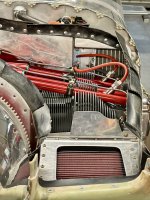
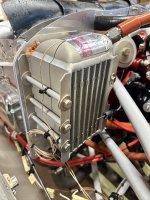
I had an uneventful first flight last year: no significant airframe squawks, a strong-running engine, and satisfactory cooling. My engine installation is about as standard as it gets: IO-360-M1B, dual magnetos, and Precision fuel injection. The oil cooler is a Stewart Warner 8406R, mounted high behind the #4 cylinder. I think my baffles are pretty good, and my CHTs have been great. Oil temperature was also within the normal range on the first flight, 185 degrees.
1750042694680.jpeg

But then, starting with just the second flight, I suddenly began to have oil-cooling issues. Instead of the acceptable oil temperature I had on flight #1, I saw 230 degrees after only ten minutes in the air, so I made a precautionary landing. Since I knew I'd had good oil cooling a few days earlier, I naturally suspected an instrumentation issue, so I started by checking the temperature sensor and wiring. No issues found there, so I repeated the test flight and had the same results - very high oil temperature after only a few minutes of flight.

Over a period of months, with offline help from some of the brightest minds on VAF, I worked my way down the list of potential causes and solutions, starting with the easiest and most probable and moving towards the weirdest and least likely. I'd tear things apart, change or replace something, reassemble, and fly - and every time get the same result, alarmingly hot oil. Every flight was 0.2 hours in the pattern, with oil temperatures that would climb as high as I dared allow before I chopped the power, and every landing was with a panel full of warning lights.

I knew that I had once had a good cooling setup, so something must have changed. But what? In rough order, here's a partial list of things I tried, all to no avail:
  • Checked oil temperature sensor and wiring
  • Checked baffles for leaks
  • Checked oil cooler for airflow restrictions
  • Checked magneto timing
  • Checked Vernatherm activity in hot water, suspecting infant mortality
  • Replaced Vernatherm anyway, after the new one I bought showed slightly greater activity
  • Checked sump screen and filter element, looking for evidence the engine was making metal
  • Checked compression, looking for excessive blow-by
  • Verified oil was flowing to the cooler, by disconnecting the bottom (input) hose after running the engine
  • Installed new oil cooler hoses from TS Flightlines, suspecting the old one could have had a collapsed liner
  • Sent oil cooler to be flushed and overhauled, suspecting some kind of internal blockage
  • Removed oil filter adapter, looking for blockage or restrictions
  • Pulled all four cylinders (!!) - suspecting a ring problem or excessive blow-by that was heating the oil
This was a long and frustrating process, and it turned up nothing. I had good instrumentation, good baffles, a good oil cooler, good hoses, and oil was flowing - so why wasn't it cooling?

I was really starting to think I had a cursed engine, with some kind of internal problem beyond my ability to fix, and was seriously contemplating pulling it off and having it torn down. But first I resolved to do one more search for things I'd overlooked, things I had previously assumed couldn't possibly be the problem.

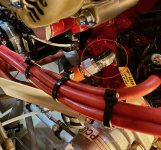
On this list were the four AN elbow fittings in the oil-cooling path: two on the oil cooler, two on the accessory case. I disconnected the hoses again and started poking a probe into each of these fittings, and when I got to the oil-output fitting in the middle of the accessory case... the probe wouldn't go in!
1750043913208.png

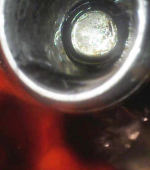
Naturally it would be the least-accessible fitting on the engine! First I took a look at it with my cheapo borescope. There was clearly something shiny at the back of the fitting:
1750044121395.png

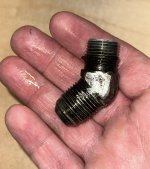
I had to remove some accessories to reach it, and it was a real fight to remove it, but I finally got the fitting out:
1750044188701.jpeg

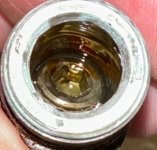
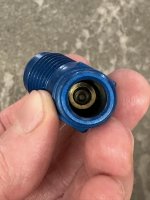
The pictures tell the story. The fitting is almost completely blocked by something that looks an awful lot like a brass pipe plug:
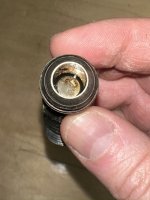
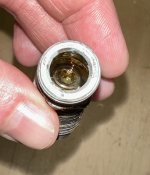
1750044224986.jpeg 1750044445773.jpeg

It was really wedged in there, too - no amount of beating on it with a punch and hammer managed to dislodge it.

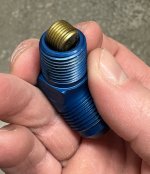
From my parts stash I grabbed a similar pipe plug and #8 fitting to play with. The plug won't go in sideways, but if it's rotated to be coaxial with the NPT side of the fitting, it drops right in:
1750044677137.jpeg 1750044666743.jpeg

Of course the obvious question is, where did the plug come from and how did it get into my oil fitting? It didn't come from the sump, since it would have been stopped by the oil screen. I don't think it's an internal oil-galley plug, since I still have good oil pressure. The best I can figure is that it somehow got dropped into the oil filter adapter, during either assembly or installation, and only made its way into the fitting after the first flight. It seems likely that it was initially turned sideways, as above, and only later flipped and became lodged inside. I do know that it didn't touch the oil pump impellers, since I had a look at them (and the mag gears) with a better-quality borescope; they still look shiny and new. I'll never know for sure, but it sure seems like I got lucky, in the sense that no permanent damage was done.

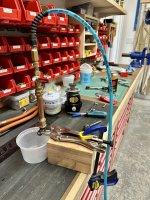
While I was waiting for a replacement fitting to arrive, I did a little science experiment with the plugged fitting, to see how much oil could actually get through it. I filled the pipe with a few ounces of oil, heated it up with a heat gun, and then opened the valve to admit 80 PSI shop air. The result was a weak stream, not any stronger than I personally can manage at three in the morning. The oil was most likely making its way around the spiral leak path of the pipe threads, and was certainly far, far less than a properly-flowing fitting ought to admit. But it was obviously enough to trick me, for months, into thinking that I had good flow to the oil cooler - after all, the hoses had oil in them after a flight, didn't they?
1750046716304.jpeg

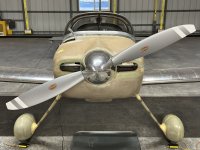
The ending of the story is a happy one: I installed a new fitting, put everything else back together, and went flying. At last, my oil temperature is back to normal - in fact, it was only 170 degrees at altitude, so I might even have to think of installing a shutter when the weather turns cold.

Finally, after spending way too much money on parts and way too much time chasing this one-in-a-million problem, I can get started on a proper Phase I test program. It will be great to actually be able to put some hours on my airplane!
1750046224904.jpeg
 
It was a long, winding, (and weird) road….but you got there! I think you skipped the most interesting part of the experimenting - adding temperature probes to the inlets and outlets of the oil cooler as well as the other end of those hoses, and using the EGT channels to monitor the temps (I had no idea you could do that!). That tipped off the lack of flow through the cooler. Up to that point, I figured you just had to have had a tight bearing, given that (almost) everything else had been checked.

Great job chasing this, and good luck on Phase 1!
 
I think you skipped the most interesting part of the experimenting - adding temperature probes to the inlets and outlets of the oil cooler as well as the other end of those hoses, and using the EGT channels to monitor the temps (I had no idea you could do that!). That tipped off the lack of flow through the cooler. Up to that point, I figured you just had to have had a tight bearing, given that (almost) everything else had been checked.

I guess I did skip over that part! I temporarily plugged some thermocouples from Amazon into my EGT connectors, giving me 4 channels of real-time temperature data, with logging. I measured the temperature of the top (outlet) and bottom (inlet) tanks on the oil cooler - using surface-mounted thermocouples insulated with patches of Fiberfrax and aluminum tape - and also placed probes close to both faces of the cooler to measure air temperature. The data pretty clearly showed that there was essentially no temperature change across the cooler, which was the clue needed to go back and look for "unicorn" causes of oil flow restriction!

1750048687375.jpeg

1750048695427.jpeg
 
Great outcome! Thanks for sharing the story - another example of "just when you think you've seen it all...."
 
I guess I did skip over that part! I temporarily plugged some thermocouples from Amazon into my EGT connectors, giving me 4 channels of real-time temperature data, with logging. I measured the temperature of the top (outlet) and bottom (inlet) tanks on the oil cooler - using surface-mounted thermocouples insulated with patches of Fiberfrax and aluminum tape - and also placed probes close to both faces of the cooler to measure air temperature. The data pretty clearly showed that there was essentially no temperature change across the cooler, which was the clue needed to go back and look for "unicorn" causes of oil flow restriction!
Brilliant and creative.

After looking at the list of things you tried, I couldn't imagine what the issue was. Glad you got it figured out and thanks very much for posting!

Fred
 
That engine has been around for a while, Mattituck went out of business a long time ago.
 
It was a long, winding, (and weird) road….but you got there! I think you skipped the most interesting part of the experimenting - adding temperature probes to the inlets and outlets of the oil cooler as well as the other end of those hoses, and using the EGT channels to monitor the temps (I had no idea you could do that!). That tipped off the lack of flow through the cooler. Up to that point, I figured you just had to have had a tight bearing, given that (almost) everything else had been checked.

Great job chasing this, and good luck on Phase 1!

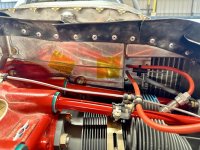
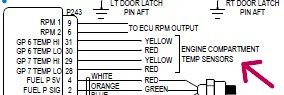
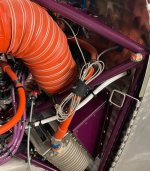
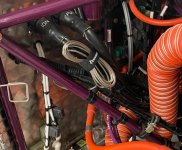
For my 14 I installed 2 ring type thermocouples to monitor the battery temps and gave me the ability to move around if needed for data gathering. For the 10 I had the panel builder add two ring type thermocouples and I just coiled them on each side of the FWF. Gives me the ability to set an alarm at "normal" operating temps for that location and to move around to record data in various locations if needed and graph in Savvy.

Screenshot 2025-06-16 091354.jpgScreenshot 2025-03-27 200905.jpgScreenshot 2025-03-27 200823.jpg
 
Last edited:
Great post, detailed and pictures too. I've seen oil coolers clog up with sludge and small debris, which gives similar symptoms. Yours being new would make me look elsewhere in the trouble shooting process. Just an added note, Lycoming diverts oil to the cooler before going through the spin on filter. Some old-timers (affectionately called geezers) like to run AeroShell 100 permanently instead of just for break in. I've seen oil coolers clogged with sludge in this case
 
Wow, what a story and great job staying at it and finding it. Thanks for sharing.

P.S. I had the same engine and cooler and I had to add a shutter which was mostly closed during winter times.
 
I guess I did skip over that part! I temporarily plugged some thermocouples from Amazon into my EGT connectors, giving me 4 channels of real-time temperature data, with logging. I measured the temperature of the top (outlet) and bottom (inlet) tanks on the oil cooler - using surface-mounted thermocouples insulated with patches of Fiberfrax and aluminum tape - and also placed probes close to both faces of the cooler to measure air temperature. The data pretty clearly showed that there was essentially no temperature change across the cooler, which was the clue needed to go back and look for "unicorn" causes of oil flow restriction!
I guess the flow must have been pretty minimal to get zero delta T. The FWF heat must have overcome any change in temps. Lucky to get it back soon. With oil squirters that would certainly be interesting. My angle valve oil temps shoot straight up when I close the damper even in an Ohio winter. What were the actual temp's inlet and outlet? With at least moderate flow the delta T would have been fairly high.
 
Well done Matt !!
That’s a real lesson in diagnostics and congratulations on finding the culprit.
My hat’s off to your perseverance !! (y)
Now go out there and enjoy your RV.
 
Great on some fantastic troubleshooting procedures and the ability to stick with it until the solution. I had a similiar issue with a Contentinal IO360 with the fuel injection system. The salvaged Maule 5 engine came from South Africa required overhaul AND a non var crankshaft. On initial flight burned up one of the six cylinders. That happened twice before we found a oil restriction fitting installed in one of the fuel injection lines.
 
Good catch Matt, My first engine start didn't.
I had a new ECI engine with a Precision FI and the engine was starved for fuel on first start. Lots of investigation (nothing near what you went through) and found a 45 flare fuel fitting that had the punch plug still in the fitting from machining.
 
...you skipped the most interesting part of the experimenting - adding temperature probes to the inlets and outlets of the oil cooler as well as the other end of those hoses, and using the EGT channels to monitor the temps (I had no idea you could do that!). That tipped off the lack of flow through the cooler.

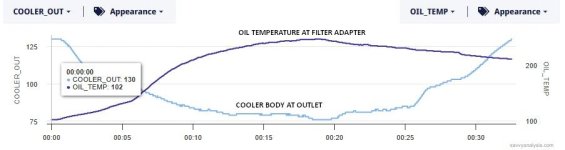
Yep. Matt's decision to instrument was a great move. Here's the money shot.

In normal operation, with oil hot (i.e. vernatherm extended) all flow goes to the cooler. The oil exits the cooler and goes to the filter adapter, which mounts the oil temperature probe. COOLER OUT and engine oil temperature should parallel.

However, in flight (roughly :05 to :30), the oil temperature is pushing redline while the body of the cooler, at the outlet, is essentially reporting ambient air temperature. There is no hot oil passing through the cooler.

Oil.jpg
 
Kudos and congrats on solving this truly one-in-a-million stumper!

Although you'll likely never know for sure how the plug found its way into the fitting, a friend who's built literally dozens of RV's said those fittings are often shipped from Van's in a mixed hardware bag.

His thought was that the plug could have made its way into the fitting in the parts bag and gone unnoticed upon installation.
 
The oil exits the cooler and goes to the filter adapter, which mounts the oil temperature probe. COOLER OUT and engine oil temperature should parallel.


View attachment 90229
Here is where I get puzzled/confused, since the oil out of the cooler goes to the adaptor and thru the temp sensor that is mounted on the adaptor, why are we seeing two different temps. Shouldn't have the instrument report the same temp that parallel the temp that is seeing at the outlet of the cooler?
I would have expected to see this graph to represent the discrepancy of the temp between the inlet of the cooler and the instrument sensor.
 
I guess I did skip over that part! I temporarily plugged some thermocouples from Amazon into my EGT connectors, giving me 4 channels of real-time temperature data, with logging. I measured the temperature of the top (outlet) and bottom (inlet) tanks on the oil cooler - using surface-mounted thermocouples insulated with patches of Fiberfrax and aluminum tape - and also placed probes close to both faces of the cooler to measure air temperature. The data pretty clearly showed that there was essentially no temperature change across the cooler, which was the clue needed to go back and look for "unicorn" causes of oil flow restriction!

This is a good lesson in diagnostics to get as close to a definitive diagnosis as one can. While the oil cooler test could have been performed at any stage in the diagnostic journey, this was essential test as Matt had eliminated the timing and baffling as factors. Using CHT inputs is brilliant - one gets all the data timed with the engine and airspeed data. Too bad Garmin does't offer some extra thermocouple options. I considered reselecting a 6 cylinder engine to offer the extra EGT and CHT inputs, but felt over my head to implement so opted for an external solution - - -the resynchronization of the data was doable, but painful.

Matts placements of the thermocouples are close enough for this kind of work. Notes attachment to the headers of the oil cooler and external insulation. This is the way to do it. I doubt having TC's in the oil flow would have been better.

Great work Matt! I hope others can follow your example to sort these thorny cooling problems.
 
Although you'll likely never know for sure how the plug found its way into the fitting, a friend who's built literally dozens of RV's said those fittings are often shipped from Van's in a mixed hardware bag.

His thought was that the plug could have made its way into the fitting in the parts bag and gone unnoticed upon installation.

Maybe! I didn't use any of Van's aluminum engine fittings, I went with steel fittings instead. I guess it can't be ruled out that a plug somehow got inside the fitting at Aircraft Spruce... I admit I probably haven't been religious about checking for internal blockage in fittings purchased from reputable suppliers, though you can bet I will be from now on. Or perhaps it happened in my garage, though with the way I store my hardware, it's tough to see how. However, since the blockage developed only after the first flight, I have to think that the plug started out oriented perpendicular to the fitting, as mentioned above... and I have a hard time imagining how I could be oblivious enough to miss that.

The only place I could see using that plug would be on Van's fuel valve....

I don't have the Van's fuel valve, but the transducer manifold is another place where similar plugs are used.

Here is where I get puzzled/confused, since the oil out of the cooler goes to the adaptor and thru the temp sensor that is mounted on the adaptor, why are we seeing two different temps. Shouldn't have the instrument report the same temp that parallel the temp that is seeing at the outlet of the cooler?

I don't think I'd assume that temperature of the surface of the oil cooler is guaranteed to be the same as the temperature of the oil inside the accessory case. The absolute temperature values here are less important than the changes over time and with changing power settings and flight conditions.

Too bad Garmin does't offer some extra thermocouple options. I considered reselecting a 6 cylinder engine to offer the extra EGT and CHT inputs, but felt over my head to implement so opted for an external solution - - -the resynchronization of the data was doable, but painful.

Hey Bill, depending on whether you have a GSU 73 or a GEA 24 in your non-touch G3X system, you should have either 1 or 2 general-purpose thermocouple inputs available! And for the G3X Touch system, the current software supports using EGT5 and EGT6 as additional general-purpose temperature inputs, potentially giving you up to 4 available channels in our 4-cylinder airplanes.
 
Last edited:
Great story! I'll never install a fitting again without first looking at the hole through the middle of it.
 
The only place I could see using that plug would be on Van's fuel valve....
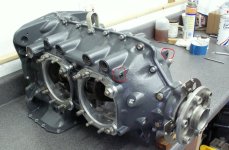
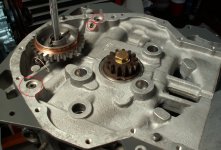
Those 1/8" pipe plugs are used to plug the ends of the oil galleries in the crankcase, among other places. As to how it got there, who knows.

1750179413841.jpeg1750179446432.jpeg
 
Wow ! Not being a mechanic and just looking at the picture, the 2 on the sides don't seem like they'd have enough clearance to fully come out once the cover is on (??), but this one sure does. :eek:
 

Attachments

  • Screenshot 2025-06-17 at 12.37.40 PM.png
    Screenshot 2025-06-17 at 12.37.40 PM.png
    2.8 MB · Views: 37
This is a good lesson in diagnostics to get as close to a definitive diagnosis as one can. While the oil cooler test could have been performed at any stage in the diagnostic journey, this was essential test as Matt had eliminated the timing and baffling as factors. Using CHT inputs is brilliant - one gets all the data timed with the engine and airspeed data. Too bad Garmin does't offer some extra thermocouple options. I considered reselecting a 6 cylinder engine to offer the extra EGT and CHT inputs, but felt over my head to implement so opted for an external solution - - -the resynchronization of the data was doable, but painful.

Matts placements of the thermocouples are close enough for this kind of work. Notes attachment to the headers of the oil cooler and external insulation. This is the way to do it. I doubt having TC's in the oil flow would have been better.

Great work Matt! I hope others can follow your example to sort these thorny cooling problems.
Works well, GEA 24

Screenshot 2025-06-16 091354.jpg
 
Great story! I'll never install a fitting again without first looking at the hole through the middle of it.
Yep! Same here. This thread will make me triple check fittings before installing them to make sure they are clear. I was already double checking them because I've seen smaller parts stuck in larger parts in the bags we get from Vans.
 
Wow ! Not being a mechanic and just looking at the picture, the 2 on the sides don't seem like they'd have enough clearance to fully come out once the cover is on (??), but this one sure does. :eek:
That one is drilled on a 45 deg angle to the back face, so no interference.
 
That one is drilled on a 45 deg angle to the back face, so no interference.
I think his point was that the straight galley plugs are blocked from unintentional removal when the accessory case cover is on, but the 45-drilled one could conceivably back out on its own.
Wow ! Not being a mechanic and just looking at the picture, the 2 on the sides don't seem like they'd have enough clearance to fully come out once the cover is on (??), but this one sure does. :eek:
it is a tapered pipe thread. They don't back out on their own since the threads bind when tight.
 
Around these parts we call this "The red shop rag syndrome..."; the errant bit of FO(D) that ends up where it doesn't belong. Glad you found it.

Don't forget Occam's Razor the next time you're chasing a weird problem to ground...
 
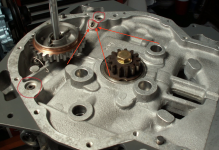
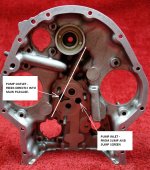
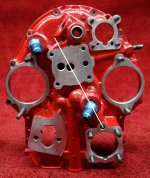
If you study a Lycoming accessory case, you'll quickly see there are only three possible ways to get an NPT plug into that resting place.

Consider; the oil pump outlet feeds the main passage, and it's the only feed. The main passage extends up to the filter adapter and viscosity valve (if installed), and down to the prop governor pad. The AN823 outlet to the cooler is in the middle of the passage. So...

1. It was lodged in the AN823 fitting when the fitting was installed.
2. It was dropped into the main oil passage through the big hole on the end. Since most use a vernatherm rather than a viscosity valve plunger, this big hole normally just gets a cap. If the cap was off...
3. Last (and less likely ) it was dropped through the hole in the center of the filter adapter pad, into the main passage.

Concerns about an NPT plug working its way loose somewhere in the engine and finding its way to the affected AN823 are groundless. It can't be done.

DSC08367__02903.jpg

Aft Side-Distribution After Pump.jpg

Path 2.jpg
 
Last edited:
Holy frijoles. That is an amazing story. Reminds me of last year when somebody was getting piston faces beat to crap by a machine screw that was getting sucked into an intake valve, then falling out that same valve and getting sucked into a different cylinder
 
I haven't posted much about my Phase I testing progress, because frankly - there hasn't been much progress.

I had an uneventful first flight last year: no significant airframe squawks, a strong-running engine, and satisfactory cooling. My engine installation is about as standard as it gets: IO-360-M1B, dual magnetos, and Precision fuel injection. The oil cooler is a Stewart Warner 8406R, mounted high behind the #4 cylinder. I think my baffles are pretty good, and my CHTs have been great. Oil temperature was also within the normal range on the first flight, 185 degrees.

View attachment 90188

But then, starting with just the second flight, I suddenly began to have oil-cooling issues. Instead of the acceptable oil temperature I had on flight #1, I saw 230 degrees after only ten minutes in the air, so I made a precautionary landing. Since I knew I'd had good oil cooling a few days earlier, I naturally suspected an instrumentation issue, so I started by checking the temperature sensor and wiring. No issues found there, so I repeated the test flight and had the same results - very high oil temperature after only a few minutes of flight.

Over a period of months, with offline help from some of the brightest minds on VAF, I worked my way down the list of potential causes and solutions, starting with the easiest and most probable and moving towards the weirdest and least likely. I'd tear things apart, change or replace something, reassemble, and fly - and every time get the same result, alarmingly hot oil. Every flight was 0.2 hours in the pattern, with oil temperatures that would climb as high as I dared allow before I chopped the power, and every landing was with a panel full of warning lights.

I knew that I had once had a good cooling setup, so something must have changed. But what? In rough order, here's a partial list of things I tried, all to no avail:
  • Checked oil temperature sensor and wiring
  • Checked baffles for leaks
  • Checked oil cooler for airflow restrictions
  • Checked magneto timing
  • Checked Vernatherm activity in hot water, suspecting infant mortality
  • Replaced Vernatherm anyway, after the new one I bought showed slightly greater activity
  • Checked sump screen and filter element, looking for evidence the engine was making metal
  • Checked compression, looking for excessive blow-by
  • Verified oil was flowing to the cooler, by disconnecting the bottom (input) hose after running the engine
  • Installed new oil cooler hoses from TS Flightlines, suspecting the old one could have had a collapsed liner
  • Sent oil cooler to be flushed and overhauled, suspecting some kind of internal blockage
  • Removed oil filter adapter, looking for blockage or restrictions
  • Pulled all four cylinders (!!) - suspecting a ring problem or excessive blow-by that was heating the oil
This was a long and frustrating process, and it turned up nothing. I had good instrumentation, good baffles, a good oil cooler, good hoses, and oil was flowing - so why wasn't it cooling?

I was really starting to think I had a cursed engine, with some kind of internal problem beyond my ability to fix, and was seriously contemplating pulling it off and having it torn down. But first I resolved to do one more search for things I'd overlooked, things I had previously assumed couldn't possibly be the problem.

On this list were the four AN elbow fittings in the oil-cooling path: two on the oil cooler, two on the accessory case. I disconnected the hoses again and started poking a probe into each of these fittings, and when I got to the oil-output fitting in the middle of the accessory case... the probe wouldn't go in!

View attachment 90192

Naturally it would be the least-accessible fitting on the engine! First I took a look at it with my cheapo borescope. There was clearly something shiny at the back of the fitting:

View attachment 90194

I had to remove some accessories to reach it, and it was a real fight to remove it, but I finally got the fitting out:

View attachment 90195

The pictures tell the story. The fitting is almost completely blocked by something that looks an awful lot like a brass pipe plug:

View attachment 90196 View attachment 90199

It was really wedged in there, too - no amount of beating on it with a punch and hammer managed to dislodge it.

From my parts stash I grabbed a similar pipe plug and #8 fitting to play with. The plug won't go in sideways, but if it's rotated to be coaxial with the NPT side of the fitting, it drops right in:

View attachment 90207 View attachment 90206

Of course the obvious question is, where did the plug come from and how did it get into my oil fitting? It didn't come from the sump, since it would have been stopped by the oil screen. I don't think it's an internal oil-galley plug, since I still have good oil pressure. The best I can figure is that it somehow got dropped into the oil filter adapter, during either assembly or installation, and only made its way into the fitting after the first flight. It seems likely that it was initially turned sideways, as above, and only later flipped and became lodged inside. I do know that it didn't touch the oil pump impellers, since I had a look at them (and the mag gears) with a better-quality borescope; they still look shiny and new. I'll never know for sure, but it sure seems like I got lucky, in the sense that no permanent damage was done.

While I was waiting for a replacement fitting to arrive, I did a little science experiment with the plugged fitting, to see how much oil could actually get through it. I filled the pipe with a few ounces of oil, heated it up with a heat gun, and then opened the valve to admit 80 PSI shop air. The result was a weak stream, not any stronger than I personally can manage at three in the morning. The oil was most likely making its way around the spiral leak path of the pipe threads, and was certainly far, far less than a properly-flowing fitting ought to admit. But it was obviously enough to trick me, for months, into thinking that I had good flow to the oil cooler - after all, the hoses had oil in them after a flight, didn't they?

View attachment 90211

The ending of the story is a happy one: I installed a new fitting, put everything else back together, and went flying. At last, my oil temperature is back to normal - in fact, it was only 170 degrees at altitude, so I might even have to think of installing a shutter when the weather turns cold.

Finally, after spending way too much money on parts and way too much time chasing this one-in-a-million problem, I can get started on a proper Phase I test program. It will be great to actually be able to put some hours on my airplane!

View attachment 90210
Mburch,
Your persistence paid off.
A saga worth telling.
Daddyman58
 
Back
Top