Van's Air Force

The definitive Van's Aircraft support community! Buying, building or flying an RV? Join our exclusive family of mentors and enthusiasts!

LOP dilemma

Superior mentions in one of their talks that having 80 compression (or very close to it) on a mid time engine is a concern that the rings were not installed correctly. he sounded like it's a bigger concern than if you see 60s.
Yes, if you get 80/80 there is a good chance you have a 0" ring gap and cracked rings are in you near future. It is theoretically impossible to get MORE than 80 PSI of measured pressure with an input pressure of 80, assuming the piston is not moving, hence the comment about inaccuracies in the gauge. This is an issue with superior, as they ship their rings oversized and expect the installer to file them down to size. Major opportunity for errors, as Lyc ships them pre-sized. Easy to forget if you usually use Lyc.

Very easy to create offsets for gauge inaccuracies. With the tester not connected to plug adapter, run the input up to 80 and read the other gauge. Your offset is 80 +- whatever the indicated gauge reads. Mine reads 2 PSI low, so I just add 2 to each measured result.
 
Last edited:
My GAMI spread is about 0.5gph. I really want to put a slightly larger orifice on #4.
I suggest the preferred approach to balance cylinders is to always go leaner (smaller nozzle) on the rich cylinders. Don Rivera discusses this from time to time. I do not go bigger than the stock 0.028” nozzle.

On an IO-360 my experience is two new nozzles and GAMI is down to 0.0 to- 0.1gph. My first IO-540 took ~4 new nozzles.

Side note - on the IO-540 I was using a plenum without turbo nozzles. This caused me to do more nozzle iterations to get the desired GAMI spread. It started off at 1.5 GPH but it too got down to 0.0 - 0.1 GHP. Still deciding if I want to put turbo nozzles on the new RV-10. Phase One will provide the needed decision data.

Carl
 
I suggest the preferred approach to balance cylinders is to always go leaner (smaller nozzle) on the rich cylinders. Don Rivera discusses this from time to time. I do not go bigger than the stock 0.028” nozzle.


On an IO-360 my experience is two new nozzles and GAMI is down to 0.0 to- 0.1gph. My first IO-540 took ~4 new nozzles.

Side note - on the IO-540 I was using a plenum without turbo nozzles. This caused me to do more nozzle iterations to get the desired GAMI spread. It started off at 1.5 GPH but it too got down to 0.0 - 0.1 GHP. Still deciding if I want to put turbo nozzles on the new RV-10. Phase One will provide the needed decision data.
Well, I was a dumbass and got GAMI injectors for certified prices instead of going to AFP. I couldn't figure out if the restrictors were removable, but I have certainly considered turbo-style injectors plumbed to the snorkel for max ram air pressure differential.

So what this boils down to is I have no idea what the orifice sizes are. I believe the front #1/2 injectors are GAMI's minimum size and no smaller size is available, so it is only possible to make 3/4 larger. If there's a way for me to investigate orifice sizes, I would like to do that (but that assumes the value is stamped somewhere and the orifice is removable).
 
Yes, if you get 80/80 there is a good chance you have a 0" ring gap and cracked rings are in you near future. It is theoretically impossible to get MORE than 80 PSI of measured pressure with an input pressure of 80, assuming the piston is not moving, hence the comment about inaccuracies in the gauge. This is an issue with superior, as they ship their rings oversized and expect the installer to file them down to size. Major opportunity for errors, as Lyc ships them pre-sized. Easy to forget if you usually use Lyc.

Very easy to create offsets for gauge inaccuracies. With the tester not connected to plug adapter, run the input up to 80 and read the other gauge. Your offset is 80 +- whatever the indicated gauge reads. Mine reads 2 PSI low, so I just add 2 to each measured result.

Ya I'm in the cracked/broken ring group on somebody else's over haul in the past. I always check the ring gap per manufactures rules and don't create problem not needed. And yes I run LOP as much as possible. TRUST AND VERIFY!!!
The OP's mechanics are out to lunch on this one.
My luck varies unless I am the one screwing it up. FIXIT
 
So what this boils down to is I have no idea what the orifice sizes are. I believe the front #1/2 injectors are GAMI's minimum size and no smaller size is available, so it is only possible to make 3/4 larger. If there's a way for me to investigate orifice sizes, I would like to do that (but that assumes the value is stamped somewhere and the orifice is removable).
I would hope each nozzle has a stamp on orifice size. I do have any experince with GAMI nozzles so see if you can pull out a nozzle and look.

Carl
 
So who makes this claim?
I really don't want to name the shop, but suffice to say they've been doing this a long time, and have a good reputation. Which, of course, could make them even more susceptible to OWT I suppose.
It didn't sound quite right to me, which is why I threw it out there.
 
I suggest the preferred approach to balance cylinders is to always go leaner (smaller nozzle) on the rich cylinders. Don Rivera discusses this from time to time. I do not go bigger than the stock 0.028” nozzle.

Carl
Carl,

I think I've seen you post this before. Would you mind elaborating? I'm not at all saying you're wrong, I'd just like to know why. The reason I ask is that I too used GAMI an they did just the opposite. They enriched the first cylinder to peak.....at least in my case (IO-390). I didn't think too much about it as I figured "balanced is balanced". That's why I'm asking the question.

Fred
 
Well, I was a dumbass and got GAMI injectors for certified prices instead of going to AFP. I couldn't figure out if the restrictors were removable, but I have certainly considered turbo-style injectors plumbed to the snorkel for max ram air pressure differential.

So what this boils down to is I have no idea what the orifice sizes are. I believe the front #1/2 injectors are GAMI's minimum size and no smaller size is available, so it is only possible to make 3/4 larger. If there's a way for me to investigate orifice sizes, I would like to do that (but that assumes the value is stamped somewhere and the orifice is removable).
is your engine an older one? The early injectors did not have removable restrictors. easy to tell. pull the nut off. if the restrictor is removable, you will observe a seam line about 1/8" down from the top, the part with the female flare. get your fingernail in that seam and lift it out. if tere is no seam line, it is the older version.
 
I really don't want to name the shop, but suffice to say they've been doing this a long time, and have a good reputation. Which, of course, could make them even more susceptible to OWT I suppose.
It didn't sound quite right to me, which is why I threw it out there.
they could be an excellent overhaul shop. skills to build an engine are VERY different than those necessary to understand engine wear cause and effect.
 
Carl,

I think I've seen you post this before. Would you mind elaborating? I'm not at all saying you're wrong, I'd just like to know why. The reason I ask is that I too used GAMI an they did just the opposite. They enriched the first cylinder to peak.....at least in my case (IO-390). I didn't think too much about it as I figured "balanced is balanced". That's why I'm asking the question.

Fred
i would agree that balanced is balanced. That said AFP generally recommends going smaller as a general rule, as it increases post servo fuel pressure, which can reduce instances of fuel boiling / roughness. AFP generally recommends .024 sizes for 320/360 and .025" for 540's.
 
Carl,

I think I've seen you post this before. Would you mind elaborating? I'm not at all saying you're wrong, I'd just like to know why. The reason I ask is that I too used GAMI an they did just the opposite. They enriched the first cylinder to peak.....at least in my case (IO-390). I didn't think too much about it as I figured "balanced is balanced". That's why I'm asking the question.

Fred
i would agree that balanced is balanced. That said AFP generally recommends going smaller as a general rule, as it increases post servo fuel pressure, which can reduce instances of fuel boiling / roughness. AFP generally recommends .024 sizes for 320/360 and .025" for 540's.
This. Don Rivera recommends this approach. I tend to do a hybrid as many times just getting one or two smaller nozzles does the trick. But, I do not disagree with Don, just too cheap to get six new nozzles then 2-3 more slightly larger when the data comes in.

Why GAMI does what it does is beyond me, other than I’d guess it had something to do with spam can engine certification. But considering we usually do not have weird engines we can sharpen our pencils and dial in what is needed instead of making sure we still meet whatever is needed for odd ball engines.

Carl
 
The choke doesn't happen from squeezing the barrel. This is purposely done via the boring and honing process. They put in that taper in the final machining. As freemasm stated, they do this so that the bore will mostly be a uniform dia at operating temp. That doesn't necessarilly mean it is bad to run in the smaller state, as long as the rings are sized correctly.
Larry, my fellow instructor at the A&P school had previously been a part owner and employee for many years at an overhaul shop specializing in Pratt & Whitney. They routinely overhauled P&W cylinders, removing the heads, weld repairing as necessary, and re-mating them to barrels. It was he who told me the the barrels were bored and/or sleeved straight, and that after the heads were shrunk on, the taper resulted. This jibes with the Powerplant textbook which states, as I described, the taper results from the interference fit of the head. The text also says that the cylinder will be straight at temperature, but I still don't buy that, at least not entirely. My opinion is that they sold the taper as a feature rather than a side effect and came up with theories to support the claim. Cylinders bored oversize could certainly be bored with a taper and might well be. Plated cylinders could also be honed with a taper. The taper is listed in the table of limitations so the overhaul shop is obliged to replicate it when boring. As far as I know, heads of Lyc and Cont aren't removed during overhaul.
Ed
 
If you are getting compressions in the 80's, it is probably time for a new tester ;)
Haha I messed that up! 78, 77,79,78.

I actually flew today and made some notes- when the RPM drop occurs during leaning, that is peak EGT on the hottest cylinder. So I CAN run LOP but at reduced RPM. I'll try it on my next XC and see where the CHTs settle down.

Now that I see the ring gap concern, I'm glad I'm not at 80!
 
Last edited:
I have built my own and a couple others, so not necessarily what you are looking for. As paul said, you should just ignore that. I am sure they see all sorts of issues but have basically no data or info on what led to those outcomes. Most of these guys understand the mechanics of engine assembly and machining. They are not engineers working on dynos and running engines to destruction in various different conditions to understand cause and effect. I would far prefer the opinions of local mechanics that see an engine every year and understand how it is run and how that behavior results in issues. Overhaulers only see the carnage, with absolutely NO appreciation for how it got there. Be sure you accept opinions from those with the credentials to support them.

LOP operation are not damaging. Every auto engine built in the last 35 years runs lop in light load conditions, even the air cooled porsche boxer engines, which are very close to a lyc. I have one.

You will find many engines that don’t make it to tbo with messed up cylinders; some will have run lop and others always rop. There are countless variables in play beyond mixture and absolutely no way to isolate just mixture as root cause in these cases. Cylinder wall deformation can cone from various different issues, but mixture is not one of them.

My 320 has 1600 hours and i never run ROP beyond take off or climb and sometimes climbs are done lop. Cylinders look great and make good compression.
Just thinking here, wasn't it in or around the mid 70s that Chrysler came out with the Lean Burn engine? I didn't know it at the time but thinking back isn't this what their theory was back then? To be LOP?
 
You have an angle valve? Do you have P-mags? How are they configured?

I have a huge 13-row 2006X oil cooler with an air valve I can use to adjust the cooling ability (plane was built in Tucson). At low altitudes on a hot day, it can creep into the mid-190s even wide open, but I don't spend a lot of time at low altitudes.

Without digging through a bunch of JPI datalogs, I have something representative for high cruising altitudes: at 15.5k, WOT (17.4in), 2530rpm, OAT -3C, I saw CHTs of 321/316/298/273, and oil temp 194F (I closed the air valve partially to get that). The front cylinders always run warm and #4 always runs cold. I need to tweak the baffling and I'm sure the front two will come down. Similarly, at 14.5k on a different day, WOT (18.1in), 2520 RPM, OAT -2C, CHTs were 305/304/298/261, and oil temp 185F.

Low altitude, 6500ft, cool day, OAT 8 deg C, 24-25in manifold pressure, 2590rpm (basically flat out), #3@271, #4@259 deg, front two <300. This is with high compression 10:1 pistons.

Angle valve engines cool like crazy with a little airflow through the cowl. Hope my CHT probes aren't busted.

I’m parallel valve with dual P-mags (IO-360-B1B). I’m not exactly sure how they’re timed on this plane as I just bought my -8 a few months ago, but I’m assuming it is a standard setup at TDC. My temps from my last post were at 5,500, OAT about 13C. I’m pretty happy with the temps my -8 runs as they stay within Lycoming spec. While “cold” by my standards, your temps are still within spec as well. Kind of wild, though, if our difference in temps is largely a result of “angled valve vs parallel valve”.

I retarded the timing by about 1 degree on my -9A per Pmag recommendation (also parallel valve) and it did bring my cruise temps down, so taking a degree of advance out certainly can be an option for managing higher than desirable CHTs. They advise extreme caution for adding advance though. As I eluded to in my comment before, this was likely unnecessary. While I felt my temps were too high, they were within Lycoming spec for continuous operation.

I had the anti splat oil shutter on my -9A, but the press-fit retaining pins on the rocker arm failed which caused the shutter to fail into a completely closed position. Despite normal/higher CHT, that plane barely got oil temps above 165F. I installed replacement hardware I received from Antisplat before selling the airplane, but I’ve opted to run without it on my -8. I didn’t feel like the capability was worth the potential failure mode due to the design of the shutter.
 
Sure, tolerances are a bit looser on air cooled cylinders. And how does that create an environment requiring temps above a certain value? Cyl grow in diameter with heat. If the piston was getting jammed in the bore at 200*, how could you possibly crank it over and idle when the chts are 30*? If pistons could jam in the bores at low temps, i am sure lycoming would have warned us about that by now. Also, CHTs are head temps. We really have no idea what the cylinder temps are at any phase of running, except initial cold start.

Rings are spring loaded and create just as much pressure against the wall whether 30* or 400*. As cylinders get hot they expand, so in theory the hotter they get, the lower the ring pressure, due to the growing bore diameter. All of that is moot though, as the real force pushing rings against the wall in the power stroke and preventing blowby is the combustion pressure, which is many orders of magnitude higher than the ring pressure. Combustion pressure doesn’t change based upon cylinder head temp.
The clearances are specified for the application NA or turbocharged etc. The clearances could be a lot less, but on some upgrades with turbocharging decades ago, some engines would fly through heavy rain and rapidly chill the barrels resulting in engine seizure. Larger piston to bore clearances resulted.

Rationalizing only goes so far. Continental has (at least internally) recommended LOP operation for a very long time, and any engineer there that knew the engine performance and internals would confirm the same things.

Choke is as explained earlier, the bores are honed and finished as a cylinder then mated to the heads. Hot heads and cryogenic cooled barrels. Pretty standard. The engines parts tolerate the pressures a bit more than the temperatures. This is why diesel engines with 4x the cylinder pressures (appropriate structural designs of course) can still last a million miles in a Class 8 truck. Exhaust temps (at the ports) are limited to ~1300F for intermittent rated engines, 1200F for continuous ratings. They work.

Heat and pressures directly affect engine bore and valve life. If worried, or it is necessary, then use the big pull to rapidly pass through the stoichiometric A/F and to the cooler operation of LOP.

For the OP -rest assured by data here, and real lab data, that LOP is not near the top of engine killers, especially for normally aspirated.
 
Kind of wild, though, if our difference in temps is largely a result of “angled valve vs parallel valve”.
It's my understanding that CHTs are one of the major differences. Angle valve cylinders have a lot of cooling fin area. I almost never have to back off the throttle or lower the nose to climb. It's a beast.

I’m not exactly sure how they’re timed on this plane as I just bought my -8 a few months ago, but I’m assuming it is a standard setup at TDC
IMO, PMags are too advanced, and too aggressive with advance.
 
Kind of wild, though, if our difference in temps is largely a result of “angled valve vs parallel valve”.

What Chris said. Set a parallel valve cylinder and an angle valve cylinder side by side and count the fins.

Parallel valve: intake side 17, center 6, exhaust side 24
Angle valve: intake side 21, center 11, exhaust side 31
 
Just thinking here, wasn't it in or around the mid 70s that Chrysler came out with the Lean Burn engine? I didn't know it at the time but thinking back isn't this what their theory was back then? To be LOP?
Not familiar, but very likely in the late 70’s trying to meet the new fuel efficiency standards. That is tough to do on a carb’ed engine. My guess is the whole industry tried that. Remember the plastic caps they used to put on the idle mixture needles, so you couldn’t richen it up to make it idle nice in cold wx. I am sure they were shrinking the mid range jets and bleeds as well to get rid of all the excess margin they had.I think the industry quickly gave up and spent their efforts on the first computer controlled stuff - throttle body injection. Much easier to match mixture to specific load environments and move to peak or lop in low load situations. By the mid 80’s bosch had a fairly advanced fuel injection controller. Jetronic. After that they worked aggressively at the dyno to see exactly how lean they could at each load level and this met all the standards, along with moving away from 3 speed automatic transmissions. Remember your dads old sedan cruising down the highway at 3500 rpm? Major league inefficiency there. My 75 vette project had a 4 speed and it still ctuised on the highway at 4K:oops:
 
Last edited:
You can set it to whatever you like. It's not as programmable as the SDS, but certainly more than a regular mag. Check out the EngineBridge documentation in addition to the pmag documentation.
Very limited and most people don't have anything installed that would allow it. EICAD from the manufacturer will let you retard or advance the whole map and set max advance. It's impossible to change how the map advances with altitude and IMO the map is much, much too aggressive there. Especially for an angle valve or high compression.

EICommander is defunct. I'm not sure you can change anything in flight with the engine bridge, but I don't like the interface.
 
I really don't want to name the shop, but suffice to say they've been doing this a long time, and have a good reputation. Which, of course, could make them even more susceptible to OWT I suppose.
It didn't sound quite right to me, which is why I threw it out there.
Well, their "good reputation" just took a powerdump here on this forum. Might be best if you didn't name them at this point.
 
The biggest issue I have seen over the years is not pilots RUNNING LOP, it's pilots GETTING to LOP. You must not meander in the "red fin". Get to LOP quickly (even if it means a temporary rough-running engine) - AKA "the big pull" - and then approach smooth running from the lean side of peak.
 
The biggest issue I have seen over the years is not pilots RUNNING LOP, it's pilots GETTING to LOP. You must not meander in the "red fin". Get to LOP quickly (even if it means a temporary rough-running engine) - AKA "the big pull" - and then approach smooth running from the lean side of peak.
That assumes you buy into the red fin mumbo jumbo. Lyc doesn’t. They recommend running at 50 -150 rop or peak, both of which are in the middle of that fin thing. That red fin stuff is a lot like the old over square thing. Unjustified and mostly inaccurate generalizations to create simple rules for folks to follow and a heavy dose of fear mongering. No doubt that peak combustion pressures prior to tdc create stress, but the red fin thing doesn’t really address that in anything close to reality. Ignition timing is a big part and not even mentioned in the concept.
 
Last edited:
That assumes you buy into the red fin mumbo jumbo. Lyc doesn’t. They recommend running at 50 -150 rop or peak, both of which are in the middle of that fin thing.
There are a lot of shortcuts I get to take cruising up high. I basically never worry about "red box" or "red fin", even with high compression pistons. If the atmosphere won't give you more than 22" (and often much less), you can't possibly hurt anything. This probably leads to bad habits like never running full rich, ever, and my mixture lever is pulled halfway back even for takeoff (at ~5500). I probably need to adjust the top range of my fuel servo. Mike Busch has said "full rich is horrendously rich" and I agree.

I've been playing around with peak EGT vs 50-100° ROP, and 25-50° LOP recently, and it definitely goes faster with a bit more fuel (no surprise there). I'll spend more time LOP if I can get my GAMI spread down more.
 
Since l’m located pretty much at sea level and like to go LOP “soon” after takeoff (to keep my CHT’s below 400, PV IO540) I “respect” the red box and cruise climb to altitude. With an EFI system it’s just a turn of a knob (-35%) and very easy. Above ~6,000 ft I’m out of the red box possibilities so I get there fairly quickly anyway. I think very little downside.
 
Last edited:
There are a lot of shortcuts I get to take cruising up high. I basically never worry about "red box" or "red fin", even with high compression pistons. If the atmosphere won't give you more than 22" (and often much less), you can't possibly hurt anything. This probably leads to bad habits like never running full rich, ever, and my mixture lever is pulled halfway back even for takeoff (at ~5500). I probably need to adjust the top range of my fuel servo. Mike Busch has said "full rich is horrendously rich" and I agree.

I've been playing around with peak EGT vs 50-100° ROP, and 25-50° LOP recently, and it definitely goes faster with a bit more fuel (no surprise there). I'll spend more time LOP if I can get my GAMI spread down more.
LOP makes a big difference in economy, but not a best speed tool. From all of my research, just going to about 20* LOP will give the greatest fuel economy. You can get a bit better by going much leaner (reducing pumping losses by staying WOT, if that applies in your case), but the gains are small. Simply going from best power (~100 ROP) to 20* LOP will net a speed loss of around 5% with a 15% fuel reduction. I forget the actual numbers, but in that range.
 
i suspect the LOP scare comes from some instances of pushing WOT and forgetting to enrich mixture beforehand, while at relatively low DA. that could potentially cause detonation..
 
It depends, it depends, it depends -- However, I think @lr172 is right on the money with posts #74, #77.

However, If you have stupidly high compression pistons (e.g. 10:1) along with a spark at 25° BTDC (really bad), or/and really sh!tty baffling:cooling, or/and sea level ops (+29.92inHg), and you dilly-dally on the pull (read: it takes you > 15 seconds to transition from full rich to peak) -- I can see that creating problem(s).

I should include PV's to the list above -- On my AV, I've never seen CHT's above 370° in climb (1200ft/min - 100kias) --- and I'm in central Texas (read: hot, unbearably-oppressively hot.)

Be-aware - The Bendix RSA5 & clone servos (Precision 5VA1, AvStar 5AV1) do not have Altitude Compensation/AMC -- ergo, you need to be leaning as you climb in order to maintain the fuel:air ratio for best power / best economy and not go "rich" during the climb --- unless you need the extra fuel to "cool" the CHTs.

Technique -- Once established in the climb ( > ~ 2000' DA) I note the hottest EGT/CHT, and then lean the mixture to maintain that EGT to cruise altitude - roughly 1/2 twist per 1000ft. I leave the throttle all the way open, dial the RPM down, then move the mixture out until the EGT's fall over ("peak") and then set the hottest for ~40 - 50°F past (lean) of peak.

(^^ Another thing they never taught us when we learned to fly. Probably because the equipment didn't have CHT, and only one EGT with a red mark and a white needle.)

i suspect the LOP scare comes from some instances of pushing WOT and forgetting to enrich mixture beforehand, while at relatively low DA. that could potentially cause detonation..

Who knows -- but going WOT with the Mixture lean causes the fire to go out due to lack of fuel -- not detonation.
 
Last edited:
i suspect the LOP scare comes from some instances of pushing WOT and forgetting to enrich mixture beforehand, while at relatively low DA. that could potentially cause detonation..
How can a lean mixture at WOT cause detonation? Unless a rough running engine is confused with detonation? Genuine question, not trying to be snarky.
 
Conceptually, the red box/fin is certainly worth teaching. However, let's not lose perspective. As originally presented, the center of focus was a Beechcraft with a turbocharger. Everyone recall the standard demonstration...go lean of peak, then add manifold pressure to regain the speed? Can't do that with your NA Lycoming, at least not when cruising an RV in the sweet spot altitudes, 8500 ~ 11500.

Anyone cruising with an advancing ignition has already ditched the fundamental concept of George Braly's teaching. The point of going lean is to delay peak cylinder pressure, a function of the slower combustion rate. Running LOP with mild advance, peak pressure moves back toward TDC, where it would have been with fixed timing and a faster burning 50~100 ROP mixture...the middle of the scary red box, if you want something to worry about.
 
How can a lean mixture at WOT cause detonation?

For a non-turbo Lycoming with standard compression ratio, detonation generally requires a lean mixture combined with very high CHT, oil temperature at max, and high intake air temperature. It's not an accident. It was designed that way to meet FAA certification requirements.
 
For a non-turbo Lycoming with standard compression ratio, detonation generally requires a lean mixture combined with very high CHT, oil temperature at max, and high intake air temperature. It's not an accident. It was designed that way to meet FAA certification requirements.
Note “standard compression ratio” and agree.
 
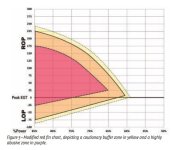
The anxiety illustration, from Mike Busch:

Busch Red Fin.JPG

A "cautionary zone" beginning at 225 ROP or richer? "Highly abusive" begins at 175F? And how is "highly abusive" defined anyway?

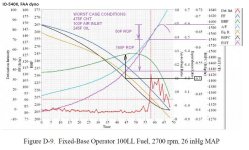
Let's look at reality. This is an IO-540K on the FAA dyno at Hughes. I'll use a 2700/26" chart to more or less match Mike's 85% power. Note the conditions...475 CHT, 103F IAT, and 245F oil temp. Anyone here dumb enough to allow that?

If we observe Mike's 175F "abusive zone", it is not even possible to generate all available power, as the max is found at roughly 140 ROP. The standard 0.5 BFSC is at 160 ROP. a little on the rich side of max power. Even at crazy high temperatures, it doesn't tip into detonation until leaned to 50~60 ROP. What do you think happens if CHT is held to <400 and oil to <200?

27-2600 Worst Case.jpg

Scary, but just a puppet.

Red Box.jpg
 
Conceptually, the red box/fin is certainly worth teaching. However, let's not lose perspective. As originally presented, the center of focus was a Beechcraft with a turbocharger. Everyone recall the standard demonstration...go lean of peak, then add manifold pressure to regain the speed? Can't do that with your NA Lycoming, at least not when cruising an RV in the sweet spot altitudes, 8500 ~ 11500.

Anyone cruising with an advancing ignition has already ditched the fundamental concept of George Braly's teaching. The point of going lean is to delay peak cylinder pressure, a function of the slower combustion rate. Running LOP with mild advance, peak pressure moves back toward TDC, where it would have been with fixed timing and a faster burning 50~100 ROP mixture...the middle of the scary red box, if you want something to worry about.
EIs that are working correctly will advance with reduction of manifold pressure. Theoretically, this will keep the timing in the sweet spot as the aircraft climbs. WOT keeps the ignition at base timing down low. To Dan's point, that is one reason I lean with WOT - it helps me stay out of the "red box" by keeping my ignition from advancing. I pull prop, then the big pull of mixture 'til I hear/feel a reduction in power, and check CHTs and fuel flow in 20 seconds or so to see if I'm where I want to be.

If the EI is not behaving as it should, advance with high manifold pressure could cause increased CHTs and without mitigation, possible detonation. I once had a partially pinched MAP sense line which caused advance when it shouldn't have oughta. While I idled out to the runway, it slowly allowed the vacuum to get to the EI box. On takeoff, the EI still thought that it was at low MAP and advanced driving my CHTs high very quickly. Eventually, the pinched line would have allowed the higher MAP to register, but by that time I was reducing throttle, opening cowl flaps, pulling mixture to way LOP, and returning to the airport. Took me a while to figure that one out and correct. I've heard of Emags unexpectedly advancing also. For me, CHT is a primary indication of proper operation.

In some of the high CHT discussions, I've seen folks saying they are reducing throttle during climb. With an EI that advances early and often, a reduction in MAP might be one cause of their high CHTs. Reducing power with prop and mixture to LOP while leaving it WOT, cools things off nicely in my airplane, though at some loss of rate of climb. If CHTs are under control, no reason not to climb at high RPM and periodically lean mixture to maintain roughly takeoff EGTs for a better rate of climb.

Ed

Read Dan's post with chart. We obviously don't want to allow such high temps. That would be dumb. The trick is how to control them. OAT is beyond our control except for maybe flying early. With good baffling, correct timing, good airflow, and careful operation of the engine controls we can control CHTs and oil temp. The "red box" doesn't have to be as scary as it might appear, but is a good conceptual tool. I personally don't allow my CHTs to stay above 400F. This is more for longevity purposes than immediate fear of detonation or engine damage. Others may choose different criteria.
 
we can do much better than mike busch on the anxiety 😃

imagine flying LOP at 10500, and the mixture control cable attachment fails. it’s time to land and you don’t notice anything strange during the low power descend.

you are a bit low on the glide path and the engine quits 500 agl when you add power. there is no airspeed or altitude left for restart.
 
i suspect the LOP scare comes from some instances of pushing WOT and forgetting to enrich mixture beforehand, while at relatively low DA. that could potentially cause detonation..
its a lot like the 100* oil temp thing. set in the 40's for radial engines with straight 50 wt oil, but everyone keeps applying it to everything. There are certainly cases where LOP operations can create damage, like 100% power on any engine. Also, turbo or super charged engines need to be rich further down thew power curve than normally aspirated engines, as they are more prone to detonation.

With lycs typically used in RVs, running LOP at 75% power or less will hurt nothing. even applying full power while leaned at sea level is not likely to do anything beyond mild detonation, which is not harmfull. Obviously you shouldn't do it, but i can all but gaurantee you wouldn't be the first to do so without blowing up your engine.
 
Be-aware - The Bendix RSA5 & clone servos (Precision 5VA1, AvStar 5AV1) do not have Altitude Compensation/AMC -- ergo, you need to be leaning as you climb in order to maintain the fuel:air ratio for best power / best economy and not go "rich" during the climb --- unless you need the extra fuel to "cool" the CHTs.
This is the best new-to-me information I've read in this thread. I'm surprised that some but not all servos do have it, and I'm surprised that my RSA5 doesn't, although it would explain the degree to which I must pull the lever back at even my home field elevation.

So what does have it? AFP? I'm assuming some fitment issues and it's not likely to be a direct swap with my intake snorkel...
 
This is the best new-to-me information I've read in this thread. I'm surprised that some but not all servos do have it, and I'm surprised that my RSA5 doesn't, although it would explain the degree to which I must pull the lever back at even my home field elevation.

So what does have it? AFP? I'm assuming some fitment issues and it's not likely to be a direct swap with my intake snorkel...

The Precision RSA-5AB1 has it. The Precision RSA-5AV1 doesn't and Avstar stopped making it. (Per Avstar this morning)

It was used in helicopter applications -- otherwise you needed three hands, along with the 1/2 brain 3/4 brain required to fly one ;)

edit: updated brain-size for helicopter operation.
 
Back
Top