Van's Air Force

The definitive Van's Aircraft support community! Buying, building or flying an RV? Join our exclusive family of mentors and enthusiasts!

How much metal is too much?

skirting_virga

Well Known Member
Patron
I'm going to preface this with: I have changed oil on a lot of old cars and there's always something in there. Usually looks like flakes of bearing material. I have no idea what is the norm for air-cooled airplane engines with presumably mile-wide bearing tolerances compared to your typical old Mazda.

I changed oil at 50h last time and found some trace metal. After feeling unusual rubbing/noise/resistance to the prop turning by hand after a flight this week, I was on high alert for an internal engine problem. After the engine cooled (a few days later), there is no rubbing/resistance and it turns quite smoothly. It's been about 18h hobbs since my last oil change and I forgot to look at the tach reading. Call it 15 tach since the last oil/filter change. I pulled and cut the filter to see if there were any major red flags, but I don't know what to think of these findings. Note that nothing seems to be ferromagnetic after a cursory swipe of a few pleats with a strong magnet.

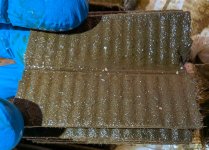
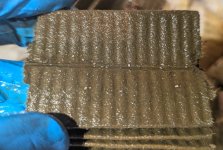
This is an IO-360 A2B, overhauled in 2018 with about 260 SMOH. CHTs are always pretty cool ~300 degrees, but #2 and #3 run 20-30 degrees warmer. The engine runs smoothly and produces good power. After cutting the filter, most of the pleats look like this:
metal_3.jpgmetal_1.jpg


EDIT: I did not pull the suction screen this time. Last time (~15 tach hours ago) it had almost nothing in it. A little bit of rubber, probably debris I kicked loose in changing the valve cover gaskets.
 
Last edited:
Normally, a one-time oil analysis from Blackstone would be less useful, but with that much foreign debris, I certainly would have gone the Blackstone route. Filter inspection, if not ferromagnetic would be most useful only if there was a lot of visible metal and that filter would be very alarming to me. If you still have the oil from that oil change, I'd send it right off and looking for someone with a borescope.
 
Normally, a one-time oil analysis from Blackstone would be less useful, but with that much foreign debris, I certainly would have gone that route. Filter inspection, if not ferromagnetic would be most useful only if there was a lot of visible metal and that filter would be very alarming to me. If you still have the oil from that oil change, I'd send it right off and looking for someone with a borescope.
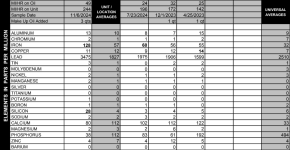
Oh - forgot to mention - I have a Blackstone analysis from the last oil change, which just came back yesterday, and IMO it's a pretty clean report. The analysis would only show microscopic stuff in the oil and this is clearly much larger. There doesn't seem to be a lot more metal in the filter this time around, but the oil change interval is also much shorter.

blackstone analysis 11-6-24.png
 
What does the narrative say on the Blackstone report? They're usually pretty good about telling you what you should and shouldn't worry about.
 
What does the narrative say on the Blackstone report? They're usually pretty good about telling you what you should and shouldn't worry about.
It seems unremarkable because there were no elevated levels of metal found in the report. I think whatever is going on here is producing relatively larger flakes/particles and not producing the sizes that would be captured by oil analysis. I told them that I did valve cover gaskets and a prop swap, and they remarked that this might explain higher levels of silicon in the sample.
The work you described explains some of the metal and silicon in this oil.
Extra metal from parts wearing in and silicon from sealers/gaskets are common after the type of work you
described, and we should find progress with each old change as that stuff washes out. Lead from fuel
blow-by may drop in the future if you decide to use unleaded fuel exclusively. If not, it's okay if we find lead
in the oil as long as it isn't excessive (and it isn't at this level). No measurable fuel or water contamination
was found in this 20W/50 oil.
Iron is slightly elevated (I don't know what their "universal averages" measure in terms of oil change time interval) and has been since the start of oil analysis. The debris I'm finding in the filter is not iron particles, however. I'm guessing it's Aluminum and Copper/bronze from the appearance.

Going by their guidance, I'm at least pulling cylinders and most likely pulling the engine. I think it's time to contact an engine shop. I suspect this is going to be very expensive.
 
Oh - forgot to mention - I have a Blackstone analysis from the last oil change, which just came back yesterday, and IMO it's a pretty clean report. The analysis would only show microscopic stuff in the oil and this is clearly much larger. There doesn't seem to be a lot more metal in the filter this time around, but the oil change interval is also much shorter.

View attachment 75925
I know a different engine (IO390 angle valve) but for mine Blackstone reports an average of 15 for iron and mine runs 4 to 5 every analysis. Surely a parallel valve engine doesn't spit out 2 times the iron concentration than an angle valve? I know you mentioned the particles were not magnetic.
 
It’s kind of impossible to do an accurate analysis from a two-dimensional photo, but those particles look more to me like “chunks” than “flakes”, and that is disturbing. The answer to your question of “how much is acceptable” will astound you - Lycoming says that if you gather them all together into a little circle, they can be the size of a thumbnail and be OK!

But I think I’d be investigating, especially if this just started.
 
I'm going to preface this with: I have changed oil on a lot of old cars and there's always something in there. Usually looks like flakes of bearing material. I have no idea what is the norm for air-cooled airplane engines with presumably mile-wide bearing tolerances compared to your typical old Mazda.

I changed oil at 50h last time and found some trace metal. After feeling unusual rubbing/noise/resistance to the prop turning by hand after a flight this week, I was on high alert for an internal engine problem. After the engine cooled (a few days later), there is no rubbing/resistance and it turns quite smoothly. It's been about 18h hobbs since my last oil change and I forgot to look at the tach reading. Call it 15 tach since the last oil/filter change. I pulled and cut the filter to see if there were any major red flags, but I don't know what to think of these findings. Note that nothing seems to be ferromagnetic after a cursory swipe of a few pleats with a strong magnet.

This is an IO-360 A2B, overhauled in 2018 with about 260 SMOH. CHTs are always pretty cool ~300 degrees, but #2 and #3 run 20-30 degrees warmer. The engine runs smoothly and produces good power. After cutting the filter, most of the pleats look like this:

View attachment 75924View attachment 75923


EDIT: I did not pull the suction screen this time. Last time (~15 tach hours ago) it had almost nothing in it. A little bit of rubber, probably debris I kicked loose in changing the valve cover gaskets.
Send in those pleats to blackstone they can tell you what everything is and how much of it.
 
If that were my filter, tear it down! No questions asked!

Your gonna find bad things….guaranteed!
 
If you’re seeing that amount on every pleat after ~15 hours, that is a lot of metal, you’ve definitely got something going on.
 
I know a different engine (IO390 angle valve) but for mine Blackstone reports an average of 15 for iron and mine runs 4 to 5 every analysis. Surely a parallel valve engine doesn't spit out 2 times the iron concentration than an angle valve? I know you mentioned the particles were not magnetic.
This is an angle-valve engine, so probably similar to yours with smaller diameter pistons and jugs. I think the high iron could be a red herring, or an unrelated cause. Nothing I can get out of the filter is ferrous.

It’s kind of impossible to do an accurate analysis from a two-dimensional photo, but those particles look more to me like “chunks” than “flakes”, and that is disturbing. The answer to your question of “how much is acceptable” will astound you - Lycoming says that if you gather them all together into a little circle, they can be the size of a thumbnail and be OK!

But I think I’d be investigating, especially if this just started.
I described them as flakes because they are all very thin in comparison to their "width". One I just measured is .034" wide, but only .002" thick. I'm sure trying to assess with a photo is troublesome. I'm unquestionably grounding the plane, I just wanted to go fishing for how to approach the problem and whether I'm pulling the engine or not. I like working on the thing, but I'm not sure I like working on it quite this much. Frustrating when an overhauled and well-cared-for engine barely makes 10% of TBO. I can only assume bad parts or bad workmanship on the overhaul.

If that were my filter, tear it down! No questions asked!

Your gonna find bad things….guaranteed!
If you’re seeing that amount on every pleat after ~15 hours, that is a lot of metal, you’ve definitely got something going on.
I was afraid of that, but at this point was really expecting it. Unfortunate since the plane had a clean bill of health and 4 years, 200h of trouble-free operation until I bought it about 65 hours ago. I've done a ton of flying with it (I guess 73 hobbs and 85 landings) in about 4 months, and I felt I have managed the engine well and done reasonable maintenance and preventive maintenance along with some modest upgrades.

I guess this is the classic nightmare scenario of buying a plane and needing an engine right away. At least it didn't quit on me over the mountains, and I learned a ton so far.
 
It’s kind of impossible to do an accurate analysis from a two-dimensional photo, but those particles look more to me like “chunks” than “flakes”, and that is disturbing. The answer to your question of “how much is acceptable” will astound you - Lycoming says that if you gather them all together into a little circle, they can be the size of a thumbnail and be OK!

But I think I’d be investigating, especially if this just started.
If that amount of debris was a new finding, I would be doing everything I could to find out what the debris actually was and where it came from. It's an alarming finding regardless of the Blackstone report.
 
If that amount of debris was a new finding, I would be doing everything I could to find out what the debris actually was and where it came from. It's an alarming finding regardless of the Blackstone report.
I look at oil analysis and filter analysis as separate things. Some problems just don't make particles small enough to show up in the oil, which means you can get a "clean" (or clean-ish) oil analysis while actually having a big problem. That's what I have.

I don't know where it's coming from, but I'd be willing to bet it's bearings. Main or rod, I'm not sure. Might be some piston skirt or pin scuffing, or rod wrist pin bushings. I'm not the right person to diagnose it, I just wanted to establish that it's abnormal, which it seems to be. Next step is finding an engine shop and asking them what they think.
 
I look at oil analysis and filter analysis as separate things. Some problems just don't make particles small enough to show up in the oil, which means you can get a "clean" (or clean-ish) oil analysis while actually having a big problem. That's what I have.

I don't know where it's coming from, but I'd be willing to bet it's bearings. Main or rod, I'm not sure. Might be some piston skirt or pin scuffing, or rod wrist pin bushings. I'm not the right person to diagnose it, I just wanted to establish that it's abnormal, which it seems to be. Next step is finding an engine shop and asking them what they think.

Absolutely. I always do both with every oil change. A significant change in either compared to the previous would be of serious concern to me.
 
Everyone making comments here should go back to post #2 and view the video, if they haven't already done so. It answers nearly all the questions. Send the filter to AvLab in Kenner, LA. THEN decide..........
 
Absolutely. I always do both with every oil change. A significant change in either compared to the previous would be of serious concern to me.
I suppose we could add suction screen to that, which I haven't checked since the last oil change, but I guess it's BIG-smaller-microscopic. There was next to nothing in the filter suction screen 15h ago.

Everyone making comments here should go back to post #2 and view the video, if they haven't already done so. It answers nearly all the questions. Send the filter to AvLab in Kenner, LA. THEN decide..........
I've had the AvLab Kit since last week, but now I can send the newest filter media instead of the previous oil change. I was probably not careful enough when I saw particles the first time.
 
Last edited:
Just as an anecdote, my club recently had a scare with metal flakes in the filter similar to the pictures that wound up being the coating inside of the valve covers flaking off. I think I recall it was a nickel coating. New covers and an oil change was the fix. Just something for people to think about when they say they would immediately tear down the engine if they saw this.
 
Just as an anecdote, my club recently had a scare with metal flakes in the filter similar to the pictures that wound up being the coating inside of the valve covers flaking off. I think I recall it was a nickel coating. New covers and an oil change was the fix. Just something for people to think about when they say they would immediately tear down the engine if they saw this.
That's a good lead, but I believe these covers are steel and I got a good look at them about 2mo ago when I changed out the gaskets. They were superficially corroded on the inside and I used a 3M roloc wheel to smooth it out. If this debris in the filter were coming from the valve covers, it would cling to a magnet.
 
Last edited:
I told them that I did valve cover gaskets and a prop swap, and they remarked that this might explain higher levels of silicon in the sample.

Can you talk more about the prop swap? Was this a fixed pitch to constant speed? I've seen photos of a lot of sludge and gunk in the crankshaft just behind the prop - could this have been dislodged? Also, looks like you changed oil brands/types - can you talk about that?

If I were faced with this based on the info I have, I'd drain the oil, suction screen, put a borescope in the sump to have a look around, put in clean oil and a new filter, and fly over the airport for a couple of hours, and repeat. Also, can't hurt to put that borescope into the cylinders, and with the plugs out, slowly turn the prop to listen for any kind of grinding or other strange noises. A borescope view into the accessory case could also be helpful.

Seems more than coincidental that this happened after some maintenance.
 
Here is some additional Lycoming info.

 
Can you talk more about the prop swap? Was this a fixed pitch to constant speed? I've seen photos of a lot of sludge and gunk in the crankshaft just behind the prop - could this have been dislodged? Also, looks like you changed oil brands/types - can you talk about that?
The prop swap was a Hartzell for a Hartzell. Identical hub, different airfoil. I went from the 7666 blades to the 7497 blades. I think the weight is even within a pound or two. The new prop was manufactured around 60 days before I put it on the plane. New O-ring and arrived packaged with a cover over the hub.

I didn't see any sludge and gunk, but oil obviously drained from the crankshaft and the hub when removed. I was meticulous when doing both the prop and valve cover gaskets about not introducing anything. I scraped off the cork from the heads, but made sure it didn't enter the engine. This is a lot easier to do with a horizontally-opposed engine than an inline and upright engine.

I did not change oil types. The previous owner used Phillips X/C 20W50. The engine log says that the A&P who did the engine overhaul in 2018 used 20W50 as well, which seems a little unusual to me for break-in, but I don't know. The previous owner also used Camguard and I have been using it also.

I preheat the oil with the electric sump preheater for 2-3 hours before flying the plane, although I have occasionally left it on for 5-6 hours because I arrived at the hangar and wanted to do something else first. In general the oil is not close to operating temp when I go to start the engine, but it gives me a pretty good head start getting from ~80° to 120° at the bottom of the green arc on the JPI. It's never over 80° after starting the engine no matter how long I preheat for.

If I were faced with this based on the info I have, I'd drain the oil, suction screen, put a borescope in the sump to have a look around, put in clean oil and a new filter, and fly over the airport for a couple of hours, and repeat. Also, can't hurt to put that borescope into the cylinders, and with the plugs out, slowly turn the prop to listen for any kind of grinding or other strange noises. A borescope view into the accessory case could also be helpful.

Seems more than coincidental that this happened after some maintenance.
I'm not sure what to say except that it does seem like a coincidence. I don't think this is a maintenance-induced failure.

I'm going to borescope it today, but this detail is critically important: when I shut down after the last flight, there was a grinding/rubbing when turning the engine over by hand. I've flown about 20 different piston airplanes and never felt something like this, which convinced me there was an urgent problem. After the engine cooled down (a few days later) it was gone. Normal resistance - smooth, oiled-bearing feeling to turning the prop through. No sound.

My assumption is that borescoping will turn up nothing because the rubbing is gone now that the engine is cold. I can't prove that the rubbing was bearings, but that's what I suspect. If the cylinder walls are scored, maybe it will see that, but I would also expect ferrous debris. I have heard of a piston pin getting loose and it would score the walls slowly but the pin quickly. This might be the very slightly elevated iron in the Blackstone Labs analysis.
 
Borescope results: all the intake and exhaust valves look pretty good, IMO. Plugs are good. Pistons have a fair amount of lead deposits on them. Compression test suggests no significant leak at 80psi.

The suction screen is clean - nothing of note in it.

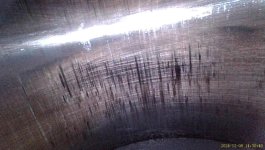
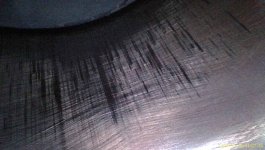
I see good cross-hatching of the cylinder walls (and indeed, the engine was burning about a quart every 10-12 hours), but there's some scuffing that looks notable to me. Is this normal or could this be related to my problem?


IMG_0006.jpgIMG_0001.jpg
 
It seems unremarkable because there were no elevated levels of metal found in the report. I think whatever is going on here is producing relatively larger flakes/particles and not producing the sizes that would be captured by oil analysis. I told them that I did valve cover gaskets and a prop swap, and they remarked that this might explain higher levels of silicon in the sample.

Iron is slightly elevated (I don't know what their "universal averages" measure in terms of oil change time interval) and has been since the start of oil analysis. The debris I'm finding in the filter is not iron particles, however. I'm guessing it's Aluminum and Copper/bronze from the appearance.


Going by their guidance, I'm at least pulling cylinders and most likely pulling the engine. I think it's time to contact an engine shop. I suspect this is going to be very expensive.
 
I think I'd start with the easy stuff first...pulling cylinders when that might not be the issue seems like a lot of effort.

I'd look at the back of the engine first. Mags could be suspect, any of the accessory drive end...If you are seeing that cross hatch in all cylinders, no scuffing...I'd hold off a minute or two.

You are obviously thinking lifters/ cam but when they fail, there tends to be a fair amount of metal going through the motor...in other words it shows up pretty distinctly. I'm thinking gears...mag, governor, tach drive, weird stuff you don't expect from such a low hour engine.

I had an O-320 E2d that scraped like hell....sounded awful after a flight. Turned out to be an exhaust valve all coked up ugly as could be. Engine would stumble after 20 minutes in the air and run rough. Guy I bought it from said it didn't do it for him. 3 hours and a reamer later, all solved.

Not saying you'll get that lucky, but you never know.

If your idea is that its making so much metal in big pieces that it's not in suspension in the oil to make it to the filter, I'd be pulling the screen first, then take the sump off...I'd take the prop back off and see if anything is in the ID of the crankshaft...from your report, it doesn't look like bearings, so it strikes me to look first at the easy stuff.

NOTE: Didn't see you pics, till after I replied. those vertical markings definitely look like piston skirt, is making contact with cylinder walls, or rings scuffing...based on those pics on that cylinder...I'd definitely investigate that further.

I'm not sure why you'd send an engine like this to a shop. I'd spend the money on an Overhaul manual and a couple hundred bucks worth of tools and do it yourself. If you are comfortable removing a jug...doing the inspection and re-assembly is easy on these engines.


These engines are less complicated than an old 1970 VW Beetle engine...even if you have to send some work off to a shop for repairs or improvements...it's WAY less money spent in the long run.

Steve
 
Last edited:
I'd look at the back of the engine first. Mags could be suspect, any of the accessory drive end...If you are seeing that cross hatch in all cylinders, no scuffing...I'd hold off a minute or two.
I haven't pulled them yet but the first thought I had was that it could be an accessory making the noise when warm. After finding metal in the oil, I'm not sure that's the simplest explanation anymore. Can the mags put metal in the oil?

There is cross hatch but also scuffing (see above images, posted an hour ago). Seems similar in all cylinders. Scuffing is top and bottom of the cylinder bore, so must be piston skirts.

If your idea is that its making so much metal in big pieces that it's not in suspension in the oil to make it to the filter, I'd be pulling the screen first, then take the sump off...I'd take the prop back off and see if anything is in the ID of the crankshaft...from your report, it doesn't look like bearings, so it strikes me to look first at the easy stuff.
I pulled the screen today - nothing in the screen. The pieces are too small for the screen and too big for oil analysis. They are caught in the filter media and there are lots of them after 15h tach time. One I measured at .036" (roughly round) by .002" thick, so they are flake-like in appearance. None are magnetic, but some look silvery like aluminum and others look more coppery like a bearing.
I had an O-320 E2d that scraped like hell....sounded awful after a flight. Turned out to be an exhaust valve all coked up ugly as could be. Engine would stumble after 20 minutes in the air and run rough. Guy I bought it from said it didn't do it for him. 3 hours and a reamer later, all solved.
This engine has never stumbled. It runs like a top, and probably makes rated power. The plane is a little slow, but I think it's a drag problem and/or density-altitude problem, not an engine problem. EGTs and CHTs are consistent and fairly tight. I just scoped the intake and exhaust valves and they look great. Didn't get to see all the stems though. I fly about 100° ROP and 8-13k feet the vast majority of the time, and the CHTs are usually around 300 degrees (~280-330°). #2 and #3 run about 20-30° warmer than #1 and #4, which I believe is a common problem for the parallel-valve engines without modifying the baffles per Dan Horton's technique.

I'm not sure why you'd send an engine like this to a shop. I'd spend the money on an Overhaul manual and a couple hundred bucks worth of tools and do it yourself. If you are comfortable removing a jug...doing the inspection and re-assembly is easy on these engines.
I can probably get comfortable with that, but my assumption here is that I'm dealing with bearing material and that's going to mean splitting the case. I hope to know more when the filter analysis of the debris comes back. I'd be thrilled if this could be solved comprehensively by pulling a single jug, but I somehow doubt that's the case. The drag/grinding sound and feel was scary. I have never felt an engine do that when turned by hand.


Maybe the cylinders are running so cold that the pistons expand and scuff more than typical? I was flying at 13.5k with -12C temps. My CHTs are 250-260° in cruise at those altitudes. Am I damaging my engine through overcooling?
 
I haven't pulled them yet but the first thought I had was that it could be an accessory making the noise when warm. After finding metal in the oil, I'm not sure that's the simplest explanation anymore. Can the mags put metal in the oil?

There is cross hatch but also scuffing (see above images, posted an hour ago). Seems similar in all cylinders. Scuffing is top and bottom of the cylinder bore, so must be piston skirts.


I pulled the screen today - nothing in the screen. The pieces are too small for the screen and too big for oil analysis. They are caught in the filter media and there are lots of them after 15h tach time. One I measured at .036" (roughly round) by .002" thick, so they are flake-like in appearance. None are magnetic, but some look silvery like aluminum and others look more coppery like a bearing.

This engine has never stumbled. It runs like a top, and probably makes rated power. The plane is a little slow, but I think it's a drag problem and/or density-altitude problem, not an engine problem. EGTs and CHTs are consistent and fairly tight. I just scoped the intake and exhaust valves and they look great. Didn't get to see all the stems though. I fly about 100° ROP and 8-13k feet the vast majority of the time, and the CHTs are usually around 300 degrees (~280-330°). #2 and #3 run about 20-30° warmer than #1 and #4, which I believe is a common problem for the parallel-valve engines without modifying the baffles per Dan Horton's technique.


I can probably get comfortable with that, but my assumption here is that I'm dealing with bearing material and that's going to mean splitting the case. I hope to know more when the filter analysis of the debris comes back. I'd be thrilled if this could be solved comprehensively by pulling a single jug, but I somehow doubt that's the case. The drag/grinding sound and feel was scary. I have never felt an engine do that when turned by hand.


Maybe the cylinders are running so cold that the pistons expand and scuff more than typical? I was flying at 13.5k with -12C temps. My CHTs are 250-260° in cruise at those altitudes. Am I damaging my engine through overcooling?
to put in perspective...I routinely flew my Aerostar 601P at FL 240 and much colder temps, never a problem.

I guess I'm still leaning towards back end of the engine at the accessory case, something along the line of a steel gear grinding into aluminum or bronze or such...but the pictures of your cylinder wall do have me thinking more that removing a cylinder and accessory case are only prolonging the inevitable...Do you have borescope pics of all 4 cylinders?

IF they all look the same, I'm agreeing it's time to pull jugs and remove the intake and get eyeballs on the sump.

S.
 
Those scuff marks in the cylinders... do the vertical lines, line up with the wrist pins? and on opposing sides??

I'd keep analyzing a bit yet...before tearing anything apart...sump is pretty easy to get off in situ...accessories a bit more PITA...but mostly should be do-able.

Steve
 
One other thought would be....get, beg, borrow, amazon etc...a stethoscope...run the engine for 10-15 minutes on the ground till warm enough to feel the grind...and then listen where...my wife generally yells at me for swiping her steth, but I have traced air noises from cylinders to valves...weird oil gurgles...all sorts of stuff.

whatever is wrong is already wrong...another ten minutes isn't probably gonna kill it...you might find what you're looking for and IF...it does blow up, in the process, at least you know what to do next.

(trying to keep a sense of humor here).


S.
 
Looks like the filter has lead deposits to me. You have to take the particles and see if they disintegrate by seeing if they'll dissolve by rubbing them between two fingers.
 
Those scuff marks in the cylinders... do the vertical lines, line up with the wrist pins? and on opposing sides??
Top and bottom of the cylinders, so not aligned with the wrist pins, aligned with the skirts. Some version of piston slap.

One other thought would be....get, beg, borrow, amazon etc...a stethoscope...run the engine for 10-15 minutes on the ground till warm enough to feel the grind...and then listen where...my wife generally yells at me for swiping her steth, but I have traced air noises from cylinders to valves...weird oil gurgles...all sorts of stuff.

whatever is wrong is already wrong...another ten minutes isn't probably gonna kill it...you might find what you're looking for and IF...it does blow up, in the process, at least you know what to do next.
I appreciate the ideas. I'd have to put a lot of new oil and a new oil filter on to try this. I'm not sure what pulling the sump would accomplish in terms of helping to identify the problem.
 
Looks like the filter has lead deposits to me. You have to take the particles and see if they disintegrate by seeing if they'll dissolve by rubbing them between two fingers.
That's the first anyone has suggested this. The pistons certainly have lead deposits.

The filter particles are definitely metallic, but there may also be oxidized lead particulate. I've rinsed some of them in gasoline and they stay intact.
 
Top and bottom of the cylinders, so not aligned with the wrist pins, aligned with the skirts. Some version of piston slap.


I appreciate the ideas. I'd have to put a lot of new oil and a new oil filter on to try this. I'm not sure what pulling the sump would accomplish in terms of helping to identify the problem.
The reason for pulling the sump is to see how much, if any of this is falling into the bottom of the pan, without going through the pump, screen and filter...in other words, if its coming off the bottom of pistons and their big chunks of aluminum, it'll likely be a mess in the bottom of the sump, as opposed to if it's bronze from a bushing getting chewed up that will likely make its way through the pump...and hopefully get collected in the filter
 
The reason for pulling the sump is to see how much, if any of this is falling into the bottom of the pan, without going through the pump, screen and filter...in other words, if its coming off the bottom of pistons and their big chunks of aluminum, it'll likely be a mess in the bottom of the sump, as opposed to if it's bronze from a bushing getting chewed up that will likely make its way through the pump...and hopefully get collected in the filter
wouldn't that be likely to show up in the oil when I drain the sump?
 
That's the first anyone has suggested this. The pistons certainly have lead deposits.

The filter particles are definitely metallic, but there may also be oxidized lead particulate. I've rinsed some of them in gasoline and they stay intact.
At 17 min into the video they talk about sending particles out for scanning electro analysis. At least you’d know what kind of metal it is. Then you can deduce what part of the motor its coming from.
 
At 17 min into the video they talk about sending particles out for scanning electro analysis. At least you’d know what kind of metal it is. Then you can deduce what part of the motor its coming from.
Agree. I suspect they can pinpoint a narrow range of parts.
 
wouldn't that be likely to show up in the oil when I drain the sump?
I've never seen an engine that doesn't get a little sludge in the sump...in the old days we used to rinse an engine at oil changes with Stoddard solvent, but now the thought is to leave whatever goo in the sump at oil changes alone.

My thought was that heavy bits that won't stay in suspension in the oil, and come off the bottoms of piston skirts, would likely end up in the sump.

S
 
I look at oil analysis and filter analysis as separate things. Some problems just don't make particles small enough to show up in the oil, which means you can get a "clean" (or clean-ish) oil analysis while actually having a big problem. That's what I have.

I don't know where it's coming from, but I'd be willing to bet it's bearings. Main or rod, I'm not sure. Might be some piston skirt or pin scuffing, or rod wrist pin bushings. I'm not the right person to diagnose it, I just wanted to establish that it's abnormal, which it seems to be. Next step is finding an engine shop and asking them what they think.
You have discovered the beginning - likely cam follower failing. They appear to be from spalling of the face. The resulting reduction in contact area and increased pressure on sliding parts is likely the cause of you increasing Fe PPM. Iron should be way less like 10X. Yes, pull a jug and inspect every single follower. Get an expert eye to do that inspection.

Worth what you paid for it and it could be wrong.
 
You have discovered the beginning - likely cam follower failing. They appear to be from spalling of the face. The resulting reduction in contact area and increased pressure on sliding parts is likely the cause of you increasing Fe PPM. Iron should be way less like 10X. Yes, pull a jug and inspect every single follower. Get an expert eye to do that inspection.

Worth what you paid for it and it could be wrong.
Wouldn't a cam follower generate ferrous/magnetic shavings? I'm seeing likely aluminum and copper and nothing sticks to the magnet. The iron in the oil is high but relatively stable trend, and it's not out of the question that it was high due to infrequent flying before I bought it, then continuing to be high with frequent flying only because I did the valve cover gaskets and may have liberated some microscopic rust particles from the valve covers in the process.
 
Last edited:
Wouldn't a cam follower generate ferrous/magnetic shavings? I'm seeing likely aluminum and copper and nothing sticks to the magnet. The iron in the oil is high but relatively stable trend, and it's not out of the question that it was high due to infrequent flying before I bought it, then continuing to be high with frequent flying only because I did the valve cover gaskets and may have liberated some microscopic rust particles from the valve covers in the process.
I agree with you...not maybe shavings at first...but more of an iron slurry... I would absolutely expect to see a significant spike in your oil analysis. This does not seem the culprit to me.

I'm still thinking accessory case and gears...thats where most of the bronze is...Aluminum is piston or case. I don't think you're seeing copper, but could be wrong.

s.
 
I agree with you...not maybe shavings at first...but more of an iron slurry... I would absolutely expect to see a significant spike in your oil analysis. This does not seem the culprit to me.

I'm still thinking accessory case and gears...thats where most of the bronze is...Aluminum is piston or case. I don't think you're seeing copper, but could be wrong.

s.
One thing you should do, is take some of those flakes and dry them off and rub them across plain white printer paper, just to see if they are simply carbon. you mentioned washing some in gas and I do that, them let them evaporate on a paper towel, then rub them on my clean finger tip on the paper.
Carbon looks like a pencil lead.
Aluminum and Bronze will gouge, but no discoloration on the paper.
 
Wouldn't a cam follower generate ferrous/magnetic shavings? I'm seeing likely aluminum and copper and nothing sticks to the magnet. The iron in the oil is high but relatively stable trend, and it's not out of the question that it was high due to infrequent flying before I bought it, then continuing to be high with frequent flying only because I did the valve cover gaskets and may have liberated some microscopic rust particles from the valve covers in the process.
Wouldn't necessarily be magnetic. Depends on the hardening/coating process on the cam or lifters. If you do end up pulling a jug it will be obvious. You might be able to get a borescope up in thought the split in the case to inspect the cam if you pull the sump.
 
Wouldn't necessarily be magnetic. Depends on the hardening/coating process on the cam or lifters. If you do end up pulling a jug it will be obvious. You might be able to get a borescope up in thought the split in the case to inspect the cam if you pull the sump.
That's my thought too....pull sump...see what crap is glued to the bottom...check it and then try to get a look at the cam with the borescope.

Cam would definitely be magnetic...Lifter faces could be a coating. Tough to say.

My thought is do the analysis stuff before pulling jugs...rule out, rule out, rule out...to the extent possible.
 
Just curious: Did you send anything to AvLab in Kenner, LA for analysis? That'd be my first step.........
 
here is the kind of filter report you get back from AvLab. If i remember right it was $95. The turnaround was 2-3 days.

1733775736300.png

Does anyone know if Blackstone report is similar?
 
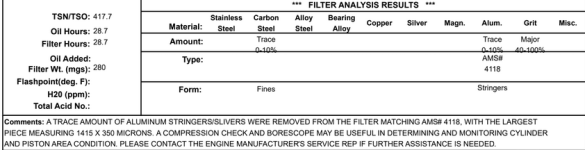
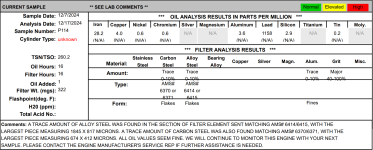
Filter analysis came back. I'm not sure what to make of this because I picked up zero particles with a strong magnet.
 

Attachments

  • Screenshot_20241223-092124.png
    Screenshot_20241223-092124.png
    512.8 KB · Views: 89
Filter analysis came back. I'm not sure what to make of this because I picked up zero particles with a strong magnet.
I’m not sure you would see the “trace” of magnetic particles detected in the analysis when you did the magnet check. Is it possible the “grit” in the report is carbon particles?

Skylor
 
Back
Top