Van's Air Force

The definitive Van's Aircraft support community! Buying, building or flying an RV? Join our exclusive family of mentors and enthusiasts!

FOD in the oil filter adapter

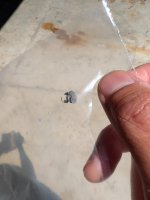
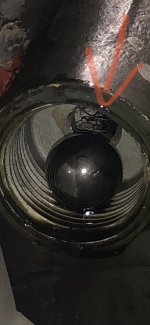
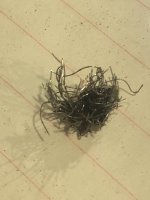
So I have been chasing a high oil temperature problem for the last six weeks. After swapping out every part of the oil cooling system with no success, I decided to pull the oil filter adapter and I found this when I looked inside.


I have no idea what it is or where it could have come from. It's coiled up like the shavings from a lathe and not magnetic. If it's FOD, I have no idea how it could have gotten there since nothing in that area of the engine has been removed since my oil temp problems started and if it was inside the case I don't see how it would have gotten past the screen or through the oil pump.


I'm hoping its not something in the accessory case that's about to blow up and I can't think of anything back there that would create a metal shaving shaped like that.

Engines an IO-360 with constant speed prop, magnetos and about 450 hours total time.PXL_20250707_211739566.jpgPXL_20250707_223136010.jpg
 
Last edited by a moderator:
So I have been chasing a high oil temperature problem for the last six weeks. After swapping out every part of the oil cooling system with no success, I decided to pull the oil filter adapter and I found this when I looked inside.


I have no idea what it is or where it could have come from. It's coiled up like the shavings from a lathe and not magnetic. If it's FOD, I have no idea how it could have gotten there since nothing in that area of the engine has been removed since my oil temp problems started and if it was inside the case I don't see how it would have gotten past the screen or through the oil pump.


I'm hoping its not something in the accessory case that's about to blow up and I can't think of anything back there that would create a metal shaving shaped like that.

Engines an IO-360 with constant speed prop, magnetos and about 450 hours total time.View attachment 92033View attachment 92034
Seems like a perfect candidate for Lycoming’s metals lab. Give them a call to arrange it. They should be able to ID the specific metal, and based on that, at least hypothesize as to a source.
 
Oil pressure would lower if the shavings came from crank or rod bearings. The oil cooler is between the suction screen and the oil filter but I see no way shavings would come from the oil cooler unless they were in there for a while and finally dislodged
 
I have very high confidence that did NOT come from the running of your engine. That is most likely from drilling or machining. It is a very classic shape. Engine wear cannot really produce things like that. It was likely stuck in a bore somewhere from original case work and didn't get flushed out during cleaning.

Also looks like it is not the source of your restriction.
 
That sure looks like a drill shaving - entirely possible it's been in there for some time and just dislodged and moved in the oil flow.
 
I have no idea what it is or where it could have come from. It's coiled up like the shavings from a lathe and not magnetic. If it's FOD, I have no idea how it could have gotten there since nothing in that area of the engine has been removed since my oil temp problems started and if it was inside the case I don't see how it would have gotten past the screen or through the oil pump.

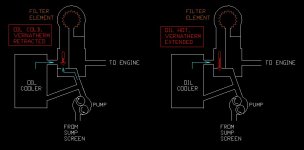
There are only two paths to the filter adapter, direct from the pump, or from the pump via the oil cooler. Point is, you're right...it's impossible for that shaving to come from a rotating or recip source inside the engine case, as there is no path around the sump screen.

So, it was (1) shaved from the inside of the pump body, or it is manufacturing swarf which was (2) lodged in the big oil gallery between the pump filter adapter pad, or (3) in the oil cooler hoses or cooler body.

The interesting question is why this coil of swarf would cause high oil temperature. Seems like it would be deformed if it had been caught between the vernatherm tip and the seat in the adapter.

Oil Flow Paths.jpg
 
If you are chasing an oil temp issue it most likely came from the cooler. Have you flushed your oil cooler?
 
I have not flown the airplane since I found that stuck in the vernatherm so I can't be sure that my oil temperature problem is resolved. If is hasn't then I have terrible luck and that was just coincidence that it was there when I pulled the filter adapter.

When I was originally chasing the oil temp problem, I replace the oil cooler, vernatherm and temperature probes none of which made any difference. However, the debris was not stuck in the vernatherm when it was replaced which is odd.
 
Please correct me if I'm wrong. If the vernatherm seat needs cutting (leaking) wouldn't that allow flow through the cooler? So a worn seat wouldn't cause high oil temp correct??
 
Please correct me if I'm wrong. If the vernatherm seat needs cutting (leaking) wouldn't that allow flow through the cooler? So a worn seat wouldn't cause high oil temp correct??
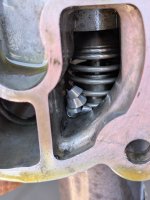
Unlike the car thermostat, which gradually opens up more and more with increasing heat, the vernatherm seals off the cold oil passage as it heats up. At a certain high temperature, the vernatherm is fully extended and completely sealing off the cold oil passage and forcing all the oil through the oil cooler circuit. Note that the extension of the device with heat is not caused by the spring depicted in the photos. The spring only serves to hold the end tight against the seat when it is fully extended. KitPlanes Magazine
 
Please correct me if I'm wrong. If the vernatherm seat needs cutting (leaking) wouldn't that allow flow through the cooler? So a worn seat wouldn't cause high oil temp correct??
If the seat leaks [Vernatherm extended], it allows a small portion of the oil to bypass the oil cooler.
 
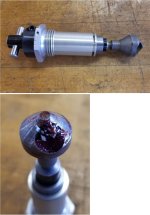
That looks like swarf produced by my Vernatherm seat cutter:
Beautiful seat cutter, but it appears that the seat width should be much less than the width of that swarf. Aren't you referring to Service Instruction 1316A?
 
Unlike the car thermostat, which gradually opens up more and more with increasing heat, the vernatherm seals off the cold oil passage as it heats up. At a certain high temperature, the vernatherm is fully extended and completely sealing off the cold oil passage and forcing all the oil through the oil cooler circuit. Note that the extension of the device with heat is not caused by the spring depicted in the photos. The spring only serves to hold the end tight against the seat when it is fully extended. KitPlanes Magazine
That spring serves two purposes. First, it allows the full travel of the wax thermostatic plug, which can be greater than the space provided, without creating damage. Second, It provides a pressure relief if the oil cooler becomes blocked..
 
Beautiful seat cutter, but it appears that the seat width should be much less than the width of that swarf. Aren't you referring to Service Instruction 1316A?
Yeah, I wasn't actually saying that Albert's swarf definitively came from the VT seat; just that the swarf looked similar to what my tool did. And if you look at the VT spring as a size reference, Albert's swarf isn't quite as big as his photo shows it to be, but still wider than you'd expect from the seat. Beautiful closeup!

And, yes, SI 1316A is the reference here.
 
Found this in a friends RV8 relief valve. Engine not apart in 10 years since purchase and one day had low oil pressure. Surly swarf from previous engine machine work and no signs of problems when removed. Nothing in screen and filter. Put it together, fly it, check screen and filter. Or, tear the whole thing apart and inspect if it makes you feel better. Hard to guarantee there is nothing stuck somewhere in an oil passage or cooler.
 

Attachments

  • IMG_3896.jpeg
    IMG_3896.jpeg
    255 KB · Views: 85
  • IMG_3897.jpeg
    IMG_3897.jpeg
    602.7 KB · Views: 84
Is it possible that it was inside the oil filter and made it thru that way? I have made a habit of checking the thread on the oil filter for any burrs as I have seen them in the past.
 
I was able to reassemble the airplane this weekend and test fly it and still no change to my high oil temperature problem. Apparently whatever was in my vernatherm was unrelated and just bad luck so I'm back to square one.
 
I was able to reassemble the airplane this weekend and test fly it and still no change to my high oil temperature problem. Apparently whatever was in my vernatherm was unrelated and just bad luck so I'm back to square one.
Do you have an engine monitor that records data? Might be some clues there - I'd upload it to Savvy and share the data with the VAF brain trust, and I'm sure you'll get to the bottom of it. Probably a good place to start is confirming your ignition timing is correct. Then see the 100 threads on making sure your baffles are installed correctly. And not running too lean. There are probably less than a handful of things that cause high oil temperatures.
 
I've considered ignition timing and baffle issues but I don't think that's the issue because I feel like that would cause higher temps cylinder head temps as well.

My problem is just high oil temps by itself, all other temps are normal. The temps reach 220 in the climb and don't come down when I pull the power back in cruise or even all the way through the descent.
 
...

When I was originally chasing the oil temp problem, I replace the oil cooler, vernatherm and temperature probes none of which made any difference. However, the debris was not stuck in the vernatherm when it was replaced which is odd.
At the time that the above components were replaced, was there any inspection of the oil lines to and from the cooler? I'm thinking that perhaps there is a blockage in one of the hoses (similar to the debris that was in the adapter) that is preventing the oil from flowing through the cooler.
 
I've considered ignition timing and baffle issues but I don't think that's the issue because I feel like that would cause higher temps cylinder head temps as well.

My problem is just high oil temps by itself, all other temps are normal.

Ahhh, quantify "normal". I note you previously wrote IO-360. Angle or parallel valve?
 
I've swapped three different oil coolers with no effect so I'm confident it's not the oil cooler.

Parallel valve I think. CHTs peak at 400F in the climb and drop to 330-350 when I level off and pull the power pack. The temp are consistent with what I've seen in the past eight years of flying the airplane.

Im considering replacing the oil cooler lines since they are almost 10 years old but I've checked them for obstructions and found nothing at all.
 
Last edited:
I've swapped three different oil coolers with no effect so I'm confident it's not the oil cooler.

Parallel valve I think. CHTs peak at 400F in the climb and drop to 330-350 when I level off and pull the power pack. The temp are consistent with what I've seen in the past eight years of flying the airplane.

Im considering replacing the oil cooler lines since they are almost 10 years old but I've checked them for instructions and found nothing at all.
have you tested or replaced the vernatherm? Cooler lines are pretty far down the list of possible sources of high OT. Typical oil pressure in cruise?
 
I've swapped three different oil coolers with no effect so I'm confident it's not the oil cooler.

IF the three oil coolers do NOT have enough air going through them, that could be a problem. The oil cooler works best with the proper amount of air flow.

Yes vernatherms do go bad. Have a friend that had his go bad and that created high oil temp under certain conditions.
 
When I had high oil temp I bought new oil hose Eaton AE701-10 and Aeroquip hose fittings 816-10D.
The old hose had smaller inner diameter and fittings at oil cooler where AN 822 elbow.
Oil flow increased and temps dropped 15 F.

Good luck
 
The temp are consistent with what I've seen in the past eight years of flying the airplane.

Right there tells a tale. Something changed.

New cooler and new vernatherm, so the operating parts should be good.

Something is putting more BTUs in the oil (for example, blow-by is a possibility), or the oil isn't moving those BTUs to the cooler (flow is blocked or rerouted), or the cooler can't transfer the BTU's to the available mass flow (i.e. mass has been reduced). All of these things can be measured.

Leakdown pressures, quickly darkened oil, or running case pressure are all clues to blow-by. A thermocouple attached to the cooler oil inlet and exit, along with the standard oil temperature gauge, will tell a lot about oil circulation. Air flow requires a manometer and a probe at each face of the cooler.

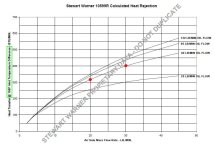
Here are two SW charts for a 10599 cooler. The proportional relationships won't be hugely different for another cooler. This chart tells us a 33% mass flow reduction (from 30 lbs to 20 lbs/min) reduces BTU transfer 20% (from 400 to 320 BTU at 100 deltaT):

ScreenHunter_2883 Jul. 15 16.02.jpg

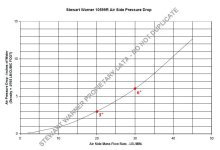
Pressure difference moves the air through the cooler. How much deltaP reduction does it take to reduce mass flow from 30 to 20 lbs/min? Answer is 50% (here from 6" H2O to 3" H20). Typical deltaP for an RV at 150 knots is around 7" H2O. 170 knots would be about 9".

ScreenHunter_2884 Jul. 15 16.11.jpg
 
Since I've run out of parts to replace trying to fix my oil temp issues, I decided to put everything back together and get some temperature numbers at the oil cooler inlet and outlet port. I taped thermocouples to the AN fittings going into and out of the cooler and got about 21F temperature drop. I don't know if that's normal since I have nothing to compare it to. What kind of numbers is everyone else getting?

This was at 4500 ft, 24C OAT and 65% power slightly LOP on an IO360. Oil temperature was indicating 220, the thermocouple at taped to the surface of the inlet was showing 200 and 189 at the outlet.
 
Since I've run out of parts to replace trying to fix my oil temp issues, I decided to put everything back together and get some temperature numbers at the oil cooler inlet and outlet port. I taped thermocouples to the AN fittings going into and out of the cooler and got about 21F temperature drop. I don't know if that's normal since I have nothing to compare it to. What kind of numbers is everyone else getting?

This was at 4500 ft, 24C OAT and 65% power slightly LOP on an IO360. Oil temperature was indicating 220, the thermocouple at taped to the surface of the inlet was showing 200 and 189 at the outlet.
the oil leaves the cooler, runs through a short hose and hits the filter adapter where the sensor is. Don't see how it can realistically rise 30* doing that. Did you pull of the filter assy looking for restrictions that could force the oil to bypass the area near the sensor? if the oil stagnates in that area, temps could read high.
 
the oil leaves the cooler, runs through a short hose and hits the filter adapter where the sensor is. Don't see how it can realistically rise 30* doing that. Did you pull of the filter assy looking for restrictions that could force the oil to bypass the area near the sensor? if the oil stagnates in that area, temps could read high.
also, if the vernatherm is staying open, the cooler outlet temp will be low as there is still a bit of flow through it, but wouldn't lower the sensor temp. A good experiment would be to measure the oil temp in the pan. It should be higher than the sensor temp after running for a while. it might give you a clue.
 
the oil leaves the cooler, runs through a short hose and hits the filter adapter where the sensor is. Don't see how it can realistically rise 30* doing that. Did you pull of the filter assy looking for restrictions that could force the oil to bypass the area near the sensor? if the oil stagnates in that area, temps could read high.
I did pull the filter assembly and removed the filter and vernatherm and gave it a clean. There shouldn't be anything in the filter assembly restricting flow. Theres no way for me to look inside the back of the engine though.
 
I did pull the filter assembly and removed the filter and vernatherm and gave it a clean. There shouldn't be anything in the filter assembly restricting flow. Theres no way for me to look inside the back of the engine though.
The vernatherm acts like a thermostat and you have to heat it and cool it to see it work correctly. I've had one stick open and one stick closed. Both gave differing from what you'd expect temp readings
 
Since I've run out of parts to replace trying to fix my oil temp issues, I decided to put everything back together and get some temperature numbers at the oil cooler inlet and outlet port. I taped thermocouples to the AN fittings going into and out of the cooler and got about 21F temperature drop. I don't know if that's normal since I have nothing to compare it to. What kind of numbers is everyone else getting?

This was at 4500 ft, 24C OAT and 65% power slightly LOP on an IO360. Oil temperature was indicating 220, the thermocouple at taped to the surface of the inlet was showing 200 and 189 at the outlet.

Matt Burch posted numbers from a similar test (after correcting a blockage) in which the cooler inlet/outlet delta was about 45F, more than you report, but variables (like cooler size) are unknown.

Like your observation, the indicated oil temperature was roughly 30 F higher than the cooler outlet. Perhaps taping thermocouples to the outside of fittings just isn't real accurate. Bed them in heat sink grease?
 
Matt Burch posted numbers from a similar test (after correcting a blockage) in which the cooler inlet/outlet delta was about 45F, more than you report, but variables (like cooler size) are unknown.

Like your observation, the indicated oil temperature was roughly 30 F higher than the cooler outlet. Perhaps taping thermocouples to the outside of fittings just isn't real accurate. Bed them in heat sink grease?
I can give it another shot gluing the thermocouples to the fittings. I've got a 7 row Aero Classics cooler mounted just behind the #4 cylinder and oil cooler lines going to AN822 fittings. If others are getting a 45 degree drop from inlet to outlet, then maybe my cooler isn't doing its job somehow? I just cant figure out why since I've tried three different oil coolers and I'm getting the same results.
 
I can give it another shot gluing the thermocouples to the fittings. I've got a 7 row Aero Classics cooler mounted just behind the #4 cylinder and oil cooler lines going to AN822 fittings. If others are getting a 45 degree drop from inlet to outlet, then maybe my cooler isn't doing its job somehow? I just cant figure out why since I've tried three different oil coolers and I'm getting the same results.

A 7 row oil cooler might not be enough for a 360. I'm using a 10 row Aero Classics with some ducting and it's fine at high ambient temps.

Ed
 
That looks much like aluminum. You don't happen to have the older style aluminum oil pump gears--do you? They caused major issues and AD's.
 
Back
Top