Yes Sir. Your question is better than my quick scanning comprehension.


Yes Sir. Your question is better than my quick scanning comprehension.

Hopefully before reducing inlet size they are able to test in much more demanding conditions than western Oregon, for example Phoenix in July, or sitting in a long departure line on a hot day at Oshkosh with the engine running. Longer term they may just need to add more stiffness to the cowl (more surface area with honeycomb core, and/or thicker core, and/or additional layers of carbon fiber...the cowl that I looked at at OSH last year was pretty thin material), but for immediate flight test purposes it'll probably help to open up the lower cowl a bit and reduce pressure differential if there's a structural concern. But it will add some drag...If your not having heating problems, I would try to reduce the inlet size first. Less cooling drag.
Checksix,Hopefully before reducing inlet size they are able to test in much more demanding conditions than western Oregon, for example Phoenix in July, or sitting in a long departure line on a hot day at Oshkosh with the engine running. Longer term they may just need to add more stiffness to the cowl (more surface area with honeycomb core, and/or thicker core, and/or additional layers of carbon fiber...the cowl that I looked at at OSH last year was pretty thin material), but for immediate flight test purposes it'll probably help to open up the lower cowl a bit and reduce pressure differential if there's a structural concern. But it will add some drag...

What is the flashing red RPM alarm telling you? That would drive me a little crazy.Here’s a couple videos from inside the cockpit - one of take-off, the other of landing.
That was the faulty RPM reading from the panel. It’s why we purchased the TruTach rpm gauge and mounted it on the glare shield. To your point - it was driving us nuts on the first flight. We thought for a moment we had overspun the prop, but quickly suspected it was the gauge (if we had really hit the 9000 rpm it registered, no doubt we’d have slung a blade or three).What is the flashing red RPM alarm telling you? That would drive me a little crazy.
The g3x will accept a standard tach signal. Basically a 5 or 12 volt square wave signal that most every ecu outputs. I can’t imagine this engines ecu doesn’t have a tach output. That would be a serious oversight.That was the faulty RPM reading from the panel. It’s why we purchased the TruTach rpm gauge and mounted it on the glare shield. To your point - it was driving us nuts on the first flight. We thought for a moment we had overspun the prop, but quickly suspected it was the gauge (if we had really hit the 9000 rpm it registered, no doubt we’d have slung a blade or three).
If I have this correct, the stock g3x set-up reads rpm from the spark plug wires. Well, there are no spark plugs on the deltahawk - so, long story short, we’re working on an alternative way to get the data.

Larry, I don't believe this engine has an ECU. All analog for simplicity.The g3x will accept a standard tach signal. Basically a 5 or 12 volt square wave signal that most every ecu outputs. I can’t imagine this engines ecu doesn’t have a tach output. That would be a serious oversight.
interesting. I haven't researched this much, must have confused it with those multi fuel engines.Larry, I don't believe this engine has an ECU. All analog for simplicity.
Marc on an unrelated question, bought and read your book, learned a lot, my question is I have two set of landing lights, the seven stars ( leading edge) and the Aveo zip tips that will be connected to the VP-X. I will be putting the tips on one bank A and the leading edge on another. the seven stars are 7.5 amps on each side. I am using a terminal block . I ran 14AWG from the lights to the terminal block. I will probably be running them continuously so my question is what size wire do I run from the VP-X to the terminal block to feed the two lights. The terminal block will be no more than two feet away from the VP-X. My email is [email protected]. Sorry for the unrelated text.Larry, I don't believe this engine has an ECU. All analog for simplicity.
The g3x will accept a standard tach signal. Basically a 5 or 12 volt square wave signal that most every ecu outputs. I can’t imagine this engines ecu doesn’t have a tach output. That would be a serious oversight.
Thanks for the clarification; a very nice feature. I assume you will drill the ring gear for a magnet and add a hall effect sensor. I did similar for my EI. I just machined a bushing to go in the 12 holes and epoxied a magnet in the bushing and used retainer compound to hold the bushing in the holes.lr172,
There is no ECU — the engine’s fuel system is fully mechanical. This was to keep things simple and enhance reliability.
The entire system is mechanical: no CAN buses, no ECU, no FADEC. The engine will operate normally even if the master is shut off or all electrical power was lost in flight. Only analog gauges and sensors are used to track engine parameters.
All that said, the rpm thing has been resolved. DH worked with Garmin on this. Still, we need to take the prop off, move a sensor, and reconfigure the g3x.
Craig
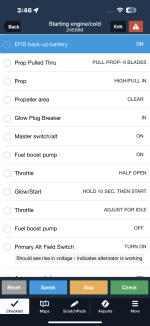
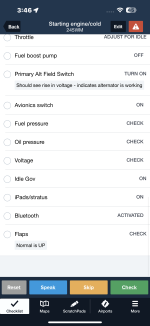
Craig, thanks for the updates.I’m more comfortable with each flight with the diesel and it’s differences from the lycoming. Nothing bad - it’s just a bit different.
For instance - Start up procedure is a bit different. Here’s a couple screen shots of my start up list on foreflight:
You’ll notice ‘new’ items such as the Glow Plug, and missing things such as there is no “adjust mixture”.
In the air, the plane handles like an RV. No surprises there. On the ground, all is good although the larger wheels (not related to the deltahawk engine) make seeing over the cowl in the 12-2 position a bit of a challenge. Nothing an occasional S-turn doesn’t handle.
Good info, thanks. Will def be at OSH this year (been going every year since 1995, except 2020 of course). Looking forward to seeing you and the 14 there!Check6,
On the prop being pulled through - it’s priming the oil pump. However, we’re not sure it’s even needed for that. Mostly, we’re just erring on the side of being cautious. Pulling the prop may disappear from the list - but, for now it’s there.
As for the idle gov and when to engage it - we need to be at a high idle fuel setting to start as the engine needs a bit more fuel to catch, then when stabilized, engine is brought down to a normal idle and the idle gov engaged. I’ve tried it both ways - that is engaging the idle gov before start or afterward. It definitely starts easier when it’s not engaged until after cranking the motor to life.
Regarding the cowl and visibility: no doubt the new cowl has an impact - but, in my opinion the larger tires have the greater affect on the forward viz. That said, the slightly redesigned cowl for the V2 (with the new, smaller block) will lessen whatever impact the cowl is having on the view.
Btw - will u be at AirVentire this year?
Foreflight winds aloft show a 16-mph tailwind. Still nice performance.215mph ground speed from O’Neil to Racine? Did you have a tailwind?
Yes - was truing out at about 175 kts.215mph ground speed from O’Neil to Racine? Did you have a tailwind?
The DeltaHawk engine sounds different than the lycoming. Not better or worse, just a bit different. It’s “distinctive” someone commented to me (it was meant as a compliment). Personally, I’ve only heard it unfiltered while it’s on the ground. Once in the plane I have my noise reduction headset on and at that point I’m not sure I can tell the difference between the engines.


Yes - they are working on a nose gear version.Are they working on a nose wheel version? I'd love to put a deltahawk on when I'm ready for an engine, assuming it's ready in time, but I'm building a nose wheel.
Wild guess Andair... Very well known company that makes selector valves, filters, gascolators, fuel injector pumps: https://www.andair.co.uk/CJS,
I was at the booth when an older, possibly British gentleman showed you his fuel valve and you said that’s what you have in the plane, I didn’t get the name or brand. Would you mind sharing?
Also, is there any hope of an RV-10 fwf in the next couple of years?
The Deltahawk RV14 has the Newton SPRL Fuel Valve. We went with it partially due to the Andair not being available at the time. In the ‘new’ DeltaHawk RV14 that we are currently building, it looks like DH will go with the Andair valve.CJS,
I was at the booth when an older, possibly British gentleman showed you his fuel valve and you said that’s what you have in the plane, I didn’t get the name or brand. Would you mind sharing?
Also, is there any hope of an RV-10 fwf in the next couple of years?
We’ve published quite a bit of data so far on performance (not just “oh yeah, it’s burning x…”). It’s in the thread. That said, we’re currently focused on finalizing the design of the FF package on the new series block while finishing the build on the #2 plane. The numbers that will matter, will come from it - since the #2 plane is the one that will represent the package DeltaHawk will sell. Additionally, we expect the performance numbers to be a bit better than those achieved in the #1 plane.HEY ANY REAL WORLD PERFORMANCE YET... Not just oh yeah it was burning X going to Oshkosh...
Love to see side by side test vs Lycoming powered RV-14, 200HP or 210HP angle valve IO-360/390.
Sea Level, Top Speed
8000' Top Speed
time to climb from ground to 8000', 12000', 16,000',
Take off Distance Ground Roll and To 100' AGL.
Last not least fuel burn, top speed, climb, cruise.... the diesel should be better but how much.
Nice ! What prop did you settle on? Root cause of the first prop that did not work?Flew 245WM from Racine, WI to Woodruff, SC and spent the last few days at the Triple Tree Fly- Inn just SE of Greenville, SC where DeltaHawk was the guest of the owners.
Gorgeous field anchored with an Augusta-quality 7000’-plus grass runway and first rate facilities.
Here’s a video of a low pass we did over the field - everyone tells me the plane sounds amazingly good. I’m always in the cockpit so I can’t really tell (especially with the Bose headsets) - so, I’ll take their word for it. You can get a little flavor of the sound if you turn up the volume on this clip.
We still have the same prop that’s been on it all along - the Hartzell 3-bladed composite.Nice ! What prop did you settle on? Root cause of the first prop that did not work?
This is what I was asking about:We still have the same prop that’s been on it all along - the Hartzell 3-bladed composite.
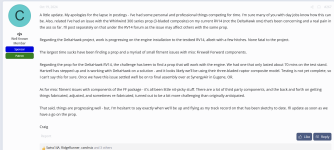
This is what I was asking about, root cause why the test stand prop lasted 70 mins? Diesels can be very destructive to props and airframes. Just asking for full disclosure. BTW I would love for this project to succeed.
View attachment 98287

Gotcha.
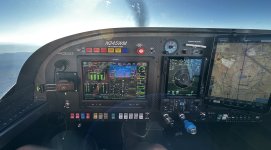
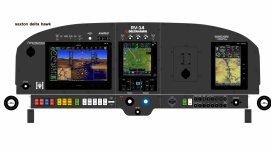 Btw - the “empty” areas on the panel are for an iPhone (left of large g3x) and large iPad (right of gtn750). Both will use MyGoFlight mounts and have usb power outlets behind them.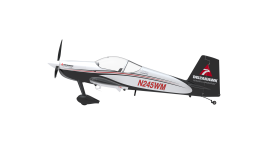
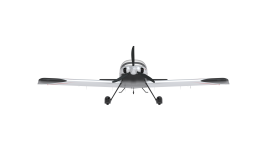
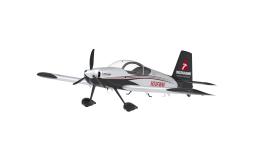
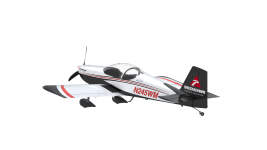
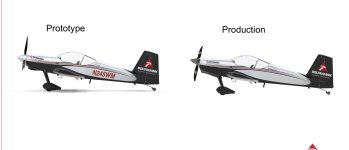
Thanks for the update Craig, the updated cowl rendering looks beautiful!A lot of work has been done to refine the integration of the engine and firewall forward components. It’s shaping up to be a very nice package.
Here’s the latest renderings with what will likely be the final cowling design:
Will do.Would love to see performance numbers at cross country altitudes (greater that 10,000 ft/) Actually posting a .CSV of the flight would be even better.
\
Thanks !
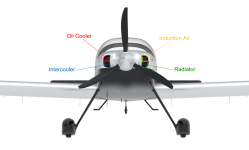
The two inlets will be split internally into four paths, one of which, as you guessed, will be induction air.Craig, I noticed in the updated cowl renderings that the induction air inlet on the bottom cowl has been eliminated. Will there be a fourth dedicated duct (in addition to the existing three for radiator, intercooler, & oil cooler) that runs all the way up to either the left or right main air inlet? Or are they tapping off one of the existing three ducts further back for induction air?
Here’s a visual on the scheme:Craig, I noticed in the updated cowl renderings that the induction air inlet on the bottom cowl has been eliminated. Will there be a fourth dedicated duct (in addition to the existing three for radiator, intercooler, & oil cooler) that runs all the way up to either the left or right main air inlet? Or are they tapping off one of the existing three ducts further back for induction air?