Van's Air Force

The definitive Van's Aircraft support community! Buying, building or flying an RV? Join our exclusive family of mentors and enthusiasts!

DeltaHawk for RV-14

Can you elaborate more on the issue with the first Hartzell composite prop? What was different with the second prop? Seems with diesels harmonics make or break the deal. Thanks, we are all rooting for this to succeed !
The first Hartzell DeltaHawk tried was the two bladed composite prop - just wasn’t a good match with the harmonics from the engine. The 3-bladed Hartzell is working very well - so that’s what we’re going with right now. DeltaHawk has told me Hartzell has been great to work with, and very supportive of the project. We may have additional options in the future.
 
@cjs

Is DH far enough along that they can give a little better insight on if they will hit the price/target of around $115K for a FWF kit and what it includes?

Tim
 
@cjs

Is DH far enough along that they can give a little better insight on if they will hit the price/target of around $115K for a FWF kit and what it includes?

Tim
Tim,
I can’t answer that - it’s a question to ask DeltaHawk directly. I really can only speak credibly to the work I’m doing with them to get the engine operational on the RV14. That said, I know from my discussions with the folks at DeltaHawk they are shooting to be price competitive with the lycoming (total firewall forward package). I know they understand how important this is to us builders.
 
This weeks update:

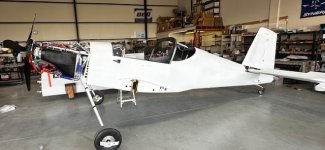
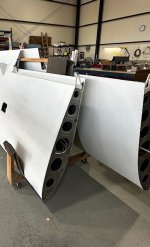
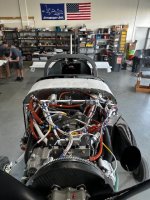
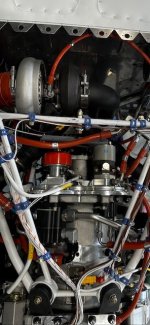
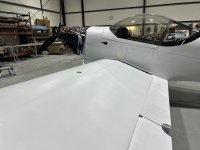
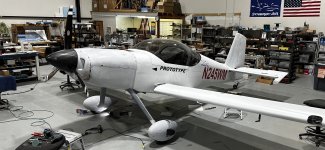
Good progress - plane is primered and ready for wings to go on. Better part of the week was in the paint booth. We will begin attaching the wings Monday.

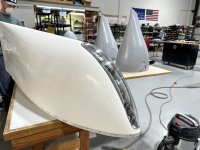
Canopy is complete and ready to install.

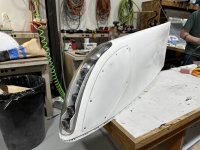
Still working on the wheel pants - but they’re gonna look good! Lots of sanding.

Here’s a few pics.
 

Attachments

  • IMG_7448.jpeg
    IMG_7448.jpeg
    72.5 KB · Views: 308
  • IMG_7449.jpeg
    IMG_7449.jpeg
    82 KB · Views: 298
  • IMG_7451.jpeg
    IMG_7451.jpeg
    140.7 KB · Views: 270
  • IMG_7455.jpeg
    IMG_7455.jpeg
    94.2 KB · Views: 259
  • IMG_7458.jpeg
    IMG_7458.jpeg
    141.8 KB · Views: 315
This weeks update:

Good progress - plane is primered and ready for wings to go on. Better part of the week was in the paint booth. We will begin attaching the wings Monday.

Canopy is complete and ready to install.

Still working on the wheel pants - but they’re gonna look good! Lots of sanding.

Here’s a few pics.
Great idea to paint before assembly... sand away... Looking good. Look forward to your flight test and performance numbers...
 
Great idea to paint before assembly... sand away... Looking good. Look forward to your flight test and performance numbers...
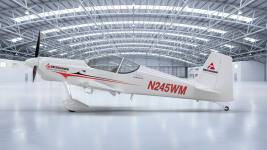
Only doing the primer. Mainly because we don’t have a paint scheme yet. So, at AirVenture likely RV-14.png it’s just going to look like this pic ….white primer w decals. But, we figured it’s better than bare metal and fiberglass.
 
So is there finally a projected date to get one? I've been following for more than two decades...
Yep, I've been following ... everybody has chimed in on the history, no need to go into an infinite loop on the matter.

Official statement is when they get their Cessna STC it locks in their "big" round of funding from their investment group and they can start production, they expect the STC to be approved in the next few months.

We'll see what happens, fully refundable deposit.
 
Yep, I've been following ... everybody has chimed in on the history, no need to go into an infinite loop on the matter.

Official statement is when they get their Cessna STC it locks in their "big" round of funding from their investment group and they can start production, they expect the STC to be approved in the next few months.

We'll see what happens, fully refundable deposit.
I am on the sidelines rooting for these guys. I must say that I am a bit surprised with the strategy on certified aircraft. I certainly get it from a funding perspective, but have to wonder about the risks. There have to be some teething issues as these engines start to log real hours and a couple of ADs would seem to create a lot of challenges and a reputation hit. Just look at superiors reputation of late; Though they are plenty big enough to survive it. I would have thought that building time in the EAB realm would have been safer. I am sure the investors demanded access to a larger market, but the risks seem very high IMO.
 
Yep, I've been following ... everybody has chimed in on the history, no need to go into an infinite loop on the matter.

Official statement is when they get their Cessna STC it locks in their "big" round of funding from their investment group and they can start production, they expect the STC to be approved in the next few months.

We'll see what happens, fully refundable deposit.
What are you going to put it in?
 
I am on the sidelines rooting for these guys. I must say that I am a bit surprised with the strategy on certified aircraft. I certainly get it from a funding perspective, but have to wonder about the risks. There have to be some teething issues as these engines start to log real hours and a couple of ADs would seem to create a lot of challenges. Just look at superiors reputation of late and they have a lomg history. I would have thought that building time in the EAB realm would have been safer.
Agree. Sounds like to me their investors want to see a contract before fully commiting, pretty common.

They have to have the hours to prove the engine to get customers to buy it but they need th engine in airplanes to get the hours ... quite a problem.

If they were $25K you would see a lot of them in EAB but let's face it, EAB is the new GA, everybody wants full glass, nice interiors, nice paint, and a reliable, proven platform.
 
Last edited:
What are you going to put it in?
Well, perhaps the 14 I'm building now if it hits in time and no drama with the current flying 14's with the engine, perhaps a future 14 or even better a 15.

I'm #20 in line, which seems like a good place to be, i.e., not #3 :oops:

There's about to be two 14's flying with the engine so we're going to know what's up soon enough.
 
I dropped a deposit on this engine, apparently 20 other RV14 builders have as well. Sound off if you're one of them!
I made my deposit right after OSH last summer. Spent many hours at the DeltaHawk tent looking at the engine and asked a million questions, and came away very impressed. This engine is in my opinion the most promising thing to replace Lycoming that I've seen in the half century I've been hanging around piston aircraft. Fingers crossed that it will be reliable and affordable. They have tens of thousands of hours on the test stand, most of that abusing the engine to stress test and certify it. Now the challenge is getting it integrated into a bunch of airframes...that is a very time consuming task, each airframe is different and as we know from the sketchy history of automotive conversions, it's often the installation/integration issues that cause teething pains more than the core powerplant. At least the DeltaHawk is a purpose-built aircraft powerplant with emphasis on being as simple as possible, so that eliminates PSRU, complex electronics & sensors, and other things that have been the Achilles heel of many other engines that have made big promises but not panned out.

For now it's just wait and see how it does in the RV-14 and what the price point will be. I think there will likely be a number of changes between the initial prototype and the second, getting the installation optimized for cooling and systems installation tweaks. That all takes way longer than everyone expects...plus I'm building a 14A, and that installation will have additional changes to the exhaust system routing, oil sump, and probably other aspects to work around the different engine mount & nose gear structure. So I'll be surprised if I can get a 14A FWF package before the end of 2026. That's just my opinion, I'm sure DeltaHawk will tell you 'in a few months'... ;)
 
Only doing the primer. Mainly because we don’t have a paint scheme yet. So, at AirVenture likely View attachment 87356 it’s just going to look like this pic ….white primer w decals. But, we figured it’s better than bare metal and fiberglass.
A question from my neighbor -

Craig,

The recent Service Notice from Van's highlighted ER fuel tanks and concerns of flutter with additional fuel weight in the wings of RV-10’s and -14’s.
Given that Jet-A weighs approximately 6.7 pounds per gallon, your RV-14 will be carrying around 35 pounds of additional fuel weight with full tanks versus one using 100LL. Will there be a commensurate reduction in Vne (approximately 16 kts based on Van’s latest SN)? Given the high critical altitude of the DH engine, it seems like you can easily bump up against this limitation (and even more so if Vne is reduced due to fuel weight).

Looking forward to seeing your plane at OSH this year. The Synergy Air folks are great to work with.
 
Short answer is I don’t know yet - especially since this SB is relatively new (may 6th).

Nonetheless, a few initial thoughts:
1. While JetA or diesel is heavier than 100LL, the fuel efficiency numbers from the DH in the Cirrus are about 35% better than stock. From my reading of the SB (and the fact no structural changes have been made to the fuel tanks or the wings) it would stand to reason one could simply fill the tanks with about 6 gals less JetA/diesel (3 gals per side) to negate any potential impact on Vne. Or, just avoid flying at 200kts until one has burned off 6 gals of fuel. Regardless, one’s range with the deltahawk would still substantially exceed the capabilities of the lycoming equipped RV14.

2. If the Vne relative to fuel weight is a concern long term (relative to the fuel tank capacity) - I imagine slightly smaller tanks could be designed.

3. My napkin math indicates the DeltaHawk will likely be capable of cruising at 200TAS at or above 12k MSL. So, keeping an eye on airspeed/Vne will certainly be a concern for anyone with the DeltaHawk. Personally, I don’t see this as a terribly difficult issue to manage. In addition to generally keeping an eye on airspeed, I have my G3X set to warn of Max Airspeed - which my current RV14 is capable of easily breaking, typically in a descent to land.

4. While the ability to cruise at a higher airspeed is a very nice benefit of the DeltaHawk engine - it’s not the only one and certainly not the primary benefit. Personally, the top two on my list are overall fuel efficiency (not just in less burn per hour and miles flown, but in the cost at the pump), lower maintenance cost (no plugs, valves, etc). I’d even toss in better take-off performance in high density altitude conditions as my third preference. And, there are a slew of others such as no mixture to manage, no mags or electronic ignition, etc.

All this said, once the plane is flying and we have actual RV14/Deltahawk performance data, we’ll figure out what if anything may be done to address this and other potential issues.

On the last point - we’re on pace to have the plane ready to fly before the end of the month, except for one late issue that has cropped up. It appears the FAA has had some staffing cuts - and the 2 weeks we normally budget to get our paperwork though in Oklahoma has now been extended to 4-6 weeks (?). Our stuff is submitted, but depending on the FAA’s workload we may be sitting on our hands for an additional week or two.
 
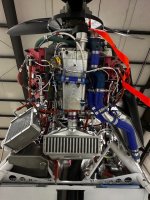
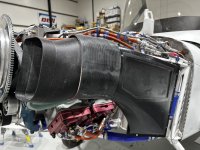
Craig, how does the interface between the ducts (for the radiator, oil cooler, intercooler) and the forward cowl air inlets work? Is it just a snug fit without any fasteners, or is there some sort of sleeve with hose clamps or other mechanism to secure and seal these components while allowing removal for maintenance? It should be simpler than a typical Lycoming with a plenum where you have to allow for relative motion between the plenum and cowl inlets, whereas on the DeltaHawk installation the ducts and cowl shouldn't have any significant relative movement other than vibration. That said, vibration between any two components in an airplane (especially FWF) can cause a lot of wear if they are touching but not firmly fastened to each other...
 
Craig, how does the interface between the ducts (for the radiator, oil cooler, intercooler) and the forward cowl air inlets work? Is it just a snug fit without any fasteners, or is there some sort of sleeve with hose clamps or other mechanism to secure and seal these components while allowing removal for maintenance? It should be simpler than a typical Lycoming with a plenum where you have to allow for relative motion between the plenum and cowl inlets, whereas on the DeltaHawk installation the ducts and cowl shouldn't have any significant relative movement other than vibration. That said, vibration between any two components in an airplane (especially FWF) can cause a lot of wear if they are touching but not firmly fastened to each other...
Great question…It’ll be easier for me to post a video on this than to describe it. Probably won’t get to it for a week or so, but I will.
 
4. While the ability to cruise at a higher airspeed is a very nice benefit of the DeltaHawk engine - it’s not the only one and certainly not the primary benefit. Personally, the top two on my list are overall fuel efficiency (not just in less burn per hour and miles flown, but in the cost at the pump), lower maintenance cost (no plugs, valves, etc). I’d even toss in better take-off performance in high density altitude conditions as my third preference. And, there are a slew of others such as no mixture to manage, no mags or electronic ignition, etc.

Good list. My 2c, no risk of shock cooling is another nice feature. I agree wholeheartedly that the efficiency is a huge draw, and because it's turbo-normalized I can fly it over the local mountains. Other things you mentioned like single-lever operation (sort of like FADEC) are certainly great to have.

I am extremely interested in getting one for my kit once they start making 6-cyl versions, to the point where if they pre-announce a reservation list at Osh I'll put down a deposit. I'm guessing that's at least a year or two away though.
 
For anyone interested in lots more detail about the design, development, and certification of the DHK series, this article in Uncrewed Systems Technology magazine is one of the most thorough I have seen. It is geared toward the UAV audience but most of the info is applicable to either manned or unmanned applications. Article was written over a year ago but I just came across it recently...

DeltaHawk DHK180
 
Last edited:
Update on this week’s progress…

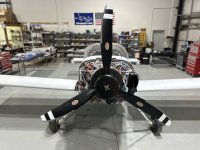
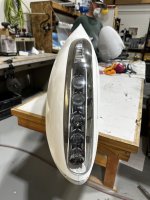
About to install the wingtips - we’re going with the Aveo set-up. I use these on my current 14 and like them. This particular model is a newer gen model than mine, and if they work as good as they look they’ll be great.

IMG_7601.jpegIMG_7600.jpegIMG_7602.jpeg

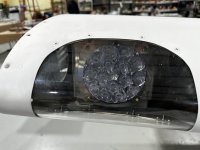
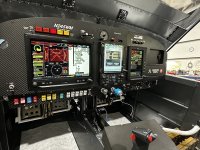
Additionally, we added some lighting in the form of leading edge lights - for those times when one is landing on remote unlit strips. The switches for these ‘off-road’ lights are above the smaller G3X on the right side of the panel.

IMG_7604.jpeg

Finishing up the aerotronics panel installation - still work to do, but we fired it up and all is working well.

IMG_7606.jpeg

Waiting on the MyGoFlight mounts for the iPhone (it’ll mount to the left of the pilot-side G3X) and the iPad (it will mount on an articulating arm anchored to the right of the co-pilots small G3X).

Lots of other tasks completed - most not worth mentioning.

We’re still waiting on our FAA sign-off, so it’s looking more likely we’ll be ready to fly but unable to do so for a week or two. Because of this we’ve pushed back the first flight date to 6/12 since there are a lot of folks traveling here for this and we don’t want to get them out here prematurely.
 
Last edited:
Craig, how does the interface between the ducts (for the radiator, oil cooler, intercooler) and the forward cowl air inlets work? Is it just a snug fit without any fasteners, or is there some sort of sleeve with hose clamps or other mechanism to secure and seal these components while allowing removal for maintenance? It should be simpler than a typical Lycoming with a plenum where you have to allow for relative motion between the plenum and cowl inlets, whereas on the DeltaHawk installation the ducts and cowl shouldn't have any significant relative movement other than vibration. That said, vibration between any two components in an airplane (especially FWF) can cause a lot of wear if they are touching but not firmly fastened to each other...
Checksix,
Short answer to your question on the fit of the ducts to the cowl: snug without any fasteners.

Longer answer: This may change. The current set-up is based on what DH is using w the Cirrus. I suspect we’ll change this a bit on V2 of the RV14 as it’s not optimal for installing/removing the cowl face plate (however, the upper and lower cowls are a breeze to install and remove).

Here’s a pic of one of the inlet ducts:
IMG_7599.jpeg

We did split it and put a flexible sleeve on it, but this was more for alignment purposes - not for vibration or installation purposes.

Again, this all will likely change a bit. We’ll focus on it more once we have flight data and know, for instance, if we need to alter the capacity of the ducts to optimize cooling/drag. The final goal is a complete cowling and ducting system that is not only efficient and effective, but easy to deal with when removing or installing the cowling.
 
Exciting! After watching some of the videos on the problems with various UL100, I’m thinking maybe this could be the best solution to getting rid of 100ll. If they can replace a good percentage of the 172 fleet I could see this being a good alternative engine that happened to get the timing right. Wish they were this far along with an RV-10 install.
 
I’m please to report that 245WM received its Special Airworthiness Certificate yesterday. Had a nice visit with our local DAR, Gary Brown - who happens to be a well of knowledge on all things related to experimentals (and, I’m sure other things, too).

Cory, with Shasta Aero out of Corvalis, came down and certified the Pitot Static and Transponder systems.

So…we’re still looking good for first flight next Thursday.
 
High speed taxi tests went well today. Plane taxis nicely and handles great on the ground. Incidentally, it’s much easier to pull around when getting it in/out of the hangar than my current 14. Not sure, but I think it may be due to the larger wheels and tires. Definitely doesn’t get hung up on small debris.

During the taxi runs we scrubbed the brake pads in - and managed to get the tail up a few times in the process.

All is looking good for first flight tomorrow. The plan is to do a few ‘just barely in the air’ hops the length of the runway - we’re talking a couple feet off the ground - making sure all temps look good, and the controls feel normal. After that we’ll likely pull the cowl again and look for any anomalies.

Then we’ll go for the first legit flight in the pattern - likely only 10-15 mins. There are two of us in the cockpit (me and DeltaHawk’s test pilot, Victor). Victor knows the engine better than I do so I’ll concentrate on flying while he listens to the engine, monitors gauges, handles the radio, and adds two eyeballs to the effort. He’s been a test pilot for about 30 years and I’m happy to have him on board for this.

After the first flight, we’ll pull the cowl again. If all looks good we’ll head up for about an hour and knock out a few test cards.

Here’s a short video of today’s start up from when we headed out for the taxi runs.


That’s about it for now - other than If you don’t hear from me tomorrow it means things didn’t go well!
 
Cool project.
The cowling alterations were done nicely, and don't detract too much from the general sport RV line.
It "diesels" some right after start, and then smoothes out some, unusual to Lycosaurus ears. Looking forward to the inflight sound, and as anyone here, the perf data ;)
 
She flies!

245WM successfully flew this morning - just short runway length hops so far. But, later today we’ll go up for longer runs.

No major issues - just a few minor squawks. Need adjustment on the idle gov control, rpm readout is erratic (appears to be a gauge issue), rpm gov may need a small adjustment, and fuel flow meter doesn’t seem to be spot on.

Good news is she still handles like an RV.

We’re going to ease our way into performance testing so don’t expect too much too soon on that front. Focus now is safety and basic eval of the plane’s flying characteristics and general engine operation.

I’ll keep posting nonetheless - even if it’s just the mundane stuff.
Sorry for the crappy video quality - will have better stuff later.

 
Last edited:
Update.

Sitting on our hands today waiting for a tru-tach rpm monitor so we can cross check the accuracy of the rpm readouts we’re getting on the panel engine monitor. The readouts have been erratic and we suspect something is amiss with the panel readout so we’re erring on the side of caution until we can cross check the readings.

We did a number of short hops yesterday using the 8000’ (34L) runway at Mahlon Sweet Field (KEUG) in Eugene, OR. The tower folks were very helpful and supportive as they slotted us in between Southwest/Delta/and other various commercial and jet traffic.

Here’s a few comments and takeaways from the initial ‘flights’…

*For context, I was left seat and focused on radio and flying (stick and throttle), Victor (DeltaHawk’s test pilot and importantly the guy with a lot of DH engine experience) watched gauges like a hawk - there are a few additional gauges vs the lycoming set-up (coolants, oil, turbo, etc) and he knows what’s ‘normal’ or not. We had a plan for each flight and discussed who’d do what should different issues should crop up.

So, the take-aways:
1. The plane taxis great. Easy to steer, holds a line, smooth. The nose sits a bit higher than I’m used to - likely due to the slightly longer cowl combined with the larger wheels and tires (Krueger’s set-up) I opted to use. Not a problem - but depending on one’s head location, an s-turn now and then might be needed to check a blind spot when looking at the 12-1 o’clock position.

2. T/O: Acceleration was good but not up to my 220+hp RV14. That said, we never rolled-on the power as aggressively as i normally do (about a three count) since we had to monitor rpms closely (gauge issue?).

Standard T/O from there: Initial forward stick to raise tail, relax elevator to neutral and at 60KIAS very slight back pressure and she’s off the ground. There was less rudder needed than I’m used to, but we were being pretty gentle and we are only using 180hp for the initial tests until we know the cooling is dialed in (so far, no indications of any issues with cooling).

3. In the air: Felt like my other RV14 (well balanced). We did some very gentle ‘s-turns’ - if you could call them that, since we’re only 30-ish feet agl and flying along the runway. I wasn’t paying attention the whole time but I did see 80-something KIAS at one point. Overall, the hops allowed us to know nothing squirrelly was going on while giving us confidence that going around the pattern would be fine (unfortunately we didn’t get to that step).

4. Landing: Again, no drama, she behaved like an RV14

*Qualifier here…I have just over 700 hours in the RV14, all but about 5 hours are in my 14. So, that’s my point of reference. Also, my 14 is slightly modified (cowl) and has the lycoming IO-390 thunderbolt with compression bumped .5 over stock - she’s rated at 223hp. Hoping we can get one of the Van’s guys in the DeltaHawk soon to get their thoughts.

So far, I’m very pleased with the DeltaHawk . I think this is going to be a great marriage (DH and the 14). But, It’s early days and obviously much more to do. Hoping to be back up in the air by tomorrow and will continue the process and report what I find.
 
@cjs

How does the weight of the two planes compare (your 220HP Thunderbolt RV14 and the DH180 RV14)?

Tim
The comparison has to be levelized.
One solution is delivered bare bones. The other is fully accessorized.
One solution requires other ancillary systems to mitigate fuel component failures. The other doesn't.
One solution requires a more advanced electrical architecture to provide comparable redundancy.
One solution would require a larger payload fraction for fuel.
etc. etc.

Fan boys from either side can weigh-in here. Getting to a true apples-to-apples comparison is a little tough. Just sayin'.
 
Did a second flight today of about 45 mins with the wheel pants on. Stayed in the pattern cutting circles above runway 34R/16L at KEUG. All went good. Plane handled great in all phases. Here’s a few take-aways to add to the previous ones in the prior post:

1. Was seeing initial climb of roughly 1500fpm at about 110 KIAS. I was mostly focused on flying the plane and looking out the window so I’ll have to pull the data card from the g3x to confirm this. This was with two pilots (440 lbs total) and 38 gals jetA.
2. In the pattern, when we were not focused on myriad other things and checklists, we stabilized airspeed and altitude for a few moments and consistently saw about 142 KTAS at approx 1500 msl, 2450 rpm (2700 is max), 5.2 gph fuel burn (yes, that’s over 30 mpg!), MP 58 - which is about 2/3 power (we saw 90 MP on climb out). We’re still not ready to go full power in straight and level flight, but maybe by tomorrow afternoon.
3. All temps remained pretty much ‘center of the green’ on the gauges. We don’t seem to have any cooling issues. Very pleased with this and the deltahawk guys deserve credit for good work on the cooling system design.
4. Did some steep turns— 60+ degrees - again, plane flew just like a stock 14.
5. Tested the Garmin Auto-pilot. Functioned perfectly.
6. Landings seem perfectly normal, but I am carrying a bit of extra speed since we haven’t done the stall tests yet. Full flaps worked fine.

Over-riding impressions so far…
1. Flys like an RV.
2. Super efficient. I think we are going to continue to see very good speed numbers and very efficient fuel flow numbers.
3. Different engine operating procedures, but all very manageable. A few more temps to watch, but then again no mixture control to dick with.
4. I apparently had a pretty big grin on my face after the flight.

I’ll update again tomorrow with additional info after the days flights. We hope to get another 3-4 hours on the meter.
 
and consistently saw about 142 KTAS at approx 1500 msl, 2450 rpm (2700 is max), 5.2 gph fuel burn (yes, that’s over 30 mpg!), MP 58 - which is about 2/3 power (we saw 90 MP on climb out).
that's impressive efficiency. Interested to see the burn at higher speeds. I have never run forced induction in aviation, only auto. What does 90” translate to in psi?
 
The comparison has to be levelized.
One solution is delivered bare bones. The other is fully accessorized.
One solution requires other ancillary systems to mitigate fuel component failures. The other doesn't.
One solution requires a more advanced electrical architecture to provide comparable redundancy.
One solution would require a larger payload fraction for fuel.
etc. etc.

Fan boys from either side can weigh-in here. Getting to a true apples-to-apples comparison is a little tough. Just sayin'.

There is a reason I asked @cjs for the comparison of the finished planes. I was guessing that @cjs would have the two planes fairly well equally outfitted.
As such, the final package weight is what matters with the most likely difference being the powerplants.

Tim
 
Another update.

Four flights today (Saturday). They’re visible on Flightaware.com if you search 245WM. There may be other sites that track this stuff, but this is the one I’ve been using.

Our goals today were to continue to feel out the performance characteristics of the plane and deal with some minor squawks that needed attention.

Here’s my take-aways from today:

Even though we’re limiting power to 180hp, she’s looking to be about equal to my current RV14 in performance (climb and speed).

I was seeing about 1600 fpm climb with 2-pilots (440 lbs) and 44 gals of fuel. A bit less than my current RV14’s climb rate in similar config.

Single pilot (205 lbs) - my last flight of the day - with about 34 gals of fuel, I saw over 2000 fpm for a brief time (about a min). I didn’t attempt this for a prolonged period as measuring this climb was not my objective. On par with my current RV14.

As for speed - we still have not run at full power other than take-off (she’ll go 100.0 MP, but we’re keeping it to about 90.0 MP). Best speed in level cruise so far was between 165-170 KTAS at 7500’, 65.0 MP, about 2300 rpm. But will likely change a bit as we play with RPM, and certainly with MP. The engine has so much torque, we find dialing back the prop sometimes gives us better speed.

Here’s a sampling of some numbers I noted at different power settings:

5000’ msl, 47 F, 142KTAS (163 mph), 4.2 gph, can’t recall the rpm/MP, 38 mpg

7500’ msl, 47 F, 160 KTAS (184 mph), 6.5 gph, 2350 rpm, 60.0 MP, 28.5 mpg

7500’ msl, 47 F, 160 KTAS (184 mph), 6.2 gph, 2300 rpm, 60.0 MP, 29.8 mpg

7500’ msl, 47 F, 168 KTAS (193 mph), 7.4 gph, 2360 rpm, 65.0 MP, 26.1 mpg

These numbers are just a sampling - don’t read too much into them as we’re not focused on performance data just yet. Nonetheless, I wanted to get some idea of what we could expect performance-wise and share.

All that said, perf numbers are looking pretty good so far. Some related thoughts…

We’re thinking best performance will be about 2250-2300 rpm’s. It appears we actually burn more fuel and lose some speed with higher rpm’s. Likely due to the engine moving out of its peak torque area.

Fuel efficiency is dropping with speed - no surprise there. But, I suspect at higher altitudes very good speed/efficiency will be realized - better even than we have seen already (due to the decreased air density (lower drag) coupled with the forced air system).

That’s it for now other than we may not fly for a few days. We’ve got a small hit list of things to address:

-Cracked wheel pant (shop accident).
-Modify the lower cowl to allow for more cooling air to exit (cowl is ‘ballooning’ a bit - seems we’re taking in inlet air faster than we are evacuating it)
-Tweak to the flaps as the left wing is very slightly heavy

 
Last edited:
Thanks for taking the time to give us detailed first hand reports Craig. Looks very promising!
 
Back
Top