Van's Air Force

The definitive Van's Aircraft support community! Buying, building or flying an RV? Join our exclusive family of mentors and enthusiasts!

Challenger reusable oil filter

I switched back to Wix, probably doesn't make much difference to Lyc, as Bob says. However, I came to these conclusions:

  1. Much wear is in the start. The Challenger/K&P provides better flow, but no drainback valve. Not sure who has the advantage there, but good preheating (WI) and Lyc lubricating system probably makes it moot.
  2. Challenger/K&P quad rings required replacement. I reused the same one 3X and it definitely showed some wear requirement replacement. I decided to change mine with every oil change. This adds (minimally) to the cost of ownership.
  3. I found the Challenger/K&P no easier to clean and inspect, which was one of the main reasons for the purchase.
  4. I liked the form factor of the Challenger/K&P, very easy to change out limiting the likelihood of spills.
  5. There seem to be no mechanical drawbacks to having better filtration. Any flow restriction delta is ultimately compensated for in the Lyc lubricating system.
  6. Wix filters are cheap, $4.81 currently on Rock Auto...which makes the K&P less advantageous if you replace the quad ring every oil change. This takes over 60 oil changes (3000 hrs) to break even on K&P cost.
  7. Free market has made the decision for me. Automotive industry doesn't use reusable screens. The competitive market place eeking out every bit of longevity and reliability tells me the science has been decided. Racing teams use the K&P, but they have different goals.
 
I switched back to Wix, probably doesn't make much difference to Lyc, as Bob says. However, I came to these conclusions:

  1. Much wear is in the start. The Challenger/K&P provides better flow, but no drainback valve. Not sure who has the advantage there, but good preheating (WI) and Lyc lubricating system probably makes it moot.
  2. C
I am of the belief that the small particles that get through, like the microscopic dust, metal and carbon, are what causes the wear during startup/ therefore, i want the cleanest oil on the bearings and cylinder walls during start.
 
I don't understand this at all. How in any sense of the word is this a "feature"?
If the filter bypasses due to cold oil, because the filter more restrictive, some of the junk on the supply side will go back into the engine.

I am of the belief that the small particles that get through, like the microscopic dust, metal and carbon, are what causes the wear during startup/ therefore, i want the cleanest oil on the bearings and cylinder walls during start.
Anything < 40 microns is inconsequential to these engines.

I've taken many oil pump housings apart, even with aluminum impellers, gauged them and found no wear. They are supplied constantly with unfiltered oil.

I cut apart 50+ filters a year, and most of the time I see very little in them, large or small.
 
Anything < 40 microns is inconsequential to these engines.
I dunno...40 microns is starting to get pretty large by comparison. It's 1-1/2 thousands of an inch, and is in the range of various kinds of dust, including fine sand. OTOH, I have zero actual training or education in the field of lubrication science OR metallurgy, so I'll defer to the experts who built the engine, and stick to the Tempest or Champion filters. YMMV.
 
Why is <40uM inconsequential?
Because that's where the efficiency of most filters starts falling off and where the particles stop being visible. I also pulled it right out of my back side...and of course just an opinion...if I can't see it in the filter, its not worth worrying about outside of changing oil more often.

That said, my regiment for breakin on a new overhaul is change oil after the first flight, and again after 5 hours. Its the only time when the torn steel particles from plateauing are present.
 
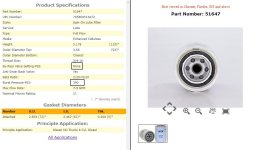
If I used a CH 48110-1 oil filter, what would the Wix equivalent be?
Wix 51647 is one possible choice. The 48110-1 is used on filter adapters with a built-in bypass.

Note Wix is a Mann+Hummel brand. Good filters can also be found in their other lines. And M+H filters are just a tiny fraction of what is available in the market.

I bring it up because based Wix is getting a lot of play from being the only automotive filter tested here. It wasn't chosen because of some belief in its superiority. We needed to choose one, and the 51515 was already in use on quite a few RV's. It was representative.

WIX 51647.jpg
 
Anything < 40 microns is inconsequential to these engines.
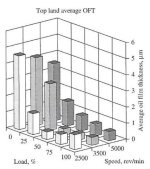
Oil film thickness at the face of the compression ring at various loads and speeds. From Internal Combustion Fundamentals, Heywood.

ScreenHunter_2514 Nov. 25 21.52.jpg

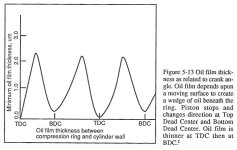
From Sky Ranch Engineering Manual, Schwaner.

Schwaner.jpg
 
From my neighbor -

It's a bit surprising to me that no one participating in this thread (or the other lengthy one on Dan's filter testing) seems to have taken the time to reach out to Lycoming to understand if they have a position on these filters. I did and here was their response -

"Internally at the factory, the Challenger filters were evaluated to determine suitability for operation in our test cells to reduce waste since they are reuseable. During this evaluation it was found that the Challenger filters did not filter down to the particulate level that a Champion or Tempest filter will however, it did perform better than a pressure screen for particulate removal. Based on these findings if the Challenger filter is installed, I recommend performing oil changes earlier than the 50 hours recommended by SB480F for spin on type filters."

I was also concerned about the PMA approval granted to the Challenger and specifically, how the PMA was given as a replacement for the Champion filter - as PMA approval is reportedly for equivalence (or better). I know that the Challenger is slightly better than the old style screen, but not even close to the Champion - so I don't understand how a PMA was ever given. Here was Lycoming's response to that question -

"The Challenger filter is not currently a Lycoming approved PMA part. As for PMA certification details, I recommend contacting Challenger or the FAA for details on what requirements they had to meet for PMA status. We evaluated the Challenger filters but due to the reduction in filtering ability led us to not pursue using them in the factory. CubCrafters uses them on their X Cub and NX Cub with the IO-390-D3B6 and probably a few other models. I have not had any negative reports from CubCrafters or operators using this type of filter about its ability to filter. Personally, I do Like the design but would operate on a reduced oil change interval if installed."

I guess one can draw their own conclusions about whether or not the K&P/Challenger filters are a suitable replacement. Personally, I removed the Challengers from both of our RV's and the K&P filters from all of our cars. Gone back to Champion and/or Tempest on the planes and Amsoil synthetic filters on the cars.
 
I don't understand this at all. How in any sense of the word is this a "feature"?
Perhaps it's a feature because it's inherent in the use of the device and can't be gotten around. If Challenger could designate their filter as "Model N-95," its virtue-signaling capability would arguably rise to the next level.

I'm glad Dan reminded us that spectroscopy is worthless for showing wear metals in oil above a certain (and very significant) particle size. Saved me the trouble.
 
This thread illustrates a divide I'm intimately familiar with. The divide between engineer/ scientist types, and the guy with field experience. Growing up in the trades I spent many hours cussing and correcting for the engineers and scientists. Through some examples I began to appreciate them. Like shorting out a 2000amp switchgear through an allen wrench. I was glad that day someone did some math for the relay settings. It saved me a trip to the burn unit lol. I do wish the guys doing the studying and math would listen to field experience a bit more. But in the end it takes both of us to make the world go round.
 
…Wear, dust, fine particles etc. don't damage aircraft engines or cause them to wear prematurely. Most aircraft engine problems stem from things that absolutely no filter will catch, like lead particles and acids in the oil….

With a pressure screen, the Lycoming recommended oil change interval is 25 hours. With a Cellulose filter, the oil change interval doubles to 50 hours. And per the above comments from Lycoming, the Challenger device is better than the screen, worse than a filter, so the recommended oil change interval is between 25 and 50 hours.

Seems to me that Lycoming draws a direct correlation between oil life and filtration quality.
 
With a pressure screen, the Lycoming recommended oil change interval is 25 hours. With a Cellulose filter, the oil change interval doubles to 50 hours. And per the above comments from Lycoming, the Challenger device is better than the screen, worse than a filter, so the recommended oil change interval is between 25 and 50 hours.

Seems to me that Lycoming draws a direct correlation between oil life and filtration quality.
To continue along this thought: I purchased a K&P when there was a shortage of oil filters a few years ago. Based on my calculations, I came to the conclusion that an oil and filter change at 50 hours would equate to about $3/hour. Running my K&P at the same cost point, I would need to get about 30 hours between oil changes. I think that's reasonable for an oil change....

All of this is dependent on how much one flies a year. Currently, I am putting about 20 hours on my aircraft annually...I can afford to save a few bucks on an oil filter. If I start flying 50+ hours per year, a filter with greater capacity might be in order. All of this information just allows us each to choose what we feel is best for the type of flying that we do.
 
Last edited:
Wait. Aren't you the same guy that poo-poo'd oil analysis as being "worthless"? oil analysis thread

Now you're trying to use them to defend another opinion of yours.

Skylor

[removed politics talk sentence. v/r,dr]. Nothing has changed as I still believe routine oil analysis is also pointless. I don't do them. Yes MY opinion, they're like you know what, everyone has one. But they are valid to do in a case like this in order to attempt to validate filter performance. Two separate, and distinct, use cases.
 
Last edited by a moderator:
From my neighbor -

I was also concerned about the PMA approval granted to the Challenger and specifically, how the PMA was given as a replacement for the Champion filter - as PMA approval is reportedly for equivalence (or better).
Its blanket STC'ed, not PMA'ed. So to use one on a certificated aircraft a 337 has to be filed.
 
Oil film thickness at the face of the compression ring at various loads and speeds. From Internal Combustion Fundamentals, Heywood.
From Sky Ranch Engineering Manual, Schwaner.

It's interesting that much fuss is made over the fact that the Challenger and K&P S15 have poor filtration below 40µ - like that's a surprise - even though K&P, who also manufactures the CP-48109 filter for Challenger, state on their website that their filtration media is 304 stainless medical mesh rated at 35µ. This rating means a +/- variation manufacturing tolerance exists, which will also vary with temperature.

Yet, the figures Dan has kindly reposted from a previous thread show oil films within the engine run in the <5 µ range - where none of the tested filter elements have any real efficacy. In my opinion, this is a bit of a "missing the forest for the trees" phenomenon.

I've been using Challenger / K&P filters going on 15 years with great success on my truck, car, motorcycle and several airplanes, all with good oil analysis results. And when after many hours past TBO, internal inspection of one of my Continental engines showed internals, including the crankshaft and rod bearings, in very good condition. If it weren't for a crack forming on the crankcase, I would have continued operation and not overhauled. I've discussed this topic in other threads on VAF as well.

Is my good experience in spite of the cleanable filters, or because of them? I do not know. But I do know that I've had very good results validated with visual inspection and oil analysis over many years with many changes of my several engines. I also know that with a good air filter and routine oil changes, the cleanable filters provide good service for the life of the engine, are easy to inspect, clean, and also have several benefits, including a rare earth magnet for retaining any ferrous debris and reducing waste at the landfill.

I recommend them.
 
Last edited:
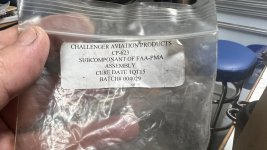
Bob, the challenger filters are PMA'd for the specific filter it is replacing, ie. a CP-48109 for Champion 48109. No 337 is required unless you are installing on an aircraft not on the Approved Model List. See attached photo or https://www.challengeraviation.com
PMA means they are approved to manufacture the part. Has nothing to do with engine or airframe approval. They have an AML for Lycomings and Continentals but it gets to be a gray area as not all those engines are approved for a spin on filter. Some aircraft were designed and built before spin-on filters became a thing and dont have clearance to the firewall for example. So one has to file 337 for an airframe STC approval that Challenger can issue.

1732636267856.png
 
PMA means they are approved to manufacture the part. Has nothing to do with engine or airframe approval. They have an AML for Lycomings and Continentals but it gets to be a gray area as not all those engines are approved for a spin on filter. Some aircraft were designed and built before spin-on filters became a thing and dont have clearance to the firewall for example. So one has to file 337 for an airframe STC approval that Challenger can issue.

View attachment 75161
This is off topic, but true for your application, however, not required if the aircraft was certified for, or already STC'd, for one of the PMA'd filters, which is the point of the PMA process.
 
This is off topic, but true for your application, however, not required if the aircraft was certified for, or already STC'd, for one of the PMA'd filters, which is the point of the PMA process.
From the neighbor -

Agreed and it begs the question of how PMA approval was ever granted for these filters when they clearly are not equivalent to (or better) than the Champion filters they are PMA'd to replace. They are not PMA'd to replace a screen, which as was pointed out - would require an STC/337.
 
This is off topic, but true for your application, however, not required if the aircraft was certified for, or already STC'd, for one of the PMA'd filters, which is the point of the PMA process.
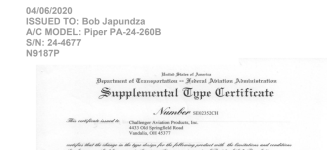
People often confuse what PMA means. PMA means they have the manufacturing, QA, and auditing processes in place that the FAA has approved. Zero to do with airframe approvals. Zero to do with the performance of the product. For oil filters they have a blanket STC, which is SE02352CH and it has an AML. Approval is by engine: https://cdn.shopify.com/s/files/1/0589/0808/2276/files/SE02352CH_R5AML.DOC.pdf?v=1728927366. This blanket STC allows them to use that STC the basis of another approval they are authorized to do, which is called a "one only" STC. Hence why you have to provide data to them in order to install.

You HAVE to have the "one only" STC approval to install this filter on a certificated airframe. Since the STC is an alteration to the aircraft type certificate, a 337 is required.

Now, back on topic. :)
 
People often confuse what PMA means. PMA means they have the manufacturing, QA, and auditing processes in place that the FAA has approved. Zero to do with airframe approvals. Zero to do with the performance of the product. For oil filters they have a blanket STC, which is SE02352CH and it has an AML. Approval is by engine: https://cdn.shopify.com/s/files/1/0589/0808/2276/files/SE02352CH_R5AML.DOC.pdf?v=1728927366. This blanket STC allows them to use that STC the basis of another approval they are authorized to do, which is called a "one only" STC. Hence why you have to provide data to them in order to install.

You HAVE to have the "one only" STC approval to install this filter on a certificated airframe. Since the STC is an alteration to the aircraft type certificate, a 337 is required.

Now, back on topic. :)
From the FAA: A Parts Manufacturer Approval (PMA) is a combined design and production approval for modification and replacement articles. It allows a manufacturer to produce and sell these articles for installation on type certificated products.

The "article" in this case is the Challenger oil filter. Yes, it's not about the airframe - it governs the part manufacture; which if your airframe is certified or STC'd for that part, can be used without further approval. Of course, none of this applies to our experimental aircraft.
 
Hmmmmmmmmmmm..... In my early aviation career, I was led to believe that 25-hour oil changes were necessary as the oil itself begins to break down to the point the molecule chains disassemble and no longer lubricate as well as fresh oil. I have done 25-hour oil changes for decades, both on my C-90 with a screen and O-320 with a filter. The oil on both starts to look pretty dark around that 25-hour mark. It would involve much gnashing and grinding of teeth to let an oil change go to 50 hours😲 😮😮!! Maybe 35-40 would save me a trip to the dentist......;)🤷‍♂️
 
The oil on both starts to look pretty dark around that 25-hour mark.
The color of the oil is not as relevant as the chemical properties, which can be determined through consistent oil analysis. As the oil gets darker, it's simply the detergent doing its job. I realize that whether to perform oil analysis is on par with "primer wars", but as an engineer, I believe whole heartedly in doing so as it is a critical part of performing Condition Based Maintenance, which is better way of maintaining your equipment.

The next time you change your oil at 25 hours, do an analysis that includes lubricity and TBN (measure of the oils ability to handle acids forming), and then keep doing so up to 50 hours. You should find that lubrication properties of the oil are still above minimum - if you are running your engine regularly long enough to boil off any water content. Not running your engine regularly will contribute to acid production (and then sludge) and break down of your oil - run that engine HARD. One trip around the pattern will not likely do the job. A better option would be to fly for an hour at normal operating RPM at least once every week or two at a MINIMUM. It will also help you stay current as a pilot too.
 
Last edited:
45-50 hours for the aircraft engines, which is generally around 4 months. Per vehicle spec for the automobiles.
Typically 7500 miles for automobiles, roughly 200 hours for an average vehicle in the USA. 15,000 for quite a few running synthetics. Which for you?
 
Typically 7500 miles for automobiles, roughly 200 hours for an average vehicle in the USA. 15,000 for quite a few running synthetics. Which for you?
Both my truck and wife's SUV have Ford's "oil minder". Rather than a specified time or mileage, both owner manuals state to change when the oil change indicator comes on, which seems to work out to about 12,000 (diesel 5w-40 CK full synthetic) on the truck and 10,000 (5w-20 SP synthetic blend) on the SUV. For the bike, BMW, it's only a few years old so has an anal retentive baby monitor service system that constantly annoys the rider.... changes at 6,000 miles or sooner with 5w-40 JASO MA2 full synthetic....or face the wrath of Deutschland.

For the airplanes, both Continental and Lycoming, I run Phillips Victory AW 20w-50. I have run longer than 50 to experiment in 5 hour increments and find my TBN drops to around 4 at 75 hours - I did not go beyond that due to lead and viscosity at minimum.

Once we go unleaded, I have no doubt that 100 hours will be very doable, which I did when I had my RV-12 and only ran 91 AKI unleaded in it with TBN >7 at 100 hours running Motul 300 oil. I used an S15 filter on that aircraft. BTW, that oil filter was always very clean with only little smear on the magnet at 100 hours.
 
Hmmmmmmmmmmm..... In my early aviation career, I was led to believe that 25-hour oil changes were necessary as the oil itself begins to break down to the point the molecule chains disassemble and no longer lubricate as well as fresh oil. I have done 25-hour oil changes for decades, both on my C-90 with a screen and O-320 with a filter. The oil on both starts to look pretty dark around that 25-hour mark. It would involve much gnashing and grinding of teeth to let an oil change go to 50 hours😲 😮😮!! Maybe 35-40 would save me a trip to the dentist......;)🤷‍♂️

From Lycoming in regard to 50hr interval for engines with a filter (see Table 1):

https://www.lycoming.com/sites/defa...%20and%20Associated%20Corrective%20Action.pdf

Routine visits to your dentist are still recommended...... ;)
 
From Lycoming in regard to 50hr interval for engines with a filter (see Table 1):

https://www.lycoming.com/sites/default/files/attachments/SB480F%20Oil%20ServicingMetallic%20Solids%20Identification%20After%20Oil%20Servicing%20and%20Associated%20Corrective%20Action.pdf

Routine visits to your dentist are still recommended...... ;)
I adhere to that 4 months calendar year or just about. It is also worthy to remind everyone that with a reusable oil filter, one can simply inspect it at lower intervals, clean it and put it back on. It will not be a big task to do that and hardly any cost at all.
 
Both my truck and wife's SUV have Ford's "oil minder"

Got it.

"I'm satisfied" is a valid criteria, but seriously, can you quantify wear for any of these vehicles? So far, the CliffsNotes read as "Nothing broke".

I suspect lack of failure has more to do with air filter maintenance than oil filtration; you seem to be a guy who keeps up with things. And we're very much on the same page regarding extension of oil change intervals. Here's some close-to-home reading you'll find interesting:

 
Last edited:
Got it.

"I'm satisfied" is a valid criteria, but seriously, can you quantify wear for any of these vehicles? So far, the CliffsNotes read as "Nothing broke".

I suspect lack of failure has more to do with air filter maintenance than oil filtration; you seem to be a guy who keeps up with things. And we're very much on the same page regarding extension of oil change intervals. Here's some close-to-home reading you'll find interesting:

This statement in the report is enlightening:
"The oil change interval set in warranties is a result of standard filters being the limiting factor, not the motor oil quality."

This is why I generally ignore the "4-month" rule. Modern oils just don't break down with time like the old stuff.
And this is why oil filter performance really is a significant part of engine wear and engine life. Which is the original basis for this whole discussion. The Challenger/K&P reusable oil screen is not an oil filter. Period.

An interesting aspect of oil change interval that was not addressed in the study is the accumulation of blow-by contaminants, especially acids. A key feature of the study is that fleet vehicles are driven A LOT. Certainly keeps the water boiled out, which may prevent formation of some of the acid? And of course all the gas engines used unleaded.
 
Last edited:
An interesting aspect of oil change interval that was not addressed in the study is the accumulation of blow-by contaminants, especially acids. A key feature of the study is that fleet vehicles are driven A LOT. Certainly keeps the water boiled out, which may prevent formation of some of the acid? And of course all the gas engines used unleaded.
And, considering they were not air cooled engines, probably made a diff in blow by due to closer tolerances in piston/ring/cylinder fit.
 
And, considering they were not air cooled engines, probably made a diff in blow by due to closer tolerances in piston/ring/cylinder fit.
True, but that even strengthens the conclusion that the key determiner of oil life and engine life is particulate load, not oil chemical degradation. As you say, our engines have more blow-by, (and lead) so it makes good filtration even more important.
 
Probably fit for another thread, but just to stir the pot a little bit, why don't we encourage running paper air filters instead of K&N air filters? If we're so worried about how well an oil filter works down to the gnat's a$$ of particle size efficiency why ignore the other side of things, at the source of some contaminants? A K&N flows better, everyone knows this. They're easy to maintain, like a Challenger oil filter. If one shines a light thru one its obvious why they flow better. I'm curious though, why folks here get worked up over the Challenger oil filters yet don't think about this. Let's not bring ram air setups into the conversation, that might really blow some gaskets.
 
Probably fit for another thread, but just to stir the pot a little bit, why don't we encourage running paper air filters instead of K&N air filters?

That's a very good point Bob, given studies show intake air being the source of most abrasives...the silicon for sure.

I actually made a point of carefully washing out an oil filter element after a trip west last June which included a few visits to a dry lake. I was surprised at the increased quantity of grit in the coffee filter element used for straining the washout liquid, as compared to past checks. It's not hard to understand the source:

ScreenHunter_2519 Nov. 27 14.59.jpg

Yep, I'm running a K&N, but I intend to try a fiber depth media filter in the near future. "Paper" isn't really accurate description for current air filters, or oil for that matter.

For now, think of it this way. Catching the grit before it enters the engine would be best, closely followed by removing it from the circulating oil. The key difference is the engine components exposed to damage. Intake air contamination mostly impacts ring wear and the oil pump. Everything else is largely protected by the oil filter...assuming it is actually a filter.
 
Got it.

"I'm satisfied" is a valid criteria, but seriously, can you quantify wear for any of these vehicles? So far, the CliffsNotes read as "Nothing broke".

I suspect lack of failure has more to do with air filter maintenance than oil filtration; you seem to be a guy who keeps up with things. And we're very much on the same page regarding extension of oil change intervals. Here's some close-to-home reading you'll find interesting:

I did mention I do oil analysis, which I consider more proactive than "nothing broke", as in "consistent oil analysis". Yes, I am that guy that does oil analysis on all my expensive engines. Call it an occupational hazard. In any event, I have not seen any increase in wear metals with all at or below Universal Averages. For my road vehicles, they aren't much higher than new - my 6.7L diesel is pretty much a flat line of wear metals since around 10k miles, currently over 180k. However, very good air filtration systems on the truck.

The HE filter article is interesting. I like their analysis on TBN and viscosity. Regarding extended oil change cycles, one benefit I see with the metal mesh filters is that, while initially larger than the paper element counterparts, they do not increase in filtration size over the oil change cycle while paper elements will. Even more critical when using 100+ hour ranges.

Anecdotally, all of our industrial oil filtration systems in power plant world are metal mesh, or worse yet - strainers and settling tanks - and very commonly electrostatic precipitators, or the king of them all, a centrifuge.

I'm in complete agreement with you regarding air filtration. High quality air filtration is an absolutely important key to clean oil as keeping the dirt (mostly silicon) out is key to minimizing wear.
 
Last edited:
An interesting aspect of oil change interval that was not addressed in the study is the accumulation of blow-by contaminants, especially acids.
It was addressed:

"The total base number (TBN) measures the oil’s acid-neutralizing capacity, and is the most important chemical parameter used to determine oil condition. Acids are formed in the engine during combustion processes. The three main acids are: sulfuric acid from sulfur in the fuel, nitric acid from nitrogen in the air, and organic acids from the oil’s thermal breakdown. Initial TBN decreases as the oil’s acid-neutralizing components are consumed. Oil Additive Packages Zinc dialkyldithiophosphate (ZDDP) is commonly used in engine oils to counter the formation of acids and maintain TBN levels. Diesel and gasoline engine oils with higher initial TBN levels can achieve longer oil drain intervals. Traditional gasoline engine oils have lower initial TBN levels, which are then depleted before the vehicles achieve the higher mileages typical of diesel engines. Motor oils with high levels of zinc and phosphorous damage catalytic converters, which limits their use in automobiles. Depending on different applications, various oil grades and brands have different TBNs. However, synthetic oils generally have higher initial TBNs, and are longer lasting."

With respect to this thread, I thought the most important finding of the study was presented in the results of their literature review:

"Because most wear results from particles in the 5-20 micrometer (m) size range (the oil film’s thickness between moving parts), numerous studies documented a correlation between filtration efficiency and engine wear. The HE filters used in this study claimed filtration of particles to 1-2 m, much better than standard filters of 30-50 m. Using standard filters is one reason that motor oil needs to be changed; it gets dirty with small particles which results in engine wear. In this regard, standard filters have not improved over the years compared to significant improvements in motor oil quality. The oil change interval set in warranties is a result of standard filters being the limiting factor, not the motor oil quality. Hence, higher quality filters will help to extend motor oil life to its full potential.
 
Probably fit for another thread, but just to stir the pot a little bit, why don't we encourage running paper air filters instead of K&N air filters? If we're so worried about how well an oil filter works down to the gnat's a$$ of particle size efficiency why ignore the other side of things, at the source of some contaminants? A K&N flows better, everyone knows this. They're easy to maintain, like a Challenger oil filter. If one shines a light thru one its obvious why they flow better. I'm curious though, why folks here get worked up over the Challenger oil filters yet don't think about this. Let's not bring ram air setups into the conversation, that might really blow some gaskets.
I think that's a great topic Bob - and should be tied to the topic of oil cleanliness and filtration. One thing to consider with aviation engines, hence the ram air setup, is that most often we're at altitude where very little dust is ingested. However, take Dan's photo above - an unfiltered intake, or ram air system, would most likely show up with a spike in silicon in oil content - very little of which would be caught by the fine oil filters identified in the previous testing as most of it is in the 1-5µ diameter range with the majority around 2 to 2.5µ, which is also the size that is the air emissions majority health concern by the EPA and the human air filter (your lungs...).
 
Last edited:
a spike in silicon in oil content - very little of which would be caught by the fine oil filters identified in the previous testing as most of it is in the 1-5µ diameter range with the majority around 2 to 2.5µ, which is why that size is the air emissions majority health concern by the EPA and the human air filter (your lungs...).
I believe the standard for air quality at 2.5 microns is because that size is the most harmful, not because it is the most common.
 
I did mention I do oil analysis, which I consider more proactive than "nothing broke", as in "consistent oil analysis". Yes, I am that guy that does oil analysis on all my expensive engines. Call it an occupational hazard. In any event, I have not seen any increase in wear metals with all at or below Universal Averages. For my road vehicles, they aren't much higher than new - my 6.7L diesel is pretty much a flat line of wear metals since around 10k miles, currently over 180k. However, very good air filtration systems on the truck.

Like I said...if it doesn't get in, there isn't much to filter out.
 
Like I said...if it doesn't get in, there isn't much to filter out.
I always thought we were filtering normal wear particles. Didn’t consider the air quality as being that substantial in comparison. I can see another series of tests Dan. Get on It ;)
 
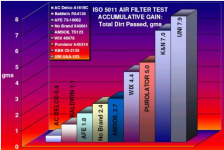
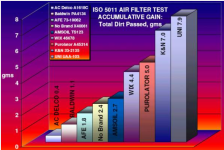
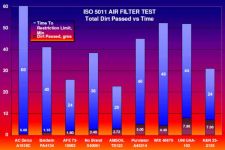
Air filter test...
 

Attachments

  • K&N dirtpass.PNG
    K&N dirtpass.PNG
    658.1 KB · Views: 58
  • K&N dirtpass.PNG
    K&N dirtpass.PNG
    658.1 KB · Views: 56
  • K&N dirttime.PNG
    K&N dirttime.PNG
    748.8 KB · Views: 57
K&N air filters have been discussed in another thread. They do a terrible job at actually cleaning the air, but they do keep insects and birds out. That's why I use a K&N - to keep big stuff out. No illusion that it's keeping out fine dirt particles. We're out of the dust and dirt in seconds (mostly), so it's not like a desert racer or a motocross bike or any other land vehicle. Any dirt that gets into the oil from blow-by will get captured quickly by the filtering of the "paper" oil filter most of us use. :)
 
We're out of the dust and dirt in seconds (mostly), so it's not like a desert racer or a motocross bike or any other land vehicle. :)
High altitude dust is certainly a thing. Have had many long trips up high and have observed leading edges covered in fine dust after landing. Rarely have I had that happen on low altitude trips.
 
Back
Top