

Van's Air Force
You are using an out of date browser. It may not display this or other websites correctly.
You should upgrade or use an alternative browser.
You should upgrade or use an alternative browser.
Challenger reusable oil filter
- Thread starter VaNewbie
- Start date


Sam Buchanan
been here awhile
Well, yes…………a few thoughts have been expressed. 
https://vansairforce.net/threads/filter-test-results.226033/
https://vansairforce.net/threads/filter-test-results.226033/

Toobuilder
Well Known Member
And that discussion may be something to look at, but the previously mentioned threads focus on “filter performance”. And in those terms, the Challenger and clones are demonstrably terrible.My opinion is these engines don't appreciably wear from or produce hard wear particles small enough that make any of the "tested" filters result in less wear in service than engines using the Challenger.
In the context of a thing pulling stuff out of a fluid, don’t look at a Challenger to be effective.

I fly an RV 9A with a Titan IO 360 and am thinking of switching to the Challenger reusable oil filter, anyone have any thoughts? What about using the K&P automotive version? It's almost exactly the same thing but much cheaper?
A whole bunch of us purchased one of the reusable oil filter variants awhile back. A whole bunch of us now use them as paper weights. That being said, happy to sell you a barely used one for half price if you are still interested.


I would say they make EXCELLENT spittoons!They seem to make great coffee cups, or mini-spittunes!

Yea, I tried yelling to Mike through my phone podcast program, but he didn’t hear me.Mike Busch was singing the Challenger’s praises on his most recent podcast. I wondered if there was a way to point him to that thread.

Might be worth sending their producer a link to the discussion.

1/4 price!!A whole bunch of us purchased one of the reusable oil filter variants awhile back. A whole bunch of us now use them as paper weights. That being said, happy to sell you a barely used one for half price if you are still interested.


I turned my K&P filter into a paper weight, but I’ll sell it to you.I fly an RV 9A with a Titan IO 360 and am thinking of switching to the Challenger reusable oil filter, anyone have any thoughts? What about using the K&P automotive version? It's almost exactly the same thing but much cheaper?


rocketbob
Well Known Member
The oil analyses that were posted in that big long thread didn't show any appreciable differences between the Challengers and anything else "tested". Wear, dust, fine particles etc. don't damage aircraft engines or cause them to wear prematurely. Most aircraft engine problems stem from things that absolutely no filter will catch, like lead particles and acids in the oil.And in those terms, the Challenger and clones are demonstrably terrible.
When I read that thread, I was having similar thoughts. For example, the oil screen that Lycoming installed on my engine is courser than the challenger, and takes a lot of engines to TBO. I'm glad others feel good about there filter knowledge, for educating us. I also keep an open mind about what worked for millions of hours in the past may still be legitimate today.The oil analyses that were posted in that big long thread didn't show any appreciable differences between the Challengers and anything else "tested". Wear, dust, fine particles etc. don't damage aircraft engines or cause them to wear prematurely. Most aircraft engine problems stem from things that absolutely no filter will catch, like lead particles and acids in the oil.
Thanks for all the rapid feed back. It sounds like most people are dissatisfied with the Challenger filter. Is it a case of bad oil analysis, poor workmanship, or out right failure/leakage? I did hear the Mike Busch podcast and he did seem to be impressed with it after one oil change.

Mike S
Senior Curmudgeon
Or simply the results of Dan's lab testing?It sounds like most people are dissatisfied with the Challenger filter. Is it a case of bad oil analysis, poor workmanship, or out right failure/leakage?
Has anybody gotten actual empirical data from running these units in their engines?
Methinks not, as it could take years to gather meaningful data from folks actually running the filters on their engines.
Last edited:

Here we go again.
In the beginning, our airplane engines had a screen to catch the big chunks floating around. Then someone came along and thought it might be nice to catch smaller chunks.... We called that a filter as opposed to a screen. Just nomenclature.
The Challenger catches the big chunks per original design certification. But, the data shows that we shouldn't call it a "filter" by modern (personal) expectations.
In the beginning, our airplane engines had a screen to catch the big chunks floating around. Then someone came along and thought it might be nice to catch smaller chunks.... We called that a filter as opposed to a screen. Just nomenclature.
The Challenger catches the big chunks per original design certification. But, the data shows that we shouldn't call it a "filter" by modern (personal) expectations.
Toobuilder
Well Known Member
Again, the argument about “effective filtration” has been proven with lab testing. The Challenger sucks. Period, dot. But that is a different argument than “…does the Lycoming need good filtration?…”The oil analyses that were posted in that big long thread didn't show any appreciable differences between the Challengers and anything else "tested". Wear, dust, fine particles etc. don't damage aircraft engines or cause them to wear prematurely. Most aircraft engine problems stem from things that absolutely no filter will catch, like lead particles and acids in the oil.
rocketbob
Well Known Member
Lycomings with 0.006" piston clearance doesn't need filtration literally down to the uM level of bacteria. The lab testing did not prove any increase in longevity of a typical Lycoming and it cannot be inferred from that test.Again, the argument about “effective filtration” has been proven with lab testing. The Challenger sucks. Period, dot. But that is a different argument than “…does the Lycoming need good filtration?…”
Cleanable mesh filters are widely used on turbine engines like the PT6 yet people here hyperventilate using a Challenger filter.
a filter like the Wix 51521 demonstrably performs better than the reusable filters and is available for $10 on Amazon. Other than the ease of opening the reusable filter, it’s hard to justify their purchase and use.
I went thru that exercise with multiple tests and comparing the oil analysis after using Challenger, Champion and synthetic automotive filter which independent test facility had shown to be the best. My oil test were all just about the same using the three oil filters. This test was done with two airplanes and both showed the same result so I have put my challenger back on.The oil analyses that were posted in that big long thread didn't show any appreciable differences between the Challengers and anything else "tested". Wear, dust, fine particles etc. don't damage aircraft engines or cause them to wear prematurely. Most aircraft engine problems stem from things that absolutely no filter will catch, like lead particles and acids in the oil.
If you suspect your engine is going to put a lot of junk out to be filtered, then your challenger might not be sufficient as the media is smaller area compared to a bigger body oil filter but for a normal/healthy engine, I have found it to be more than sufficient.

I have the K&P, ran it for a while, but pulled it based on the testing results. It might be true that a Lycoming engine does not need filtering beyond the level of a stainless filter like the K&P or Challenger, however I can't in good conscience put on a filter that I know is doing a worse job than another easily accessible option.
Toobuilder
Well Known Member
lycoming’s tolerance for dirty oil before it does damage is a test that will likely never be performed. Nor should it - it’s like trying to figure out how high a brick needs to fall before it hurts your head when you can just wear a helmet.Lycomings with 0.006" piston clearance doesn't need filtration literally down to the uM level of bacteria. The lab testing did not prove any increase in longevity of a typical Lycoming and it cannot be inferred from that test.
Do we need to clean oil down to the molecular level to keep a Lycoming alive? Clearly not. But when one can choose a paper filter that is cheaper, lighter, more available, more reliable, and wildly more effective than the Challenger, why is this discussion even taking place?

Let's see, I can buy a filter that removes 90% of the contaminates or one that removes 10% - I'm going for the one that removes 10%! Now where are those tires that wear out five times faster but cost three bucks less? That sounds good to me too.
Last edited:
rocketbob
Well Known Member
The discussion is happening because screen filters like the Challenger are being poo-pooed with unsubstantiated reasoning. They are good enough for Lycomings and they're much easier to deal with when it comes to inspecting. Dare I say they're more environmentally friendly to boot. Saying the other filters work better in the real world is a stretch of the imagination as I continue to point out here. There is zero data to support that conclusion.Do we need to clean oil down to the molecular level to keep a Lycoming alive? Clearly not. But when one can choose a paper filter that is cheaper, lighter, more available, more reliable, and wildly more effective than the Challenger, why is this discussion even taking place?
Not at all against using automotive filters asI started using the 1515/1068 filters over 20 years ago. People here said no way should anyone use an automotive filter because its gonna burst or its gonna fall off from not having safety wire tabs.
Exactly my point. They work fine. Anyone that says they should be used as a spitter, coffee cup, etc. in my opinion should be walking around the grocery store with an N95 mask on so I can laugh at you.This test was done with two airplanes and both showed the same result so I have put my challenger back on.

I have used Champion and Tempest oil filters and have had regular oil analysis at every oil change. I switched to the Challenger reuseable oil filter and saw no real change in my oil analysis. I find the filter is a lot easier to get on and off with no mess since it’s got a smaller footprint. I’m not against using the paper type filters but I tend to agree with Rocketbob that our old technology tractor engines don’t really need surgical cleanliness. I also appreciate the work Dan H and others have done and there are valid points to be considered.
Blackstone Oil lab comment was “metals look pretty good next to universal averages for this type of Lycoming, and those are based on ~30-hour oil runs. No water or fuel turned up, and the oil tested well physically. Nice report, all told.”
Blackstone Oil lab comment was “metals look pretty good next to universal averages for this type of Lycoming, and those are based on ~30-hour oil runs. No water or fuel turned up, and the oil tested well physically. Nice report, all told.”

Lycomings with 0.006" piston clearance doesn't need filtration literally down to the uM level of bacteria.
Come on Bob, you know better. Piston-to-wall clearance is of minimal interest. The key issue is boundary lubrication, i.e. sliding or point contact, often with reversing direction...piston ring faces, rocker shafts, cam lobes-vs-tappets, gear tooth faces, etc. When working through a rebuild, we can measure, see, and feel wear everywhere we look. That wear is due to contact.
A Lycoming isn't a special case. It's an IC engine like any other, and most of the wear issues are the same. If anything, the wide temperature range of air cooling makes lubrication more difficult, not less.
The lab testing did not prove any increase in longevity of a typical Lycoming and it cannot be inferred from that test.
Absolutely correct. ISO 4548-12 is a single subsection of a worldwide filter test standard, not an engine test protocol.
Cleanable mesh filters are widely used on turbine engines like the PT6 yet people here hyperventilate using a Challenger filter.
We have turbine design guys here, so I'll leave that discussion to them. I'll also skip the hyperbole. Data is a calm illumination, and it says the reusables are poor filters. Given we operate Lycomings with very short oil change intervals, it is perfectly reasonable to argue there is no need for a filter, particularly when operating in a clean environment. It is not reasonable to argue better filtration is without benefit, given the obvious wear patterns we observe at teardown.
Along these lines, I had the old fashion screen on my RV6. After 1500 hours, it told me that me engine needed serious attention. I found one piston was starting to burn through.The oil analyses that were posted in that big long thread didn't show any appreciable differences between the Challengers and anything else "tested". Wear, dust, fine particles etc. don't damage aircraft engines or cause them to wear prematurely. Most aircraft engine problems stem from things that absolutely no filter will catch, like lead particles and acids in the oil.
If old fashion screen does the job, I believe reusable filter will do better. Nothing scientific about my comparison. Have been using reusable oil filter for years. My engine on the 10 has 1850 hours on it and oil analysis come perfect every time. I like the ability to check oil filter at anytime without having to replace it entirely.
rocketbob
Well Known Member
Oil analysis that folks have done with and without these filters in use proves otherwise.Data is a calm illumination, and it says the reusables are poor filters.
Toobuilder
Well Known Member
The Challenger filter is poo-pooed because they are deficient as filtration devices compared to almost every other filtration scheme. This has been established with hard data. They SUCK. That’s all many people need to know. Whether that poor filtration translates to lower component life or safety is wide open for debate. But one thing that is NOT in question is that cleaner oil is ALWAYS better than less clean.The discussion is happening because screen filters like the Challenger are being poo-pooed with unsubstantiated reasoning.
Toobuilder
Well Known Member
They are good enough for Lycomings and they're much easier to deal with when it comes to inspecting.
If the Lycoming does not generate enough debris to “need” a superior filter, what are we inspecting for?
Can’t have it both ways.
rocketbob
Well Known Member
Please take a moment to dig deep in your mind and explain why oil analysis doesn't reflect this. Using perjoritives just further indicates to me you are grasping at straws.This has been established with hard data. They SUCK. That’s all many people need to know.
Toobuilder
Well Known Member
Do you deny the results of the particulate removal performance published in the other thread?
I don't think anyone can deny test results. I think the debate is whether better filter is necessary.Do you deny the results of the particulate removal performance published in the other thread?
Toobuilder
Well Known Member
Exactly the point of my first sentence in my first post in this thread (post #5)I don't think anyone can deny test results. I think the debate is whether better filter is necessary.
rocketbob
Well Known Member
Not at all. But, like I've said, the filter lab tests prove not a single thing about realty.Do you deny the results of the particulate removal performance published in the other thread?
The reality is folks have done oil analysis before, after, and back on Challenger filters and found there are no elevated metals by using this supposedly inferior filter. For some reason which puzzles me you don't acknowledge this. Or I should say I think I know the reason, and that is you don't want to admit that your reasoning is flawed.
I look around inside 300-400 cylinders per year, overhaul engines, send things off to get machined, etc. and I can tell you nothing I see as causes for parts to get rejected relates to poor filtration. Approaching 100% its pitting and corrosion that causes problems. Filters of any type don't do squat to help with this.
All these engines need is a screen to examine routinely if something internal is rapidly deteriorating.

Pilot135pd
Well Known Member
Aside from all the good rehashed information, I think it boils down to this.
1- OP didn't search CHALLENGER before asking
2- Lycomings don't need a filter, if you're just wanting to catch what Lycoming's oil mesh has always caught
3- The Challenger does a worse job at filtering than the $10 disposable WIX and others cheaper than the Challenger
4- Keep doing oil analysis testing every oil change because that tells you more than any filter
5- If you have a Challenger it doesn't hurt to use since you already paid for it and it's easier to inspect it than a disposable filter
and finally
6- If you DON'T have a Challenger but decide you want to pay so much for something that catches the same thing the original oil mesh does, instead of using a cheaper disposable filter, and later come complain about the price of eggs, someone will do a search and flame you for it later
1- OP didn't search CHALLENGER before asking
2- Lycomings don't need a filter, if you're just wanting to catch what Lycoming's oil mesh has always caught
3- The Challenger does a worse job at filtering than the $10 disposable WIX and others cheaper than the Challenger
4- Keep doing oil analysis testing every oil change because that tells you more than any filter
5- If you have a Challenger it doesn't hurt to use since you already paid for it and it's easier to inspect it than a disposable filter
and finally
6- If you DON'T have a Challenger but decide you want to pay so much for something that catches the same thing the original oil mesh does, instead of using a cheaper disposable filter, and later come complain about the price of eggs, someone will do a search and flame you for it later
Last edited:

Aside from all the good rehashed information, I think it boils down to this.
1- OP didn't search CHALLENGER before asking
2- Lycomings don't need a filter, if you're just wanting to catch what Lycoming's oil mesh has always caught
3- The Challenger does a worse job at filtering than the $10 disposable WIX and others cheaper than the Challenger
4- Keep doing oil analysis testing every oil change because that tells you more than any filter
5- If you have a Challenger it doesn't hurt to use since you already paid for it and it's easier to inspect it than a disposable filter
and finally
6- If you DON'T have a Challenger but decide you want to pay so much for something that catches the same thing the original oil mesh does, instead of using a cheaper disposable filter, and later come complain about the price of eggs, someone will so a search and flame you for it later
 Gad................. they SAID I would have flashbacks...........
 We have all been here before......we have all been here before.......
 CSNY Deja vu
Last edited:
For those who use them as coffee mug or paper weight, would you mind send it to me (I will pay postage) and I will buy you a very nice coffee mug or paper weight to replace it. If you like we can conduct a test to see if an actual coffee mug preforms better or Challenger when used as a coffee mug.
Oil analysis that folks have done with and without these filters in use proves otherwise.
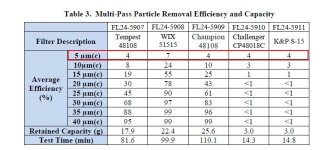
The 4548-12 reports how much of each particle size is being captured, from 5 to 40 microns. Spectrographic analysis reliably detects particle sizes of less than 10 microns. It is possible to have a significant quantity of larger particles in a spectro sample, and they will not appear in the results. At the same time, it is possible to circulate very small particles detectible with spectro, and they will not be captured with a typical filter.
4548-12 range in green. Spectro is blue box. A3 medium is an SAE standard test dust.
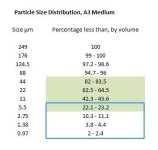
At the small particle end of the scale where the test methods reliably overlap, there is good agreement between the 4548-12 results and spectro analysis. Put another way, the 4548-12 predicts there will not be any significant difference in spectro results between the filters and the screens:
Toobuilder
Well Known Member
And I think the issue here is that you are unable to compartmentalize two distinct concepts. One is the fact (yes, I said “fact”) that the automotive style cellulose filter is superior to the screen at pulling junk out of the oil. That FACT is compelling when trying to decide what method you want to use. Cheap and effective wins over costly and ineffective in my book.…Or I should say I think I know the reason, and that is you don't want to admit that your reasoning is flawed…
The above is COMPLETELY SEPARATE from the opinion you and others hold that there is no benefit to cleaner oil. And you may be right. But short of an actual laboratory study, your option, highly regarded as it is, is still just an opinion.
And finally, there can be ZERO argument that having a better oil filter “does no harm” at the very least. For those of us that have an option that simply spins on the back of the engine, why in the world would anyone pick the more expensive, least effective option? It makes zero sense to me. If that’s “…flawed reasoning…” so be it.

Mike Busch was singing the Challenger’s praises on his most recent podcast. I wondered if there was a way to point him to that thread.
That's not quite true. He said it was an experiment, and he was not ready to write any articles about them. He has only done one oil change, and although he pointed out all the usual practical advantages, neither he or his co-hosts addressed filtration. He was totally wrong about the construction of the Challenger media ("laser cut holes"...nope), and pressure loss across the filter.
I was amused when he started talking about how much smaller they were. Yep, there's a reason for that....
I sent Mike an email with a link to our forum thread with the filter results. We’ll see if he addresses the filter suitability again in a future podcast.That's not quite true. He said it was an experiment, and he was not ready to write any articles about them. He has only done one oil change, and although he pointed out all the usual practical advantages, neither he or his co-hosts addressed filtration.
glider_rider
Well Known Member
I believe, it's not about the piston clearance but about wear and tear on bearings.Lycomings with 0.006" piston clearance doesn't need filtration literally down to the uM level of bacteria. The lab testing did not prove any increase in longevity of a typical Lycoming and it cannot be inferred from that test.
Cleanable mesh filters are widely used on turbine engines like the PT6 yet people here hyperventilate using a Challenger filter.
Attachments
Good point. Agree.I think the mods could probably close this discussion. The original question has long since been answered, and the rest of the discussion isn't any different than the discussion in the original filter testing thread.
My comments, I agree with Rocketbob that better filtration may not be necessary.
The engine I put in my RV had a screen. I wanted better filtration so added a spin on paper filter that Lycoming recommends. I wanted not I needed better filtration.
I purchased the spin on stainless steel mesh filter because I wanted some kind of filter IF I could not get a paper filter. I would rather cut open a paper filter and dispose of the waste than clean the reusable filter.
I have friends (yes I have more than one friend and more than one that use the reusable screen filters) that have and use the Challenger filter. I do not tell them that it is the wrong filter or a bad filter. I keep my mouth shut and let them use the filter they want. IF they do something that I think is UNSAFE, I will politely tell them about my safety concerns.

Sliding contact suffers far worse abuse from particulate including water e.g. gear teeth, cams/followers, etc.I believe, it's not about the piston clearance but about wear and tear on bearings.
Additional note and forgive me if already mentioned here. The Lycoming SB480 allows 50 oil change intervals with a filter vs 25 for pressure screen. Sure, it could be primarilty associated with lead fouling but there are stated, OEM-released advantages associated with better filtration. Just sayin'.
We seem to have just about run this thread into the ground, but as a follow-up, here is Mike Busch’s response to my email to him regarding the lab testing results on the various oil filters:That's not quite true. He said it was an experiment, and he was not ready to write any articles about them. He has only done one oil change, and although he pointed out all the usual practical advantages, neither he or his co-hosts addressed filtration. He was totally wrong about the construction of the Challenger media ("laser cut holes"...nope), and pressure loss across the filter.
I was amused when he started talking about how much smaller they were. Yep, there's a reason for that....
View attachment 75017
“Erich, I am intimately aware of that lab testing, and took it into consideration when I made my decision to install the Challenger filters on my airplane. I know the VAF testing scared a bunch of RV owners into removing these filters from their airplanes, inappropriately so in my opinion. The fact that the challenger filter does not catch extremely small particles that are harmless to the engine as well as a paper filter does is a feature, not a bug, in my attachment. —Mike”
There was no “attachment” with his email, so I’m guessing his use of that word was some kind of odd typo, and he meant to say “opinion”.
I’m not sure whether the small particles that pass through the reusable oil filters are harmless or not, but since there are other filters available for $10 that remove such particles I think I’ll stick with them for now.
Does the automotive paper filter has a backing metal mesh? I used a synthetic filter (Fram XG16) that the independent test showed a much better result than WIX filter but it has a metal mesh that makes it super hard to cut open and examine the filter media and that made it unusable for me.
This topic is like so many of the things going on in this world today. I simply do not understand "the other side". I don't know if it's because I'm getting old or if things really are weird.
If I'm buying a water filter for my drinking water, would I want one that removes 90% of the impurities or 10%? In my way of thinking, this argument is no different with an oil filter. I want to remove as many of the contaminants as possible as long as there is no downside like reduced flow or pressure issues. I don't care if the impurities are deemed by some as harmless. I don't want anything sloshing around in my engine other than pure, clean engine oil.
Are folks defending reusable filters that don't work as well AT FILTERING because they are cheaper over time? If so, that may explain why I don't understand "the other side". When it comes to my airplane, I have zero interest in saving money. Just the opposite. If I find something that is 5% safer but costs twice as much, I'll buy it. My airplane is the last place I try to save money.
If I'm buying a water filter for my drinking water, would I want one that removes 90% of the impurities or 10%? In my way of thinking, this argument is no different with an oil filter. I want to remove as many of the contaminants as possible as long as there is no downside like reduced flow or pressure issues. I don't care if the impurities are deemed by some as harmless. I don't want anything sloshing around in my engine other than pure, clean engine oil.
Are folks defending reusable filters that don't work as well AT FILTERING because they are cheaper over time? If so, that may explain why I don't understand "the other side". When it comes to my airplane, I have zero interest in saving money. Just the opposite. If I find something that is 5% safer but costs twice as much, I'll buy it. My airplane is the last place I try to save money.
Toobuilder
Well Known Member
This topic is like so many of the things going on in this world today. I simply do not understand "the other side". I don't know if it's because I'm getting old or if things really are weird…
I’m in the same boat. I can’t for the life of me understand how people are arguing for “less clean” oil for the exact same effort required for “more clean” oil. And they are willing to PAY MORE for the privilege!
When Lycoming went to the spin on filter, the oil change interval doubled. Cleaner oil is better - can there really be any debate on this?
I think this just shows how far people will go to justify a decision - evidence be damned.
