Van's Air Force

The definitive Van's Aircraft support community! Buying, building or flying an RV? Join our exclusive family of mentors and enthusiasts!

Filter Test Results

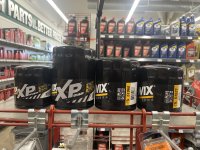
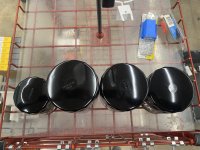
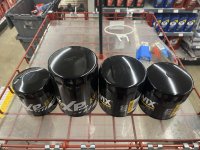
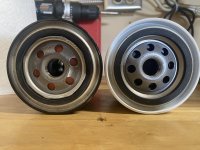
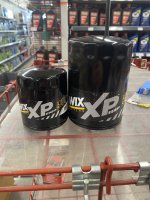
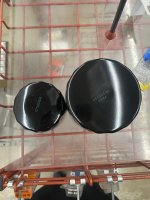
Went to the auto shop this morning to try and figure out what filter I’m wanting to go with. I took several of them from this thread and put them next to each other. Thought some of you would like to see the comparison.
Still not sure what I want to run. I thought I was set on the wix51348/k&p 1002 but after seeing it I can’t believe how small the filter is. Can that be big enough for our use?
The 51515 is big. Quite a bit bigger than a champion 48108. So I’m thinking maybe the 5152.
 

Attachments

  • IMG_3022.jpeg
    IMG_3022.jpeg
    1.7 MB · Views: 168
  • IMG_3023.jpeg
    IMG_3023.jpeg
    1.6 MB · Views: 170
  • IMG_3028.jpeg
    IMG_3028.jpeg
    1.7 MB · Views: 144
  • IMG_3027.jpeg
    IMG_3027.jpeg
    1.7 MB · Views: 143
  • IMG_3026.jpeg
    IMG_3026.jpeg
    1.8 MB · Views: 162
Went to the auto shop this morning to try and figure out what filter I’m wanting to go with. I took several of them from this thread and put them next to each other. Thought some of you would like to see the comparison.
Still not sure what I want to run. I thought I was set on the wix51348/k&p 1002 but after seeing it I can’t believe how small the filter is. Can that be big enough for our use?
The 51515 is big. Quite a bit bigger than a champion 48108. So I’m thinking maybe the 5152.
I think size effects filter longevity not effectiveness, bigger the filter the longer it takes to clog and increase pressure. Case size is mostly a consideration of application and room to remove and install. The tests listed above indicate filter effectiveness at removing particulate matter from the oil and all are being used on aircraft.
 
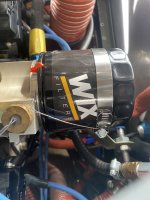
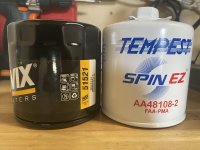
I Switched out my k&P s15 today. I went with the Wix 51521. I had a spare Tempest 48108 so I put it next to the Wix as a comparison. They are exactly the same size except the tempest has the hex on the bottom.
Did the 3/4 turn to tight and threw some safety wire in with a clamp just to make sure.
 

Attachments

  • IMG_3040.jpeg
    IMG_3040.jpeg
    1.7 MB · Views: 151
  • IMG_3035.jpeg
    IMG_3035.jpeg
    1.8 MB · Views: 149
  • IMG_3034.jpeg
    IMG_3034.jpeg
    1.6 MB · Views: 153
I Switched out my k&P s15 today. I went with the Wix 51521. I had a spare Tempest 48108 so I put it next to the Wix as a comparison. They are exactly the same size except the tempest has the hex on the bottom.
Did the 3/4 turn to tight and threw some safety wire in with a clamp just to make sure.
Does WIX has the metal mesh backing to the filter media? I used a Fram synthetic that has a metal mesh and it is really hard to cut the media to examine it once opened. The testing has shown much superior to WIX and other filters but this is a pain to take the media out to look it over.
 
I was listening to the 1/1/25 episode ("Check it, log it, and then relax") of AOPA's Ask the A&Ps podcast with Mike Busch, Paul New, and Colleen Sterling this morning and they were discussing the results posted here. Not expressing an opinion on what they said, but thought I'd post it here for anyone that is interested. They start discussing it around the 45:25 minute mark.
 
Last edited:
I was listening to the 1/1/25 episode of AOPA's Ask the A&Ps podcast with Mike Busch, Paul New, and Colleen Sterling this morning and they were discussing the results posted here. Not expressing an opinion on what they said, but thought I'd post it here for anyone that is interested. They start discussing it around the 45:25 minute mark.
Thanks for posting this with the exact time for the relevant part. I have done some testing of my own and provided the result in here for those who are interested. My Challenger filter is back on and in use in both RV14s
 
In instruction, we call Mr Busch's misuse and mischaracterization of the overlooked fact the metal mesh filter seller used the WRONG standard test to market the reuseable filter as a "SLOC".

Sudden Loss of Credibility. It invalidates everything positive he supported while belittling VAF.

Confirmation/Continuation bias is an attractive threat. Putting the reuseable element mesh filter into the standard test for oil filters should have been the wakeup call, not continuation dismissal.

It was shown that the reuseable mesh standardized test selected by the manufacturer was not equivalent.

THEN one can choose to be a consumer and or a product advocate. Is the reuseable filter good enough?

Sacramento Sky Ranch showed we DO care about the smaller metal wear particles when it comes to power longevity, that only paper filters MAY trap.

You can find the same easily on tube dynamometer tests. Sure, we had only screens and lower oil standards back in the day.

Been waiting to hear his take, Glad to see any outsider's take.

Yes, it flows easier and inspects easier, but it's a step backwards in filtration. Paper Filters were a leap up from screens, metal mesh was a very attractive step, at the time, but were lab proven to be backwards.

Caveat Emptor. STC= only do no harm. OG pressure screens were no doubt larger, so in comparison, reuseable mesh filters are approved.

After 25 hours, mine was obviously not catching nearly what a paper filter does for dirt and carbon type deposits. Those are larger microns than wear metal vs oil film layer protection. It did show a few more PSI, nothing else touched. Flows more, filters less. Did anyone going from pressure screen OEM to paper filters have to crank up oil pressure? I did NOT, either on O-360s or C-85s.
 
Last edited:
I was listening to the 1/1/25 episode ("Check it, log it, and then relax") of AOPA's Ask the A&Ps podcast with Mike Busch, Paul New, and Colleen Sterling this morning and they were discussing the results posted here. Not expressing an opinion on what they said, but thought I'd post it here for anyone that is interested. They start discussing it around the 45:25 minute mark.
Thank you for the linlk. After hearing them and not having a "bought it already" bias in my mind, everything they said has already been discussed here, so I don't understand why any of them would lose or gain any credibility.
 
Last edited:
From my neighbor -

We’ve had this discussion previously within this thread. If these filters were simply approved as an STC, I would agree with your assessment of “do no harm”. However, they received a PMA for being identical to a Champion filter - so one would assume they are identical in function, because they clearly aren’t identical in form. Yes, they fit, but they aren’t at all identical in function, as was proven by DanH’s ISO 4548 tests. How they received a PMA is beyond me.
 
and that would be the first mistake...assuming anything related to the FAA.
Neighbor replied -

Maybe so, but when the FAA says “The applicant shows this compliance through tests and computations unless the article is identical to the article design on a type-certificated product. Identicality means that an article is the same in all respects to an article design in a type-certificated product. Evidence of license agreement shows this identicality” - I think it’s fair to assume a PMA part is identical.
 
Neighbor replied -

Maybe so, but when the FAA says “The applicant shows this compliance through tests and computations unless the article is identical to the article design on a type-certificated product. Identicality means that an article is the same in all respects to an article design in a type-certificated product. Evidence of license agreement shows this identicality” - I think it’s fair to assume a PMA part is identical.
My point was, that's what ONE part of the FAA said. Go ask any other person in the FAA if you want hear many other replies. In a perfect world the FAA would be consistent and what you state would be true.
 
Oh wow, just wow. Serious SLOC. I’m no engineer but pretty sure fluid dynamics tells you that you can not increase flow through a smaller form factor without reducing restriction internally, I.e. larger holes, fewer layers. Less filtration.
My brothers shop has replaced quite a number of pickup engines with “cold flow” air filters, essentially the air equivalent of challenger oil filters. They don’t just explode! But they do wear more, and more quickly because the mesh doesn’t filter nearly as well as paper.
Finally, race, particularly drag engines are rebuilt frequently, how is that a positive?!!
Darn, I enjoy the show but now have to do more thinking for myself🤷‍♂️
 
I’ll throw this wrench into the “good enough” argument. It’s a point I made in Toobuilders bypass/polishing filter thread IIRC. Although anecdotally applied here, the mere fact that the engine OEM allows double the oil service interval when switching from a screen to a filter is telling. Yes, there will be diminishing returns the finer filtration applied. The recorded fact that the subject filter(s) here have quantifiable differences in performance and the aforementioned speaks volumes. Don’t have to be an engineer to draw correlations.

I’ll also state that I’m not a Busch fanboy like a lot of people here. Being knowledgeable doesn’t mean one has any real insight to the underlying technical reasonings. I also dislike it when anyone regurgitates someone else’s work without giving proper credit; pet peeve of mine.
 
The recorded fact that the subject filter(s) here have quantifiable differences in performance...
And where Bush lost all credibility for me is the fact that he insinuated in the podcast that the testing method performed was "selective" to favor the performance of the cellulose elements. Taken a step further, he indirectly discredited the tester and results as biased from the start.
 
And where Bush lost all credibility for me is the fact that he insinuated in the podcast that the testing method performed was "selective" to favor the performance of the cellulose elements. Taken a step further, he indirectly discredited the tester and results as biased from the start.
Indeed, very disappointing. Never heard the term SLOC before, but I certainly know what it means now.
 
Firstly, thank you @DanH for spearheading this effort.
Secondly, I think watching the following video clip might bring a few laughs as well as shed some light on how the scientific method works (or should...) Monte Python - Holy Grail (credit to Monte Python)

For those who have looked at the filter test results and compared those results to their oil test results (e.g. Blackstone, Aviation lab, et al.) and drawn the conclusion that the Challenger/S15 is "good enough" and/or continued their use, I think you just figured out that witches are made of wood, and so are ducks...

;)
 
I find it interesting that we have a few members that insist our choices are wrong despite the evidence that those choices are being made consciously. This is akin to telling a taildragger that their choice is wrong despite the fact that he made that choice totally aware of the extra insurance that they may need to pay.
 
I find it interesting that we have a few members that insist our choices are wrong despite the evidence that those choices are being made consciously. This is akin to telling a taildragger that their choice is wrong despite the fact that he made that choice totally aware of the extra insurance that they may need to pay.

The difference between tail wheel and nose wheel is almost totally subjective. Yes, there is a premium for inexperienced pilots + Tail Wheels, but both aircraft will complete (mostly) the mission as designed and intended.

The Challenger/S15 will *not* filter out the material that eventually will cause the "concerning" values in an Oil analysis report, where a cellulose filter will. (size matters :) )

Your choice to continue with the Challenger/S15 is fine. I also went that way, until I saw the data. Now I'm back to Champion (I had a case of 'em left over.)
 
Has anyone here looked at their Challenger or K&P element, and thought it was "aluminum perforated by a laser"?
I have looked and while I am not an expert to affirmatively say so but it does not look aluminum at all.
 
Has anyone here looked at their Challenger or K&P element, and thought it was "aluminum perforated by a laser"?

And that comment right there is when it was clear to me Mr Bush has no idea what he’s talking about. The construction differences are “the” reason for the poor performance of that type of filter. I think he is aware of the thread here on VAF but has not bothered to read any of it. It reeks of an elitist mindset that he has gained so much knowledge that he can’t be bothered with any more.

I could respect him if he promoted a counter argument that was based on facts, but all he had was opinion - and those were based on incorrect data. Nope - I’m done with him.
 
Has anyone here looked at their Challenger or K&P element, and thought it was "aluminum perforated by a laser"?
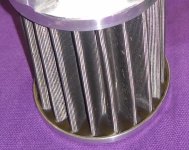
I initially believed the hype and thought it was laser drilled. However, examination with my iPhone camera in macro mode, I could see that it was a woven material.
 
Subjective?!?!?!?
I will need to look up the meaning of that word to make sure it has not changed since I learned the meaning of that word.
Don't bother -- I took a grammatically poor short cut. I should have said - "The Value/Worth/Beauty of a tailwheel -vs- a nose dragger is mostly subjective."
 
For those who have looked at the filter test results and compared those results to their oil test results (e.g. Blackstone, Aviation lab, et al.) and drawn the conclusion that the Challenger/S15 is "good enough" and/or continued their use
With the challenger filter it seems to me that the oil analysis is going to be more reflective of the engine health rather than health of the filter itself. This could be a side benefit of "inferior" filtering. Just trying to look at the bright side :)
 
I wish that stainless steel filter media could layer and be reduced in openings size to exactly mimic paper or synthetic filter media. I also wish its O ring/seal was twice as beefy.

It would flow the same, filter almost the same, not show the extra 2-3 psi mine showed before going back to Wix after 25 hours. I was an early adopter.

It opened and cleaned so darn easily. It inspected about as easily with way less work/effort/mess/bandaids.

It just didn't filter the normal amount of carbons and those are too large in microns for me to accept.

I think the most important test has not been reported from the field- has anyone caught early signs of originating cam/lifter wear metals in one yet? Was it in the media or on the magnet or both?

We "know" the old OEM pressure screens and 25 hour intervals were good enough for TBO and 50 hours and paper media filters were both "better" and trapped metals indicating early failure at inspection.
 
Last edited:
Has anyone here looked at their Challenger or K&P element, and thought it was "aluminum perforated by a laser"?
That was only one detail that made it hard to watch. I didn't finish the subject section of the video. The egoistic attitude is very off putting.

- "It's just statistics." regarding the test results was stated more than once. Well, here's some knowledge that is beaten into you early in engineering school and other places I'm sure. If you can't measure something, you can't make it better.

- So these three "experts" know more about the subject testing than ASTM, ASME, ISO, or the companies who make their living providing such analysis?

Before anyone thinks I'm in disagreement because they're A&Ps versus something else, I'm not. I've known many techs, mechanics, A&Ps etc. who've made me a lot smarter; many whose opinions I'd trust over others who have multiple, advanced degrees. Success and failure is all about people, and I just watched three people talk out of their butts and collectively step on their d!_#s. It was the epitome of dangerous employees, not knowing what they don't know.
 
I find it interesting that we have a few members that insist our choices are wrong despite the evidence that those choices are being made consciously. This is akin to telling a taildragger that their choice is wrong despite the fact that he made that choice totally aware of the extra insurance that they may need to pay.
But taildraggers ARE wrong. It's just simple fact. That silly thing is always trying to swap ends on you, even the airplane knows something is wrong.
 
Last edited:
That was only one detail that made it hard to watch. I didn't finish the subject section of the video. The egoistic attitude is very off putting.

- "It's just statistics." regarding the test results was stated more than once. Well, here's some knowledge that is beaten into you early in engineering school and other places I'm sure. If you can't measure something, you can't make it better.

- So these three "experts" know more about the subject testing than ASTM, ASME, ISO, or the companies who make their living providing such analysis?…

They stated authoritatively that the test was “selected” to favor the paper filters. OK. So what type of test SHOULD have been run?

…because the test that demonstrated the ability to remove $#it from the oil showed definitively that the cellulose filters vastly out performed the screens. What other metric should we be looking for, Mr. Bush?
 
If someone was so inclined, they could write into the show at [email protected] to rebut what was said. It wouldn't be the first time they caught flack for something they said on the show. There's been several times where they've revisited the discussion based on feedback.
 
I initially believed the hype and thought it was laser drilled. However, examination with my iPhone camera in macro mode, I could see that it was a woven material.

Exactly. Hard to imagine how an A&P could actually examine an element for trash and hold firm to a "laser perforated aluminum" belief.

ScreenHunter_2605 Jan. 15 12.14.jpg

Where does the laser claim come from anyway? I don't recall reading it on anyone's website.

For those who may harbor doubts, the sieve screen industry calls this Plain Dutch Weave, one of many available patterns. Note the larger diameter of the wires running across your screen. It makes Dutch Weave more robust than plain weaves. It also drives the characteristic appearance, as the small diameter over-under wires are forced to bend around the relatively large wire.

cropped.jpg
 
Exactly. Hard to imagine how an A&P could actually examine an element for trash and hold firm to a "laser perforated aluminum" belief.

View attachment 78587

Where does the laser claim come from anyway? I don't recall reading it on anyone's website.

For those who may harbor doubts, the sieve screen industry calls this Plain Dutch Weave, one of many available patterns. Note the larger diameter of the wires running across your screen. It makes Dutch Weave more robust than plain weaves. It also drives the characteristic appearance, as the small diameter over-under wires are forced to bend around the relatively large wire.

View attachment 78589
Maybe here -- https://www.fxrdivision.com/fxr-oil...reusable-spin-on-oil-filter-black-or-polished

"Made from laser cut, medical grade, 304 stainless steel micronic filter cloth"
 
Seems like another business opportunity for someone to take the 1 micron mesh, and make a better filter.
Not 1, more like 16. About a 15 psid bypass spring, fully open by 20psid

Whatever has enough filtering to not increase the flow vs paper filters or show up as increased oil pressure indications.

Should be a good inch taller, if not more.
 
I've kept up with this thread. I'm no expert. I started using car filters when I converted my '67 Citabria to a Casper spin-on adapter. The maker recommended the K&N HP1002. I was a little skeptical about the small size. I have gone through at least 20 using Aeroshell W100plus 50 hr change interval and Blackstone oil analysis. The engines started out AEIO-320 then O-320 and now IO-360. Every one cut and closely inspected. In this case size doesn't matter. Technology has marched on except in the aircraft industry. Y'all (this is Texas) might notice that car oil filters have gotten much smaller. The filter on my 465 hp Corvette uses a filter the size of the K&N HP`1002 (AC Delco PF64). The supercharged 650 hp version uses the same one. I would be willing to bet either engine flows more oil. The old oil filters back in the 60s used to be the size of Champions, too. I am now using the Wix 51348XP on my Licon IO-360-EXP with no safety wire.
'
 
They stated authoritatively that the test was “selected” to favor the paper filters. OK. So what type of test SHOULD have been run?

…because the test that demonstrated the ability to remove $#it from the oil showed definitively that the cellulose filters vastly out performed the screens. What other metric should we be looking for, Mr. Bush?

Show me ONE, just ONE, certificated, Wix, whatever, in-service filter that has accumulated anything in the sub-40 micron range. This would appear in the filter as a paste.

Double dog dare you any of you guys.

I cut open ~60 filters annually for inspections and have never seen this. EVER!

Ironically I only see a small amount of black ferrous paste around the circumference of the magnet in Challenger filters.
 
The filter on my 465 hp Corvette uses a filter the size of the K&N HP`1002 (AC Delco PF64). The supercharged 650 hp version uses the same one. I would be willing to bet either engine flows more oil.
I use the same filter on my Corvette and actually used one on my 540 for an oil change. Then I remembered that my Corvette uses 5W30 oil which is like water compared to even the 20/50 aviation oil and I chickened out and went back to the 1068 NAPA. Interestingly, those tiny LS style filters have a fairly low burst pressure. I would have thought the smaller surface area of the can (vessel) would increase the rating. Not according to the Wix specs.
 
Show me ONE, just ONE, certificated, Wix, whatever, in-service filter that has accumulated anything in the sub-40 micron range. This would appear in the filter as a paste.

Double dog dare you any of you guys.

I cut open ~60 filters annually for inspections and have never seen this. EVER!

Ironically I only see a small amount of black ferrous paste around the circumference of the magnet in Challenger filters.

I agree with you. I too am skeptical that the results that Dan has paraphrased represent any real-world scenario; the test is by design a HALT-type test and isn't intended to replicate real world usage. Moreover, although the "bubble point" test is poo-poo'ed, actual test labs such as Ascent Filtration Testing (among others) actually do run them in addition to other tests as they do provide some value (according to them - call them and they'll explain it). What would the lab that Dan used have to say? We don't know and can't find out, since they want to remain anonymous.

What I do trust is the particle count analysis I've got from Blackstone for a couple OCIs with different filters. This is separate from the the spectrographic analysis and an extra charge option. For my flying and my engine, there just isn't a lot of difference between any of the filters I've tried in that (or in the regular "insoluable % " included in the baseline oil analysis they do) . If your style of flying includes lots of flying in very dusty areas with no air filter (or if you're pre-disposed to pouring a few ounces of sand down the filler neck during your preflight), that's different than mine and YMMV.
 
For those who have looked at the filter test results and compared those results to their oil test results (e.g. Blackstone, Aviation lab, et al.) and drawn the conclusion that the Challenger/S15 is "good enough" and/or continued their use, I think you just figured out that witches are made of wood, and so are ducks...

;)

So, do you recommend oil changes at 25 hours, or is every 50 good enough? After all, Rhonda @ Barrett recommends a 25hr OCI. But why not 10 hours instead - after all, the oil has demonstrably less stuff in it as the change intervals get shorter. I'd contend that if you're not changing the oil after every flight and you believe every 25 or 50 hours is "good enough", then you've also decided that witches are made of wood and so are ducks...

;)
 
So, do you recommend oil changes at 25 hours, or is every 50 good enough? After all, Rhonda @ Barrett recommends a 25hr OCI. But why not 10 hours instead - after all, the oil has demonstrably less stuff in it as the change intervals get shorter. I'd contend that if you're not changing the oil after every flight and you believe every 25 or 50 hours is "good enough", then you've also decided that witches are made of wood and so are ducks...

;)
I change the oil & filter @25 hours. This is a habit that goes back 30+ years; I started doing it on the first airplane I owned. And, like postulating my ex-wife was made from wood, I assumed this short duration would be better. Was it? I dunno...but the ex-wife was definitely....made from wood.

:ROFLMAO:
 
I saw no "paste" in the mesh. Magnets are cool indicators, like a mini kidney loop.

I do see more non magnetic dirt/carbon"paste" caught in paper media. The 60 filter a year cutters, if you can filter any bias- is my one off sample tracking?
 
Last edited:
So, do you recommend oil changes at 25 hours, or is every 50 good enough? After all, Rhonda @ Barrett recommends a 25hr OCI. But why not 10 hours instead - after all, the oil has demonstrably less stuff in it as the change intervals get shorter. I'd contend that if you're not changing the oil after every flight and you believe every 25 or 50 hours is "good enough", then you've also decided that witches are made of wood and so are ducks...

;)
The stuff that makes the oil black is lead that is not affected by the filter.
 
Back
Top