Van's Air Force

The definitive Van's Aircraft support community! Buying, building or flying an RV? Join our exclusive family of mentors and enthusiasts!

VPX or Circuit Breakers or Fuses?

Mich48041

Well Known Member
The thread "VPX Issues That No One Can Solve" is going off topic. So I created this thread to "discuss" your preference for circuit protection. My preference is fuses. They are inexpensive, light weight, and never fail to open with excessive current. Vans Aircraft elected to install fuses in the RV-12. Over 800 RV-12s are flying with fuses.
I purchased one circuit breaker with the intention of installing it my RV-12. Admittedly it was not aviation quality. I had purchased it from Mouser or Digikey, can't remember which one. Before installing it, I tested it on the work bench by connecting its terminals to a 12 volt battery. Instead of tripping, it literally smoked without tripping off. I never did install a circuit breaker in my plane. Circuit breakers are mechanical devices that can fail to open. Of course fuses can fail by opening without apparent reason. But it is extremely unlikely that a fuse would fail to open with overcurrent.
There are certain situations where a circuit breaker is desirable: overvoltage protection circuit or landing gear hydraulic pump, etc. But in most cases the pilot is better off waiting until safely on the ground before resetting a circuit breaker or replacing a blown fuse.
An airliner crashed in Florida while the pilots were preoccupied with malfunctioning indicator light.
What is your choice for overcurrent and short circuit protection and why?
 
I choose a vpx pro and associated pps for the solid state design. I like gadgets and the ability to customize and monitor more. My design has G5 and ibbs backup for the g3x, and did follow ibbs recommendations for bank selection on the vpx. My emags do have their own breakers and wire/terminals ran from the pps power post. So my level of redundancy vs risk is managed for my expectations.
 
For critical stuff I went with breakers.

My avionics guru suggested that it would be desirable to have the ability to reboot individual boxes in flight without having power down everything. There's also some other stuff that you need to make 100% certain has no power to it for certain maintenance functions. Starter circuit hot during engine work comes to mind. Another example is that P-mags say they aren't to have power on when the ship is on an external power supply. An easy way to ensure that I don't have an oopsie is to just pull the breakers.

I have no experience with VPX. I've flown behind breakers for 4 decades now and they just work. Plus if one tanks, I can get a replacement pretty much anywhere. I felt like the VPX system was sort of trying to re-invent the wheel, but people that have them seem to like them.
 
We have a VPX Pro in our current RV-10 and we did have to have it fixed under warranty once or twice now. They have been helpful. For somebody like me who likes to dig into details it is neat to see power consumption in flight.

On my new RV-10 I'm doing dual electrical busses so VPX wasn't really an option (I didn't like the idea of having VPX on only half of my electrical system). But even if I was doing a single bus I probably would not have gone with the VPX. I don't like the idea that it is a single point of failure. I can work around that with an essential bus in flight, but I don't want to have my plane stuck somewhere waiting on a VPX repair or replacement.

So my new RV-10 will have 5 push/pull breakers and one fuse box per bus. The breakers are for anything that I might want to power off or reboot in flight. The fuses are for everything else. I'm using mini-ATC fuses that light up when they blow. Although it's theoretically possible for me to access those fuses in flight, the design is to only access them on the ground.
 
What is your choice for overcurrent and short circuit protection and why?

Are you looking for opinions or good engineering requirements?

If you are looking for opinions, you will hear plenty. Some might even be compelling at first blush. If you are looking for a robust system from an engineering standpoint, then you need to do your homework and define your mission, then decompose the top level requirements into component level specifications. The truth will then set you free.
 
My first build I used fuses (RV-8A) because that seemed to be the favorite at the time. The fuses lasted up to the first major panel redo, At that point fuses proved to be too cumbersome. They were replaced with breakers.

I studied the VPX offerings over the years and found that to design around this single point failure risk required various backup system that bypassed the VPX. For my power distribution design this translated to the only option to use the VPX was to use two of them, each feeding half the panel. Obviously a poor option.

The most reliable part of your electrial system are the batteries. The issue if making sure you can get power from the batteries to where you need it, even if something fails.

Side note - a careful two identical ship battery design, feeding your panel on the battery side of the master solenoids, provides for backup modes of operation and elimination of the plethora of backup batteries.

Carl
 
May as well rephrase the questions as....

1. Do you like toys and gadgets?

2. Do you like dead simple?

3. Do you like traditional?
 
For critical stuff I went with breakers.

My avionics guru suggested that it would be desirable to have the ability to reboot individual boxes in flight without having power down everything.

Coming down the glideslope to minimums is not the time or place to be rebooting misbehaving boxes.

Honestly I can't recall a fuse blowing on any airplane I have.

Some people like to spend on gee-whiz stuff that solves non-existent problems. Which ends up creating other problems in terms of cost, obsolescence, supportability, complexity, and knowledge.

Fuses for me. Breakers when it makes sense.
 
Can you share where you found this? I thought id poured over the docs well, but maybe I missed something.
It was from a email from Robert Newman with tcw. He stated that the ibbs sense and pass through power and devices should be on the same bank, such that a bank fault would switch over to the ibbs correctly. If they are not timing issues can result.
 
What is your choice for overcurrent and short circuit protection and why?

I am an engineer. Every systems decision is rooted in failure analysis. I don't screw with fancy or cool, adding complexity must be justified and failure points understood.

Here is what I did:

Two completely separate electrical systems. One with a larger alternator and battery, and one with a small alternator and battery. Critical avionics have multiple inputs (diode or'd) and have a leg on each bus. There are no buss ties, no emergency switches, no limp home procedures.

Startup sequence validates the system and switches are in order. Master on, aux master on (at this point critical avionics boot so I can see things run on battery and check oil pressure on startup), ign 1 on, ign 2 on, start, aux alternator on (now I can see my master caution clear due to float voltage), then avionics master on (which causes my avionics to swing to the main bus because it's a volt higher), then ignition cutouts to test plugs. While taxing, I'll turn off ign 1 and ign 2 and watch it run on the secondary bus for a few minutes.

As for fuses and breakers, breakers for things I may want to reset in flight like alternators or ignition, fuses for everything else. This way the troubleshooting steps have been decided for me. If a breaker pops, perhaps play with it, fuse blows, land when able.

If I have a main bus short to ground, critical systems continue, I get a master warning, and I land as soon as possible. There are no switches to flip and I get warning lights and CAS messages explaining the fault.

That's what I did, now for the list of things I won't do:

No electronics bolted to the engine.
No critical systems using crappy connectors. It's crimped and pinned, or no thanks.
No microcontrollers powering critical systems unless there are backups, and that those backups are automatic.
No complexity that isn't obvious. For example, the screen dying is obvious in that it's almost certainly the screen or a fuse.
Transition training to my airplane from a systems perspective must be direct and simple. Absolutely no hidden magic behind an emergency switch only I understand.
Backups need to be validated before every flight.
No fail over with operational differences from normal ops such as backup power requiring 600-800 rpm to work.
No plane power alternators.
 
Last edited:
Don't eliminate the Dynon/AFS Advanced Control Panel. You may be able to find a used one with fuses, or the new ones have electronic circuit protection.
 
I purchased one circuit breaker with the intention of installing it my RV-12. Admittedly it was not aviation quality. I had purchased it from Mouser or Digikey, can't remember which one. Before installing it, I tested it on the work bench by connecting its terminals to a 12 volt battery. Instead of tripping, it literally smoked without tripping off. I never did install a circuit breaker in my plane.
I’ll try to refrain from the never-ending-debate part of this thread, but this anecdote made me chuckle. When I was nineteen and bought my first truck, I wanted to install a bunch of driving lights and needed a control panel. Of course, I wanted it much fancier than it needed to be so I bought a handful of cool-looking circuit breakers for a local surplus store. I wanted to see one open, so I did the same thing - connected it directly across the battery with no load. Big flash and noise - never did find where al the pieces went! My first lesson in Ohms Law - I needed some load, otherwise I was just pumping a HUGE amount of current through the tiny little breaker.

Such is how we learn….. 😉

(OK - one comment - I like breakers with digital electronics o that I can reboot easily because I don’t put switches on things like EFIS’s. Those are “part of the airframe” - I have no instruments without them, so if they don’t power up, I don’t proceed with engine start. I test a lot of pre-production stuff and frequently need reboots - even in flight - so I like breakers for that reason.)
 
as an electrical engineer, it comes down to one point. as cool as the VPX is, do you want to put all your eggs in one basket that is full of single point supplied parts, and one manufacturer to support it? when, and not if, the VPX or its parts become un-obtainiable, you are looking at a total rewire to get back in the air. breakers or fuses, your choice, will win that debate every day.
 
I would argue that if you have an electrically dependent ignition or FI system, you should have no problem with a VPX as far as risk tolerance goes. I can fly without a panel. Can't fly without an engine.
 
as an electrical engineer, it comes down to one point. as cool as the VPX is, do you want to put all your eggs in one basket that is full of single point supplied parts, and one manufacturer to support it? when, and not if, the VPX or its parts become un-obtainiable, you are looking at a total rewire to get back in the air. breakers or fuses, your choice, will win that debate every day.
Seems a similar debate could be made about any hardware we purchase. One just needs to understand the risk and have a strategy. I have one for my VPX's and I'm very comfortable with it. Fail to plan, plan to fail. Any yes lots of engineers use VPX who understand this. My VPX's have given me many years of trouble-free hours. (Over 800) At one time the leading panel builder for experimentals told me the majority of the panels he builds were using VPX. That might have changed with the GAD 27 coming out as it's taken a few features needed that the VPX provided that the GAD 27 now does. If you are not comfortable using VPX or don't want to take the time to understand it, fine, don't use it. For critical circuits I use breakers and not the VPX but that was my decision. Every airframe has single points of failure. Just need to have a plan and training when one of these occurs.
 
Last edited:
Coming down the glideslope to minimums is not the time or place to be rebooting misbehaving boxes.
I never said it was. yet the fact remains that sooner or later you're going to have a magic box lock up, and if you need to reboot it I'd rather have the option of cycling the breaker vs the entire panel.
 
As a registered professional electrical engineer with decades of experience in process plant power systems and instrumentation/control systems, I am not a fan of the all-in-one power system "black box". These may work fine initially, but as they age they can become difficult to support or find repairs due to obsolescence of components. I prefer simple, well proven, easy to trouble shoot designs. So circuit breakers or fuses.

For my RV-10, I decided on using all aviation style breakers, with each breaker feeding a single load/device. This meant a lot of breakers, but it does minimize the impact of a single circuit/breaker failure. And I wanted to be able to isolate individual circuits/devices easily for trouble shooting, which is much easier with breakers than fuses. I have also needed to occasionally re-boot a device such as the ADAHRS while on the ground when there was too much motion on G3X boot up causing a calibration failure. But I have never tried to reboot anything during flight. I do have the autopilot and trim breakers well marked so I can quickly pull them during flight in the event of a problem or run-away. But I wouldn't reset the breaker once I opened it until back on the ground.

If I needed to save money or space, I would probably have used fuses instead of breakers, with the fuse panel located for easy access when on the ground, while still using a few breakers for critical items such as autopilot and trim power.

I have also realized that with the IBBS backup and dual feeds to most of the Garmin LRUs, that it can actually be difficult to reboot an LRU once everything is powered up. Simply pulling the breaker for the device doesn't interrupt power to it as it simply draws from the IBBS through the second power input. So you need to think through any reboot plan to account for all the automatic power backups you installed. However, this does give me some confidence that my instrumentation won't go dark due to a single failure in the power system. <grin>

But this is Experimental Aircraft - You can design it as you wish.
 
Last edited:
Several folks have mentioned reboots. Is there really much of that going on?
 
We liked the VPX panel and wiring simplicity, the configurability, and the visibility into amps, circuits etc. 140 hours in and flawless thus far. Ignition is on a pair of breakers, and there is a fuse block for silly stuff like USB charger and cabin lights.
 
Last edited:
I would argue that if you have an electrically dependent ignition or FI system, you should have no problem with a VPX as far as risk tolerance goes. I can fly without a panel. Can't fly without an engine.

I'll argue that point.

I have two ignition systems, each with their own crank position trigger, and each ignition system has a leg on the main bus through its own switch and breaker and a leg on the aux bus with a fuse between each of them and the battery. If the main bus fails, the ignition systems revert to the aux bus. This fail over is tested during taxi.

How would you build a VPX system with the same level of redundancy? Two VPX units? Two switches for each system? How would the two units be sync'd to make sure they are configured the same way? How would you test the fail over at preflight?

If you want to argue that the EI system I'm running isn't as reliable as a mag, I'd entertain that point, but we are back to risk:benefit analysis. I think that having less timing at idle for smoother running and better starts with fuel injection as well as a little more timing at LOP is worth the risk given the redundancy explained above. Also, I can get plugs, wires, coils at NAPA in a pinch.

If it gives me problems, I have mags to put in, and it wouldn't take me that long to install them.
 
BTW for those that call the VPX a single point of failure, be aware that the Pro model is actually two devices in one chassis. There is a bit of commonality between the 'sides', but not much.
 
Well, it is certainly going as expected!

You see, the BEST system is the one that the individual asked decided to use...

Here is my data point:

RV-10 with EFII.
Dual split bus with crosstie.
Two batteries
Two alternators
VPX for everything but the engine; IBBS for PFD backup, G5 for emergency backup
Engine bus fed through two diode bridges, direct wired (through a contactor set) to the batteries. Circuit breakers used here.
 
BTW for those that call the VPX a single point of failure, be aware that the Pro model is actually two devices in one chassis. There is a bit of commonality between the 'sides', but not much.

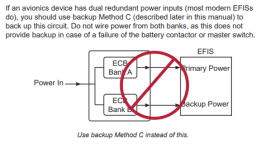
Fair enough, but I don't understand why the manual tells you to not use both sides to power each input of diode or'd avionics:

1763248493302.png

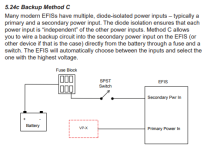
Instead they want you to do this:

1763248540193.png

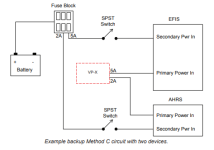
or this:

1763248553409.png

Which means that you would really need two switches for every device, one to tell the VPX what to do, and another to power the secondary input along with the fuse.

I wonder why this is.... I would have expected the first option to work given the claim that the banks are discrete from each other.

Anyway, this violates my design standards because normal ops and failure ops require a different switch configuration, and the pilot would have to recognize what is going on and that some switches remain off unless the VPX fails.

If you could wire it like the first drawing then perhaps there is enough redundancy for my liking, but even then I'd need operational advantages that warrant the additional complexity.
 
The description is pretty indicative. You want your EFIS to have a real backup of some kind in case of a total electrical failure such as the master contactor or the battery. Most people use an IBBS on the second power pole of the EFIS.
 
Several folks have mentioned reboots. Is there really much of that going on?
In my special case - yes….but that's because I am always testing things - AoA’s, HUD’s, standby (standalone) AHRS’s that sometimes lock up and don’t play well with other things - so you have to power cycle them to re-establish communications. Development test flying - not normal operations with well-understood production equipment. On the ground, I will use breakers when powering just one or two boxes to do software or database loads. But you don’t (generally) do that stuff in flight of course!

(We had breakers on the “heavy glider” for the same reason - a single breaker rather than a “breaker and a switch” was lighter, and the 1970’s-era digital stuff sometimes needed to be power cycled to re-established comm. The frustrating part was that main computers were fused to the main busses, so you couldn’t completely power cycle them without wire cutters…..)
 
The description is pretty indicative. You want your EFIS to have a real backup of some kind in case of a total electrical failure such as the master contactor or the battery. Most people use an IBBS on the second power pole of the EFIS.

That makes sense, there are two banks, but only one power input.... so you really want something totally different feeding the second power input.

If people are using the IBBS on the second power pole, doesn't that largely negate the point of the VPX in that you no longer see the current flow, since there are two paths?
 
so I did the same thing - connected it directly across the battery with no load. Big flash and noise - never did find where al the pieces went! My first lesson in Ohms Law - I needed some load, otherwise I was just pumping a HUGE amount of current through the tiny little breaker.
I knew that a circuit breaker connected directly across a 12 volt battery would draw a lot of current. But I would expect the circuit breaker to pop, not smoke. One of reasons for having a circuit breaker is to protect against short circuits. What if an aircraft wire vibrates against sharp metal and shorts out? I think a fuse would open quicker with less smoke.
Paul, your story about pieces flying everywhere reminded me of when I was young and connected an AC coil to DC. Even though the DC voltage was less, the current was much greater with DC than with AC. :)
 
I will not put all my eggs in one basket, especially if that basket is an electronic system.
You don't need to, spend some time understanding the "electronic system" and don't place what you are not comfortable into the "one basket". Have the best of both worlds as the saying goes......
 
VPX Pro/PPS, for back up I have the back up batteries for my dual Dynon screens. So far, the only problems I've ever seen documented with Vertical Power products have been either install error, or very rarely a defective unit replaced by the manufacturer.

Has anyone even heard of an inflight failure that could have caused and emergent situation?
 
You don't need to, spend some time understanding the "electronic system" and don't place what you are not comfortable into the "one basket". Have the best of both worlds as the saying goes......
Wouldn't that just defeat the purpose and make things even more complicated.
Here is another reason that makes VPX not a right choice for me. Over the years we all have seen companies come and go, the original VPX was one of them, Trutrak another . If they are no longer in business, this will put my entire electronic system at risk. I am a fan of CB, they don't need a software to work.
 
Wouldn't that just defeat the purpose and make things even more complicated.
Here is another reason that makes VPX not a right choice for me. Over the years we all have seen companies come and go, the original VPX was one of them, Trutrak another . If they are no longer in business, this will put my entire electronic system at risk. I am a fan of CB, they don't need a software to work.
…and that is fine, and it is ultimately your decision.

That doesn’t mean it is the right decision for anyone else…
 
Sorta like the primer wars. I've used VPX Pro on two airplanes (one with PPS). Trouble free. The only time I've ever had to reset any of my equipment is when I forget my flap switch on a t&g (on the throttle, momentary-down; on-up). I go into the vpx page on my efis and reset. On the other hand...I was an early adopter of the VP200 system. When it went tango uniform after being orphaned, rewiring was ordained. I do have some circuits on fuses, but have never had one blow. Think you can probably do whatever you choose and be fine.
 
Several folks have mentioned reboots. Is there really much of that going on?
My g3x mysteriously rebooted itself twice. Never found a cause. NO pilot intervention required. I have had my grt fail to boot up properly and needed to force it to reboot. Startup issue only. Have had several instances where my alt fld breaker tripped (both for ov and over current) and was able to nurse it home by repeatedly resetting the breaker. Have had to reboot my adsb in devices a few times.

Possibly I am just unlucky.
 
I’m really excited to get my Advance Panel with ACU installed. As a retrofit, it solves a lot of “problems” in regard to wiring and integration.
Both screens can be autonomous, have battery back up, each, and only share the ADHS which I’ve backed up with an integrated AV/30, which also has its own integral battery. It syncs to, and for, the AFS screens but you could fly the airplane with the AV/30 alone, on its integral battery.
The simplicity of network integration and wiring was a huge selling point for me.
I did not opt for any high power switching as all of that stuff is wired and there already.
After multiple upgrades over the years, EFIS change out, new power distribution system, etc…. it was time to clean things up. The ACU accomplishes that and adds capabilities you can’t get with discrete systems. (The want or need is arguable, but I don’t care).
I wanted something new, interesting, and compelling. I didn’t want to relive the terminal strip ring terminal ground hog day again. Been there, done that, soooo…...boring! (which is not a bad thing in aviation).
The airplane will be VFR/Night, as it has always been. I may have made a different decision for an IFR machine, who knows.
I hangared next to Rob and Jenny with Advance well before Advance was even a thing. Watched them grow their company, family, and enjoy its success. I have lots of family in their home town. There is trust there. I don’t know anybody that owns a fuse or breaker company ;)
I won’t enter the argument as to what’s best for you or why. It was the right choice for me. Just prepping for the install has been a blast with some fun challenges digging back into my 20 year old 6.
This upgrade has re-energized my interest and enthusiasm, and that is invaluable.
 
I find it interesting that the vpx defenders all say that the vpx is reliable and trustworthy, yet feed their ignition or efi with breakers or fuses instead of the vpx. Possibly everyone DOES understand the reliability differences.
 
I find it interesting that the vpx defenders all say that the vpx is reliable and trustworthy, yet feed their ignition or efi with breakers or fuses instead of the vpx. Possibly everyone DOES understand the reliability differences.
the number of available high power circuits can also be a contributing factor to splitting off some circuits from the VPX. Also system design. With my dual bus system, I would have needed two vpx’s.
 
the number of available high power circuits can also be a contributing factor to splitting off some circuits from the VPX. Also system design. With my dual bus system, I would have needed two vpx’s.
And at least on Garmin you can only manage one VPX through the flight displays.
 
Side note - a careful two identical ship battery design, feeding your panel on the battery side of the master solenoids, provides for backup modes of operation and elimination of the plethora of backup batteries.
One caveat: IF your avionics bus has a feeder fuse, that sucker can blow, and at that point the backup battery attached to the back of your G5 or whatever turns out to be useful.
 
I find it interesting that the vpx defenders all say that the vpx is reliable and trustworthy, yet feed their ignition or efi with breakers or fuses instead of the vpx. Possibly everyone DOES understand the reliability differences.
In our case, no. We chose breakers for the ignition to avoid any noise getting into the rest of the system (and maybe a fully unnecessary choice TBH). Having said that, I believe any honest builder will fully admit that a simple circuit breaker is more reliable than a VPX. So in this case it makes sense from two perspectives. Is the added risk of running avionics off a VPX worth the overall advantages? Yep IMO.
 
If people are using the IBBS on the second power pole, doesn't that largely negate the point of the VPX in that you no longer see the current flow, since there are two paths?

Garmin avionics (and probably others) will choose one power pole over the other based on input voltage. The main bus will be around 14v when the alternator is alive, so that will supply power over the IBBS.
 
Last edited:
In our case, no. We chose breakers for the ignition to avoid any noise getting into the rest of the system (and maybe a fully unnecessary choice TBH). Having said that, I believe any honest builder will fully admit that a simple circuit breaker is more reliable than a VPX. So in this case it makes sense from two perspectives. Is the added risk of running avionics off a VPX worth the overall advantages? Yep IMO.
Good points. To be clear, I am not knocking anyone for taking those risks and can see why they would do it. I have an engine with dual EI, so I also take risks. I was just responding to what felt like justification that VPX and CBs were equal in fault risk. Probably a misread from folks expressing in short posts.
 
The thread "VPX Issues That No One Can Solve" is going off topic. So I created this thread to "discuss" your preference for circuit protection. My preference is fuses. They are inexpensive, light weight, and never fail to open with excessive current. Vans Aircraft elected to install fuses in the RV-12. Over 800 RV-12s are flying with fuses.
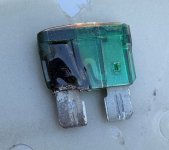
Here is a fuse from my inexpensive, light weight, dead simple fuse panel in my RV-12. You should see what the heat did to the circuit board. It melted the solder and burned the board. I replaced the damaged board with a VP-X. Once I did lots of gremlins and weird readings went away.
Pick your technology and the failure modes that go along with it. Sometimes issues aren't as simple as they seem at first, as is true in life.

IMG_5631.jpg
 
Last edited:
One caveat: IF your avionics bus has a feeder fuse, that sucker can blow, and at that point the backup battery attached to the back of your G5 or whatever turns out to be useful.
Yep - good that you noticed. My design has two avionic busses (half the panel on one, the other half on the other), each feed from a separate battery via a breaker at the battery. Each bus can be powered from either battery mitigating the risk you describe.

Carl
 
Back
Top