Van's Air Force

The definitive Van's Aircraft support community! Buying, building or flying an RV? Join our exclusive family of mentors and enthusiasts!

VPX or Circuit Breakers or Fuses?

Lots of travel in an RV and lots of IFR and night flying, faster airplanes, family on board, edge complex system, backups, dual electrical systems, etc.

RV12 is a mostly VFR flyer, slower landings, Rotax, edge simple avionics.

SuperCub or perhaps RV-15 mostly VFR, big tires, lots of landing options, really slow landings, edge simplest avionics.

Vertical Power is a nice system, it's reliable and easy, it's just a risk assessment vs your mission, anything can go wrong with anything ... and too much complexity is just as bad as not enough.

Heck, even if your VPX is 100% reliable guaranteed something connected to it is not.

My $0.02.
 
AFS ACM. VFR airplane.
B&C alternator
P-mags
Mags are on a buss off the Master Solenoid. Breakers for the mags.
Stall horn also on the buss.
Two ram mounts for backup cell and tablet.
If the panel goes black, hopefully the two backups will get me down.
 
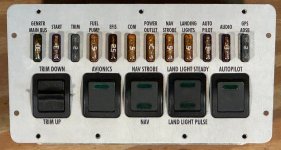
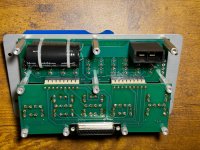
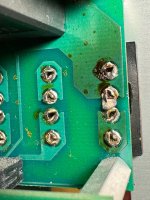
Here is a fuse from my inexpensive, light weight, dead simple fuse panel in my RV-12. You should see what the heat did to the circuit board. It melted the solder and burned the board. I replaced the damaged board with a VP-X. Once I did lots of gremlins and weird readings went away.
Pick your technology and the failure modes that go along with it. Sometimes issues aren't as simple as they seem at first, as is true in life.

View attachment 102239

That was a fuse panel failure, not a fuse failure. Put another way, the fuse didn't harm your fuse panel. The fuse can't generate heat. Got pictures of that panel?
 
One caveat: IF your avionics bus has a feeder fuse, that sucker can blow, and at that point the backup battery attached to the back of your G5 or whatever turns out to be useful.
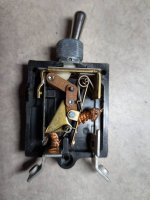
Two weeks ago my avionics master switch failed internally. Caca pasa. What ever system you have, battery backup is pretty nice to have.
switch.jpg
 
Here is a fuse from my inexpensive, light weight, dead simple fuse panel in my RV-12. You should see what the heat did to the circuit board. It melted the solder and burned the board. I replaced the damaged board with a VP-X. Once I did lots of gremlins and weird readings went away.
Pick your technology and the failure modes that go along with it. Sometimes issues aren't as simple as they seem at first, as is true in life.

View attachment 102239
Yikes!
 
That was a fuse panel failure, not a fuse failure. Put another way, the fuse didn't harm your fuse panel. The fuse can't generate heat. Got pictures of that panel?
A distinction without a difference. Let's call it a fuse system failure then. The fuse and the fuse panel are components of the fuse system. My VP-X system has been more reliable than my fuse system.
 
A distinction without a difference. Let's call it a fuse system failure then. The fuse and the fuse panel are components of the fuse system. My VP-X system has been more reliable than my fuse system.
Which fuse block? Those are not all created equal.

I like the bussmann stuff Stein carries or the blue sea systems stuff. I've found them to grip the fuse tightly and work well.

Perhaps I should scan my wiring with a thermal imager every annual, that would find any issues like this....
 
A distinction without a difference. Let's call it a fuse system failure then. The fuse and the fuse panel are components of the fuse system.
You're correct of course, but there is a reason for the failure. I would like more insight, if possible. High resistance, thus heat, but why?
 
Which fuse block? Those are not all created equal.

I like the bussmann stuff Stein carries or the blue sea systems stuff. I've found them to grip the fuse tightly and work well.

Perhaps I should scan my wiring with a thermal imager every annual, that would find any issues like this....
+1

A quality fuse block will use metal buss components to interconnect all of the parts. Using a circuit board as a bus to connect all the lugs sounds like a terrible idea and suspect this was a substandard part. Many otherwise highly reliable components can be made unreliable by using poor quality components or poor design. Most cars have two or three fuse blocks. 100’s of millions of them out there and almost never see something like that.
 
You're correct of course, but there is a reason for the failure. I would like more insight, if possible. High resistance, thus heat, but why?
It looked like increased resistance due to simple corrosion on the fuse tab.
 
No. You can see the two clean scratches in both fuse blades, indicating good contact. Failure was likely in the board trace or a bad solder joint where the fuse holder lug goes through the board. A cold solder joint will give high resistance.
No. It got clean scratches when I pulled it out. There is plenty of corrosion on that fuse blade terminal. As you can see in another post each blade terminal has two soldered lugs. They were not both bad. The fuse terminal is definitely where the heat was generated due to corrosion.
 
And where exactly does this AV-50001 come from? It's not a fuse block in any conventional design sense. It's a soldered component collection which happens to have some fuse locations.

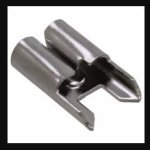
Let's take a serious look at cause. The failed position is the 30 amp main. The terminals look like this, yes?

ScreenHunter_3028 Nov. 17 09.55.jpg

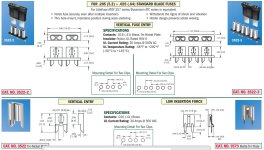
Now look down into the position. Is each terminal on a baseplate (like the 3522-2 below) or are they individual terminals mounted directly on the PCB (bottom)?

ScreenHunter_3030 Nov. 17 09.57.jpg
 
Regardless of Dans good question, some of those solder joints look cold. There is evidence that some of the others are heating up as well, but could just be flux runoff. Regardless, bad soldering led to the heating and failure in my opinion.
Poor workmanship on the circuit board.
 
Regardless of Dans good question, some of those solder joints look cold. There is evidence that some of the others are heating up as well, but could just be flux runoff. Regardless, bad soldering led to the heating and failure in my opinion.
Poor workmanship on the circuit board.
No. It was corrosion.
 
Buying a fuse block? Don't buy one that grips the bottom edge of fuses because the grip is not strong enough. The female terminals should grip each side of the fuse like the one that Dan H pictured in post #69 above. It is a good idea to remove and reinsert fuses once a year during the condition inspection. Doing so will remove any corrosion and will reveal a weak terminal grip.
 
as an electrical engineer, it comes down to one point. as cool as the VPX is, do you want to put all your eggs in one basket that is full of single point supplied parts, and one manufacturer to support it? when, and not if, the VPX or its parts become un-obtainiable, you are looking at a total rewire to get back in the air. breakers or fuses, your choice, will win that debate every day.
I can only speak to my own experience - I've had three VP-X systems, one in a -7A, one in a -12 and one in my current -10. I've had none of the concerns folks mention here. It was easy to install, easy to setup and easy to use. I've had zero "reboots on final" or any other of the potential concerns raised here. However, I have seen failed fuses, circuit breakers that corrode and fault, and switches that failed. The VP-X on the other hand...electronic CB's and switches are multiple orders of magnitude higher in reliability.

Having said that, I did make a "belt and suspenders" essential bus on my -10 with backup power via copper bus bar and CB's for an EFII, fuel pump, COM1 and MFD to go along with my independent A and B busses, alternators and batteries. For even more redundancy, my G5 backup has its own battery. I've built in redundancy, but still have the "gadgets" for convenience.

It's discussions like this that remind me that you can make what you perceive as a fireproof, bullet proof, space-launch ready aircraft, but the ultimate single point of failure is still the pilot.
 
Last edited:
No. It was corrosion.
I disagree. Those holders use a relatively thick metal and mke for a tight grip on the blade. While 95% of the blade can have corrosion, it usually doesn’t migrate to the parts that are in contact with other metal when that connection is tight . Sees this on cars all the time. Lots of corrosion on a terminal, but the contact portion is clean. Like the grd strap connection to the frame. Rust everywhere but unbolt it and the two contact surfaces are nice and shiny
 
I’ve been following this discussion because it’s an interesting subject with some seemingly valid points. I haven’t heard of any primer wars discussions lately - maybe this VPX-CB-fuse war is taking its place. In your evaluation if you’re a builder and trying to decide, I don’t think you can get more simple or direct than what Dan H posted in post # 8. I chose Dan’s option #2 in 4 out of my 6 RV’s - “dead simple”. Fuses are less expensive (big deal for a ‘pilot’), many times easier to build, and they have a long history of reliability. Despite that burned fuse in the previous post, there are literally millions of these driving around on our roads - reliably. A defective fuse block was probably the problem, and I realize that doesn’t matter in this specific case because the “system” failed, but that failure is incredibly unusual. On my first homebuilt airplane (RV6) I installed the Control Vision DC Load Center bus system. It worked very well and the PTC fuses were available for purchase at Mouser for about 50 cents, so I made a couple extension boards to fine tune my system. But as we all know, that system is no longer available, or supported. ATC fuses and aircraft quality circuit breakers have been around for decades, and most likely will be available for a long time into the future.
 
That was a fuse panel failure, not a fuse failure. Put another way, the fuse didn't harm your fuse panel. The fuse can't generate heat. Got pictures of that panel?
I was chatting with an engineer from Blue Sea last week. He happened to mention proper tempering of the copper fuse holding contacts in their fuse box was an example of one of the issues of QC they had to keep a really close eye on.
 
Since my EFII system is electrically dependent to keep the big fan turning, I have six circuit breakers. One for each cpu, one for each fuel pump, one for the injector power and one for the alt fld. All of the rest is on fuses. Inexpensive, simple, reliable, and infinitely supported.
 
I was chatting with an engineer from Blue Sea last week. He happened to mention proper tempering of the copper fuse holding contacts in their fuse box was an example of one of the issues of QC they had to keep a really close eye on.

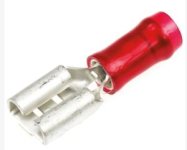
Yep, same as the familiar PIDG spade terminals we all crimp on our wires. Same corrosion behavior too.

ScreenHunter_3031 Nov. 18 12.06.jpg

I disagree. Those holders use a relatively thick metal and make for a tight grip on the blade.

To be fair, I'm sure Bob knows what corrosion looks like. Of course, if corrosion, what caused it? Spade terminations don't corrode without reason.

Something certainly generated heat. At the moment, we don't have enough factual information to blame it on a corroded spade-to-terminal connection, or a failed solder joint at the PCB.
 
Of course, if corrosion, what caused it? Spade terminations don't corrode without reason.

Something certainly generated heat. At the moment, we don't have enough factual information to blame it on a corroded spade-to-terminal connection, or a failed solder joint at the PCB.
Not cleaning the flux off the PCB after soldering will certainly cause corrosion.
 
I think I was one of the first VP customers with the old VP-50. To be perfectly honest, my old RV-7A was the first airplane I built and I sort of understood the electrical architecture and I sort of didn't at the same time and a VP unit seemed like the simplest solution. Just install it, run each component to it. Simple.

I understand things a lot better now so fuses and breakers would be my preference on the second plane I've built, even though that decision was made for me by virtue of building an RV-12iS.

I also didn't like how quickly the VP-50 was orphaned.

There are no future support issues with CBs and fuses.
 
I have also realized that with the IBBS backup and dual feeds to most of the Garmin LRUs, that it can actually be difficult to reboot an LRU once everything is powered up. Simply pulling the breaker for the device doesn't interrupt power to it as it simply draws from the IBBS through the second power input. So you need to think through any reboot plan to account for all the automatic power backups you installed. However, this does give me some confidence that my instrumentation won't go dark due to a single failure in the power system. <grin>
If you follow the TCW instructions (p. 18 in the manual) and include the backup power master switch, turning that switch off will disable the backup battery and allow you to cycle/reboot the LRUs with dual feed.
 
Last edited:
Back
Top