



joer308
David Paule -3B Update
dr

ZachKarpinski
Hello everyone, I’m hoping to get some advice and perspective on my situation. I’ll try to provide as much context as possible so you can see the full picture.
I’m not the builder of my RV, but I bought it after what I thought was a thorough pre-buy. It’s a beautifully built airplane — Oshkosh award-winning at one point, excellent riveting and paint, Garmin-upgraded panel — but since taking delivery it’s been one headache after another. The logs show a full engine overhaul in 2007 at 1790 hours, a teardown inspection in 2020 at 450 hours (new cam and top, cylinders honed), a cylinder replacement later that year at 466 hours, a full top overhaul in 2023 at 530 hours with new Superior Millennium cylinders, and then I purchased it in 2024 at 740 hours. The engine is an O-360-A1A, originally with a SureFly and Slick mag, 3878 carb, Van’s baffling, and a fixed-pitch Sensenich.
Immediately after purchase, I began fighting high CHTs. Even in January, I was seeing 430–450°F in climb and about 430°F in cruise. I climb at 120 KIAS and cruise at around 65% power (24–2600 RPM at 6–11,000 feet), but the temps were still excessive. I went down the checklist: air, fuel, timing. On the cooling side, I RTV’d and sealed everything, re-baffled the upper cowl, added a cowl flap, increased clearance behind #3, built custom air dams for #1 and #2, and more. That got me about a 20°F improvement. On the fuel side, I swapped the 3878 carb for a 4164, increasing takeoff fuel flow from 13–14 GPH to 14–14.5 GPH. This cooled climb temps by another 10–15°F, but it also meant i lost about 50-75RPM due to the more fuel i was throwing at it.
Timing became the next focus after both my mags failed in short succession. First the Slick died, then the SureFly. I replaced both with P-Mags, set them up with EICAD at –1.4 advance shift and max advance 26.6°, jumper out. This was the biggest improvement: climb temps dropped to about 400°F even in summer, and cruise settled around 360–370°F. I could also lean more aggressively, about 9.5 GPH at 50–100 ROP, though LOP is still not possible with the carb due to ~150°F EGT spread. Learned about just how advance the surfly goes and was happy to change it. I also installed a larger oil cooler, which brought oil temps from 215°F down to about 185°F. At this point I was finally somewhat comfortable, but still not thrilled — in climb I’d see 75–100°F CHT spreads until level-off, which I chalked up to carb distribution. In cruise everything tightened up to within 10°F.
Unfortunately, at my very first oil change since purchase (788 hours), the filter came back as a glitterbox — aluminum, not magnetic. A teardown revealed a piston pin rubbing the cylinder wall. The bottom end of the engine looks fine, but my crank is not compatible with a constant-speed prop. If I want to go that direction, I’ll need to exchange it.
Now I’m at a crossroads. I want a reliable engine, balanced CHTs, fuel injection, and a CS prop. The question is how to get there. Do I overhaul this engine despite its history, or bite the bullet and pursue a new one? Lead time on new engines looks to be 11–14 months. Would it make sense to go with a Superior XP-O kit and source a yellow-tag crank to save time? I want to stick with vertical induction to avoid having to get a new cowl unless somebody can convince me otherwise. Should I do a crank exchange and overhaul the rest of mine and purchase an overhauled BA? Anybody else done these upgrades?
As for props, I like the idea of strong climb performance but don’t want to give up top-end cruise. The new Hartzell composite two-blade — essentially the lightweight carbon BA clone — looks appealing except the price. Has anyone here run that setup, and what are your impressions? I plan to stick with standard compression cylinders for longevity, but I want to make sure whatever crank I use is properly matched to the prop I choose. Recommendations?
So those are my questions: Did anything I do possibly contribute to the wrist pin issue? With this engine’s history, would you trust an overhaul or walk away and start fresh? If fresh, which path would you take — new engine, XP-O kit, or something else? And finally, for those running the newer Hartzell composite ba clone, does anybody have a comparison in performance between that and the standard BA?
Thanks in advance for your time and thoughts.
mikelupo
Mine on one of my tanks is leaking like a sieve. I believe it was cracked by over-torquing a NPT hose nipple fitting on there. ...and then proseal was used (like a big booger) to stop the leak. I suppose this was done by the original builder. I changed the fitting from a hose nipple to a proper A/N fitting. ...and had to clean everything up to do so. Now I know why the proseal was there. But I don't want to put it back together that way.
My plan is is to drill out the old one, remove it through the sender hole. Tap threads in the new one. Use screws to mount. Alternatively, I suppose I could use sealed dome pull rivets but I'd rather try the screws first. Screws seal up ok for the sender, rhetorically, why not this?
I would like to buy two of them b/c I'll screw up the first one! They are currently back-ordered on Van's Website.
glenadavis
I recently purchased an RV12 from the estate of the builder. It has the carbureted Rotac 912 engine. I am having a problem with static on the radio during reception. If I'm more than 10 miles from the ATCtransmitter I hear a ticking sound, tick tick tick tick, That as I travel farther away from the transmitting station makes it impossible to understand what is being said. Even at my home airport when I listen to the AWOS, I hear it faintly in the background. Today while in flight I turned off one mag at a time and as I did this the ticking sound became less pronounced. I'm not much of a technician or electronics expert but to me it sounds like spark plug noise. But that's just a guess. My panel consists of a Dynon Skyview HDX and a Garmin SL30. I also have the PS Engineering Audio Panel. Pretty basic panel. This problem makes it difficult for me even to get flight following as the ticking static in the background makes it difficult to hear the controller as I get any distance from his transmitter. Has anyone else experienced this and can offer any suggestions on where to start looking? Thank you.
OFF TOPIC:
Please consider donating yearly to help keep this American 1-person pirate ship afloat:
Get your VansAirForce.net Charity Cap!
Older issues of the ‘VAF News’ can be found at:
THE VAF LIST (a list of RV-related lists)
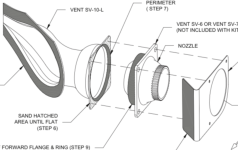
SV-6 Vent fit
I am on page 29-21, Step 11, and fitting the SV-6 vent into the SV-10fresh air vent. The forward face of the SV-10 is perfectly flats, as is the face of the SV-6. It seems as if the diameter of the SV-6 is too large or the inside diameter of the SV-10 is too small? Am I the only one that has...
vansairforce.net
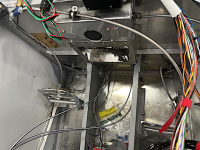
David Paule -3B Update
RV-3B Dave's in Colorado
After removing the RH Pmag and changing some fittings, I managed to eliminate the interference and still have one of the hoses fit. It helped to have a strong shop light oriented carefully, as well as removing some of the LH Pmag’s leads. And I did buy a specialized wrench which proved...
vansairforce.net
dr
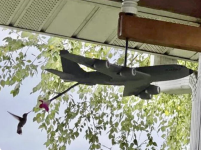
WDYDWYRTW? Sep 6-7, 2025
The spousal unit is doing a thing for her yoga for cancer patients group (www.YogaBridge.org) this weekend at a local spot, and three of her lifelong friends drove/flew into town for it. I offered to go sleep out at the hangar so they could have the house, and do whatever it is women of this...
vansairforce.net
ZachKarpinski
Hello everyone, I’m hoping to get some advice and perspective on my situation. I’ll try to provide as much context as possible so you can see the full picture.
I’m not the builder of my RV, but I bought it after what I thought was a thorough pre-buy. It’s a beautifully built airplane — Oshkosh award-winning at one point, excellent riveting and paint, Garmin-upgraded panel — but since taking delivery it’s been one headache after another. The logs show a full engine overhaul in 2007 at 1790 hours, a teardown inspection in 2020 at 450 hours (new cam and top, cylinders honed), a cylinder replacement later that year at 466 hours, a full top overhaul in 2023 at 530 hours with new Superior Millennium cylinders, and then I purchased it in 2024 at 740 hours. The engine is an O-360-A1A, originally with a SureFly and Slick mag, 3878 carb, Van’s baffling, and a fixed-pitch Sensenich.
Immediately after purchase, I began fighting high CHTs. Even in January, I was seeing 430–450°F in climb and about 430°F in cruise. I climb at 120 KIAS and cruise at around 65% power (24–2600 RPM at 6–11,000 feet), but the temps were still excessive. I went down the checklist: air, fuel, timing. On the cooling side, I RTV’d and sealed everything, re-baffled the upper cowl, added a cowl flap, increased clearance behind #3, built custom air dams for #1 and #2, and more. That got me about a 20°F improvement. On the fuel side, I swapped the 3878 carb for a 4164, increasing takeoff fuel flow from 13–14 GPH to 14–14.5 GPH. This cooled climb temps by another 10–15°F, but it also meant i lost about 50-75RPM due to the more fuel i was throwing at it.
Timing became the next focus after both my mags failed in short succession. First the Slick died, then the SureFly. I replaced both with P-Mags, set them up with EICAD at –1.4 advance shift and max advance 26.6°, jumper out. This was the biggest improvement: climb temps dropped to about 400°F even in summer, and cruise settled around 360–370°F. I could also lean more aggressively, about 9.5 GPH at 50–100 ROP, though LOP is still not possible with the carb due to ~150°F EGT spread. Learned about just how advance the surfly goes and was happy to change it. I also installed a larger oil cooler, which brought oil temps from 215°F down to about 185°F. At this point I was finally somewhat comfortable, but still not thrilled — in climb I’d see 75–100°F CHT spreads until level-off, which I chalked up to carb distribution. In cruise everything tightened up to within 10°F.
Unfortunately, at my very first oil change since purchase (788 hours), the filter came back as a glitterbox — aluminum, not magnetic. A teardown revealed a piston pin rubbing the cylinder wall. The bottom end of the engine looks fine, but my crank is not compatible with a constant-speed prop. If I want to go that direction, I’ll need to exchange it.
Now I’m at a crossroads. I want a reliable engine, balanced CHTs, fuel injection, and a CS prop. The question is how to get there. Do I overhaul this engine despite its history, or bite the bullet and pursue a new one? Lead time on new engines looks to be 11–14 months. Would it make sense to go with a Superior XP-O kit and source a yellow-tag crank to save time? I want to stick with vertical induction to avoid having to get a new cowl unless somebody can convince me otherwise. Should I do a crank exchange and overhaul the rest of mine and purchase an overhauled BA? Anybody else done these upgrades?
As for props, I like the idea of strong climb performance but don’t want to give up top-end cruise. The new Hartzell composite two-blade — essentially the lightweight carbon BA clone — looks appealing except the price. Has anyone here run that setup, and what are your impressions? I plan to stick with standard compression cylinders for longevity, but I want to make sure whatever crank I use is properly matched to the prop I choose. Recommendations?
So those are my questions: Did anything I do possibly contribute to the wrist pin issue? With this engine’s history, would you trust an overhaul or walk away and start fresh? If fresh, which path would you take — new engine, XP-O kit, or something else? And finally, for those running the newer Hartzell composite ba clone, does anybody have a comparison in performance between that and the standard BA?
Thanks in advance for your time and thoughts.
Overhaul, rebuild, or buy new cross roads
Hello everyone, I’m hoping to get some advice and perspective on my situation. I’ll try to provide as much context as possible so you can see the full picture. I’m not the builder of my RV, but I bought it after what I thought was a thorough pre-buy. It’s a beautifully built airplane — Oshkosh...
vansairforce.net
mikelupo
Mine on one of my tanks is leaking like a sieve. I believe it was cracked by over-torquing a NPT hose nipple fitting on there. ...and then proseal was used (like a big booger) to stop the leak. I suppose this was done by the original builder. I changed the fitting from a hose nipple to a proper A/N fitting. ...and had to clean everything up to do so. Now I know why the proseal was there. But I don't want to put it back together that way.
My plan is is to drill out the old one, remove it through the sender hole. Tap threads in the new one. Use screws to mount. Alternatively, I suppose I could use sealed dome pull rivets but I'd rather try the screws first. Screws seal up ok for the sender, rhetorically, why not this?
I would like to buy two of them b/c I'll screw up the first one! They are currently back-ordered on Van's Website.
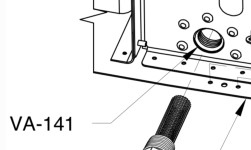
Anyone have any VA-141's (Fuel Flange, 3/8 NPT) that you didn't use in your build
Mine on one of my tanks is leaking like a sieve. I believe it was cracked by over-torquing a NPT hose nipple fitting on there. ...and then proseal was used (like a big booger) to stop the leak. I suppose this was done by the original builder. I changed the fitting from a hose nipple to a proper...
vansairforce.net
glenadavis
I recently purchased an RV12 from the estate of the builder. It has the carbureted Rotac 912 engine. I am having a problem with static on the radio during reception. If I'm more than 10 miles from the ATCtransmitter I hear a ticking sound, tick tick tick tick, That as I travel farther away from the transmitting station makes it impossible to understand what is being said. Even at my home airport when I listen to the AWOS, I hear it faintly in the background. Today while in flight I turned off one mag at a time and as I did this the ticking sound became less pronounced. I'm not much of a technician or electronics expert but to me it sounds like spark plug noise. But that's just a guess. My panel consists of a Dynon Skyview HDX and a Garmin SL30. I also have the PS Engineering Audio Panel. Pretty basic panel. This problem makes it difficult for me even to get flight following as the ticking static in the background makes it difficult to hear the controller as I get any distance from his transmitter. Has anyone else experienced this and can offer any suggestions on where to start looking? Thank you.
Radio Noise Problem.... need some help.
I recently purchased an RV12 from the estate of the builder. It has the carbureted Rotac 912 engine. I am having a problem with static on the radio during reception. If I'm more than 10 miles from the ATCtransmitter I hear a ticking sound, tick tick tick tick, That as I travel farther away from...
vansairforce.net
OFF TOPIC:
Please consider donating yearly to help keep this American 1-person pirate ship afloat:
Get your VansAirForce.net Charity Cap!
VAF Charity Cap: Help your charity and promote this site.
Get the cap all the cool kids are wearing! I don’t get a penny. It’s around $15. $5 more if you want your N-number on the back (I put 'STAFF' on the back of mine because it makes me laugh. Put STAFF on yours too if it makes you smile). And down the road $10 to the charity of your choice...
vansairforce.net
Older issues of the ‘VAF News’ can be found at:
Doug's Area ...The VAF News, About VAF, My Resume
Pushed out every now and then.
www.vansairforce.net
THE VAF LIST (a list of RV-related lists)
THE VAF LIST (a list of RV-related lists)
The VAF List ...a list of RV-related lists. RV-related things you might want to browse over (a closed post that is sticky and maintained by dr). Link to this in 'Links' in the menu. v/r,dr Small businesses that help bring you this list of RV-related lists: 360 Avionics www.360Avionics.com Ace...
vansairforce.net
Last edited:


