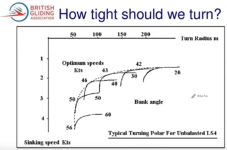
NOTSO, great test work. The short answer to using AOA is just fly the entire thing on speed (maximum endurance glide). It's the best blend of overall performance, while maintaining a sufficient margin from stall. It's also an easy way to fly the airplane without having to hit multiple target airspeeds. It's already been pointed out, but you do have to figure out residual thrust at IDLE. With a fixed pitch prop, some additional drag is required to duplicate actual engine-off glide angle (e.g., flaps 40 in the RV-4, flaps 30 in a C172 etc.) for practice. With a constant speed prop, zero thrust works well.
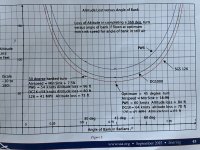
One of things we learned in our research is that you must (I really mean MUST) use some sort of decision aid to be able to reliably do this under ambient conditions. In no way does this mean not practice (you are correct that the FAA is advocating it be taught, which is why we started the research in the first place) or experiment--I just means in the end, there is no "one size fits all" solution for any airplane under all conditions, it's simply too dynamic for the Mark I Eyeball/butt computer. An actual decision aid allows to you look at the picture BEFORE you takeoff and then provides GUIDANCE after the airplane starts moving.
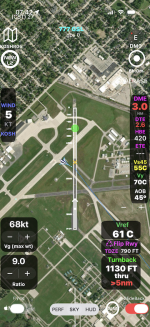
Ron's point is spot on, and by looking at the picture
before you take the active runway, you may find that your least bad option may be aft of the wing line, assuming sufficient altitude can be attained prior to the malfunction. Only a computer can paint that picture for you.
Here is the ultimate result of all of our homework. It's an IOS app (sorry android people

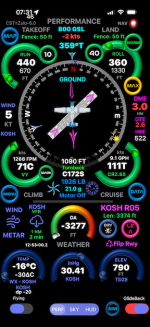
) called TLAR, military slang for "that looks about right." It's the expert version and you can access it at TLARPilot.com. It combines the aerodynamics of the airplane with real time load and ambient meteorological conditions. All of which are significant, with wind possibly the most significant. This version is designed for pre-flight and in-flight use. For preflight, the pilot inputs the specifics (airplane type, weight, fuel load, airport/runway) and then either integrates METAR data or manually inputs temperature, altimeter setting, elevation and wind direction and speed. The system then calculates basic takeoff, climb, cruise and landing performance (distances, configuration, target airspeeds and fuel flow). This is an example for a C172M using runway 5 at KOSH today (on the frozen tundra, where the local temp is the Greek letter "zero"

). This big negative density altitude means the airplane has some really good performance at light weight:
View attachment 108552
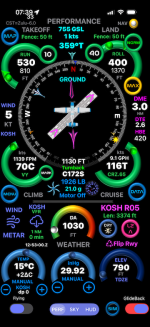
In this example, Flaps 10 takeoff ground roll is 440' with 670' required to clear a fifty foot obstacle. A Vy climb will occur at 71 KCAS, and the airplane will climb at 1268 FPM. 65% cruise will net 111 KTAS and 9.1 GPH. A Flaps 40 landing will require 1330 feet over a fifty foot obstacle, with a ground roll of 360 feet. Different parameters can be adjusted (just like an APS or "aircraft performance system" for folks that are used to flying big jets) so you can what-if different takeoff and landing configurations, climb and cruise techniques. You can also "manually over-ride" any of the METAR data, so lets manually input 15 deg C and 29.92 that it isn't quite so North Pole before we look at takeoff planning:
View attachment 108553
This is a bit more realistic, since I know I'm not inclined to push the airplane out of the hangar at -16! Now let's look at takeoff decision making. This next pic is the "sky" mode. If you look at runway 5, the white dot is liftoff, and the end of the white arrow is the distance at which the airplane will get to 50'. You can see the wind arrow showing a quartering headwind from the left. The yellow X is the last point at which we can land straight ahead AND REMAIN ON THE RUNWAY if the engine fails. The green dot is the point at which the airplane will get to minimum turn back altitude (1130' MSL in this example). The various parameters the computer is using are shown on the display, so if you want to adjust the angle of bank from optimum, etc., go ahead and you can see how that effects performance:
View attachment 108555
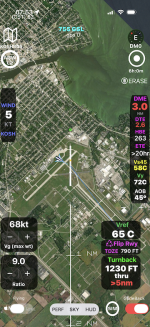
Now let's go to a summer-time scenario and raise the zero fuel weight of the airplane and look at what our options are if we decide to use Runway 5 under these conditions. Notice that we don't have a lot of options if we have a problem on Runway 5. That's fine--it's just physics. Now we know we may want to select a different runway (36 would be a good option) if that's available. Perhaps we want to off-load some fuel or payload, etc. But the bottom line is that the first time we are thinking about whether or not a turn-back is even an option isn't after the airplane is airborne. We know from mishap statistics that a lot of people don't, since fully 25-30% of turn-back attempts are started at 200' AGL or less; and there isn't an airplane in the world (apologies to the glider and ultra-light folks!) that can do that:
View attachment 108557
In the next post, we'll walk through engine failure scenarios at low and high altitude using the computer vs. the Mark I eyeball.
Fly safe,
Vac





 ) using tuft testing and FAR 23 stall warning criteria. In this test, I'm starting at Vref appropriate for gross weight, and walking the airplane into stall warning and stall so we could precisely measure AOA to determine what the buffer is with a basic stall warning system. This is good example of how a simple wing (constant chord, constant incidence, no taper or washout) stalls all at once, and also starts flying all at once. This is real-time video. The only difference between this test and the departure demo we are discussing is that I'm properly coordinating flight control inputs--both wings are stalling, vs the "departure" where only the left wing stalls as a result of adverse yaw. Again, the take-away is how fast this occurs: