Van's Air Force

The definitive Van's Aircraft support community! Buying, building or flying an RV? Join our exclusive family of mentors and enthusiasts!

The Impossible Turn...

Prop, partial power and rudder coordination

Prop considerations:

Great point regarding the type of propeller fitted. That will have a huge impact on glide performance. We haven't discussed drag associated with controllable types. The modeling in the app accounts prop drag to the extent the "about right" solution is correct. There are two drag "tweek" calibration features the user inputs.

The entire turnback from failure to touch down is less than a minute (admittedly, seems a LOT longer with temporal distortion when the adrenaline kicks in). The "I'd maintain aircraft control, analyze the situation and take the appropriate action" matrix is so condensed, that the "maintain aircraft control" part is going to take up most of the brain bytes. If the pilot exercised good checklist discipline prior to takeoff and is operating with a sufficient supply of clean fuel, there isn't much troubleshooting to be done. There is certainly nothing wrong with a couple of bold face (memory) items...boost pump, ignition and gas are obvious contenders; but not at the expense of aircraft control.

The app will model the drag of a windmilling propeller at high RPM (fine) pitch, so that means that condition is accounted for in the physics. I'd never fault a re-start attempt, but if I was in that situation, my boldface would be to reduce prop RPM and maneuver for landing. As we pointed out previously, CAFE testing has shown that there is no tactical advantage to trying to stop the prop to reduce drag for a power-loss event below 3000' AGL. Similarly, there is a minimum altitude below which troubleshooting is likely to channelize attention and reduce overall maneuvering SA (i.e., maintaining aircraft control). Obviously, the later will vary from pilot to pilot and situation to situation. It's a good place to establish a personal minimum. Mine are pretty straight forward: I'm below emergency bail out altitude, so my only option is to fly the airplane to the crash, and I prioritize accordingly.

Partial Power Loss:

When I was a young CFI in the late Paleozoic, I lost a jug in a Piper Cherokee shortly after takeoff when a valve exited the cylinder head through the valve cover. The remaining three continued to run until all of the oil leaked out--a good couple of minutes. Sufficient to maneuver to low-key for an alternate runway. The engine flamed out on final, but we had sufficient energy to land and clear the runway. By the same token, we lost an F-15 pilot in an RV-6 after a partial loss that turned into a complete loss of power. He maneuvered to low key in attempt to return to the departure runway in a low energy state, almost made the airport, but departed controlled flight at low altitude trying to stretch the glide end game and impacted the ground in 90 degrees of bank.

The takeaway is there is no one right game plan. It's probably best to assume complete power loss at any time and maneuver accordingly. A basic hip pocket will be to turn base for an alternate runway or maneuver to low key for the runway just departed. The app will actually do the math for the runway departed, and indicate when you are at low key with sufficient energy to make the runway.

For folks not familiar with the terminology, "low key" is the point on downwind that the airplane can glide to the runway out of a continuous base turn. The place your instructor would pull the throttle and say "just maneuver to the runway and land."

Rudder coordination:

Everyone that points out the need for proper training is spot on. Fail to coordinate, exceed critical angle of attack and the airplane is going to depart controlled flight. With an unintentional skid input it happens fast: https://youtu.be/cLg_LGjpL9Q. Likely non-recoverable at low altitude. If the airplane is properly coordinated and inadvertently stalled at low altitude, a recovery may be possible: https://youtu.be/BPD5xk1wgOw. This is why we move the AOA tone with the ball in the sound field (i.e., you hear it when the airplane isn't coordinated properly) and put a slip/skid ball on the visual display. It's critical for the pilot to have SA, especially in an airplane like an RV that doesn't provide much (or any) buffet cuing at low G.

Having said that, if the critical angle of attack isn't exceeded, then the airplane can't depart; so ultimately it's AOA awareness that is the key to maintaining positive aircraft control when you are maneuvering near the aerodynamic limit.

v/r,

Vac
 
Last edited:
Additional Graphics

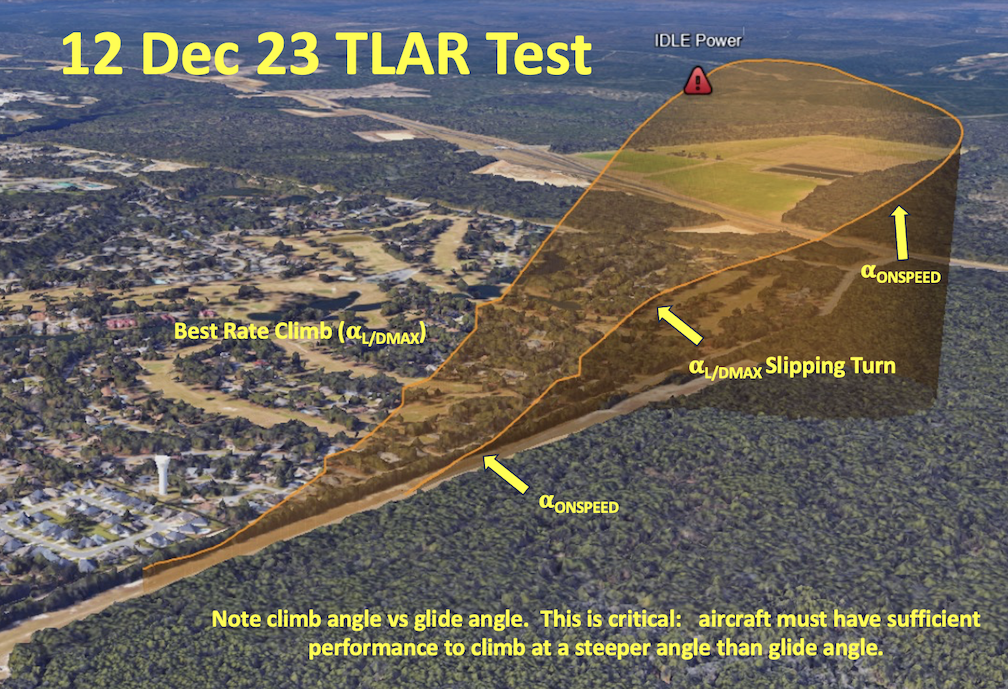
The engineers converted some of our high-speed GNSS/INS data to .kml format and then used Google Earth to develop a nice 3D graphic of a couple of turn back tests :). This compliments the academics in Charlie’s briefing in the first post of this thread and cockpit video well to illustrate what’s happening throughout the maneuver.
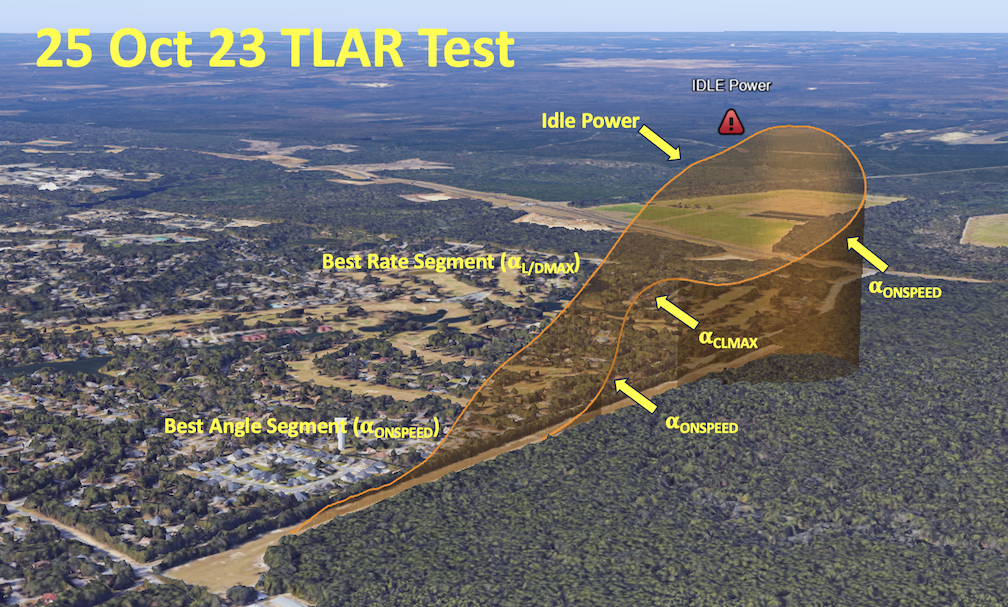
Here is the 25 Oct test (previously posted): https://youtu.be/F_RFKlUhdeE

If we plot that, the flight path looks like this:

3c039a_f48e218f7abd446696390e7fd502dc11~mv2.png


I ran another test with updated software which fixed the glide capability graphic and voice warnings on 12 Dec. I manage to smartly screw this test up! Notice that I count to three and then pull the power after the "turnback possible" cue. This is backwards. No excuse, but there are still some good lessons to be had. Here is the cockpit and iPhone video from that test: https://youtu.be/zXjkHjFdLAA.

Here is the test plotted in .kml format from takeoff to landing:

3c039a_f116bf8fd5af41329256a6471261574e~mv2.png


It’s pretty apparent why I’m only able to test a right-hand turn back at my home field.

In the Google Earth pictures, you can see wind effects on the geometry of the turn circle. Also apparent in both pictures is that climb angle is steeper than glide angle.

I deal with the bit of extra altitude (a good problem to have) after each initial turn back using different techniques. In the first video, you hear my say “square corner,” as I perceive the need to lose some energy by flying a maximum instantaneous turn. Maximum instantaneous turn rate occurs at the aerodynamic limit of the airplane (i.e., right before stall). Using this technique, I pull the nose around as quickly as possible AND increase drag simultaneously. This allows me to touchdown with sufficient distance to roll-out. Notice that after “bleeding” the excess altitude, I transition back to on speed for touchdown.

In the 12 December test, you can see a similar sight picture after turning back to point at the runway, and initially I mention a “square corner,” but then elect to slip the airplane during the alignment turn instead. If you watch the AOA indexer, you can see that I transition to L/Dmax (vs on speed) in the slip. This increases descent rate and provides a bit more maneuverability. It does, however result in excess airspeed that I have to lose during the transition to the flare. An on speed slip may have been a better option, but things happen fast during a turn back and both techniques employed in the video resulted in flight path management sufficient for touchdown in accordance with “training rules” (i.e., enough runway left to allow for roll-out and stop with a 10-knot tailwind). The latter is a personal limit and determined pre-takeoff using ambient conditions. I avoid quartering tail winds with a tail wheel unless it is necessary for flight test. Just like an actual emergency, the key is to have figured this out before takeoff, not during the heat of the moment when I’m sucking up the seat cushion.

Flying the simulated power loss during initial climb and return to the runway for an opposite direction landing is one of the most difficult maneuvers I can imagine in a civilian flying environment. I'm not skilled enough to "eye ball" a turnback without help from the computer (TLAR app) and some pre-flight planning, nor am I skilled enough to max perform the airplane this close to the ground without the "eye's out" trend information provided by the AOA tone. I’ve labeled the AOA cues I’m using on the graphics and included indexer (visual AOA display) in the video. My hat's off to anyone that can fly with this level of precision using conventional instrumentation: https://youtu.be/OwcstKP3DVQ. It's a privilege to fly and work with such talented folks.

Fly safe and best wishes for a Merry Christmas and Happy New Year,

Vac
 
Last edited:
... Also apparent in both pictures is that climb angle is steeper than glide angle.
...
Really important point you have raised, Vac. The two angles are dramatically different for your aircraft, and I guess most RVs. We don't glide well, and we are typically over-powered, whatever that means. :)

I guess if you are going straight out on the runway heading, this is the fundamental condition that must happen for a successful turnback.

Any aircraft with an anemic climb rate would be wise to stay in the airport "safety cone" until getting to altitude.
 
Jeff Brown and I are briefing the EAA team's three years worth of homework regarding power loss on takeoff tonight via webinar to the National Association of Flight Instructors 2000 Eastern Daylight Time, Wednesday 18 September 2024:

https://mentorlive.site/program/84.html

The EAA team consists of three experimental test pilots (one astronaut), two USAF weapons school instructors, a professional analyst, two by PhD aerodynamicists, the FlyONSPEED team of engineers and the EAA simulator team. With only a few exceptions, we all are all current and qualified in some flavor of RV. The briefing covers mishap analysis 2011-2021 which is, unfortunately consistent and fairly easy to summarize, survey results, field, simulator and instrumented flight test study results. We've developed a methodology for training as well as an iPhone-based pre-flight and in-flight decision making aid to help pilots during this low-frequency, high risk situation. The "impossible turn" isn't, nor is it a 180-degree turn/maneuver. It's a complex topic that will like engender some passionate discussion, including the benefit of maintaining a high level of AOA SA while you are flying the airplane to the point at which you are handing it over to the insurance company...May be why our first survey question is "Are you nuts?"

Fly safe,

Vac

Stick Monkey
 
Last edited:
One idea

There is endless debate about the so-called impossible turn, and there obviously are a lot of variables that will differ materially for a given aircraft, loading, airport, etc. The physics, human factors, aerodynamics, etc. of this issue are truly fascinating. It's no wonder we love talking about this stuff.

But I think one indisputable and overridingly important fact is that an enormous number of pilots get the required analysis very badly wrong when the event actually occurs.

They misapprehend the physics, they overestimate their own abilities, they remain startled for too long, they fail to make the big push, they otherwise fly badly, whatever. But they get it wrong. We know, for a fact, that they fail over and over and over, year after year, and very frequently do so with awful consequences.

I strongly suspect that if literally NOBODY EVER tried to return to an airport following an engine failure after takeoff, there would be a lot more people walking around today. Maybe we'd have a few more bent aircraft -- maybe -- but I have to believe a lot more people would walk away from these situations.

Pilots seem to have a natural reptile-brain desire to get back to where they came from, and it's very possible they are also just too worried about bending their airplanes.

Let's give them something else to worry about. Here's my proposed "new rule":

1. If you experience an engine failure on takeoff while less than 1200 AGL, you are PROHIBITED from returning to the airport.

2. Insurance companies can deny hull coverage for impossible turn attempts commenced below 1200 AGL.

3. A new FAR will make you lose your license if you try it -- with only one caveat:

4. Caveat: If on a given takeoff the pilot really thinks that literally the only possibility for survival, or avoiding mass casualties on the ground, will be a return to the airport from less than 1200 AGL (and I think this situation is going to be fairly rare), he or she needs to recite this morbid detail before takeoff, and warn any passengers, as part of the required briefing, that an engine failure on takeoff will very likely prove fatal. If a return from below 1200 AGL is subsequently attempted (and the pilot survives...) the FAA will have to agree with the analysis, or else there goes the license and the insurance company can deny coverage.
If you can't fly a coordinated turn in a 45 degree bank you probably should try the impossible turn. If you can't recognize a stall you probably shouldn't try the impossible turn. Remember, you don't necessarily have to make it back to the runway. If it isn't working out level the wings, dump the flaps and land as slow as possible into the softest thing around. I can easily do it from 500 AGL with my RV-4 IO-360 CS. Interestingly, it is most difficult when it is calm.
 
If you can't fly a coordinated turn in a 45 degree bank you probably should try the impossible turn. If you can't recognize a stall you probably shouldn't try the impossible turn. Remember, you don't necessarily have to make it back to the runway. If it isn't working out level the wings, dump the flaps and land as slow as possible into the softest thing around. I can easily do it from 500 AGL with my RV-4 IO-360 CS. Interestingly, it is most difficult when it is calm.
You are making substantial assumptions; a coordinated 45 degree bank turn is VERY simplistic and doesn't represent all that is required to complete that impossible turn.

I demonstrate the impossible turn as an illustration of what NOT to do, as a very high percentage of students do not succeed...
 
You are making substantial assumptions; a coordinated 45 degree bank turn is VERY simplistic and doesn't represent all that is required to complete that impossible turn.

I demonstrate the impossible turn as an illustration of what NOT to do, as a very high percentage of students do not succeed...
No it doesn't but the impossible turn does not take test pilot skills. If you want to put the impossible turn into your bag of tricks you need to practice. I try to do a 500' turn back to a full stop as the first take off most days. Don't forget there is a down wind landing at the end. It also helps tremendously to cheat a little by off setting down wind after you reach the point where it is not possible to land on remaining runway.
 
No it doesn't but the impossible turn does not take test pilot skills. If you want to put the impossible turn into your bag of tricks you need to practice. I try to do a 500' turn back to a full stop as the first take off most days. Don't forget there is a down wind landing at the end. It also helps tremendously to cheat a little by off setting down wind after you reach the point where it is not possible to land on remaining runway.
Not very realistic, as you know what is going to happen before you even takeoff...
 
Then should we stop practicing all emergency procedures? Or just shutoff the mags at 500', since that would be more realistic?
Now you are just being silly.

Of course we should practice.

My point is that practicing from 500’, knowing it’s going to happen, and likely at the same airport, is providing a false sense of security. The likelihood of all those initial conditions occurring in an actual emergency is zero.

When I train students, that turn is demonstrated and then attempted at a safe altitude. Most don’t complete it successfully, even when they know it’s going to happen.

Later in the training footprint, I give them a surprise scenario and ask for that turn. Even fewer complete it.

One thing is for certain, trying that turn from 500’ and ending in a stall/spin will ruin your day.
 
One of the big takeaways from three years of research and flight test is there simply is no one altitude (or altitude band) from which a successful turnback can be flown. The only answer is "it depends" and there is no way to determine that without a technical aid. The technical aid needs to provide a pre-flight prediction AND needs to have dynamic update capability once the airplane is moving, because any prediction goes out the window once the airplane starts the takeoff roll if the pilot deviates from profile, or ambient conditions vary from pre-flight assumptions. What's interesting, is that most pilots think there is some altitude from which they can turn back; and that's simply not the case--there is too much variability to have a "hip pocket" minimum altitude. And the other big takeaway is that a turnback attempt is a pre-meditated contingency option that has been properly briefed before takeoff only if this no other viable alternative. It's safer to maneuver ahead and maintain aircraft control. One of the few statistics we brief is that airplanes that hit a structure on the ground, under control have a 25% fatality rate in our ten-year study period. That means that, worst case, even if you hit something attached to the ground, you have 75% chance of making it out of that situation alive. But if you stall, your odds of surviving plummet dramatically.

There is a viable way to do the physics required to provide the pilot with a useful decision making tool. This similar in concept to using an "APS" or "aircraft performance system" in a jet for preflight planning and a "CCIP" or "continuously computed impact point" once the airplane is moving. Not rocket science, just basic Newtonian physics. This doesn't mean that there's no place for the Mark I eyeball--it still needs to assess flight path; but the ability to deal with is an very low frequency/high risk event requires a computer-derived solution. And, even the computer isn't perfect--it's only as good as the model and the assumptions applied. Way better than a human, but also not 100% either. Any training or practice needs to focus on optimizing performance and maintaining aircraft control all the way through the crash. Much easier and safer using AOA as a primary reference, but we also offer "airspeed only" techniques.

Our briefing is archived, so anyone that wants a more detailed explanation is welcome to watch the recorded version using the link above; and we are happy to field any question via this forum as well. Any instructors willing to participate in field evaluation of our work are also welcome--details and resources are described in the briefing.

Fly safe,

Vac
 
One of the big takeaways from three years of research and flight test is there simply is no one altitude (or altitude band) from which a successful turnback can be flown. The only answer is "it depends" and there is no way to determine that without a technical aid. The technical aid needs to provide a pre-flight prediction AND needs to have dynamic update capability once the airplane is moving, because any prediction goes out the window once the airplane starts the takeoff roll if the pilot deviates from profile, or ambient conditions vary from pre-flight assumptions. What's interesting, is that most pilots think there is some altitude from which they can turn back; and that's simply not the case--there is too much variability to have a "hip pocket" minimum altitude. And the other big takeaway is that a turnback attempt is a pre-meditated contingency option that has been properly briefed before takeoff only if this no other viable alternative. It's safer to maneuver ahead and maintain aircraft control. One of the few statistics we brief is that airplanes that hit a structure on the ground, under control have a 25% fatality rate in our ten-year study period. That means that, worst case, even if you hit something attached to the ground, you have 75% chance of making it out of that situation alive. But if you stall, your odds of surviving plummet dramatically.

There is a viable way to do the physics required to provide the pilot with a useful decision making tool. This similar in concept to using an "APS" or "aircraft performance system" in a jet for preflight planning and a "CCIP" or "continuously computed impact point" once the airplane is moving. Not rocket science, just basic Newtonian physics. This doesn't mean that there's no place for the Mark I eyeball--it still needs to assess flight path; but the ability to deal with is an very low frequency/high risk event requires a computer-derived solution. And, even the computer isn't perfect--it's only as good as the model and the assumptions applied. Way better than a human, but also not 100% either. Any training or practice needs to focus on optimizing performance and maintaining aircraft control all the way through the crash. Much easier and safer using AOA as a primary reference, but we also offer "airspeed only" techniques.

Our briefing is archived, so anyone that wants a more detailed explanation is welcome to watch the recorded version using the link above; and we are happy to field any question via this forum as well. Any instructors willing to participate in field evaluation of our work are also welcome--details and resources are described in the briefing.

Fly safe,

Vac
Well stated. I would add, though, that no matter how good the calculations are, they cannot predict the human factor…
 
Remember, at any point in the impossible turn you can change your mind, level the wings and land
To be more specific, any point before a stall/spin. Of course, you have then lost precious time to scout a landing place, and may now be in a worse situation.

My $0.02 on the "Impossible Turn": One name: Richard McSpadden. If a former Thunderbirds Commander, AOPA Safety Guru, and "Impossible Turn" video producer
can fall victim to his own pet specialty, I do not like my chances....but it's a free country.

He wasn't the PIC (of record), but he's just as dead.

'Nuff said.
 
To be more specific, any point before a stall/spin. Of course, you have then lost precious time to scout a landing place, and may now be in a worse situation.

My $0.02 on the "Impossible Turn": One name: Richard McSpadden. If a former Thunderbirds Commander, AOPA Safety Guru, and "Impossible Turn" video producer
can fall victim to his own pet specialty, I do not like my chances....but it's a free country.

He wasn't the PIC (of record), but he's just as dead.

'Nuff said.
I wasn't going to go there but that's a fact.
 
I love reading and learning about all of this but my current plane glides like a piano when it loses the engine so all I would look for is directly below in front because that's where I'm going to land. At least I just need 200'-300' to land comfortably. This is what the approach view is with full 44 degree flaps @ 1500' AGL and 75mph down to the flare where it bleeds down to 32mph in a couple of seconds, if you want to land on the numbers. It's a little scary the first couple of times as you learn, then it gets fun. :D
 

Attachments

  • 452533329_7752660608193835_7693696842831288717_n.jpg
    452533329_7752660608193835_7693696842831288717_n.jpg
    155.8 KB · Views: 73
I wasn't going to go there but that's a fact.
Yes, I appreciate that. I just hope no one thinks I am trying to make light of the McSpadden crash. It's horrible for him, his family, and aviation as a whole. However, all these pages of comments about bank angles, energy management, airspeed control, blah, blah, blah may be obscuring a basic fact: We are all imperfect humans and pilots and react differently in emergencies.

IF everything goes perfectly, and IF you are not rusty, and IF you react quickly, and IF the weather is right, and IF you have just enough altitude, and IF your luck holds, etc., you might make impossible turn, but there is no margin for error here....and the slightest failure is deadly. (I know...preaching to the choir..)

We've been taught from Day #1 to fly "ahead" of the airplane...to have a plan and execute it. For me, it's simple: I'm not going to try it. Ever. For any reason. At any time. It never crosses my mind to attempt it, and I consciously plan to land straight ahead. I'm comfortable with my personal decision, and even the Good Lord himself is not going to change my mind.

Best wishes to everyone on your personal decision.
 
To be more specific, any point before a stall/spin. Of course, you have then lost precious time to scout a landing place, and may now be in a worse situation.

My $0.02 on the "Impossible Turn": One name: Richard McSpadden. If a former Thunderbirds Commander, AOPA Safety Guru, and "Impossible Turn" video producer
can fall victim to his own pet specialty, I do not like my chances....but it's a free country.

He wasn't the PIC (of record), but he's just as dead.

'Nuff said.

My understanding is that Francis was flying, not McSpadden. And they were in formation with an A36 Bonanza. And it was not a stall/spin. And if you've never been to Lake Placid, departing north leaves you with very few options. The airport's on a bluff. Highway 73 is absolutely rife with power lines and cables going every which way. That accident was a worst case scenario from many different angles, ranging from the kind of emergency to the exact spot and altitude that it happened.

It might not be correct to assume that if they had just continued straight ahead that things would have turned out any differently. There are plenty of places where there simply aren't good options if you have a low altitude complete power loss.

Vac mentioned that statistically, continuing straight after engine failure head had a 25% fatality rate. That's doesn't mean you've got a 1 in 4 chance of perishing at ANY airport, but rather is going to be much more likely with certain airports and runways. Take a look at Fullerton, Compton, Hawthorne, Cable, Brackett, and many other Southern California airports. One size does not fit all.

--Ron
 
Spad was a squadron mate. The purpose of this thread isn't to speculate or even discuss a particular mishap, it's to present the results of a three year effort to help folks with understanding more about a very low frequency, but high risk event.

As I said, it's a topic that always generates passionate discussion. If you watch the briefing, one of our survey questions is "are you nuts?" As in, no way I'd ever consider this. 1000 pilots (100 instructors) participated in the survey. 5% indicated that they would never consider a turnback. They are correct, insofar as I can not refute that logic using the scientific method. The pilots that were not correct were those that "have a minimum altitude for a turnback attempt" (i.e., a hip pocket calculation) and those that said "a turnback is practical at some altitude."

This does not mean that there is no benefit from training, preflight planning or the use of a technical aid (i.e., a computer to do the physics). Ultimately the risk is loss-of-control, which remains the #1 killer in general aviation. That is not the case in the military or airline operations. In the military, the answer was wide-spread adoption of angle of attack systems and changes in the way we train pilots. In the airlines, the answer has been increased automation. Ultimately, the focus needs to be on reducing loss-of-control mishap risk. That occurs far more frequently and kills more pilots than loss of power during the takeoff/initial climb phase. If the objective is to loose fewer of our friends and colleagues, then we need to keep our eyes on the ball. We can continue to debate, or we can look to other flying communities that have cracked the nut and learn. Ultimately more awareness of "how hard the wing is working" and automation will make its way to general aviation.

Fly safe,

Vac
 
Last edited:
About the energy - speed vs. altitude - my understanding is if you have enough speed to get you through the "startle factor" without stalling, then that's enough speed and better to have the altitude, since speed comes with drag losses. Is this also your view?

Not exactly. Energy is energy, yes speed causes some more bleed, and pitch rate load demand so as to zoom costs more, but energy is energy. Chapter 4 AFM:

Total ME = PE + KE = mgh + mV^2 / 2
Es = h + V^2 / 2g
… neglecting zoom pitching-up and/or instant turn extra load costs, extra h = V^2 / 2 g

110 mph * 5280 fps/mph / 3600 s/h = 161 fps -> (161 fps)^2 / (2*32.2 fps^2) = 404 ft altitude equivalent
90 mph -> 132 fps -> 271 ft
404 ft - 271 ft = 133 ft
minus pitch rate transaction costs, looks like you’re getting a hundred feet or more for that speed. Or a good bite into your displacement turn.

As really you’re going into immediate turn, so onspeed as proxy for min pwr * 1.189 for 45 AOB
60*1.3*1.189 = 92 mph is close enough to the above 90 mph for my pilot math. It is kinda nice your best glide straight speed is near your min power most degrees turn per altitude speed.

but… how long and how cleanly did you reach 110? Accelerating in ground effect can be a huge energy addition advantage for which I don’t have an estimate for you. I’d recommend trying a Vy climb to a common point comparing to the ground effect acceleration zooming to Vy and climbing to pass the common point for comparison. I suspect you’ll find Vy winning here. After all Vy is max excess power. Most ground effect assisted zoom climbs speak to competing with Vx or against max excess thrust. Lots of reasons to not want to do the Vx and prefer zoom climb against such but which wins is plane specific. Engine cooling, forward visibility, stall margin being big ones. Rare zoom climbs look to Rutowski optimum energy climb but that really only works for supersonic interceptors. At the opposite end, it is interesting the survivable helicopter energy tunnel also looks a bit ground effect zoom climby.

Aerodynamics for Naval Aviators needs to be adapted to propellers yet for jets states,
This poses somewhat of a problem in determining the proper procedure for obstacle clearance after takeoff. If the obstacle is a considerable distance from the takeoff point, the problem is essentially that of a long term gain and steady state conditions will predominate. That is, acceleration from the takeoff speed to (L/D)max speed will be favorable because the maximum steady climb angle can be attained. However, if the obstacle is a relatively short distance from the takeoff point, the additional distance required to accelerate to (L/D)max speed may be detrimental and the resulting situation may prove to be a short term gain problem. In this case, it may prove necessary to begin climb out at or near the takeoff speed or hold the aircraft on the runway for extra speed and a subsequent zoom. The problem is sufficiently varied that no general conclusion can be applied to all jet aircraft and particular procedures are specified for each aircraft in the Flight Handbook.”

As the prop Vx is near liftoff speed, such suggests no need to zoom, yet zooms have been effective for me. Ground effect really does reduce energy costs. But enough to be useful? (Again, I like them for reasons other than energy optimization while effective only needs to be good enough.) May also want to test ground effect assisted zoom climb vs a common point against Vx and the common point. May need to do several to optimize how much acceleration to subsequent zoom. Parasite side takes over quickly. I imagine 110 is fair but not much faster. L/Dmax intersection shifts down and left in ground effect as induced side gets depressed. Note Vac suggests onspeed as proxy for Vx and this is probably a good idea for margin preservation. Here is one such comparison.


Do note in all this the analogy of zoom to instantaneous turn and climb with sustained turn. You have some excess KE and presumably some excess PE for which you need to pay out degrees turn and distance travel. In this sense, extra KE is also money in the bank.


Interesting only one person went alternate runway. There is huge value in X shaped and V shaped configuration airfields saving significant altitude for alignment turn costs.

Don't stall! If the turn isn't completely successful, the unstalled controlled crash will be closer to the airport in somewhat more friendly terrain than that off the departure ends.

Yep. Believe someone else mentioned reaching the field before worrying about reaching runway… similarly, some runways are wide enough you need not be aligned with and on centerline, a diagonal can be ok (can help with slower planes and crosswind too). Lineup is desired lineup not necessarily runway lineup.


I climb at Vx turn 45 degrees after takeoff to reduce the return overshoot. My first attempt resulted in an inability to get low enough for landing even with full flaps and full rudder deflection. From there I incrementally decreased the turn-back altitude to find my optimum.

What I found was Vx and a bank of no less than 45 degrees were required. With that the turn-back altitude is surprising low. I won’t publish it here because each of us need to find our own comfort level. I hope to try your approach.

I’d avoid Vx climb though 45 AOB is optimum for gliding turn and this is best at minimum power required AOA which is near synonymous with propeller Vx AOA. Climbing at Vx, however, kills your startle factor to stall response margin. Though if you’re on a long runway with no straight ahead beyond the runway, it could help as you could transition from straight ahead on runway to turn back no fear of downwind overrun. But moment straight ahead on runway falls out of option, would want to accelerate from Vx for Vy.

If not trained for in advance, no one should attempt something they have only seen or read about but in desperate times the human mind can go many different directions.

Disagree. Reminds me of a Beau of the Fifth, rebranded Belle of the Ranch, in which he discusses what size first aid kit should you have. This video also talks Dunning-Krueger, which is unfortunate as DK is bunk but that will be a separate comment should someone request, yet the video suggests your kit should essentially be one level above your own level to use the kit. I think that important as you might not be trained but some fields have no good straight ahead options. If you think you can make it but have a straight ahead option, go straight ahead. If you have no other options, however, better to make the attempt.


It's best to train the way we fly, but not many light GA powerplant failure training scenarios involve anything except a total, instantaneous failure of the engine.

You will never be able to train all potential failure modes. Not even close.
 
I demonstrate the impossible turn as an illustration of what NOT to do, as a very high percentage of students do not succeed...

yet every glider student masters 200 feet rope break returns prior to certification while every helicopter pilot has done 180 autorotations… and we can’t interpolate between these?
 
It also helps tremendously to cheat a little by off setting down wind after you reach the point where it is not possible to land on remaining runway.
Edit insert: seems I introduced confusion while trying to clarify. While climbing still on an upwind leg, offset with wind drift downwind of crosswind component or away from intended direction of reversal turn; make reversal turn into crosswind component thus against the wind. A preparatory upwind leg offset downwind saves displacement reducing lineup correction turn requirements while reversal turn into wind reduces both displacement and lineup correction requirements. Consider relabeling upwind to crosswind to downwind type initial turn to start of a reversal turn and try to use “with wind” and “against wind” for physicality of wind or simply draw it out to avoid pattern position names. In my original I was thinking reversal turn not the preemptive cut.

Original comment: I assume I’m misreading and you mean more what I do but am typing for clarity.
Offset upwind. You want to offset into the crosswind. Except should geometry enable alternate runway. Upwind so you don’t have to fight the wind in the glide. Tailwinds extend glides; headwinds shorten them. Though, yes, when able, cheat. Tow planes often do after first hundred feet to better assist gliders should need arise.
 
Last edited:
yet every glider student masters 200 feet rope break returns prior to certification while every helicopter pilot has done 180 autorotations… and we can’t interpolate between these?
Just as every internet thread ends when someone invokes a certain former German Chancellor….all “Impossible Term” threads end when the 200’ rope break is thrown into the argument. There is no correlation between a sailplanes and a sport plane liek an RV when it comes to glide ratio…..
 
I assume I’m misreading and you mean more what I do but am typing for clarity.
Offset upwind. You want to offset into the crosswind. Except should geometry enable alternate runway. Upwind so you don’t have to fight the wind in the glide. Tailwinds extend glides; headwinds shorten them. Though, yes, when able, cheat. Tow planes often do after first hundred feet to better assist gliders should need arise.
I believe the original guy had it correct.. you don’t want that tailwind push when you turn back, because you’ll have to turn more to get back to centerline.. if you offset a little downwind, when you turn into the wind, it’ll help keep your turn radius small and you’ll turn in place and end up right over the centerline.
 
Just as every internet thread ends when someone invokes a certain former German Chancellor….all “Impossible Term” threads end when the 200’ rope break is thrown into the argument. There is no correlation between a sailplanes and a sport plane liek an RV when it comes to glide ratio…..

That is crap. Theirs is larger, sure, but that simply means adapting to different numbers. It readily shows feasibility and feasibility at a basic level of competence. Students in T-6s, T-45s, F-16s all are doing low keys and high keys at progressive levels. Those T-6 students are still down at PPL level when learning such. Vac’s demonstrations are showing 400 ft turn backs and that is very much like 200 ft rope break scenarios. Certain other light pistons may need some more height, Cirrus won’t do so well and is going to be in CAPS window before turn around window, but the physics and process are still the same. They’re also why we also mention 180 autorotation showing much worse players for which we are interpolating.
 
I believe the original guy had it correct.. you don’t want that tailwind push when you turn back, because you’ll have to turn more to get back to centerline.. if you offset a little downwind, when you turn into the wind, it’ll help keep your turn radius small and you’ll turn in place and end up right over the centerline.
This, exactly. The best part is that it takes little effort to do the sidestep. Just remain on runway heading and the crosswind will drift you over there, or you can add some drift if needed. When you turn back to the airfield you'll be closer to the runway centerline than if you offset upwind and are turning down-wind.
 
That is crap. Theirs is larger, sure, but that simply means adapting to different numbers. It readily shows feasibility and feasibility at a basic level of competence. Students in T-6s, T-45s, F-16s all are doing low keys and high keys at progressive levels. Those T-6 students are still down at PPL level when learning such. Vac’s demonstrations are showing 400 ft turn backs and that is very much like 200 ft rope break scenarios. Certain other light pistons may need some more height, Cirrus won’t do so well and is going to be in CAPS window before turn around window, but the physics and process are still the same. They’re also why we also mention 180 autorotation showing much worse players for which we are interpolating.

No one is arguing the aerodynamics of the turn back - at some point, with a perfect airplane and perfect technique, every airplane has a turn back altitude that works. But in the real world, the turn back is not an aerodynamic, engineering, or physics argument - its success or failure depends on the pilot’s reaction time and skill. In the military, you can insist on a level of discipline, skill, and competence that must be maintained. In the GA world, that simply cannot be assumed by anyone trying to build up a safety program. We have demonstrated time and time again that - for over a hundred years - we can’t make the assumption that the pilot will recognize the failing engine, make an instantaneously correct decision, and execute a perfect (aerobatic) maneuver to return to the runway. And when they screw it up, they die - the don’t get hurt, they don’t hurt their passengers…they die.

Arguing military aircraft and training, sailplanes, and aerobatic flight does not change the historical record - and unless you can come up with a way to guarantee that every pilot is always trained, prepared, and ready to do it right (which you can’t if you are going to allow the freedom of average Joe’s to fly their personal aircraft), advocating for the turnback is sophistry.
 
This, exactly. The best part is that it takes little effort to do the sidestep. Just remain on runway heading and the crosswind will drift you over there, or you can add some drift if needed. When you turn back to the airfield you'll be closer to the runway centerline than if you offset upwind and are turning down-wind.

I must have been confusing which turn you’re talking about. Yes, drift with the crosswind while still climbing to reduce alignment needs. But on the actual reversal turn into the crosswind to reduce displacement and alignment needs.
 
My understanding is that Francis was flying, not McSpadden. And they were in formation with an A36 Bonanza. And it was not a stall/spin. And if you've never been to Lake Placid, departing north leaves you with very few options. The airport's on a bluff. Highway 73 is absolutely rife with power lines and cables going every which way. That accident was a worst case scenario from many different angles, ranging from the kind of emergency to the exact spot and altitude that it happened.

It might not be correct to assume that if they had just continued straight ahead that things would have turned out any differently. There are plenty of places where there simply aren't good options if you have a low altitude complete power loss.

Vac mentioned that statistically, continuing straight after engine failure head had a 25% fatality rate. That's doesn't mean you've got a 1 in 4 chance of perishing at ANY airport, but rather is going to be much more likely with certain airports and runways. Take a look at Fullerton, Compton, Hawthorne, Cable, Brackett, and many other Southern California airports. One size does not fit all.

--Ron
Ron -
Thanks for your very pertinent words of wisdom countering the mostly crap from others. Not including Vac. Could you post about Sunrise turn back program?
 
Paul Bertorelli on AVWeb studied engine failures in GA planes. His work showed an engine fails roughly every 3500 hours. Contrary to popular belief the failures occurred at roughly the same percentage in takeoff, landing and cruise phases. It’s not the impossible turn it’s the improbable turn. Practicing putting more gas in the tanks is a better value.
 
No one is arguing the aerodynamics of the turn back - at some point, with a perfect airplane and perfect technique, every airplane has a turn back altitude that works. But in the real world, the turn back is not an aerodynamic, engineering, or physics argument - its success or failure depends on the pilot’s reaction time and skill. In the military, you can insist on a level of discipline, skill, and competence that must be maintained. In the GA world, that simply cannot be assumed by anyone trying to build up a safety program. We have demonstrated time and time again that - for over a hundred years - we can’t make the assumption that the pilot will recognize the failing engine, make an instantaneously correct decision, and execute a perfect (aerobatic) maneuver to return to the runway. And when they screw it up, they die - the don’t get hurt, they don’t hurt their passengers…they die.

Arguing military aircraft and training, sailplanes, and aerobatic flight does not change the historical record - and unless you can come up with a way to guarantee that every pilot is always trained, prepared, and ready to do it right (which you can’t if you are going to allow the freedom of average Joe’s to fly their personal aircraft), advocating for the turnback is sophistry.
…and the EAA simulator program agrees across all experience levels.

I demonstrate the turn to students but advise against it. I like improbable instead of impossible as a description…
 
There are no statistics on successful turn back's, therefore any percentages, etc are meaningless. There are many other similar engine failure situations where there are no legitimate statistics. One example I have posted before are two engine stoppages on consecutive days in a Pitts S1S with no electrical system. The two events involved near identical situations, VERY low altitude, no chance of reaching the end of the runway, the pilot instead aimed for a point abouit 1000' past the approach end of runway and was rolling out of a 30 degree plus banked turn and flaring at the same time.
Regarding the turnback I was based on an Ag strip for several years. Following the "when in Rome" protocol, I would fly the downwind leg at altitudes from 100 to 600 AGL and practice idle power approaches from abeam the numbers.
My 1000 plus hours in the Pitts S1S were power to idle abeam the numbers any time traffic permitted.
 
Ron -
Thanks for your very pertinent words of wisdom countering the mostly crap from others. Not including Vac. Could you post about Sunrise turn back program?

I wouldn't necessarily call it a program. It was more like one of the options taught to students on how to deal with upwind power plant failures. I say "was" because the owner of Sunrise has been facing health issues and elected to close the school this summer after nearly 50 years in business.

I was a Sunrise student, customer, tenant, aerobatic competitor, and instructor at various times in my flying career, so I've seen this from many perspectives. Before solo, students would see and practice low altitude engine failures and receive practical upright spin training (multiple turns, multiple spins, different directions, etc). It's obviously dangerous to attempt to maneuver if you're not proficient. But stick and rudder proficiency was Sunrise's specialty, and they didn't allow poor skill in this area. The phraseology and teaching techniques we utilized as instructors were constantly scrutinized and refined by the school based on decades of teaching this stuff.

They were also very strict on wake turbulence avoidance techniques. If you study SNA's airport diagram, you'll see that the small runway is very close to a parallel with constantly landing 737s, 757s, A320s, and other wake turbulence generators with a prevailing wind that blows the wake toward the small runway. We were always taxiing behind airliners or having them on parallel taxiways next to us and turning toward their gate, with serious jet blast hazards. This stuff was no joke.

The airport is a busy mix of airline, biz jet, helicopter, flight training, aerobatic, and transient operations. Warbirds from the museum. Antiques. Experimentals. It's all there. I once looked at the number of operations and compared it to the airports acerage and couldn't find a more busy and congested airport anywhere. We soloed students in that environment every day. Sunrise is the only place I know of where you could get checked out in the Pitts or Extra and take them out solo or with passengers. Nobody else could get insurance coverage to do that.

But Sunrise could.

Anyway, Sunrise's position was never that a student should always turn around, or that they should always land straight ahead, but rather that you had to think about what you were flying, where you were at, what the wind was doing, and what sort of obstacles and landing options were around you -- before you took off. Then based on that data, and your experience and comfort level, you'd have a turn around altitude in mind. They also taught climbing at Vx until you reached that altitude. The idea was to get as much altitude as possible while close to the field. The same philosophy held true when flying the pattern. We would stay in close and if extended downwind would climb to remain within glide distance of the airport, or ask for a 360 on the downwind if possible. If a student got low, I'd simulate an engine failure and ask them to tell me if they'd make the airport.

When the Santa Ana winds blew and you would take off into a 20 knot headwind that would reach 40 knots by 1000 AGL, you'd have to think about what an engine failure would entail and where you'd land, especially since the runways were reversed.

I always reminded students that they didn't need to return to the departure runway. Or any runway at all. A taxiway, an open ramp, the infield grass, and many other places would suffice. And over the years, there were a few engine failures, some of them low altitude. All ended safely. I myself had an engine fail in a Cutlass in the Santa Ana Canyon. I glided to and landed at Corona Airport.

The idea of limiting bank angle in the pattern or never considering a turn around were not part of Sunrise's philosophy. That alone made them an outlier.

Here is a 2007 video they made to illustrate the relationship between bank angle and altitude loss in a glide. (And an alternate link in case the web site is removed). They used an old Skyhawk for this. I thought the most prescient statement was that limiting bank angle was more likely to cause a stall/spin accident. That has been my experience as well.

I'd be remiss in not stating once again that this is all based on a) a high degree of stick and rudder proficiency, b) thinking through your plan *before* you take off, and c) having received proper flight instruction.

--Ron
 
practice idle power approaches from abeam the numbers.
My 1000 plus hours in the Pitts S1S were power to idle abeam the numbers any time traffic permitted.

I do this as well. It's good practice and also pretty fun. I'm constantly impressed by the glide ratio of my RV-6. That Sensenich GA prop produces so little drag that I feel like I'm in a glider. Pretty much the polar opposite of my old Pitts S-2B.

--Ron
 
I do this as well. It's good practice and also pretty fun. I'm constantly impressed by the glide ratio of my RV-6. That Sensenich GA prop produces so little drag that I feel like I'm in a glider. Pretty much the polar opposite of my old Pitts S-2B.

--Ron
Ron-
Thanks for the excellent post. Setting aside Vac's posts, you post is about 1000 times more valuable than the total of all the previous garbage on this subject.
I go back to an era when solo was routine in a Pitts. At the Sebring contest's I had as many as 8-10 people flying the S2B in contest. Somehow the airplane survived intact.
 
I just took my flight review today with a well known tail wheel instructor at Corona. I flew a bunch of power off 180, sometimes with flaps, sometime with simulated flap failure. We did a few simulated impossible turns at 1000 AGL. I did some of these maneuvers when I was flying solo, with 1/2 fuel tank. Today, the plane was at full tank, with two full size adults, and a middle weight tool bag for XC travel. The plane behaved very differently than I was used to. Today my calibrated AOA started sounding the slow beeps at 70kts instead of the expected ~64-65kts. That was a surprise and it got me notice.

The goal of the flight review wasn't to make the runway but to push my comfort zone and to guage the performance of the airplane with now that I am flying at different weight and CG compare to solo weight. It was productive day learning more about the airplane and it was beneficial to get feedbacks from an experienced CFI. I was surprised at the glide distance of the RV8 with a fixed pitch propeller with no flap, and how a heavy weight RV behaves at slow speed, no flap, and no power, and my flying close to the ground. When I was doing the impossible turn flying solo, I flew a bit faster because I was scared, but the airplane was at a light weight, fwd CG. Today, I flew close to the AOA point, trying to maximize the turn performance by flying at 45deg bank that produced a slow beep on an occasion. I knew the CFI can help me to recover if I mess up. It was another exercise to expand my comfort zone and to poke the airplane envelope. I didn't read all the posts about probability of failure or why doing it in the first place, the importance for my flight review was for me to practice, and to build confidence in the airplane when it operates outside of the normal operational scenario. Other people do them differently like flying aerobatics, flying different high performance airplanes, airlines, military stuff. I don't have these experiences. My experience is limited, I just flown past the 300 hours mark last month, and the majority of them were flying this RV8. Regardless what you feel about the discussion, go and practice whatever you are comfortable with, and have fun.
 
I just took my flight review today with a well known tail wheel instructor at Corona. I flew a bunch of power off 180, sometimes with flaps, sometime with simulated flap failure. We did a few simulated impossible turns at 1000 AGL. I did some of these maneuvers when I was flying solo, with 1/2 fuel tank. Today, the plane was at full tank, with two full size adults, and a middle weight tool bag for XC travel. The plane behaved very differently than I was used to. Today my calibrated AOA started sounding the slow beeps at 70kts instead of the expected ~64-65kts. That was a surprise and it got me notice.

The goal of the flight review wasn't to make the runway but to push my comfort zone and to guage the performance of the airplane with now that I am flying at different weight and CG compare to solo weight. It was productive day learning more about the airplane and it was beneficial to get feedbacks from an experienced CFI. I was surprised at the glide distance of the RV8 with a fixed pitch propeller with no flap, and how a heavy weight RV behaves at slow speed, no flap, and no power, and my flying close to the ground. When I was doing the impossible turn flying solo, I flew a bit faster because I was scared, but the airplane was at a light weight, fwd CG. Today, I flew close to the AOA point, trying to maximize the turn performance by flying at 45deg bank that produced a slow beep on an occasion. I knew the CFI can help me to recover if I mess up. It was another exercise to expand my comfort zone and to poke the airplane envelope. I didn't read all the posts about probability of failure or why doing it in the first place, the importance for my flight review was for me to practice, and to build confidence in the airplane when it operates outside of the normal operational scenario. Other people do them differently like flying aerobatics, flying different high performance airplanes, airlines, military stuff. I don't have these experiences. My experience is limited, I just flown past the 300 hours mark last month, and the majority of them were flying this RV8. Regardless what you feel about the discussion, go and practice whatever you are comfortable with, and have fun.
Remember that the possibility of an engine failure on take off happening at the correct altitude for a return to the runway is almost zero.
 
Remember that the possibility of an engine failure on take off happening at the correct altitude for a return to the runway is almost zero.
It was an exercise to understand the airplane performance. Nothing replicates a real life emergency. There was a lot of discussion about the topic by the local pilots and I found out nobody in the discussion even practiced them just to see how their airplanes behave, even at altitude.
 
It was an exercise to understand the airplane performance. Nothing replicates a real life emergency. There was a lot of discussion about the topic by the local pilots and I found out nobody in the discussion even practiced them just to see how their airplanes behave, even at altitude.
Phat, what an excellent use of BFR time! Isn't AOA a thing of beauty when it gives that "push" nudge when you aren't anticipating it? It's excellent to see folks experiment and learn :cool:. Because RV's in general are good climbing GA airplanes, we have more maneuvering options than airplanes with less climb performance. If something happens during initial climb; and it's probably a good idea to capitalize on that performance.

Ron also brings up a good point about glide performance. If the engine really quits, I wouldn't touch the flap lever until touchdown is assured (wherever that may be), but during practice I use flaps 40 in my fixed-pitch RV-4 since that replicates engine off flaps up glide angle and gives me the same sight picture I'll have without power (i.e., I need the drag from flaps to compensate for residual thrust from the fixed pitch propeller). If I had a controllable propeller, I'd use zero-thrust (assuming I know the MP and RPM associated with that condition, as determined in flight test). Of course, you could make a cogent argument that use of flaps induces a negative habit pattern, so I simply tell myself this is for training. The same way I remind myself just prior to starting the takeoff roll I'm sitting in a tail-dragger and do whatever it takes with flight controls to keep it straight. Sometimes it helps just to cage the gyros.

Norman is correct as well, we have no idea where or when we'll have an issue with power. Hence I think some sort of "APS" or aircraft performance system is required to assist with decision making. I do like Flats' "rope break" analogy--it's the same operational mindset, even though as Paul points out, apples to oranges regarding glide ratio: altitude is purely airplane/performance dependent and there is a right way to fly the turn. And some airplanes under some conditions NEVER have a turn-back option. If my performance software says I have a minimum turn-back altitude, my objective as the pilot is to optimize performance up to that altitude. If something happens prior to that, I'm committed to the glide footprint calculated by the HAL 9000 unit (computer). With an AOA, I takeoff on speed and climb at L/Dmax to approximate Vy adjusted for weight and DA (assuming the system gives me those cues). Without an AOA, rotate IAW POH and transition to Vy appropriate for gross weight and density altitude as efficiently as possible. I find that even using this technique (vs. accelerating in ground effect) still provides some natural zoom after simulated engine failure in the RV-4. The airplane's velocity vector/flight path angle doesn't immediately fall out of the sky. You can see this in the demonstration video. And, as Phat's points out, it's a different airplane with the other seat occupied. If you are just looking out the window, a good place to start is to reduce pitch to a level attitude (but "honor the slow tone" if you've got it!).

To re-iterate, I'd only consider this if A) I'm using a performance computer that provides real-time decision making tools; B) there is simply no other straight ahead or crosswind runway or off-field option; C) I've got an accurate on speed AOA cue with fast and slow trend information. That's my personal operational risk management matrix. The power loss on takeoff working group recognizes not all GA airplanes are equipped with an accurate AOA system, so we have to offer an airspeed-only technique, the crux of which is "no slower than stall warning" (assuming the airplane is equipped and it's calibrated accurately) during maneuvering. Keep in mind some of our RV's aren't equipped with AOA or stall warning, and aerodynamic cues at low g (less than 2) can be quite limited in some models (including my RV-4). The danger associated with "not less than stall warning" is that doesn't provide much margin (about 1 1/2 to 2 degrees actual AOA, and AOA increases geometrically as speed decreases: the slower you go, the faster you go slower). A "slow tone" (anything slower than on speed) is more helpful. What's amazing is that it doesn't take much of an accelerated stall combined with less than stellar rudder coordination to result in a non-recoverable departure from controlled flight. And I would respectfully point out, no one can do the stall speed cockpit math or accurately differentiate between 1.2 and 1.4 g's, yet the AOA is screaming (what Phat learned :)). As Paul likes to point out, flying by the seat of your pants is a myth that refuses to die--sometimes you can, sometimes you can't:


"Spad" McSpadden was a squadron mate, and I recently lost another friend and his wife in a LOC mishap in the pattern. We have to remember that no one is immune to LOC, regardless of experience and training, myself included. It's critical to not stall and fly the airplane all the way to the crash. Crashing on the airport is a bonus. Getting to a runway? Several consecutive miracles required, to quote an un-named movie. Our group is currently integrating an APS option (that runs on an iPhone) with the AOA trainer in the EAA PPC at Oshkosh. When we get that working correctly, I'll post a demonstration and update this thread. The objective of this drill is to have pilots determine actual performance, similar to what we do at the airline, and think about "if/then" options prior to pushing the power up. Mishap stats tell us many pilots don't, this is evidenced by the high percentage of pilots that attempt to turn back below 200-300 feet, unfortunately.

Fly safe,

Vac
 
Last edited:
I have the Dynon AOA which is not a progressive AOA system like OnSpeed. The Dyon AOA usually only beeps at the similar speed to the stall vane if I follow the Dynon calibration instructions. This means the AOA beeps when I am about to touchdown. This topic was discussed in another thread. To get an earlier AOA slow beep I had to trigger the Dynon to stall at smaller AoA in order for it to sound off earlier, at a slightly higher speed in order to give me more warnings. This took a lot of trials and errors. Now when I get a slow beep, I am getting a warning of a higher AOA but I still have margin, compare to no margin as before. More stuff for me to play with.
 
Last edited:
  • Like
Reactions: Vac
It was an exercise to understand the airplane performance. Nothing replicates a real life emergency. There was a lot of discussion about the topic by the local pilots and I found out nobody in the discussion even practiced them just to see how their airplanes behave, even at altitude.
My response was not aimed at you or anyone in particular. I find that there is a general lack of training today, in knowing what the plane you are trained in or are currently flying is capable of doing.
 
Another point to consider if you fly from a little country airport like I do, if you crash straight ahead and there is no fire you might be waiting for help for a long time.
 
Remember that the possibility of an engine failure on take off happening at the correct altitude for a return to the runway is almost zero.

It isn’t a correct altitude, it is a band of altitudes tapering and expanding relative to range. A zone if you will. Generally if you have more energy than the zone, you have this option plus others. Though you may have an exclusion window of too much energy and lack of means to dissipate hence an overshoot, but loaded turns and forward slips should really help shrink such exclusion window. Strong headwinds and short runways drive presence of and size of any exclusion window. If you’re in zone, you have the option and may have others. If your energy is less than zone, this is not an option and hope you are at a field that presents other options. It is not a spot. The spot is a tripwire showing you have now gained this option. As it is not a spot, probability is higher than you think. Meanwhile the likelihood of more and most severe consequences should the event happen is also greatest.

Because RV's in general are good climbing GA airplanes, we have more maneuvering options than airplanes with less climb performance. If something happens during initial climb; and it's probably a good idea to capitalize on that performance.

Something I’ve noticed in several discussions demonstrating the turn back, SAFE’s, NAFI’s, ASI’s, one of Vac’s, they all, point out steeper climbs almost as if this surprises; it shouldn’t surprise, it has to be, your turn back slope has to be shallower than your climb as the distance will always be greater.

100 feet AGL

I recently tested out my plane, (180hp RV-4, fixed pitch prop) first at altitude, then slowly brought it lower and lower. There are two ways I typically takeoff, one way is staying in ground effect till 110 knots or the end of the runway, then gently climb out, the other way is to climb to 1000 feet at Vy.
Using the Ground Effect method, I can get to the end of the runway around 110 knots indicated (3300 foot length at 2600msl), then gently start a climb, at 100agl, I chopped the power, counted to 3 seconds for the “startle factor” and began a turn back. I make it every time.. anything higher than 100 feet, I actually have to stay straight a little longer before I turn back so I don’t over run the opposite end!

I’d like to revisit the energy discussion here. Vy is most excess power hence best energy addition but as you’re accelerating, you aren’t holding this. Vx is most excess thrust but is less excess power… if you accelerate from liftoff which is near enough Vx to presume you’re already at Vx and accelerate ground effect to Vy, that whole band is more excess power therefore more energy than you would have gained at Vx climb. It is also less drag throughout so less costly of your energy. Now you can go a bit beyond Vy and still have more excess power than Vx but the moment you hit an excess power equal to Vx’s, your band has ended. And your parasite drag is increasing costing more with no benefit from ground effect right of L/Dmax. And you’ll have to pay a tax in increased load for pitch rate to set a zoom. Best really is ground effect accel to Vy, as able climb Vy, zoom if and when needed to Vx instead using that energy for turn if height not needed.

You could catch Vy in ground effect for most energy add in shortest time then choose to climb Vy or zoom Vx to reduce linear displacement and gain most immediate height. That choice kind of goes back to the above, the steep climb profiles enable more steep descent profiles but there is that worry for short field and/or headwind driven exclusion window… note both the SAFE and the Brian Schiff presentations emphasize with stiff headwinds, low ground speed in the straight-ish ahead options really increases survivability even for crashes into not much of option straight ahead available as compared to a crash running with the wind. If you’re gonna do it with stiff wind, you really want a long runway. Also, the steep climb profile vs shallower descent depends on average of climb. Vy means you’ll be less likely to be too steep reducing exclusion window while you could zoom if needed or instant turn with that energy difference Vy to Vx instead, which likely is a better option (assuming you have AOA data available).

Remember instantaneous turn is analogous to zoom while sustained is analogous to climb. Instant turn and zoom both use kinetic to get you something while climb uses CE for PE and sustained turned in normal circumstances uses CE for angles while using PE as a reserve for this case.

running with the wind

raises an interesting point. What is upwind? Downwind? Do you use the wind and physicality for application of the terms? Or pattern legs? If pattern legs, does your terminology toggle? Physically you’re doing a downwind landing but it’s still a final leg. On departure you’re both physically upwind and pattern upwind but the moment you decide to turn you’re now going downwind relative to pattern and intended landing.

I use flaps 40 in my fixed-pitch RV-4 since that replicates engine off flaps up glide angle and gives me the same sight picture I'll have without power (i.e., I need the drag from flaps to compensate for residual thrust from the fixed pitch propeller). If I had a controllable propeller, I'd use zero-thrust (assuming I know the MP and RPM associated with that condition, as determined in flight test). Of course, you could make a cogent argument that use of flaps induces a negative habit pattern, so I simply tell myself this is for training. The same way I remind myself just prior to starting the takeoff roll I'm sitting in a tail-dragger and do whatever it takes with flight controls to keep it straight. Sometimes it helps just to cage the gyros.

For others doing it dualed up in a training scenario, you could have the other person put them down. Should also brief both will reach to put them up in go around decision. This way you can get the more real perf while not getting the negative conditioning. Though I think this is a conditioning you wouldn’t actually fall afoul in real situation.

Rope break is not apples to oranges, it is green apples to red apples. Consider the time to execute each. The actions involved in each. The physics is the same, the timeliness is similar, only things different are steeper glide after a bigger pitch change. The right way to fly the turn is the same. Though you could have an add with extra kinetic per the optimum energy zoom climb preparatory approach giving an extra step to the start of the turn.

Software sounds great to me though you don’t necessarily need it if you’re willing to accept a higher more conservative trip into zone. Starting with the Brian Schiff worksheet and working down in practice to find your personal bottom edge of zone is feasible.


I think less a factor for RVs though potentially an issue carrying to other planes:

I do get leery with the no AOA indication airspeed only based turn back. Optimum turn is 45 AOB at minimum power required. Best straight glide is L/Dmax (faster in headwind, slower with tail, another thing gliders can readily show). Yet minimum power required is often really close to stall. Goal of the turn is more angles for less altitude, or less energy if capacity to “zoom.” 45 AOB needs to be increased 18.9%, so round up pilot math 1.2 minimum power in the turn. But you probably don’t have a published minimum power when applying to other aircraft and will have needed to find it for your RV (kit plane article comes in handy here). Vx is typically pretty close, so you could use 1.2 Vx. Or, as Vac uses onspeed as proxy for both Vx and minimum power for those with AOA, you could similarly use 1.2 Vref. You’ll note often these numbers are close to straight ahead best glide L/Dmax. So, alternately, you could just use constant best glide speed straight as it closely mirrors optimum turn’s speed too. But we get into issues with some planes as L/Dmax may occur flaps up pretty close to stall, or at least closer than we assume. The Cirrus SR22 occurs at 0.65 normalized AOA not 0.5. Cessna 177RG at 0.6 not the expected 0.5. Icon is similar though it has AOA standard equipment. This has implications if you’re holding speeds going into turns. Especially as Vac likes to point out, “the slower you go the faster you go slow.” If you were already trimmed, no problem, do the turn letting the nose settle where it will based on the trim. But, as this situation starts with both ease of pitch and start turn immediately, you likely aren’t trimmed to the desired value and will be using some back stick. At which point it is easy to get too much. While you could start more conservative without a computer and work it down, without AOA feedback, you probably want to look at the platform and see if this be a concern. If so, you may want to adapt to more conservative procedures and therefore a higher bottom of zone. (Vs/Vbg)^2 <= 0.5 and you’re ok. The larger it is greater than 0.5 then the more concern you should have. Both values should be published for other aircraft. Note Vs as in you’ve already cleaned up. If you’re a Vy climb, there is good chance your Vy is slightly faster than L/Dmax. Due to tractor propeller wash effects and impacts to AOA, think go around trim stall causes, your trim will be even faster as you start your glide. You might want to simply accept this value with your Schiff tests, and make your profile accordingly, accepting you’ll trim toward L/D after initial turn if you have wherewithal and need. Consider it a slight margin allowing you to pull back after the first rollout. But your bottom of zone starts higher. Yet you can let the trim work and not risk stall by avoiding back stick in the turn.


Note: if you have AOA, you can do this for any weight simply noting the correlating AOA good for every weight. But the AOA will need sufficient range of display and precision.
 
Last edited:
It isn’t a correct altitude, it is a band of altitudes tapering and expanding relative to range. A zone if you will. Generally if you have more energy than the zone, you have this option plus others. Though you may have an exclusion window of too much energy and lack of means to dissipate hence an overshoot, but loaded turns and forward slips should really help shrink such exclusion window. Strong headwinds and short runways drive presence of and size of any exclusion window. If you’re in zone, you have the option and may have others. If your energy is less than zone, this is not an option and hope you are at a field that presents other options. It is not a spot. The spot is a tripwire showing you have now gained this option. As it is not a spot, probability is higher than you think. Meanwhile the likelihood of more and most severe consequences should the event happen is also greatest.


Something I’ve noticed in several discussions demonstrating the turn back, SAFE’s, NAFI’s, ASI’s, one of Vac’s, they all, point out steeper climbs almost as if this surprises; it shouldn’t surprise, it has to be, your turn back slope has to be shallower than your climb as the distance will always be greater.


I’d like to revisit the energy discussion here. Vy is most excess power hence best energy addition but as you’re accelerating, you aren’t holding this. Vx is most excess thrust but is less excess power… if you accelerate from liftoff which is near enough Vx to presume you’re already at Vx and accelerate ground effect to Vy, that whole band is more excess power therefore more energy than you would have gained at Vx climb. It is also less drag throughout so less costly of your energy. Now you can go a bit beyond Vy and still have more excess power than Vx but the moment you hit an excess power equal to Vx’s, your band has ended. And your parasite drag is increasing costing more with no benefit from ground effect right of L/Dmax. And you’ll have to pay a tax in increased load for pitch rate to set a zoom. Best really is ground effect accel to Vy, as able climb Vy, zoom if and when needed to Vx instead using that energy for turn if height not needed.

You could catch Vy in ground effect for most energy add in shortest time then choose to climb Vy or zoom Vx to reduce linear displacement and gain most immediate height. That choice kind of goes back to the above, the steep climb profiles enable more steep descent profiles but there is that worry for short field and/or headwind driven exclusion window… note both the SAFE and the Brian Schiff presentations emphasize with stiff headwinds, low ground speed in the straight-ish ahead options really increases survivability even for crashes into not much of option straight ahead available as compared to a crash running with the wind. If you’re gonna do it with stiff wind, you really want a long runway. Also, the steep climb profile vs shallower descent depends on average of climb. Vy means you’ll be less likely to be too steep reducing exclusion window while you could zoom if needed or instant turn with that energy difference Vy to Vx instead, which likely is a better option (assuming you have AOA data available).

Remember instantaneous turn is analogous to zoom while sustained is analogous to climb. Instant turn and zoom both use kinetic to get you something while climb uses CE for PE and sustained turned in normal circumstances uses CE for angles while using PE as a reserve for this case.


raises an interesting point. What is upwind? Downwind? Do you use the wind and physicality for application of the terms? Or pattern legs? If pattern legs, does your terminology toggle? Physically you’re doing a downwind landing but it’s still a final leg. On departure you’re both physically upwind and pattern upwind but the moment you decide to turn you’re now going downwind relative to pattern and intended landing.


For others doing it dualed up in a training scenario, you could have the other person put them down. Should also brief both will reach to put them up in go around decision. This way you can get the more real perf while not getting the negative conditioning. Though I think this is a conditioning you wouldn’t actually fall afoul in real situation.

Rope break is not apples to oranges, it is green apples to red apples. Consider the time to execute each. The actions involved in each. The physics is the same, the timeliness is similar, only things different are steeper glide after a bigger pitch change. The right way to fly the turn is the same. Though you could have an add with extra kinetic per the optimum energy zoom climb preparatory approach giving an extra step to the start of the turn.

Software sounds great to me though you don’t necessarily need it if you’re willing to accept a higher more conservative trip into zone. Starting with the Brian Schiff worksheet and working down in practice to find your personal bottom edge of zone is feasible.


I think less a factor for RVs though potentially an issue carrying to other planes:

I do get leery with the no AOA indication airspeed only based turn back. Optimum turn is 45 AOB at minimum power required. Best straight glide is L/Dmax (faster in headwind, slower with tail, another thing gliders can readily show). Yet minimum power required is often really close to stall. Goal of the turn is more angles for less altitude, or less energy if capacity to “zoom.” 45 AOB needs to be increased 18.9%, so round up pilot math 1.2 minimum power in the turn. But you probably don’t have a published minimum power when applying to other aircraft and will have needed to find it for your RV (kit plane article comes in handy here). Vx is typically pretty close, so you could use 1.2 Vx. Or, as Vac uses onspeed as proxy for both Vx and minimum power for those with AOA, you could similarly use 1.2 Vref. You’ll note often these numbers are close to straight ahead best glide L/Dmax. So, alternately, you could just use constant best glide speed straight as it closely mirrors optimum turn’s speed too. But we get into issues with some planes as L/Dmax may occur flaps up pretty close to stall, or at least closer than we assume. The Cirrus SR22 occurs at 0.65 normalized AOA not 0.5. Cessna 177RG at 0.6 not the expected 0.5. Icon is similar though it has AOA standard equipment. This has implications if you’re holding speeds going into turns. Especially as Vac likes to point out, “the slower you go the faster you go slow.” If you were already trimmed, no problem, do the turn letting the nose settle where it will based on the trim. But, as this situation starts with both ease of pitch and start turn immediately, you likely aren’t trimmed to the desired value and will be using some back stick. At which point it is easy to get too much. While you could start more conservative without a computer and work it down, without AOA feedback, you probably want to look at the platform and see if this be a concern. If so, you may want to adapt to more conservative procedures and therefore a higher bottom of zone. (Vs/Vbg)^2 <= 0.5 and you’re ok. The larger it is greater than 0.5 then the more concern you should have. Both values should be published for other aircraft. Note Vs as in you’ve already cleaned up. If you’re a Vy climb, there is good chance your Vy is slightly faster than L/Dmax. Due to tractor propeller wash effects and impacts to AOA, think go around trim stall causes, your trim will be even faster as you start your glide. You might want to simply accept this value with your Schiff tests, and make your profile accordingly, accepting you’ll trim toward L/D after initial turn if you have wherewithal and need. Consider it a slight margin allowing you to pull back after the first rollout. But your bottom of zone starts higher. Yet you can let the trim work and not risk stall by avoiding back stick in the turn.


Note: if you have AOA, you can do this for any weight simply noting the correlating AOA good for every weight. But the AOA will need sufficient range of display and precision.
I agree that allowing the plane to accelerate faster than Vy in ground effect isn’t the most efficient use of power, do to the loss from parasitic drag. I do it more because it’s fun. My experimentation was to compare climbing at Vy to 1000agl and timing it from standstill to 1000 feet. I don’t recall the timing, but from brake release to 1000 was something like 45 seconds. The turn back from 1000 feet, I was WAY to close to the airport, even with a 3 second startle factor, I needed big S-turns, full flaps, and slipping all the way down. I had better luck delaying the turn back by several more seconds. After that experience, I applied the same 45 seconds from brake release but instead I stayed low, got to the end of the airport, and started a gentle climb. 45 seconds, I was at 100agl, chopped the throttle, waited the 3 seconds startle factor, and I was still able to turn back. Less residual energy for sure, so I guess that proves your point. It’s worth noting that I chopped power to idle, not an actual engine failure, I also have a fixed pitch prop that glides really well.
 
during practice I use flaps 40 in my fixed-pitch RV-4 since that replicates engine off flaps up glide angle and gives me the same sight picture I'll have without power

Fly safe,

Vac
What a great tip!

I, probably like many others, practice engine out landings at idle and always wonder how far off the glide performance would be if the engine truly stopped producing thrust.

This will be added to my next practice. Thanks for sharing.
 
Phat, what an excellent use of BFR time! Isn't AOA a thing of beauty when it gives that "push" nudge when you aren't anticipating it? It's excellent to see folks experiment and learn :cool:. Because RV's in general are good climbing GA airplanes, we have more maneuvering options than airplanes with less climb performance. If something happens during initial climb; and it's probably a good idea to capitalize on that performance.

Ron also brings up a good point about glide performance. If the engine really quits, I wouldn't touch the flap lever until touchdown is assured (wherever that may be), but during practice I use flaps 40 in my fixed-pitch RV-4 since that replicates engine off flaps up glide angle and gives me the same sight picture I'll have without power (i.e., I need the drag from flaps to compensate for residual thrust from the fixed pitch propeller). If I had a controllable propeller, I'd use zero-thrust (assuming I know the MP and RPM associated with that condition, as determined in flight test). Of course, you could make a cogent argument that use of flaps induces a negative habit pattern, so I simply tell myself this is for training. The same way I remind myself just prior to starting the takeoff roll I'm sitting in a tail-dragger and do whatever it takes with flight controls to keep it straight. Sometimes it helps just to cage the gyros.

Norman is correct as well, we have no idea where or when we'll have an issue with power. Hence I think some sort of "APS" or aircraft performance system is required to assist with decision making. I do like Flats' "rope break" analogy--it's the same operational mindset, even though as Paul points out, apples to oranges regarding glide ratio: altitude is purely airplane/performance dependent and there is a right way to fly the turn. And some airplanes under some conditions NEVER have a turn-back option. If my performance software says I have a minimum turn-back altitude, my objective as the pilot is to optimize performance up to that altitude. If something happens prior to that, I'm committed to the glide footprint calculated by the HAL 9000 unit (computer). With an AOA, I takeoff on speed and climb at L/Dmax to approximate Vy adjusted for weight and DA (assuming the system gives me those cues). Without an AOA, rotate IAW POH and transition to Vy appropriate for gross weight and density altitude as efficiently as possible. I find that even using this technique (vs. accelerating in ground effect) still provides some natural zoom after simulated engine failure in the RV-4. The airplane's velocity vector/flight path angle doesn't immediately fall out of the sky. You can see this in the demonstration video. And, as Phat's points out, it's a different airplane with the other seat occupied. If you are just looking out the window, a good place to start is to reduce pitch to a level attitude (but "honor the slow tone" if you've got it!).

To re-iterate, I'd only consider this if A) I'm using a performance computer that provides real-time decision making tools; B) there is simply no other straight ahead or crosswind runway or off-field option; C) I've got an accurate on speed AOA cue with fast and slow trend information. That's my personal operational risk management matrix. The power loss on takeoff working group recognizes not all GA airplanes are equipped with an accurate AOA system, so we have to offer an airspeed-only technique, the crux of which is "no slower than stall warning" (assuming the airplane is equipped and it's calibrated accurately) during maneuvering. Keep in mind some of our RV's aren't equipped with AOA or stall warning, and aerodynamic cues at low g (less than 2) can be quite limited in some models (including my RV-4). The danger associated with "not less than stall warning" is that doesn't provide much margin (about 1 1/2 to 2 degrees actual AOA, and AOA increases geometrically as speed decreases: the slower you go, the faster you go slower). A "slow tone" (anything slower than on speed) is more helpful. What's amazing is that it doesn't take much of an accelerated stall combined with less than stellar rudder coordination to result in a non-recoverable departure from controlled flight. And I would respectfully point out, no one can do the stall speed cockpit math or accurately differentiate between 1.2 and 1.4 g's, yet the AOA is screaming (what Phat learned :)). As Paul likes to point out, flying by the seat of your pants is a myth that refuses to die--sometimes you can, sometimes you can't:


"Spad" McSpadden was a squadron mate, and I recently lost another friend and his wife in a LOC mishap in the pattern. We have to remember that no one is immune to LOC, regardless of experience and training, myself included. It's critical to not stall and fly the airplane all the way to the crash. Crashing on the airport is a bonus. Getting to a runway? Several consecutive miracles required, to quote an un-named movie. Our group is currently integrating an APS option (that runs on an iPhone) with the AOA trainer in the EAA PPC at Oshkosh. When we get that working correctly, I'll post a demonstration and update this thread. The objective of this drill is to have pilots determine actual performance, similar to what we do at the airline, and think about "if/then" options prior to pushing the power up. Mishap stats tell us many pilots don't, this is evidenced by the high percentage of pilots that attempt to turn back below 200-300 feet, unfortunately.

Fly safe,

Vac
Being the product of an instructor that liked to follow FAA guidelines, i have never done a spin. I hope to find someone one day to do one with me, as i am unwilling to do one by myself. In this video you posted, is that a spin? I have seen graphics showing what the plane does in a spin, but have never seen the cockpit view. I had always been taught that a spin only develops with a skid, however, in the video, you are coordinated. What is causing the spin here.

I realize this is dumbing down the discussion a bit, but some education would be valuable to me and expect others as well.
 
Being the product of an instructor that liked to follow FAA guidelines, i have never done a spin. I hope to find someone one day to do one with me, as i am unwilling to do one by myself. In this video you posted, is that a spin? I have seen graphics showing what the plane does in a spin, but have never seen the cockpit view. I had always been taught that a spin only develops with a skid, however, in the video, you are coordinated. What is causing the spin here.

I realize this is dumbing down the discussion a bit, but some education would be valuable to me and expect others as well.
You cannot spin a plane if the ball is in the center, if the ball is in the center you are in a spiral.
 
Larry and Norman,

The demo in the vid is a snap departure (a semi-horizontal spin, if you will). It’s purely for demo and instructional use. It’s the result of just enough adverse yaw (skid) to induce a snap roll. The electronic ball isn’t that great, but in its defense the amount of aileron applied is so slight it’s hard to detect. RV’s have Hershey bar wings, so the stall happens quickly and without much aerodynamic warning, which is why proper coordination is so important. The airplane is much more departure resistant in a slip (but will eventually depart if you force it). If you haven’t had spin training, it’s definitely worth the time in any suitable airplane with a qualified instructor. The reason I teach this departure mode (at altitude) is because it happens so quickly, it helps to experience it real-time. The airplane goes from controlled flight to uncontrolled flight quickly. If you were to overshoot final, and make this handling error at 300’ or so, the ground is probably going to get in the way of recovery.

Good discussion, and still pertinent to aircraft handling during a power loss on takeoff. More folks lose control on takeoff and departure than during approach and landing.

Fly safe,

Vac
 
Back
Top