Rehab on sticking valve - IO390
I'll begin with a summary:
My engine is a Lycoming IO-390 - Thunderbolt build. At 270 hours in October 2021, I experience a sticking exhaust valve on cylinder 2. The valve was so tight, that it required tapping out to release it. I reamed the valve guide yielding a black semi-hard tar/coke material. No wobble test was performed, and nothing was done to other cylinders. Returned to service and normal operation.
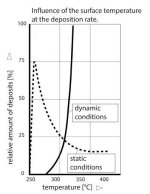
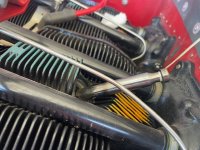
Just before this incident, I had installed the Tunnel Cooling Flap kit designed for the EXP-119 engine on RV-14s. My plane has a Vetterman trombone exhaust (2 x 2-into-1), meaning the tunnel is empty providing addition cowl exit area and even greater cooling than a stock setup. While I was installing it in the quest for speed/efficiency, it became a good way to increase engine temps in an attempt to reduce valve guide buildups (following the Camguard and Mike Busch school's of thinking).
At 396 hours (125 since last incident), I again experienced a sticking exhaust valve, again on cylinder #2 on 2 days. Day 1 involved "morning sickness" for 30 seconds prior to a normal flight with 2 segments, an hour each. On Day 2, morning sickness occurred again, for about 45 seconds. After a normal run-up (with CHTs all over 250), I took off and had cylinder #2 drop out for 6 seconds on climb out, followed by 45 minutes of normal operation.
Now - the update to the story:
Lycoming Technical Service spent about 40 minutes on the phone with me, but every idea for a cause was a dead end - they are stumped.
1. too cool? - except I increase CHTs with the tunnel cooling flap and "harder" operations, and cylinder #2 runs 350 in cruise, a good number.
2. dirty oil? - I change every 40 hours, and my silicon reading is very low
3. slow flight operation (cool and low power)? - I don't do this
4. glazed cylinder with excess oil going to valve? - 78/80 on all cylinders
Lycoming recommendations:
1. SB 388 C (wobble test) on all cylinders
2. SI 1425A - ream valve guides on all cylinders
forward results to Tech Service
To perform the infamous wobble test, you need fixture (ST310 for angle valve) which Lycoming will rent to you. This process is really tedious - I had to call a Lyc distributor (Aircraft Spruce) who called Lycoming to verify the tool is available, and it then drop ships from Lycoming. The rental for 30 days is a somewhat reasonable $100, but Lycoming also requires a $4,600 deposit before shipping (they REALLY want it back - refunded on return). It took a week to get the tool. You can buy an alternate tool from ACS for <$300, but it is out of stock until January, so I went with the rental. Before the rental tool fixture arrived, I was able to borrow the ACS tool (made by Sydow) from a neighbor, and in my hands, the ACS/Sydow version was superior to use.
The wobble test
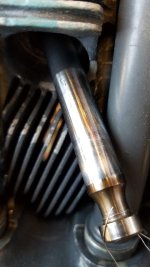
SB 388C measures the "lateral play" end to end in the valve guide. I believe the idea is that too little play and differential expansion rates will cause binding (morning sickness until everything warms up, and again under high load such as climb out). Too much play and there is excess room for deposits and contaminants to build up. For an angle value, the acceptable wobble is 0.015 to 0.030". To perform the measurement, an extension is fastened to the end of the valve stem, with the extension displaced in opposite directions by prying against the case, and the differential measured, either with feeler gauges against a set screw or with a micrometer gauge. My good cylinders were .020 and .022" with the faulty #2 only 0.012".
Next comes
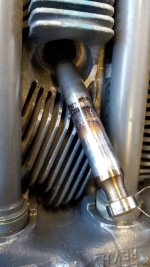
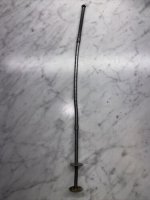
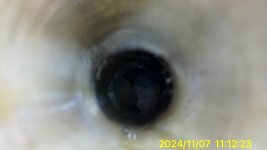
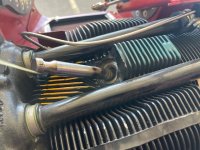
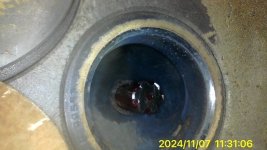
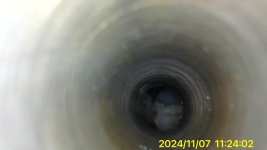
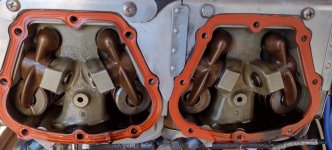
SI 1425A for reaming the valve guides. The valve springs have to be removed (this was done before the SB388C), and the valve pushed into the cylinder. A reamer is greased (to catch debris) and fed into the guide. A clean guide will accept the reamer with only hand forces - this was true of my cylinders #1 and #4. Valve guides with buildup with require more force - either a hand tool on the reamer or in my case, I used a power drill at very slow speed. Cylinder #3 had minor buildup (a trace of black coke on the bit) and a coating on the valve stem that cleaned off with acetone and scotchbrite. Cylinder #2 (the problem child) had a clean valve stem but more significant coking in the guide. After reaming, the wobble test was 0.018" - still my tightest but close to the rest. After all the reaming, the valves have to be fished back into the guide (a tricky endeavor), the springs and keepers reinstalled, pushrods and shrouds put back if removed, and rockers, covers etc. put back.
The plane is back in the air - two flight days with normal operations. I have asked Lycoming about using CamGuard additive in the oil (captures monomers that form varnish) and TCP fuel additive that scavenges lead.
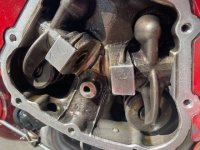
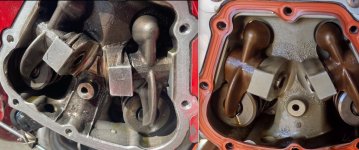
I will post some pictures in a separate post for those interested.
Let the ideas and suggestions start ...