Van's Air Force

The definitive Van's Aircraft support community! Buying, building or flying an RV? Join our exclusive family of mentors and enthusiasts!

Spinning one's RV 8

Bingo! No perception to need to swap rudder. And also no reason to think longitudinal stick direction as you presume you’re still upright (or inverted in the other case). Train to repetitive cycles of scan through Altitude, AOA, and Turn Needle. Such will resolve this problem.

Whereas AOA will tell you upright or inverted and Turn Needle will tell you left or right. There is no ambiguity in either instrument. Roll direction will however, skew a turn coordinator. And your eyeballs can deceive you too, looking down the nose is fallible and all the more-so due to lack of reassessment with expectation as you’ve illuminated. Human eyes more readily perceive the roll as direction than the yaw. When such agrees with what they expect, there you go, and you might not even think to hold a hand over your brow to block the larger roll views since you’ve got what you expect. Now, as Turn and Slip are antique while the evil Turn Coordinator is antiquated, good luck getting the companies to tell you whether or not their turn rate sliders and bars are strictly yaw or mix roll rate. AOA and Turn Needle. AOA and Turn Needle. AOA and Turn Needle. Keep checking and rechecking. Though add altitude in the cycle to know when to punch. In Navy training, you basically don’t stop reading out loud altitude, AOA, Turn Needle repetitively. Verbalize the first few steps as you do them, verbalize the scan, verbalize the next few steps, verbalize the scan, then repeat the scan.

It is quite some time since I made my previous comments, but I can’t resist. The constant comments about AOA are somewhat pointless, in that if you are in a developed spin, you have already exceeded the critical AOA. This continued discussion is more concerned with regaining the suitable AOA. The other repeated comments concerning opposing the turn needle is not correct. What is required, is to oppose the YAW. It is the SLIP ball which indicates yaw. I have no experience with high powered dedicated aerobatic aircraft, but would think that they obey basic aerodynamics. No one in this discussion has referred to basic truths. Unless AOA is exceeded, no stall. You cannot stall with zero ‘g’. So long as there is no yaw, the aircraft will not spin. Basic yes, but so many have not put this together.

I am not qualified to comment on dedicated aerobatic aircraft, but as an ex Navy fighter/test pilot, I have plenty of experience recovering from both deliberate spins and departures due to my ham fistedness during so called combat maneuvering.
As many of you have said, an inverted spin can be confusing, but the slip ball (indicator) will not lie, unlike the turn needle which can.

To repeat what I said earlier, other techniques may well be effective with some aircraft, but in my experience, which includes high wing loaded swept wing aircraft, the one method that has always worked for me in a wide variety of both light and high wing loaded military straight and swept wing aircraft, is as Mr. Luddite and others have said, throttle close, ailerons neutral, FULL opposite rudder, pause, stick smoothly forward until the spin stops. NEURALISE RUDDER. Then SMOOTHLY recover from the dive. Stress on the SMOOTHLY.

I think experienced aerobatic pilots not recovering, while interesting should not be included, because there are so many extreme conditions which are not known. It is interesting to check… unrecoverable MILITARY spin accidents. The reason for stressing military, is due to the standardized, disciplined spin recovery training in aircraft known to be reliable.

As someone has previously said. Why try to reinvent the wheel?
 
One small addition to my previous comments, is that I have not flown a computer controlled or assisted military aircraft. I have no idea how the latest aerodynamics, or computers might affect spin recovery. My military flying was in earlier jets from first generation non hydraulic controls, to what might be considered third generation with full hydraulic controls with no manual reversion. The spin characteristics on some were quite….vigorous, but they all recovered when the well proven recovery action was used.
 
The constant comments about AOA are somewhat pointless, in that if you are in a developed spin, you have already exceeded the critical AOA. This continued discussion is more concerned with regaining the suitable AOA. The other repeated comments concerning opposing the turn needle is not correct. What is required, is to oppose the YAW. It is the SLIP ball which indicates yaw.

As many of you have said, an inverted spin can be confusing, but the slip ball (indicator) will not lie, unlike the turn needle which can.

Why try to reinvent the wheel?

The ball mostly shows yaw when in controlled flight; after departure, the ball merely reflects which side of cg the instrument is on. If centered over the longitudinal axis, the ball ends up in a random direction. Consider the multi-engine with an engine out and how the ball differs from the yaw string. Turn Needle is the only thing that reflects the yaw. (Yaw strings have issues with localized flows.) Turn needle works erect and inverted while looking down the nose is fallible. Turn coordinators are unreliable if inverted as you don’t know if roll rate or yaw dominates. As to AOA, it tells you whether or not you’re inverted. I’m not reinventing the wheel.

This is old school Navy teaching.

The only reliable thing for sense is AOA, the only reliable thing for direction is Turn Needle.
 
@Brent


In spin recoveries, we have yet another concern raised by Mason applicable to all airplanes and gliders in terms of how do we determine in which direction are we spinning. The direction of yaw is our direction of spin while roll and yaw match when erect but go opposite if inverted. A back of airplane view Turn Coordinator may lead you astray while the needle style Turn and Slip Indicator will always serve you well:

Pilots have spun all the way to the ground thinking they were in an erect spin when they were actually inverted. An inverted spin may not appear all that inverted in attitude. The pilot may be only slightly against the belt, perhaps only a little more than an erect, steep, nose-down spin.

During an inverted spin a pilot must be aware of which way the nose is yawing. This is determined by looking directly down the nose. It is also true that the old-fashion turn indicator determines yaw equally well, whether the airplane is erect or inverted. However, the modern turn coordinator requires interpretation. It displays both yaw and roll as a roll. This information could be interpreted as yaw during an erect spin, but would be extremely confusing during an inverted spin. The ball portion of both these instruments means nothing during a spin.


The USN via the T-6 OCF FTI gives us emphasis for Turn Indicator,

Disorientation experienced by the pilot during an inverted spin is primarily because the yaw and roll occur in opposite directions. Pilots are more sensitive to motion about the longitudinal axis than the vertical axis, and are consequently more likely to interpret an inverted spin in the direction of roll rather than the direction of yaw. Regardless of whether the aircraft is spinning erect or inverted, the turn needle will always deflect fully in the direction of spin and is the only reliable indication of spin direction.


One small addition to my previous comments, is that I have not flown a computer controlled or assisted military aircraft. I have no idea how the latest aerodynamics, or computers might affect spin recovery. My military flying was in earlier jets from first generation non hydraulic controls, to what might be considered third generation with full hydraulic controls with no manual reversion. The spin characteristics on some were quite….vigorous, but they all recovered when the well proven recovery action was used.

Highly fuselage loaded aircraft need aileron use for recovery. There is one plane that needs both aileron and differential thrust.
 
The ball mostly shows yaw when in controlled flight; after departure, the ball merely reflects which side of cg the instrument is on. If centered over the longitudinal axis, the ball ends up in a random direction. Consider the multi-engine with an engine out and how the ball differs from the yaw string. Turn Needle is the only thing that reflects the yaw. (Yaw strings have issues with localized flows.) Turn needle works erect and inverted while looking down the nose is fallible. Turn coordinators are unreliable if inverted as you don’t know if roll rate or yaw dominates. As to AOA, it tells you whether or not you’re inverted. I’m not reinventing the wheel.

This is old school Navy teaching.

The only reliable thing for sense is AOA, the only reliable thing for direction is Turn Needle.
I have no experience of flying a multi engine aircraft with a yaw string fitted, I can’t think of the point, but it is irrelevant in this discussion.

All aircraft have the slip ball or its equivalent is more or less on the longitudinal axis. The slip ball does not lie, if the it airraft is yawing upright or inverted w
 
I have no experience of flying a multi engine aircraft with a yaw string fitted, I can’t think of the point, but it is irrelevant in this discussion.

All aircraft have the slip ball or its equivalent is more or less on the longitudinal axis. The slip ball does not lie, if the it airraft is yawing upright or inverted

It is highly relevant as it proves the ball doesn’t actually show yaw. Many inclinometers are not close to the longitudinal axis though even minor displacement means the centrifugal of the spin puts that ball to the outside relative to instrument placement. If on axis, then it really depends on where it was as the spin starts though oscillations will give it a chance to flip. Once you’ve departed controlled flight, all the inclinometer does is lie. It is generally good in controlled flight though not perfect, yet good enough (that is the point of contrasting the MEL yaw string, to show not perfect). After departure, Turn Needle good, ball bad.

If, however, you’re misnaming Turn and Slip indicator meaning Turn Needle as opposed to the Turn Coordinator, then I’m with you. Turn coordinator ok if erect, unreliable if inverted. The TC is susceptible to roll rate dominating yaw rate and it is also susceptible to instrument position within the panel skewing such. TN good, TC bad.


Here is some old school footage regarding Turn Needle:


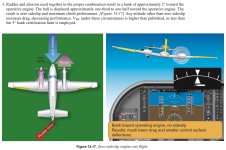
And here is the Airplane Flying Handbook regarding that yaw string on a multi (which was included on the F-14 as standard production equipment; non-multi but AV-8 and U-2 also had them). As the props don’t wash the windscreen and initial parts of cockpit windows aft of windscreen, multis can actually get away with both yaw strings and side strings, yaw string for true yaw and side string for AOA. Strings may get messy flying through weather hence why we likely don’t use them, but many MEIs will put a yaw string on for the first few flights such that a student can see the difference true sideslip versus the ball when first getting into engine out operations. Getting the yaw string straight significantly reduces drag in a low performance capacity situation. It actually has value.

IMG_0467.jpeg
 
It is the SLIP ball which indicates yaw.

The slip ball DOES NOT indicate yaw, it indicates lateral acceleration forces acting on the instrument. Just try doing a stable slip - once stabilized in a slip, an aircraft has no yaw yet the slip ball will not be centered due to a portion of the gravity vector acting laterally on the aircraft. The needle of a turn and slip indicator gyro DOES indicate yaw.

Skylor
 
I have no experience of flying a multi engine aircraft with a yaw string fitted, I can’t think of the point, but it is irrelevant in this discussion.

All aircraft have the slip ball or its equivalent which is more or less on the longitudinal axis. The slip ball does not lie,
Consider an aircraft flying straight and level with a boot full of rudder. The slip indicator will be trying to escape one way or the other. The turn needle will indicate neutral…no turn. Now allow speed to degrade to exceed the critical AOA the aircraft may well spin.
The problem with your insistence on referring to the turn needle, is that to many, the turn needle is associated with aileron, not rudder. You really do not want to oppose a spin by using aileron, EXCEPT with some aircraft to use IN spin aileron to help recovery in some circumstances.
 
The slip ball DOES NOT indicate yaw, it indicates lateral acceleration forces acting on the instrument. Just try doing a stable slip - once stabilized in a slip, an aircraft has no yaw yet the slip ball will not be centered due to a portion of the gravity vector acting laterally on the aircraft. The needle of a turn and slip indicator gyro DOES indicate yaw.

Skylor
You raise an interesting point as far as semantics are concerned. If you claim in a group of experienced pilots that an aircraft in a slip is not yawing but lacking in lateral acceleration I think you will be greeted with a glazed expression. If an aircraft in a stable slip decreases the airspeed, or to be precise increases the AOA beyond the critical AOA, by your interpretation the aircraft will not spin because there is no ‘lateral acceleration thus no yaw. That is absolute nonsense.

Perhaps Mr. Luddite might have som comments about lateral acceleration.
 
You raise an interesting point as far as semantics are concerned. If you claim in a group of experienced pilots that an aircraft in a slip is not yawing but lacking in lateral acceleration I think you will be greeted with a glazed expression. If an aircraft in a stable slip decreases the airspeed, or to be precise increases the AOA beyond the critical AOA, by your interpretation the aircraft will not spin because there is no ‘lateral acceleration thus no yaw. That is absolute nonsense.

Perhaps Mr. Luddite might have som comments about lateral acceleration.

And in fact most accomplished aerobatic pilots will tell you that a stall in a slip does not lead to a spin. I have confirmed this in my -8. You generally need yaw (skid) to induce a spin.

Skylor
 
The slip ball DOES NOT indicate yaw, it indicates lateral acceleration forces acting on the instrument. Just try doing a stable slip - once stabilized in a slip, an aircraft has no yaw yet the slip ball will not be centered due to a portion of the gravity vector acting laterally on the aircraft. The needle of a turn and slip indicator gyro DOES indicate yaw.

Skylor

Define yaw? Yawing motion or yawing moment? Or is it presence of side wind? And which is of more concern? The FAA books generally use the motion for the definition which is the most useless of the definitions. They do, however, recognize ‘yawing moment’ thus yaw as adjective to moment which is the most useful way of it.

Agree that the ball does not indicate yaw and this is the important part as this is the safety part. Disagree that there is no yaw once stabilized in a slip. What it is is balanced out with horizontal lift, but it is still there. The turn needle indicates yaw direction in a spin which is all you need from it.

In controlled flight, TN shows turn rate or scale of degrees heading change per second, which is not the same as yaw moment but could be considered yaw motion. Consider the yaw string a moment. It directly shows beta or the angle of side wind. As side wind is a result of improper coordination, it reflects adequacy of yaw not yaw itself. In controlled flight, the ball is a pretty good proxy of this. As such both are good in controlled flight as directors for more or less yaw though neither show actual yaw (neither motion nor moment but need for moment). They each show sufficiency of yaw.

In a spin, the ball is useless as it displaces to centrifugal forces. In a spin the yaw string could be good in your particular glider or it could suck. It is susceptible to local airflow disturbances. Some nicely and cleanly point in spin, others not as much. Turn Needle, however, shows direction of turn in the spin.

The TN gives degrees turn over time which is the yawing motion and has use in controlled flight though it does not reflect side wind in such. It does not show yawing moment. If you’re instrument flying, you’re concerned about the motion and that rate. If you’re looking to maintain controllability, you’re more worried about both the side wind and the yawing moment not the motion. If you’re looking to recover, the moment is your concern.

In a slip, you are yawing. It is just you have no yawing motion. The moment is there.

You raise an interesting point as far as semantics are concerned. If you claim in a group of experienced pilots that an aircraft in a slip is not yawing but lacking in lateral acceleration I think you will be greeted with a glazed expression. If an aircraft in a stable slip decreases the airspeed, or to be precise increases the AOA beyond the critical AOA, by your interpretation the aircraft will not spin because there is no ‘lateral acceleration thus no yaw. That is absolute nonsense.

There is a whole other thread on this.


And in fact most accomplished aerobatic pilots will tell you that a stall in a slip does not lead to a spin. I have confirmed this in my -8. You generally need yaw (skid) to induce a spin.

Skylor

Yes, you can spin from a slip, but it takes a lot of work and is not direct. Vac has a video in which you hear him adding extra top rudder to “drive it over the top.” But technically you can’t spin directly from a slip. Your slip first has to kick over the top into a skid and then spin. This won’t happen until you lose aileron authority and can no longer counter the rolling moment of the rudder. This means you have to be deeper into stall for such to occur in well designed planes as the stall has to get to the ailerons. You can get there, extra rudder as Vac did, or deeper stall losing ailerons. The motions may not be there in the moment of stall, but the moments are and in the moment they’re still balanced but not for long.

Interesting on this subject, I’ve found a glider video that shows spinning if stalled in the slip and merely removing the slip to coordinated flight in this particular craft.
 
Consider an aircraft flying straight and level with a boot full of rudder. The slip indicator will be trying to escape one way or the other. The turn needle will indicate neutral…no turn. Now allow speed to degrade to exceed the critical AOA the aircraft may well spin.
The problem with your insistence on referring to the turn needle, is that to many, the turn needle is associated with aileron, not rudder. You really do not want to oppose a spin by using aileron, EXCEPT with some aircraft to use IN spin aileron to help recovery in some circumstances.

The ball is preventative; the TN is corrective.

The multi is wing loaded, as are gliders, so you actually want to do out-spin aileron. The inertial concerns override the adverse yaw aero concern. For fuselage loaded craft, in spin aileron adds inertial and aero for recovery advantage. For balanced loading, aileron is strictly an aero concern and you want in spin for the favorable outside adverse yaw. Though really for the wing loaded, elevator will be your biggest ticket to get input quickly. The craft must be heavily fuselage loaded for aileron to become primary. For the most of us in between these cases, rudder wins. Neutral aileron eliminates the confusion as to which way you’re loaded. Note also aileron flips if inverted. Have a look at both those articles previously linked.

The TN is not associated with aileron. Aileron rolls result in very little TN movement. There will be some as rolls aren’t pure, you’re making an egg with your nose as opposed to a dot, but still very little TN. Do a flat rudder turn, however, and you’ll see plenty of TN. You will need counter aileron to inhibit rudder induced roll in order to turn flat which adds to the point as the TN will be opposite the ailerons in such. Yes, the ball will also be displaced.

Insistence of TN comes specifically to after departing controlled flight. There is a critical distinction here. The ball is good while in controlled flight for managing coordination including deliberately un-coordinating (slipping), but after departure it is no good as centrifugal forces mess it up. Ball before departure helps you avoid spin, TN after to get out of spin. Yaw string before like the ball. Yaw sting after only if you’ve tested it in known directions to prove you have clean airflow. TC after only if upright.


The ball is preventative; the TN is corrective.


Yes, you can spin from a slip, but it takes a lot of work and is not direct. Vac has a video in which you hear him adding extra top rudder to “drive it over the top.” But technically you can’t spin directly from a slip. Your slip first has to kick over the top into a skid and then spin. This won’t happen until you lose aileron authority and can no longer counter the rolling moment of the rudder. This means you have to be deeper into stall for such to occur in well designed planes as the stall has to get to the ailerons. You can get there, extra rudder as Vac did, or deeper stall losing ailerons. The motions may not be there in the moment of stall, but the moments are and in the moment they’re still balanced but not for long.

Interesting on this subject, I’ve found a glider video that shows spinning if stalled in the slip and merely removing the slip to coordinated flight in this particular craft.

Yes, but once the "extra top rudder to drive it over the top" is added means that the slip is no longer stabilized and yawing motion is introduced. I guess I need to rephrase to "a stabilized slip" is unlikely to lead to a spin, just like a coordinated turn is unlikely to lead to a spin.

Skylor
 
@luddite42

You might find this interesting:


The T-38 crossed over from inverted to erect spin with no control input changes. Though we have to caveat this translation was during incipient not developed spin. It both entered the inverted spin and crossed over to the erect spin all while longitudinal stick was neutral.

“at one hundred forty knots and a forty degree pitch attitude, the application of full left rudder and right aileron with zero degrees horizontal stabilizer caused the aircraft to enter an inverted spin. After two turns it transitioned to an erect attitude.” No rudder swap. No forward stick nor forward to aft stick motion.

“The inverted entry technique frequently resulted in erect spin initiation.”
 
@luddite42

You might find this interesting:


The T-38 crossed over from inverted to erect spin with no control input changes. Though we have to caveat this translation was during incipient not developed spin. It both entered the inverted spin and crossed over to the erect spin all while longitudinal stick was neutral.

“at one hundred forty knots and a forty degree pitch attitude, the application of full left rudder and right aileron with zero degrees horizontal stabilizer caused the aircraft to enter an inverted spin. After two turns it transitioned to an erect attitude.” No rudder swap. No forward stick nor forward to aft stick motion.

“The inverted entry technique frequently resulted in erect spin initiation.”
Yes, the uncommanded crossover is interesting...a characteristic which no piston airplane exhibits of course.
 
The T-38 crossed over from inverted to erect spin with no control input changes. Though we have to caveat this translation was during incipient not developed spin. It both entered the inverted spin and crossed over to the erect spin all while longitudinal stick was neutral.

I have thus far been unable to find a soft copy of the T-38 spin report though I did find a page with synopsis from the report:

“This report presents the results of the Air Force Flight Test Center's evaluation of the T-38 spin characteristics. The T-38 is a two place tandem supersonic trainer. The mission of the airplane is to accomplish all phases of basic pilot training, including: day and night transition, formation, navigation, instrument and aerobatic flying. The T-38 will not enter a continuing spin except following an abrupt application of the aft stick at close to maximum possible rates. This aft stick rate required is abnormal to a degree that an intentional rapid aft stick deflection is required. The spin modes of the T-38 include an unstable inverted mode, a continuing oscillatory erect mode, and a continuing erect smooth flat mode which may develop from the oscillatory mode. The immediate corrective procedure for all out-of-control gyrations following intentional or inadvertent control application is to neutralize and release all controls. If the aircraft spins, the recovery procedure for the inverted spin mode is to neutralize and release all controls and wait for the spin to break or convert to an erect spin. The recovery procedure for an erect spin is to apply and hold full rudder against the spin, full back stick, and as much aileron with the spin as can be held. Recovery from the inverted spin is very positive and fast; however, recovery from an erect spin, either oscillatory or smooth and flat, cannot be assured. Recovery from the oscillatory spin can be made in from to [sic] to eight turns providing the engines do no both flame-out (double engine flame-outs can be expected in a spin) and hydraulic pressure to the control system is not lost. An electrical back-up hydraulic system is required to assure recovery from an oscillatory spin. Due to the uncertainty of recovery, intentional spins in the T-38 should be prohibited and appropriate warning placed in the Flight Manual.”

Neutral controls and allow the inverted to break or convert and if converting to erect, or somehow starting erect, then opposite rudder, stick full aft — T-38 is a significantly fuselage loaded platform — and in-spin with spin aileron, again for fuselage loaded inertial concerns (not so much the outside wing adverse yaw achieved aerodynamically that you would presume (though such is another little bit of anti-spin contribution)).

 
Yes, the uncommanded crossover is interesting...a characteristic which no piston airplane exhibits of course.
Hi Mr. Luddite, I suspect that you know more about actually flying generic aircraft than some who attempt to dazzle the great unwashed with pseudo technical expressions. I have never experienced this so called cross over, presumably because I know how to recover from a spin, and consequently I was ready and quite happy when it stopped.

Having stroked you enough, I have to mention that I had some in depth training on various types of spins with members of the Russian aerobatic team. (They weren’t Russians, but Lithuanians flying with the team when it was the USSR). The ‘heads up’ that they gave me, was that after recovering from an extensive flat spin, be very ready to neutralize controls otherwise it may well transition into an inverted spin. Again, despite spinning through the skies in numerous aircraft, many very high wing loaded swept wing aircraft I have never heard the term ‘crossover’. Could it be a fancy term meaning reversing direction, enquiring minds wonder?

I don’t know anything about T38 that you mentioned has an 840 degree/sec rate of roll, I am sure that is a very good aircraft. What I can tell you with certainly, is that the aircraft I flew from a carrier, and other places, was claimed to have a 540 degree/sec rate of roll. I didn't actually count them myself, but when necessary with a nasty trying to get on my tail, a bootful of rudder increased even that roll rate. This was in the early sixties with nary a computer in sight. This aircraft weighed 42,000lbs loaded. A spin in this aircraft was quite attention getting, but I was never ever tempted to experiment and release the stick to neutral, and I was very alert not to have ANY out spin aileron. I suspect that a number of aircraft, particularly swept wing have been lost due to having a little out spin aileron.

Keep Ludditing
 
And in fact most accomplished aerobatic pilots will tell you that a stall in a slip does not lead to a spin. I have confirmed this in my -8. You generally need yaw (skid) to induce a spin.

Skylor
Perhaps because I have difficulty taking some of the esoteric comments of some seriously, I should have been more specific. If you are in a slip or skid, same thing really. I suspect that in my RV8 I ran out of elevator authority before stalling the wing. I have not managed to spin from a slip when descending, but then I would prefer not to since mostly when I am slipping on the approach it is because I miss judged it.

Whether it is referred to as a slip or a skid, you are applying rudder and opposing it with aileron. That is yaw. As I said to start, I am not sure that you can reduce speed ( increase AOA) in a descent enough to stall…….. unless you are pulling ‘g’ of course.
 
It is highly relevant as it proves the ball doesn’t actually show yaw. Many inclinometers are not close to the longitudinal axis though even minor displacement means the centrifugal of the spin puts that ball to the outside relative to instrument placement. If on axis, then it really depends on where it was as the spin starts though oscillations will give it a chance to flip. Once you’ve departed controlled flight, all the inclinometer does is lie. It is generally good in controlled flight though not perfect, yet good enough (that is the point of contrasting the MEL yaw string, to show not perfect). After departure, Turn Needle good, ball bad.

If, however, you’re misnaming Turn and Slip indicator meaning Turn Needle as opposed to the Turn Coordinator, then I’m with you. Turn coordinator ok if erect, unreliable if inverted. The TC is susceptible to roll rate dominating yaw rate and it is also susceptible to instrument position within the panel skewing such. TN good, TC bad.


Here is some old school footage regarding Turn Needle:


And here is the Airplane Flying Handbook regarding that yaw string on a multi (which was included on the F-14 as standard production equipment; non-multi but AV-8 and U-2 also had them). As the props don’t wash the windscreen and initial parts of cockpit windows aft of windscreen, multis can actually get away with both yaw strings and side strings, yaw string for true yaw and side string for AOA. Strings may get messy flying through weather hence why we likely don’t use them, but many MEIs will put a yaw string on for the first few flights such that a student can see the difference true sideslip versus the ball when first getting into engine out operations. Getting the yaw string straight significantly reduces drag in a low performance capacity situation. It actually has value.

View attachment 110361
As I said, I have never seen a yaw string on a multi engined aircraft, neither do I see the point if the instructor knows what the yaw indicator is for. In the glass cockpits os the various multi engined aircraft, it is digitally presented, in earlier aircraft that we all know and love it is the little ball that our instructor told us to step on, otherwise, if we then stall he would demonstrate a spin.
We really don’t need simplistic cartoons to demonstrate the obvious.
 
Hi Mr. Luddite, I suspect that you know more about actually flying generic aircraft than some who attempt to dazzle the great unwashed with pseudo technical expressions. I have never experienced this so called cross over, presumably because I know how to recover from a spin, and consequently I was ready and quite happy when it stopped.

Having stroked you enough, I have to mention that I had some in depth training on various types of spins with members of the Russian aerobatic team. (They weren’t Russians, but Lithuanians flying with the team when it was the USSR). The ‘heads up’ that they gave me, was that after recovering from an extensive flat spin, be very ready to neutralize controls otherwise it may well transition into an inverted spin. Again, despite spinning through the skies in numerous aircraft, many very high wing loaded swept wing aircraft I have never heard the term ‘crossover’. Could it be a fancy term meaning reversing direction, enquiring minds wonder?

I don’t know anything about T38 that you mentioned has an 840 degree/sec rate of roll, I am sure that is a very good aircraft. What I can tell you with certainly, is that the aircraft I flew from a carrier, and other places, was claimed to have a 540 degree/sec rate of roll. I didn't actually count them myself, but when necessary with a nasty trying to get on my tail, a bootful of rudder increased even that roll rate. This was in the early sixties with nary a computer in sight. This aircraft weighed 42,000lbs loaded. A spin in this aircraft was quite attention getting, but I was never ever tempted to experiment and release the stick to neutral, and I was very alert not to have ANY out spin aileron. I suspect that a number of aircraft, particularly swept wing have been lost due to having a little out spin aileron.

Keep Ludditing
I have to wonder if the correct verb should have two Ts as in Luditting?

Regardless, being a simple soul, I like to instruct in simple terms.
If you exceed the critical angle of attack the wing will stall. All that means is that it is still producing lift, but not enough to be equivalent to weight.
The wing will stall at any speed depending the amount of lift it has to generate…’g’ loading.
If there is zero ‘g’ the wing won’t stall.
If there is no yaw, there will be no spin. You can stall all day, there will be no spin without yaw…….keep the ball centered!
If there is a stall with yaw at higher than normal speed, the spin will be more rapid.
Bottom line…… keep the ball in the center!

As I said, a simple soul, and after 68 years of attacking the air, those rules still apply. Mind you, over those years, being a simple soul I have violated those incredibly simple rules, then been forced to recover.

Obviously this does not apply to an aerobatic regime.
 
It's a common term not a fancy term in the acro world simply referring to a spin that has transitioned from upright to inverted or vice versa, usually in the context of a pilot's failure to recognize it.

https://cdn.imagearchive.com/biplaneforum/data/attach/1/1444-Pitts-S-1-Spin-Crash-Canada-7-12.pdf
I must admit to being just a little facetious, I obviously understood what was meant, and freely admit to not being in the aerobatic world, but I do know not to screw up a recovery if possible. I also mentioned previously that I have no experience of modern dedicated aerobatic aircraft. For example I have seen some maneuvers that I cannot visualize the control inputs required, but I have enjoyed your comments.
 
Again, despite spinning through the skies in numerous aircraft, many very high wing loaded swept wing aircraft I have never heard the term ‘crossover’.

I think there is a point of confusion here. Wing loading is different than wing loaded. When we talk about spins, we’re talking about where is the majority of inertia, both mass and its displacement from cg, in terms of the wings or in the fuselage. In this sense most swept wing platforms in which you’d be spinning are actually fuselage loaded. A century series fighter has extremely high wing loading but is fuselage loaded. Some very low wing loading aircraft like gliders are actually wing loaded as they have more inertia in the wings than the fuselage.
 
As I said, I have never seen a yaw string on a multi engined aircraft, neither do I see the point if the instructor knows what the yaw indicator is for. In the glass cockpits os the various multi engined aircraft, it is digitally presented, in earlier aircraft that we all know and love it is the little ball that our instructor told us to step on, otherwise, if we then stall he would demonstrate a spin.
We really don’t need simplistic cartoons to demonstrate the obvious.

Yet while flying with an engine out, that ball shouldn’t be centered else you have side winds and are carrying extra drag that could really hurt you especially at density altitude. A centered ball in a single engine twin is yawing. Comparing the yaw string to the inclinometer is the point here showing a centered ball no longer reflects what you think it does.

To be fair, it would be nice if the graphic showed both the bank into the good engine and the ball displaced into it with the centered yaw string. It showed the yaw string centered with ball offset, but it failed to show the bank. The triangles shouldn’t be aligned in that graphic. And this would have helped to show the ball to the inside as this is where the low point will be.
 
Last edited:
You guys turned this simple beautiful question into something that has nothing to do with RVs. Moderators should close it
The one simple beautiful question was about PARE which also has nothing specifically to do with RVs though is also one of those “Kahneman” substitution type questions when we ask one thing but are really looking for something else. In this case the something else is more robust appreciation for spins and recoveries for which the topic has been generally adhered.
 
Warning: This post is about IAC competition spin minutia, but it does add a different type of spin entry to the discussion which is fun to do.

Because some posters are interested in crossover spins, I will point out that there are two types. The accidental type has been discussed at length here.

The intentional type was part of the IAC catalog of acceptable figures for Unlimited for many years. While the nose is dropping after the stall, the elevator is reversed and the plane "crosses over" to spin under the opposite g loading. For example, after a stall upright the elevator is moved fully forward while full rudder is applied (or just after rudder) and the plane pitches down and smoothly enters an inverted spin. I've never done one in an RV, but I watched (and competed against) Scott Riddell while he flew Unlimited in his RV4 in the '90s, and he did crossover spins beautifully. I found them to be more fun than ordinary spins in my Pitts because you have to get the timing of the elevator reversal just right.

(More minutia: This was possible under IAC rules that required the nose to drop through the horizon before yaw was initiated. The crossover spin was removed at about the same time as the rule was changed to require yaw, pitch and roll to start at the same time during spin entry. Also at about the same time crossover snaps were removed. I don't remember the rationale for these changes.)
 
Yet while flying with an engine out, that ball shouldn’t be centered else you have side winds and are carrying extra drag that could really hurt you especially at density altitude. A centered ball in a single engine twin is yawing. Comparing the yaw string to the inclinometer is the point here showing a centered ball no longer reflects what you think it does.

To be fair, it would be nice if the graphic showed both the bank into the good engine and the ball displaced into it with the centered yaw string. It showed the yaw string centered with ball offset, but it failed to show the bank. The triangles shouldn’t be aligned in that graphic. And this would have helped to show the ball to the inside as this is where the low point will be.
A twin with a centered ball with an engine out is not yawing, it’s crabbing (slipping, actually)!. If a twin is flying engine-out, wings level, ball centered, the heading remains constant (no yaw) but the rudder force that is being used to stop the yaw created by the asymmetrical thrust is also creating a sideways force on the airframe that needs to be offset by adjusting the lift vector of the wing, hence the bank into the dead engine. To say the airplane is “yawing” is like saying the airplane is “rolling” when holding a steady bank.

Skylor

p.s. Single rotor helicopters exhibit a similar balance of force requirement as an engine out twin. The tail rotor thrust requires to stop yaw from the main rotor torque moves the helicopter sideways unless the rotor disk is also banked slightly in the direction of tail rotor thrust.
 
Last edited:
A twin with a centered ball with an engine out is not yawing, it’s crabbing!. If a twin is flying engine-out, wings level, ball centered, the heading remains constant (no yaw) but the rudder force that is being used to stop the yaw created by the asymmetrical thrust is also creating a sideways force on the airframe that needs to be offset by adjusting the lift vector of the wing, hence the bank into the dead engine. To say the airplane is “yawing” is like saying the airplane is “rolling” when holding a steady bank.

Skylor

p.s. Single rotor helicopters exhibit a similar balance of force requirement as an engine out twin. The tail rotor thrust requires to stop yaw from the main rotor torque moves the helicopter sideways unless the rotor disk is also banked slightly in the direction of tail rotor thrust.

Yawing, crabbing, whatever. Point is you need to eliminate the sideslip or beta. You are countering the yawing moments. To do so, you roll into the good engine not the dead engine. Both rudder steps on the good engine and bank is into the good engine. With such the ball will be displaced slightly into the good engine when in coordinated flight with zero beta. You may not be rolling while holding a steady bank but you are rolled.

As for relativity to this conversation and spins, it is regarding the inclinometer not necessarily being centered for coordinated flight. This is another exception to such while in spins the inclinometer is useless.
 
Yawing, crabbing, whatever. Point is you need to eliminate the sideslip or beta. You are countering the yawing moments. To do so, you roll into the good engine not the dead engine. Both rudder steps on the good engine and bank is into the good engine. With such the ball will be displaced slightly into the good engine when in coordinated flight with zero beta. You may not be rolling while holding a steady bank but you are rolled.

As for relativity to this conversation and spins, it is regarding the inclinometer not necessarily being centered for coordinated flight. This is another exception to such while in spins the inclinometer is useless.

"Yawing, crabbing, whatever." :mad: THAT'S THE WHOLE POINT AND IT'S NOT "WHATEVER". These are two distinctly different things! In the single engine twin, the rudder is what is countering the yawing-moment (and resultant yawing motion) of the asymmetrical thrust.

The point that relates to spins is this: It takes YAW MOTION (rotation about the airplane's vertical axis) to create the autoration that results in a spin. I agree that the inclinometer is useless during spins, but not necessarily before. I understand that in a C-150 the inclinometers on opposite side of the panel will indicate opposite readings because they are affected by the centrifugal force of the spin itself. However, the turn indicator needle will indicate the rotation direction in the spin. BTW, one important point that may mislead people into thinking that you can spin from a steady slip is that stalling during the slip does require constant adjustment of the rudder to prevent yaw from occurring as speed and asymmetrical drag occurs on the wings. If at any time during the stall, yaw motion is allowed to occur, a spin becomes more likely.

Skylor
 
Last edited:
I must admit to being just a little facetious, I obviously understood what was meant, and freely admit to not being in the aerobatic world, but I do know not to screw up a recovery if possible.
Well, the whole problem is that knowledge does not replace muscle memory. Everyone "knows" not to screw up a recovery until their brain fogs over what they're seeing through the windscreen for the first time by accident. Training instills muscle memory. Those climbing the aerobatic ladder beyond granny loops and barrel rolls especially need the knowledge AND the training. PS: I'm pleased to see your fondness and focus on the term luddite. ;)
 
Last edited:
@RV8JD @Roadjunkie1

Use the “unwatch” button. The extended discussion has not hurt you in any way. Yet it may benefit others. There is no harm here except that which you create upon yourself.

IMG_0577.jpeg
 
@Roadjunkie1 so you’re not watching and you’re not getting update emails and you’re not getting update alert bells when coming into Vans Air Force… all you see is the thread occasionally popping back into the unread thread queue to which you can easily scroll by. Hmmm….
 
Well, the whole problem is that knowledge does not replace muscle memory. Everyone "knows" not to screw up a recovery until their brain fogs over what they're seeing through the windscreen for the first time by accident. Training instills muscle memory. Those climbing the aerobatic ladder beyond granny loops and barrel rolls especially need the knowledge AND the training. PS: I'm pleased to see your fondness and focus on the term luddite. ;)
There is absolutely no such thing as muscle memory!
 
Warning: This post is about IAC competition spin minutia, but it does add a different type of spin entry to the discussion which is fun to do.

Because some posters are interested in crossover spins, I will point out that there are two types. The accidental type has been discussed at length here.

The intentional type was part of the IAC catalog of acceptable figures for Unlimited for many years. While the nose is dropping after the stall, the elevator is reversed and the plane "crosses over" to spin under the opposite g loading. For example, after a stall upright the elevator is moved fully forward while full rudder is applied (or just after rudder) and the plane pitches down and smoothly enters an inverted spin. I've never done one in an RV, but I watched (and competed against) Scott Riddell while he flew Unlimited in his RV4 in the '90s, and he did crossover spins beautifully. I found them to be more fun than ordinary spins in my Pitts because you have to get the timing of the elevator reversal just right.

(More minutia: This was possible under IAC rules that required the nose to drop through the horizon before yaw was initiated. The crossover spin was removed at about the same time as the rule was changed to require yaw, pitch and roll to start at the same time during spin entry. Also at about the same time crossover snaps were removed. I don't remember the rationale for these changes.)
Finally something useful to me- I didn't realize that for IAC the judging requires yaw, roll, and pitch to start simultaneously. I've been "practicing" the primary sequence. So I think I'll need to be a little more patient before smashing the rudder. Or time the power reduction at the top of the 45 upline better so it stalls quicker. 🍻
 
Back
Top