Bingo! No perception to need to swap rudder. And also no reason to think longitudinal stick direction as you presume you’re still upright (or inverted in the other case). Train to repetitive cycles of scan through Altitude, AOA, and Turn Needle. Such will resolve this problem.
Whereas AOA will tell you upright or inverted and Turn Needle will tell you left or right. There is no ambiguity in either instrument. Roll direction will however, skew a turn coordinator. And your eyeballs can deceive you too, looking down the nose is fallible and all the more-so due to lack of reassessment with expectation as you’ve illuminated. Human eyes more readily perceive the roll as direction than the yaw. When such agrees with what they expect, there you go, and you might not even think to hold a hand over your brow to block the larger roll views since you’ve got what you expect. Now, as Turn and Slip are antique while the evil Turn Coordinator is antiquated, good luck getting the companies to tell you whether or not their turn rate sliders and bars are strictly yaw or mix roll rate. AOA and Turn Needle. AOA and Turn Needle. AOA and Turn Needle. Keep checking and rechecking. Though add altitude in the cycle to know when to punch. In Navy training, you basically don’t stop reading out loud altitude, AOA, Turn Needle repetitively. Verbalize the first few steps as you do them, verbalize the scan, verbalize the next few steps, verbalize the scan, then repeat the scan.
It is quite some time since I made my previous comments, but I can’t resist. The constant comments about AOA are somewhat pointless, in that if you are in a developed spin, you have already exceeded the critical AOA. This continued discussion is more concerned with regaining the suitable AOA. The other repeated comments concerning opposing the turn needle is not correct. What is required, is to oppose the YAW. It is the SLIP ball which indicates yaw. I have no experience with high powered dedicated aerobatic aircraft, but would think that they obey basic aerodynamics. No one in this discussion has referred to basic truths. Unless AOA is exceeded, no stall. You cannot stall with zero ‘g’. So long as there is no yaw, the aircraft will not spin. Basic yes, but so many have not put this together.
I am not qualified to comment on dedicated aerobatic aircraft, but as an ex Navy fighter/test pilot, I have plenty of experience recovering from both deliberate spins and departures due to my ham fistedness during so called combat maneuvering.
As many of you have said, an inverted spin can be confusing, but the slip ball (indicator) will not lie, unlike the turn needle which can.
To repeat what I said earlier, other techniques may well be effective with some aircraft, but in my experience, which includes high wing loaded swept wing aircraft, the one method that has always worked for me in a wide variety of both light and high wing loaded military straight and swept wing aircraft, is as Mr. Luddite and others have said, throttle close, ailerons neutral, FULL opposite rudder, pause, stick smoothly forward until the spin stops. NEURALISE RUDDER. Then SMOOTHLY recover from the dive. Stress on the SMOOTHLY.
I think experienced aerobatic pilots not recovering, while interesting should not be included, because there are so many extreme conditions which are not known. It is interesting to check… unrecoverable MILITARY spin accidents. The reason for stressing military, is due to the standardized, disciplined spin recovery training in aircraft known to be reliable.
As someone has previously said. Why try to reinvent the wheel?

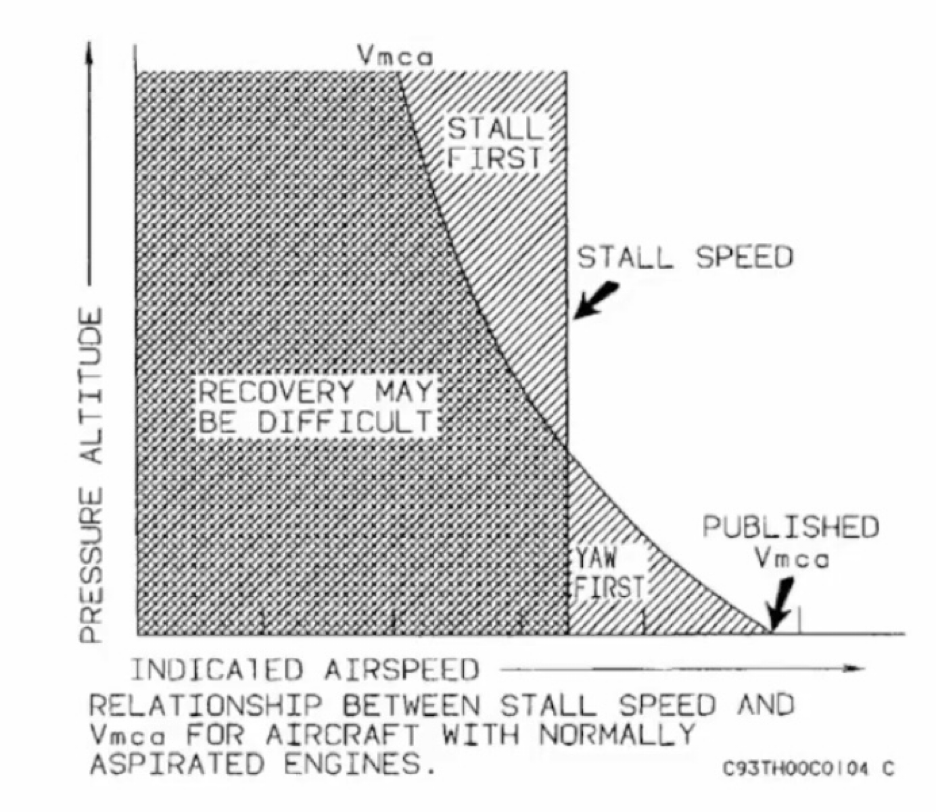


 THAT'S THE WHOLE POINT AND IT'S NOT "WHATEVER". These are two distinctly different things! In the single engine twin, the rudder is what is countering the yawing-moment (and resultant yawing motion) of the asymmetrical thrust.