Van's Air Force

The definitive Van's Aircraft support community! Buying, building or flying an RV? Join our exclusive family of mentors and enthusiasts!

RV9 ALTERNATOR-replacement suggestion

I have seen posters here that are on their third PP alternator. Does that not also fit your qoute? What about “… repeating the same behavior looking for a different result.” I am not saying they are universal junk. But i see a fair number of folks coming here reporting problems with their pp alternators; many failing after 100-200 hours. I just never hear that about others. Certainly anecdotal data, but just don’t see how you can ignore the significant number of posts with pp problems and the lack of same with others.
Yup - I think the behavior fits your quote much better; 3 failures and changing nothing and understanding nothing between each -- yeah, that's insane.

I hear/see about the same number as you do, and every one of them is user/builder/installer error, and it's not just Plane Power. I just went through this with an -8A with IO-360-A1A with an Autozone 14684R installed; no heat shields, broken mount, and loaded with oil because of a blown nose seal -- yeah, the SRE bearing was shot (shrug).

Are the PP units more sensitive to builder F-ups? Possibly, probably, maybe. From an engineering perspective tho, it's impossible to say because the data is obscured by primary failures.
 
Yup - I think the behavior fits your quote much better; 3 failures and changing nothing and understanding nothing between each -- yeah, that's insane.

I hear/see about the same number as you do, and every one of them is user/builder/installer error, and it's not just Plane Power. I just went through this with an -8A with IO-360-A1A with an Autozone 14684R installed; no heat shields, broken mount, and loaded with oil because of a blown nose seal -- yeah, the SRE bearing was shot (shrug).

Are the PP units more sensitive to builder F-ups? Possibly, probably, maybe. From an engineering perspective tho, it's impossible to say because the data is obscured by primary failures.
all good points here.
 
Only one of the alternator failures I've seen were electrical in nature and that was a secondary failure mode. I've done a few autopsies and posted the results on here -- search for "Thoughts on Plane Power".

In a nutshell here they are:

1. Pin&Wire interface fatigue failure - inside the 3 pin plug at the back of the alternator. This is caused by vibration and a cost reduction by Hartzell omitting the rubber isolators on the wires
2. Heat induced regulator failure
3. Heat induced rectifier failure
4. Heat and Installation error induced rear bearing/case-bracket (SRE) failure
5. Builder modification errors, loose screws upon reassembly.

Resolutions/Remediations:

1. Easy fix - add the isolators or fill the cavities with neutral cure silicone (eg. GE Silicone II)
2. & 3. fixes -
* add a 1" blast tube pointed at the back of the alternator -- as required by the installation instructions from Hartzell/Plane Power - builders tend to skip this.
* If a crossover exhaust header runs underneath/behind the alternator (IO-360-B, M engines with Crossover exhaust) - put a Heat Shield on the header...keep the alternator from "seeing" that heat.
4. Pulley tension & alignment -- not too tight, not too loose, and 0 degrees misalignment of the belt.
5. Nuts/Screws tight?
6. Terminations solid and secure? <100mOhm resistance between Battery (-) and Engine/Alternator case?
What Decker said!
 
The poll doesn’t take into account the installed base of each type, therefore you cannot determine the quality or reliability of either.

If you knew the actual installed units of each type, then you could determine relative failure rates.
It's not a really valid poll, since the participants are self-selected.

That aside...I'm a little surprised at all the leaps to conclusions and recommendations to make fairly major changes here without even knowing some basic things. Like how many hours on the alternator, for example. Did anyone think that it could just be worn brushes, if the alternator is approaching 1000 hours (precisely the tme when my PP alternator "failed", just as they stated when they recommended 1000 hour replacement of the brushes?).
 
I gather from Post #6 you have Nippon Denso Lester #14684. Have you verified you can turn it off via a switch on the instrument panel? Thanks.
Have you done that same test on your alternator system? And, do you know if you have a 3-wire or 1-wire alternator setup?

Self-exciting alternators, commonly known as "1-wire" alternators, represent a very specific type of charging system designed for simplicity, most often used in hot rods, tractors, and limited custom applications, rather than being the standard for modern cars -- rarely ever used in production cars. The Vans supplied Nippon Denso Lester #14684 is clearly a 3-wire setup, which requires continuous DC field current. You guys are simply taking a limited, highly specialized case out of context.

I will also keep my Odyssey AGM battery and dual magnetos setup for enhanced alternator and/or battery failure isolation and will also turn-off my independent field current breaker/switch in the unlikely event of an alternator over-voltage condition. (y):cool:(y)

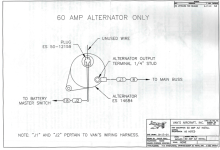
Below is the Vans supplied Nippon Denso Lester #14684 setup that was used for many years on many RV's -- a 3-wire field current configuration.
1776095942778.png
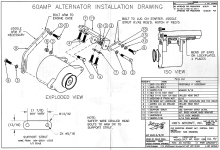
1776097131161.png
 
It's not a really valid poll, since the participants are self-selected.

That aside...I'm a little surprised at all the leaps to conclusions and recommendations to make fairly major changes here without even knowing some basic things. Like how many hours on the alternator, for example. Did anyone think that it could just be worn brushes, if the alternator is approaching 1000 hours (precisely the tme when my PP alternator "failed", just as they stated when they recommended 1000 hour replacement of the brushes?).
"4 out 5 dentists surveyed"

I forgot completely about the brushes being a wear item -- thanks for the reminder!
 
Yes, I installed Vans FWF kit back in 2003, which came with the Nippon Denso Lester #14684 alternator and kit (many RV's have them). I test few the airplane in 2004 and have been flying my 9'er regularly for nearly 22-years now.
Speaking of hours on brushes how many hours for 22 years' worth of flying?
 
Speaking of hours on brushes how many hours for 22 years' worth of flying?
Last flight on Thursday to Friday Harbor (FHR) showed 1,870 -- hard to get more than 85-hours per year living in the Pacific NW.

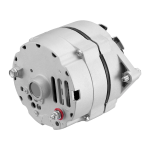
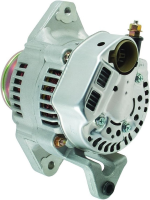
BTW -- here's the difference between a 1-wire "self-exited" alternator (1-output with case ground) and a 3-wire (2-field inputs and 1-output), which is the Nippon Denso unit that Vans Aircraft sold before switching to the considerably higher cost Plane Power alternator. The one on the left is a Delco specifically made for farm tractors. And, the one on right has been install in millions of Japanese made cars for many years and Vans RV's, too. Mine is still running strong, and I have a spare unit in reserve if needed. A B&C internally regulated type would be my second choice. I already have a highly reliable B&C, fast cranking stater after removing the original SkyTec that had miserable cranking performance.

1776128047889.png 1776128120603.png

 
Has anyone else noticed that OP has disappeared from this thread? :) So without knowing what "failed" means, or how many hours on the alternator, or even what kind of alternator it is...2 pages of recommendations. ;)
 
Has anyone else noticed that OP has disappeared from this thread? :) So without knowing what "failed" means, or how many hours on the alternator, or even what kind of alternator it is...2 pages of recommendations. ;)
Probably at SnF now. I would not be on any forum if I was there. Alas, I am not....
 
Yes, I installed Vans FWF kit back in 2003, which came with the Nippon Denso Lester #14684 alternator…

I have tested that my alternator field switch/breaker de-energizes the field windings in the alternator…

Alternators with field windings simply can't energize themselves without the application of field current…
Thanks for the response.

Excellent that you can de-energize the field on your alternator from the cockpit. It’s important though for folks to understand this is not always the case with automotive alternators.

I do understand that a wound-field wound alternator needs field current in order to provide power to the B lead but field current can, in the case of many automotive alternators, come from the alternator internally once the alternator is spinning and turned on.

One-wire alternators (B lead only) I was unaware of. Good they will start and run, evidently with no battery present, using residual magnetism, or evidently in some cases with magnets installed into the field core, bad they cannot be turned off once spinning.

 
Last edited:
Have you done that same test on your alternator system?…
I have a B&C externally-regulated alternator that can be turned off by de-powering the field via an off/battery/battery+alternator progressive switch on the instrument panel.
 
Last edited:
Thanks for the response.

Excellent that you can de-energize the field on your alternator from the cockpit. It’s important though for folks to understand this is not always the case with automotive alternators.

I understand that a wound-field wound alternator needs field current in order to provide power to the B lead but field current can, in the case of many automotive alternators, come from the alternator internally once the alternator is spinning and turned on.

One-wire alternators (B lead only) I was unaware of. Good they will start and run, evidently with no battery present, using residual magnetism, or evidently in some cases with magnets installed into the field core, bad they cannot be turned off once spinning.

My wife and I just did a lunch flight yesterday to KPWT. After the engine was running, we turned-OFF the alternator field-switch, where the volage meter changed from 14.3V to 12.2V, and the charge meter went from a "positive charge" to a "negative discharge". Now -- we don't do this routinely since over time, doing this or tuning-OFF your master or ALT switch while the engine is running is well know to damage alternators and voltage regulators. From what I understand, the typical failure mode of ND alternators are a gradually increase of battery voltage over time (over multiple flights), not charging at lower-rpm or stops charging altogether. My heat shielded ND now has 1,872 hours, and it's still producing 14.3V across my odyssey PC680 AGM battery. I have replaced the battery twice over that 22-years but only for slow cranking in cold conditions -- the normal reason. Maybe what's killing alternators are pilots flipping-OFF their master/alt before the engine has stopped turning. :unsure:
 
Last edited:
My wife and I just did a lunch flight yesterday to KPWT. After the engine was running, we turned-OFF the alternator field-switch, where the volage meter changed from 14.3V to 12.2V, and the charge meter went from a "positive charge" to a "negative discharge". Now -- we don't do this routinely since over time, doing this or tuning-OFF your master or ALT switch while the engine is running is well know to damage alternators and voltage regulators. From what I understand, the typical failure mode of ND alternators are a gradually increase of battery voltage over time (over multiple flights), not changing at lower-rpm or stops changing altogether. My heat shielded ND now has 1,872 hours, and it's still producing 14.3V across my odyssey PC680 AGM battery. I have replaced the battery twice over that 22-years but only for slow cranking in cold conditions -- the normal reason. Maybe what's killing alternators are pilots flipping-OFF their master/alt before the engine has stopped turning. :unsure:
Turning off the battery contactor / master I can understand can trigger the failure mode via load dump. But why should simply cutting the field alone for testing trigger this failure mode ?
 
Turning off the battery contactor / master I can understand can trigger the failure mode via load dump. But why should simply cutting the field alone for testing trigger this failure mode ?
On a separate note I dont have an earthx battery but my understanding is that the BMS can disconnect the earthx battery under certain error conditions (similar to turning off master) that can in-turn trigger the alternator fault mode. And hence their recommendation to use an OV protection device if your alternator does not already provide that protection.
 
Turning off the battery contactor / master I can understand can trigger the failure mode via load dump. But why should simply cutting the field alone for testing trigger this failure mode ?
I understand that over time, removing power to the regulator and field coil can potentially damage the regulator for an internally regulated alternator. However, my alternator breaker/switch is only intended for abnormal charging conditions and always remains ON while the engine is running. Did this test for johnbright only.

 
On a separate note I dont have an earthx battery but my understanding is that the BMS can disconnect the earthx battery under certain error conditions (similar to turning off master) that can in-turn trigger the alternator fault mode. And hence their recommendation to use an OV protection device if your alternator does not already provide that protection.
Thank you for that information -- it's starting to make more sense now! I'm running the "old school" Odyssey PC680 AGM battery with no real desire nor need to go with an EarthX battery. I also really like my "old school" dual Slick magnetos for decoupling the battery from my engine ignition system.
 
On a separate note I dont have an earthx battery but my understanding is that the BMS can disconnect the earthx battery under certain error conditions (similar to turning off master) that can in-turn trigger the alternator fault mode. And hence their recommendation to use an OV protection device if your alternator does not already provide that protection.
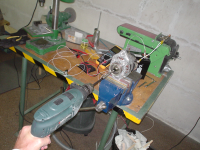
Everything I have read and the "alternator in a bench vice with a big honkin drill" testing I have done tells me that cutting the Field wire is a safe and clean way to turn off an alternator.

1776238604534.png
 
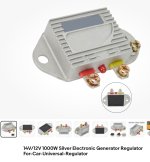
I bought these cheap and nasty items off EBay for peanuts for my O320 RV4, I only use external regs Alt’s. 👍 I also use a cheap and nasty Full River AGM HC20 battery👍
 

Attachments

  • 4491FD8A-D41C-4F09-A38E-ACACD292DC70.jpeg
    4491FD8A-D41C-4F09-A38E-ACACD292DC70.jpeg
    260.8 KB · Views: 25
  • 969CA854-7DFE-41F2-96FF-DF23AE99C9FA.jpeg
    969CA854-7DFE-41F2-96FF-DF23AE99C9FA.jpeg
    325.3 KB · Views: 23
I understand that over time, removing power to the regulator and field coil can potentially damage the regulator for an internally regulated alternator. However, my alternator breaker/switch is only intended for abnormal charging conditions and always remains ON while the engine is running. Did this test for johnbright only.


The opportunity for electrical damage to an alternator, internally or externally (A-circuit or B-circuit) regulated, is the removal of the load from the output of the RECTIFIER.

Typical in aircraft installations is a very large circuit breaker (40A, 60A etc.) or ANL fuse installed INLINE on the B+ wire from the alternator. Should this device open, and a significant load is being driven at the time (large load == low resistance in the circuit) the rectifier diodes in the alternator can become damaged.

Also typical in aircraft installations is a small circuit breaker installed on the Alternator's IGN, or Field Supply wire - usually 5A. This circuit breaker is installed in series with the Alternator Field switch, and is intended to protect the wire from over current conditions in the REGULATOR circuit.
 
Everything I have read and the "alternator in a bench vice with a big honkin drill" testing I have done tells me that cutting the Field wire is a safe and clean way to turn off an alternator.

View attachment 115191
Yes -- I agree as long as the field current is cut-off while the alternator output is feeding the battery (loaded). But, if the master-switch is turned OFF with the engine still running, the alternator output suddenly becomes unloaded. Since the alternator is a big inductive device, it still wants to produce charging current and can raise its output voltage to extremes to do this. It's similar to unplugging a vacuum cleaner without turning it OFF ("blue arc" at the plug). The alternator output current has no where to go but back into your unloaded buss through the alternator B+ circuit breaker (60A or 35A depending on alternator type)

So, if you shut your master switch OFF before the ALT field switch, bad things can happen to your system buss and alternator electronics. Turning them OFF together in a single master (as Vans shows) can cause that, too. Vans alternator wiring diagram should really show a separate ALT switch for powering down the alternator field before opening the master relay. I always pull the mixture to idle-cutoff and wait for the prop to stop, then power-down the master and alternator switches. I also turn OFF the avionics switch before pulling the mixture to idle-cutoff -- somewhat standard procedure in most certified airplanes, too.
 
Also typical in aircraft installations is a small circuit breaker installed on the Alternator's IGN, or Field Supply wire - usually 5A. This circuit breaker is installed in series with the Alternator Field switch, and is intended to protect the wire from over current conditions in the REGULATOR circuit.
Yes and correct -- I also have a combined ALT field breaker/switch myself for that same reason!
 
The opportunity for electrical damage to an alternator, internally or externally (A-circuit or B-circuit) regulated, is the removal of the load from the output of the RECTIFIER.

Typical in aircraft installations is a very large circuit breaker (40A, 60A etc.) or ANL fuse installed INLINE on the B+ wire from the alternator. Should this device open, and a significant load is being driven at the time (large load == low resistance in the circuit) the rectifier diodes in the alternator can become damaged.

Also typical in aircraft installations is a small circuit breaker installed on the Alternator's IGN, or Field Supply wire - usually 5A. This circuit breaker is installed in series with the Alternator Field switch, and is intended to protect the wire from over current conditions in the REGULATOR circuit.
Would you happen to know in the plane power alternator what would happen if the B lead shorts before the ANL ? This has happened to me in flight, the 60AMP ANL blew and my avionics rebooted and started running off battery. I did turn off the alternator after that but I was surprised it survived that short for the short duration during which it was probably dumping the whole 60 amps. No sign of burn marks nothing. May be it does have some other form of protection against a B lead short.

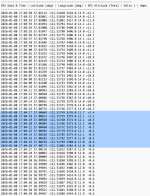
The dynon logs that I capture every second only showed the voltage drop from 14V to 11.7V and then it was running on battery till i landed.

I bench tested the alternator and they found nothing. Spoke to plane power and they said "There are no repairs approved on this model alternator except brush/regulator replacement so no other spare parts are available. We can test it here but all that would test would be function. Yes, the alternator does or does not work; yes, the regulator is controlling voltage; and yes, it is not overvolting. Personally, I’m not sure that’s worth the effort and cost of shipping and testing. If you need to be absolutely sure, replace the alternator. My recommendation would be to re-install the alternator and monitor for any adverse operations. It will either work or not, there won’t be an in-between." -- anyways that alternator seems to be working just fine after this incident and it taught me an important lesson to check all the cables for proper shielding against shorts.

I did install the earthx OV protection as a backup since the bench test could not really test the OV module / trigger an actual OV. Attached dynon logs.
 

Attachments

  • Screenshot 2026-01-27 at 8.45.58 AM.png
    Screenshot 2026-01-27 at 8.45.58 AM.png
    173.8 KB · Views: 6
Would you happen to know in the plane power alternator what would happen if the B lead shorts before the ANL ? This has happened to me in flight, the 60AMP ANL blew and my avionics rebooted and started running off battery. I did turn off the alternator after that but I was surprised it survived that short for the short duration during which it was probably dumping the whole 60 amps. No sign of burn marks nothing. May be it does have some other form of protection against a B lead short.

The dynon logs that I capture every second only showed the voltage drop from 14V to 11.7V and then it was running on battery till i landed.
What direction did your amp meter indicate when this happened (+charging or -discharging)? That should tell you what side the short-circuit occurred on (i.e. buss or alternator side of the circuit breaker).
 
Would you happen to know in the plane power alternator what would happen if the B lead shorts before the ANL ? This has happened to me in flight, the 60AMP ANL blew and my avionics rebooted and started running off battery. I did turn off the alternator after that but I was surprised it survived that short for the short duration during which it was probably dumping the whole 60 amps. No sign of burn marks nothing. May be it does have some other form of protection against a B lead short.

The dynon logs that I capture every second only showed the voltage drop from 14V to 11.7V and then it was running on battery till i landed.

I bench tested the alternator and they found nothing. Spoke to plane power and they said "There are no repairs approved on this model alternator except brush/regulator replacement so no other spare parts are available. We can test it here but all that would test would be function. Yes, the alternator does or does not work; yes, the regulator is controlling voltage; and yes, it is not overvolting. Personally, I’m not sure that’s worth the effort and cost of shipping and testing. If you need to be absolutely sure, replace the alternator. My recommendation would be to re-install the alternator and monitor for any adverse operations. It will either work or not, there won’t be an in-between." -- anyways that alternator seems to be working just fine after this incident and it taught me an important lesson to check all the cables for proper shielding against shorts.

I did install the earthx OV protection as a backup since the bench test could not really test the OV module / trigger an actual OV. Attached dynon logs.
Your description of the event is non-sensical to me...

1. How/Where did the B+ wire "short?" This is such an unlikely event, it's hard to visualize...unless the aircraft wasn't wired following A.C. 43-13(b) guidance and other industry best practices, or it was an act of sabotage...

2. In what configuration would your aircraft systems/avionics ever draw 60A?

-break-

How did you bench test the alternator? Steps - Procedures - Tools.

-break-

The Plane Power overvoltage detection and protection is via the Regulator: When the sensed voltage exceeds 16V an SCR inside the regulator package activates and connects the Field voltage supply to Ground. This causes the Field Circuit Breaker (5A) to open, which in turn removes the voltage supply to the Rotor Field, turning the alternator off -- no output on the B+ wire.

-break-

Hartzell/Plane-Power does sell/provide piece parts to overhaul their devices -- Some are available from Aircraft Spruce, and Alternator Brush, Maniac Motors, other alternator shops; provided you know what the part #'s are.
 
What direction did your amp meter indicate when this happened (+charging or -discharging)? That should tell you what side the short-circuit occurred on (i.e. buss or alternator side of the circuit breaker).
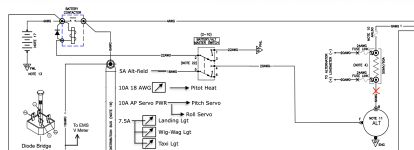
My ammeter is a loadmeter. So it wont measure the current from battery. See pic. The short happened at the red X see pic. The ANL blew because of current from the battery to the ground, which confirms why there was a sudden voltage drop. So to answer your question it was likely discharging. The voltage is measured at the main bus.
 

Attachments

  • Screenshot 2026-04-15 at 11.02.23 AM.png
    Screenshot 2026-04-15 at 11.02.23 AM.png
    301.5 KB · Views: 25
Your description of the event is non-sensical to me...

1. How/Where did the B+ wire "short?" This is such an unlikely event, it's hard to visualize...unless the aircraft wasn't wired following A.C. 43-13(b) guidance and other industry best practices, or it was an act of sabotage...

2. In what configuration would your aircraft systems/avionics ever draw 60A?

-break-

How did you bench test the alternator? Steps - Procedures - Tools.

-break-

The Plane Power overvoltage detection and protection is via the Regulator: When the sensed voltage exceeds 16V an SCR inside the regulator package activates and connects the Field voltage supply to Ground. This causes the Field Circuit Breaker (5A) to open, which in turn removes the voltage supply to the Rotor Field, turning the alternator off -- no output on the B+ wire.

-break-

Hartzell/Plane-Power does sell/provide piece parts to overhaul their devices -- Some are available from Aircraft Spruce, and Alternator Brush, Maniac Motors, other alternator shops; provided you know what the part #'s are.
It was milspec wiring so not shielded. See the pic. I dont think there was anything wrong with the wiring. The B lead wire is sort of hidden because its routed from under. I dont have a pic to show the routing to you. The A&P who checked it said thats how they are all wired. I put an additional shielding to prevent this in future.


I did not say it was drawing 60A before failure. Pl see the dynon logs. It was drawing about 10 AMPS, but at the time of short it was grounded so i would expect it to draw full 60A till the sense was gone or some other thing prevented the draw.

I did not say this was an OV event. And no my field breaker did not pop either. Just a reboot because the source of current switched from alternator to battery after the ANL blew.
 

Attachments

  • Screenshot 2026-04-15 at 11.52.55 AM.png
    Screenshot 2026-04-15 at 11.52.55 AM.png
    2.5 MB · Views: 15
It was milspec wiring so not shielded. See the pic. I dont think there was anything wrong with the wiring. The B lead wire is sort of hidden because its routed from under. I dont have a pic to show the routing to you. The A&P who checked it said thats how they are all wired. I put an additional shielding to prevent this in future.


I did not say it was drawing 60A before failure. Pl see the dynon logs. It was drawing about 10 AMPS, but at the time of short it was grounded so i would expect it to draw full 60A till the sense was gone or some other thing prevented the draw.

I did not say this was an OV event. And no my field breaker did not pop either. Just a reboot because the source of current switched from alternator to battery after the ANL blew.
i was more curious about how the alternator survived and if someone knows the intrinsics of what happens if the B lead is shorted. Does the alternator stop producing power or does it produce full rated power till sense is gone. It was not exactly a load dump issue given it had ground to dump all the load it needed to. But yea important to check those wires from time to time.
 
It was milspec wiring so not shielded. See the pic. I dont think there was anything wrong with the wiring. The B lead wire is sort of hidden because its routed from under. I dont have a pic to show the routing to you. The A&P who checked it said thats how they are all wired. I put an additional shielding to prevent this in future.


I did not say it was drawing 60A before failure. Pl see the dynon logs. It was drawing about 10 AMPS, but at the time of short it was grounded so i would expect it to draw full 60A till the sense was gone or some other thing prevented the draw.

I did not say this was an OV event. And no my field breaker did not pop either. Just a reboot because the source of current switched from alternator to battery after the ANL blew.

First off - Milspec <> Shielding. The white tefzel is insulation (not shielding.)

The scenario: The B+ wire shorts against the engine case (This shouldn't happen if the wire is installed correctly - my earlier point), and the ANL opens up because the current being driven by the voltage potential of the buss (the buss is comprised of the Battery *and* the Alternator) exceeded 60A, by a lot (14.2V / .001R?)...

The Alternator Regulator continues to see the buss voltage provided by the 18 and 20GA wire going to its F terminal (sidebar - this is a mistake, the wire gauge should be the same - 18ga) and it doesn't change its output voltage/current, but the rectifier will become cooked because of the excessive forward current (hence my question - how did you test this.)

Your avionics rebooted because of a voltage sag *not* because the current source changed. Do you have the entire schematic?

Maybe reach out to Joel/Linda for some guidance here.
 
My wife and I just did a lunch flight yesterday to KPWT. After the engine was running, we turned-OFF the alternator field-switch, where the volage meter changed from 14.3V to 12.2V, and the charge meter went from a "positive charge" to a "negative discharge". Now -- we don't do this routinely since over time, doing this or tuning-OFF your master or ALT switch while the engine is running is well know to damage alternators and voltage regulators. From what I understand, the typical failure mode of ND alternators are a gradually increase of battery voltage over time (over multiple flights), not charging at lower-rpm or stops charging altogether. My heat shielded ND now has 1,872 hours, and it's still producing 14.3V across my odyssey PC680 AGM battery. I have replaced the battery twice over that 22-years but only for slow cranking in cold conditions -- the normal reason. Maybe what's killing alternators are pilots flipping-OFF their master/alt before the engine has stopped turning. :unsure:
Yup. I start engine, THEN turn “On” ALT Field, you can see voltmeter go from battery voltage to charging voltage.
At shut down, Mixture to cut off, after engine is stopped, ALT field switch OFF.

ND alt and Oddseesy Battery as well.
 
  1. Would you happen to know in the plane power alternator what would happen if the B lead shorts before the ANL (between the ANL and the alternator - ed)…
  2. This has happened to me in flight, the 60AMP ANL blew and my avionics rebooted and started running off battery…
  3. I bench tested the alternator and they found nothing. Spoke to plane power and they said “… Yes, the alternator does or does not work; yes, the regulator is controlling voltage; and yes, it is not overvolting... My recommendation would be to re-install the alternator and monitor for any adverse operations. It will either work or not, there won’t be an in-between."
  4. I did install the earthx OV protection as a backup since the bench test could not really test the OV module / trigger an actual OV.
  1. My Bob Nuckolls notes say no damage done to the alternator.
  2. Excellent demonstration of why the ANL is there, in addition to the possibility of the alternator shorting internaly, It’s installed as close as possible to the battery because the battery is the power source capable of damaging the B lead and the B lead is capable of exploding the battery if AGM (which is what mchalla has) or if EarthX I suppose the battery would disconnect itself.
  3. What I hear the Plane Power fellow saying… don’t waste money sending the alternator to us for testing.
  4. No harm adding the EarthX overvoltage protection device but IMO no reason to think the OV protection in the Plane Power alternator has been compromised. Note the Plane Power rep did not mention that OV protection could be compromised.
 
Last edited:
From your notes " I used another heavy duty continuous hold relay... the alternator B lead is switched via this relay. The alternator switch now controls this relay." -- I think this is the only fool proof way to ensure the alternator is disconnected.
Here’s what Bob Nuckolls has to say about putting a contactor in the B lead as depicted in his Z24 which can be found here. What he prefers is an alternator who’s field current is supplied externally, be the regulator internal or external to the alternator. Your Plane Power internally-regulated alternator gets field current externally.

One could argue what if the field wire of an externally-regulated alternator shorts to B+ somewhere in its run which would make a contactor in the B lead valuable. Just talking here, I don’t consider this a significant enough threat to justify a B lead contactor. Proper installation and periodic visual inspection is enough IMO.
 
Last edited:
The instant that b-lead grounds you're going to pop big fuses or circuit breakers you're going to blow shunts well before any avionics gets damaged
 
One could argue what if the field wire of an externally-regulated alternator shorts to B+ somewhere in its run which would make a contactor in the B lead valuable.
That is about as likely as the contactor sticking closed. Actually probably less likely. You can’t out think all failure scenarios.
 
On a separate note I dont have an earthx battery but my understanding is that the BMS can disconnect the earthx battery under certain error conditions (similar to turning off master) that can in-turn trigger the alternator fault mode. And hence their recommendation to use an OV protection device if your alternator does not already provide that protection.
The reason for recommending an OV protection device is simple: it helps protect your aircraft’s electrical system and avionic regardless of whether you use a lead-acid or lithium battery. If the voltage regulator fails, system voltage can rise dramatically (potentially well beyond what typical aircraft electronics are designed to tolerate). That level of over-voltage can exceed the built-in protection of many components.

With OV protection installed, the device will quickly take the alternator offline when an over-voltage condition is detected, preventing the rest of the system from being exposed to damaging voltage. If an over-voltage event occurs and (in a rare, compounded scenario) the OV protection device also fails, pilot action is the backup: turn the alternator off to protect the electrical system. Delaying that action can lead to blown fuses or breakers, overheated wiring, and damage to expensive avionics. This recommendation is intended to reduce the risk of those outcomes.

Regarding the BMS and how it responds in specific scenarios, we provide a detailed manual that walks through the behavior and annunciations. EarthX Manual However, here is a quick summary related to the “disconnect” concern:

1) Start/fault current events: During engine start, if there is a bad starter or a hard short (for example, a damaged cable contacting the airframe), the battery may disconnect to protect itself and the aircraft electrical system. It will also provide a clear alert indication so you can investigate the cause before takeoff. The battery will automatically attempt to reset after approximately 3 minutes.

2) Deep discharge: The other scenario where the battery will stop supplying power is when it has been fully discharged (i.e., the usable energy has been depleted). In that respect, it is similar to a lead-acid battery that has been drained. The difference is that EarthX provides an alert once approximately 70% of the battery’s capacity has been used giving you actionable information that a traditional lead-acid battery typically cannot provide.
 
The reason for recommending an OV protection device is simple: it helps protect your aircraft’s electrical system and avionic regardless of whether you use a lead-acid or lithium battery. If the voltage regulator fails, system voltage can rise dramatically (potentially well beyond what typical aircraft electronics are designed to tolerate). That level of over-voltage can exceed the built-in protection of many components.

With OV protection installed, the device will quickly take the alternator offline when an over-voltage condition is detected, preventing the rest of the system from being exposed to damaging voltage. If an over-voltage event occurs and (in a rare, compounded scenario) the OV protection device also fails, pilot action is the backup: turn the alternator off to protect the electrical system. Delaying that action can lead to blown fuses or breakers, overheated wiring, and damage to expensive avionics. This recommendation is intended to reduce the risk of those outcomes.

Regarding the BMS and how it responds in specific scenarios, we provide a detailed manual that walks through the behavior and annunciations. EarthX Manual However, here is a quick summary related to the “disconnect” concern:

1) Start/fault current events: During engine start, if there is a bad starter or a hard short (for example, a damaged cable contacting the airframe), the battery may disconnect to protect itself and the aircraft electrical system. It will also provide a clear alert indication so you can investigate the cause before takeoff. The battery will automatically attempt to reset after approximately 3 minutes.

2) Deep discharge: The other scenario where the battery will stop supplying power is when it has been fully discharged (i.e., the usable energy has been depleted). In that respect, it is similar to a lead-acid battery that has been drained. The difference is that EarthX provides an alert once approximately 70% of the battery’s capacity has been used giving you actionable information that a traditional lead-acid battery typically cannot provide.
As we pick apart such things, "pilot action is the backup: turn the alternator off to protect the electrical system." WAY too late.
 
Back
Top