Van's Air Force

The definitive Van's Aircraft support community! Buying, building or flying an RV? Join our exclusive family of mentors and enthusiasts!

PMag Spark Plug Guide

jliltd

Well Known Member
Benefactor
I have been reading VAF and talking to folks who use NGK automotive spark plugs with their PMags. From what I have learnt I gather the following:

First and foremost we should use plugs with a solid post terminal (tip), not the equivalent model number with the screw-off tip. There have been issues over time with the screw off tips loosening and arcing leading to ignition trouble. There have been workarounds like crimping hard on the tips with side cutters etc. in order to alleviate the loosening but why not avoid the whole mess by sticking to the solid tip plugs.

Next, I gather that there are 2 poplular heat ranges....


For compression ratios up to 9:1

NGK BR8ES Part Number 3961 with solid/permanent tip – standard plug

Optional Upgrade: NGK BR8EIX Part Number 6747 with solid/permanent tip – Iridium

The 8 heat range is the suggested rating in the EMag Air installation manual.


For compression ratios above 9:1

NGK BR9ES Part Number 7788 with solid/permanent tip – standard plug

Optional Upgrade: NGK BR9EIX Part Number 3089 with solid/permanent tip -- Iridium


I also hear from folks who buy the cheaper standard plugs and replace them every second oil change or so (~ 100 hrs), whereas the Iridium models can go a few hundred hours (~500). The Iridiums cost 3 or 4 times more than the standard plugs.

I would like to hear comments about my understanding of the above.

Jim
 
Last edited:
...
I also hear from folks who buy the cheaper standard plugs and replace them every second oil change or so (~ 100 hrs), whereas the Iridium models can go a few hundred hours (~500). The Iridiums cost 3 or 4 times more than the standard plugs.

I would like to hear comments about my understanding of the above.

Jim
We do not recommend running past 100 hours with any automotive spark plug.

The reason is that with an EICommander installed, the pilot will notice the deterioration of the spark event once past 100 hours. This is regardless of if the standard plugs or iridium plugs are installed.

The pilot will not notice a difference unless they have a way to "read" the P-mag spark events.

Since the cost is so cheap and it is good practice to inspect the plugs once a year, we recommend replacing them during the condition inspection or at 100 hours, whichever comes first.
 
I have been reading VAF and talking to folks who use NGK automotive spark plugs with their PMags. From what I have learnt I gather the following:

First and foremost we should use plugs with a solid post terminal (tip), not the equivalent model number with the screw-off tip. There have been issues over time with the screw off tips loosening and arcing leading to ignition trouble. There have been workarounds like crimping hard on the tips with side cutters etc. in order to alleviate the loosening but why not avoid the whole mess by sticking to the solid tip plugs.

Next, I gather that there are 2 poplular heat ranges....


For compression ratios up to 9:1

NGK BR8ES Part Number 3961 with solid/permanent tip ? standard plug

Optional Upgrade: NGK BR8EIX Part Number 6747 with solid/permanent tip ? Iridium

The 8 heat range is the suggested rating in the EMag Air installation manual.


For compression ratios above 9:1

NGK BR9ES Part Number 7788 with solid/permanent tip ? standard plug

Optional Upgrade: NGK BR9EIX Part Number 3089 with solid/permanent tip -- Iridium


I also hear from folks who buy the cheaper standard plugs and replace them every second oil change or so (~ 100 hrs), whereas the Iridium models can go a few hundred hours (~500). The Iridiums cost 3 or 4 times more than the standard plugs.

I would like to hear comments about my understanding of the above.

Jim


I have a 10:1 compression engine and initially went with the BR9ES heat range plugs, but suffered from numerous instances of lead bridging shorting the plug. Switched to the BR8 heat range based on their successful use in Nigel Speedy's 10:1 engine. All good now. I went with the Iridium plugs. They are rather more expensive, but still quite reasonable in the overall scheme of things.
 
I have a regular compression O-320 and have been running one Slick and one E-Mag (then P-mag) since around 2005. Initially I used BR8ES exclusively, but found they wore quite quickly, although it was not an issue as I changed them every annual - around 40 to 50 hours. By that time the gap would be around 0.040" or more, having started at 0.035". I also found the plugs would load up with lead to some extent.

A few years ago I switched to BR9ES after talking with NGK tech support (at an auto show) and reading their advice on the web. I have found much less wear and less lead deposits. One year I only flew 20 hours - hardly any wear. I still change the plugs each year or two ( 50 to 70 hours typically).

I do lean aggressively as soon as I throttle back after take-off & climb, and usually fly between 2000' & 4000' cruising between 140 & 150kt.

I have come to the conclusion that there are more variables than just compression ratio, and one that is difficult to quantify is operating "style". The only advice I would give is to try a higher (cooler) plug if the wear of your plugs is higher than you would like.

Pete
 
I have a regular compression O-320 and have been running one Slick and one E-Mag (then P-mag) since around 2005. Initially I used BR8ES exclusively, but found they wore quite quickly, although it was not an issue as I changed them every annual - around 40 to 50 hours. By that time the gap would be around 0.040" or more, having started at 0.035". I also found the plugs would load up with lead to some extent.

A few years ago I switched to BR9ES after talking with NGK tech support (at an auto show) and reading their advice on the web. I have found much less wear and less lead deposits. One year I only flew 20 hours - hardly any wear. I still change the plugs each year or two ( 50 to 70 hours typically).

I do lean aggressively as soon as I throttle back after take-off & climb, and usually fly between 2000' & 4000' cruising between 140 & 150kt.

I have come to the conclusion that there are more variables than just compression ratio, and one that is difficult to quantify is operating "style". The only advice I would give is to try a higher (cooler) plug if the wear of your plugs is higher than you would like.

Pete

I agree that there are more variables, I run 1 E Mag and 1 Mag since 2001 or 2002. I think 1 other variable is if its fuel injected or carb. I think the fuel injection distributes the fuel more evenly
 
NGK? Not so much.

I have been reading VAF and talking to folks who use NGK automotive spark plug
I also hear from folks who buy the cheaper standard plugs and replace them every second oil change or so (~ 100 hrs), whereas the Iridium models can go a few hundred hours (~500). The Iridiums cost 3 or 4 times more than the standard plugs.

I would like to hear comments about my understanding of the above.

Jim

Jim,
I bought Jeff Rose's first 0-320 Electroair system for my RV4 back in 94'. Since then my HR2 and current RV6X use both a P-Mag and a EI system. In all these years NGK is my least favorite plug and the only plugs I have had fail inflight.

What are my faves?

Autolite 386 Great heat range, sold at NAPA and need no inserts.
Denso L-14U Also a great heat range and same thread as the Autolites.

Lots of years and hours on both, highly recommended.

V/R
Smokey
 
Jim,
I bought Jeff Rose's first 0-320 Electroair system for my RV4 back in 94'.


Autolite 386 Great heat range, sold at NAPA and need no inserts.

Smokey


Smokey,
I too had the original Jeff Rose (Prior to Electroair), great ignition but eventually gave out, so I switched to PMags. I used the Autolite 386 plugs in the Jeff Rose and worked like a charm.

Am I understanding you correctly that you use the Autolite 386 with your PMags? Any issues or comparison to the NGK BR8ES? I would take the 18mm Autolite 386 any day if this is the case.

Cheers,

Dan
 
386 is great with PMAG

There are four RV's I know running Autolite 386 plugs with the PMAG including mine. All report excellent results.
 
Apologize if I missed it but do the Autolite 386 plugs come as a solid cap version? I did a quick search but only found them with removable caps.
 
Pmag Spark Plug

I've been chasing some pmag issues over the last few weeks. 1st noticed as my RPM was jumping around and then just stopped working. We cleaned all the contacts and then it appeared to be working well again, but soon started bouncing again. There was no change when doing run ups an checking mags. Last week I replaced the plugs (clearly the gaps were off) when I took the plugs to NAPA I was given a replacement plug and told it would be good, needless to say the plug was 1/2inch shorter thread, and 1" longer top (Obviously not a replacement). The original plug was NGK R 3035 BR8ECM, which is interesting now as I read the above and there is no mention of that number. I'm still trying to figure out which PMAG it really is, and how to service it. The RPM's are reading normal but jumping occasionally to a higher RPM. Any insight would be great.

Jon
 
I've been chasing some pmag issues over the last few weeks. 1st noticed as my RPM was jumping around and then just stopped working. We cleaned all the contacts and then it appeared to be working well again, but soon started bouncing again. There was no change when doing run ups an checking mags. Last week I replaced the plugs (clearly the gaps were off) when I took the plugs to NAPA I was given a replacement plug and told it would be good, needless to say the plug was 1/2inch shorter thread, and 1" longer top (Obviously not a replacement). The original plug was NGK R 3035 BR8ECM, which is interesting now as I read the above and there is no mention of that number. I'm still trying to figure out which PMAG it really is, and how to service it. The RPM's are reading normal but jumping occasionally to a higher RPM. Any insight would be great.

Jon
I wonder what the difference between a BR8ES and a BR8CEM is? I've been running the BR8ES with good results, but I think I might try the Autolite 386 next time I do a condition inspection (January). I am also going to see about sending my E-Mag 113 in to have it converted to a P-Mag 114. I read on another post it is about $380, money well spent as far as I'm concerned.
 
I wonder what the difference between a BR8ES and a BR8CEM is? I've been running the BR8ES with good results, but I think I might try the Autolite 386 next time I do a condition inspection (January). I am also going to see about sending my E-Mag 113 in to have it converted to a P-Mag 114. I read on another post it is about $380, money well spent as far as I'm concerned.

Most important is that you get the latest firmware update to your P-mags. This is critical for continued safe operation.

I have been running 114 boards in my 113 P-mags since the 114's came out. No issues at all. Well worth the cost of the upgrade!
 
We do not recommend running past 100 hours with any automotive spark plug.

The reason is that with an EICommander installed, the pilot will notice the deterioration of the spark event once past 100 hours. This is regardless of if the standard plugs or iridium plugs are installed.

The pilot will not notice a difference unless they have a way to "read" the P-mag spark events.

Did you ever find that report?

http://www.vansairforce.com/community/showpost.php?p=1348633&postcount=14
 
Last edited:
Most important is that you get the latest firmware update to your P-mags. This is critical for continued safe operation.

I have been running 114 boards in my 113 P-mags since the 114's came out. No issues at all. Well worth the cost of the upgrade!

Where do you get this from, and how do you update it?
 
I too use 386 plugs

Started with BR9-ES but wanted to ditch the adapters so switched to 386 plugs on my pmag 200 hrs or more ago. When I added second p mag I went right to 386 plugs. They are $8 for 4 of them so when I change oil at 25 hrs I replace top or bottom plugs alternately. Usually discarded plugs are in pretty good shape with minimal lead deposits.
 
We do not recommend running past 100 hours with any automotive spark plug.
Auto plugs routinely go 100,000 miles. At an average speed of 40 mph so that's about 2500 hrs. And that's in both normally aspirated and forced induction motors.

Are these automotive plugs so substandard that we're not comfortable going more than 100 hrs? If that's the case why even run them? Why not stick with 80 yr old aviation plugs that will go 500 hrs or the fine wires that are good for 1000 hrs or so?

I'm finally running a LS ignition in my RV 9 and will aim somewhere around the 500 hr mark for my precious metal plugs unless of course they start talking to me. I personally believe that we have other more potential points of failure with these electronic ignitions systems that are a bigger concern.

Champion plugs in my experience were the worst for life expectancy. Autolite or Denso 👍

Tim
 
Auto plugs routinely go 100,000 miles. At an average speed of 40 mph so that's about 2500 hrs. And that's in both normally aspirated and forced induction motors.

Are these automotive plugs so substandard that we're not comfortable going more than 100 hrs? If that's the case why even run them? Why not stick with 80 yr old aviation plugs that will go 500 hrs or the fine wires that are good for 1000 hrs or so?

I'm finally running a LS ignition in my RV 9 and will aim somewhere around the 500 hr mark for my precious metal plugs unless of course they start talking to me. I personally believe that we have other more potential points of failure with these electronic ignitions systems that are a bigger concern.

Champion plugs in my experience were the worst for life expectancy. Autolite or Denso 👍

Tim
Last time I looked, most auto plugs where iridium or platinum and they would go that long. (100,000 miles) Switch to the old standard copper plug and then they are only good for no more than 1/4 of that time. (18,000 to 35,000-miles)
 
As an experiment I ran a set of Autolite 386 plugs to "failure". For this test I defined failure as anything less than perfect performance expected of new plugs. I had one plug cause an intermittent miss at 330 hours in an O-360 with 9.5:1 compression. I feel comfortable running these plugs as long as 200 hours based on this test. The fact these plugs can be replaced for less than three dollars each says 200 hours is plenty and indeed I usually just replace them at 100 hours (every other oil change).
 
  • Like
Reactions: JGT
I honestly didn't even realize there are 18mm auto-plug options until recently.

One has to wonder why E-mag Air recommends using 14mm plugs with adapters? Seems the 18mm plug option eliminates complexity.
 
I honestly didn't even realize there are 18mm auto-plug options until recently.

One has to wonder why E-mag Air recommends using 14mm plugs with adapters? Seems the 18mm plug option eliminates complexity.
The options for 18mm plugs are very limited, and they don't seem to be quite as good as the 14mm plugs. The main application for the 18mm seems to be very old vintage tractors and other old motors, so there is not a lot of innovation by the spark plug manufacturers with the 18mm plugs. The 14mm-18mm adapters are not much trouble if you buy good ones and take care when torquing them.
 
I will be using the Autolite 386 Spark Plugs for a 3hr flight, (what should I gap the 386 to?)
When I get back home I will switch back to new inserts and NGK's BR8ES as I have been running for the past 540hrs.
 
I will be using the Autolite 386 Spark Plugs for a 3hr flight, (what should I gap the 386 to?)
When I get back home I will switch back to new inserts and NGK's BR8ES as I have been running for the past 540hrs.
Gap is dictated by the coil and not the plug. Follow the recommendation of your EI supplier.
 
With 9:1 compression IO360 dual Pmags (jumper in) and Autolite 386s I get rough running at TOC when leaning at 8500ft with WOT. I must reduce MP to get to LOP smoothly. EGTs peak within .2gph of each other and all EGTs decrease, not a singe cyinder probem, when trying to lean with WOT. Why do I get rough if I don't reduce throttle/MP??
 
With 9:1 compression IO360 dual Pmags (jumper in) and Autolite 386s I get rough running at TOC when leaning at 8500ft with WOT. I must reduce MP to get to LOP smoothly. EGTs peak within .2gph of each other and all EGTs decrease, not a singe cyinder probem, when trying to lean with WOT. Why do I get rough if I don't reduce throttle/MP??
Try waiting 3-5 minutes after reaching cruise before leaning. I often find that things are just not that smooth after transitioning to cruise and it goes away in a few minutes. Always assumed it was a heat issue from climb. I would not say it was rough though. I used 386's on my 6 for many hours, so don't believe that is your issue.
 
  • Like
Reactions: BES
Try waiting 3-5 minutes after reaching cruise before leaning. I often find that things are just not that smooth after transitioning to cruise and it goes away in a few minutes. Always assumed it was a heat issue from climb. I would not say it was rough though. I used 386's on my 6 for many hours, so don't believe that is your issue.
I also find in my 10 that I cannot get to the FF that I want at lower altitudes if WOT. I must pull the throttle back some as it is just too lean. Less MAP lets me richen up ans still meet my target. At higher altitudes that is not an issue. What is your leaning process and targets? degrees LOP, FF RPM, AS
 
What long-reach plugs have folks had luck with? We are using the Denso IKH27, but since we replace them yearly, I don't think iridium is worth the money. Thoughts?
 
NGK? Not so much.


Jim,
I bought Jeff Rose's first 0-320 Electroair system for my RV4 back in 94'. Since then my HR2 and current RV6X use both a P-Mag and a EI system. In all these years NGK is my least favorite plug and the only plugs I have had fail inflight.

What are my faves?

Autolite 386 Great heat range, sold at NAPA and need no inserts.
Denso L-14U Also a great heat range and same thread as the Autolites.

Lots of years and hours on both, highly recommended.

V/R
Smokey
I run dual P-mags and I used to run NGK's for the past 6 months I switched to the Autolite 386 and I have been very happy. No adapters needed and it actually lowered my CHT's.
 
I'm interested in trying the Autolite 386 plugs without adaptors in place of the current NGK BR8ES (solid tip stock #3961 - screw on post stock #5422) with adaptors. The E-Mag P114 Manual has the solid terminal tip as "preferred" and it looks like the Autolite 386 has a screw on tip. Is there a solid tip version of the Autolite 386 or do those running them just make sure they are tightly secured?
 
I'm interested in trying the Autolite 386 plugs without adaptors in place of the current NGK BR8ES (solid tip stock #3961 - screw on post stock #5422) with adaptors. The E-Mag P114 Manual has the solid terminal tip as "preferred" and it looks like the Autolite 386 has a screw on tip. Is there a solid tip version of the Autolite 386 or do those running them just make sure they are tightly secured?
I use red loctite. they will unscrew otherwise. keep it on the threads only, not the flange for good conductivity
 
I crimp the screw on cap a bit and use red loctite as well on the autolite 386 plugs. I’ve been using the 386 plugs since installing my pmags over 250 hours ago. Throwing away the old plugs for new ones about every 50-100 hours at my condition inspection. I wish I could get more flying hours in than that every year but that seems to be where I end up. Never had a problem with the 386 plugs and I like not having to deal with the adapters.
 
What long-reach plugs have folks had luck with? We are using the Denso IKH27, but since we replace them yearly, I don't think iridium is worth the money. Thoughts?
I have tried pretty much all the spark plug options, and I found that the cheapest NGKs with the solid tips were the best in my limited experience. I've bought a bunch of them at Rock Auto for about $2 each.

 
I also find in my 10 that I cannot get to the FF that I want at lower altitudes if WOT. I must pull the throttle back some as it is just too lean. Less MAP lets me richen up ans still meet my target. At higher altitudes that is not an issue. What is your leaning process and targets? degrees LOP, FF RPM, AS
Lean with rapid pull through the red to ~8gph, 140KIAS, 65%power. Low altitudes reduce MP before mixture to avoid red box and detonation.
 
I'm interested in trying the Autolite 386 plugs without adaptors in place of the current NGK BR8ES (solid tip stock #3961 - screw on post stock #5422) with adaptors. The E-Mag P114 Manual has the solid terminal tip as "preferred" and it looks like the Autolite 386 has a screw on tip. Is there a solid tip version of the Autolite 386 or do those running them just make sure they are tightly secured?
When I presented my threaded tip Autolite 386 to Brad at Emag OSH booth, he suggested pliers on the threads so the tips screw on hard. Works.
 
Anyone use Denso L-14U 18mm? Seems this cooler plug might work in my high compression IO360
Yes. Switched to them 1000 hours ago on my 6. It is a cooler plug that better fits the application. It also uses a nickel coating instead of paint so it doesn’t rust like the 386’s. I am stock cr. No way I would use the 386 in a high cr engine.
 
Yes. Switched to them 1000 hours ago on my 6. It is a cooler plug that better fits the application. It also uses a nickel coating instead of paint so it doesn’t rust like the 386’s. I am stock cr. No way I would use the 386 in a high cr engine.
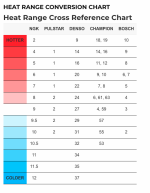
This link seems to show the Denso L-14U as a high heat, equivalent to an NGK 4 heat range, according to this chart. Isn't that a bit hot for these engines?


1768890661826.png
 
This link seems to show the Denso L-14U as a high heat, equivalent to an NGK 4 heat range, according to this chart. Isn't that a bit hot for these engines?


View attachment 107726
Hard to say what is too hot for these engines, as we have no comparable heat range data for the aviation plugs. Many use the 386's with no issues and many also use the br8es (colder plug) with no issues. I certainly have had no issues with them. Autolite is almost impossiblr to compare heat ranges, as they are not standardized. I had done some research that suggested the 386 was hotter, but no good data. You can also get the autolite 373, which is 3 steps colder than the 386, but fear that may be too cold and not burn off deposits. I have a pretty good eye on reading plugs and in 1600 hours on my 320 have seen no evidence of the plug being too hot. You can typically see signs when they are.

The 8 range in NGK is pretty middle of the road for auto engines, so am sure a lot of folks think it makes sense, but unsure that is really comparable. All you can really do is keep testing colder plugs untill you start to see deposits, then back off a couple of steps.

So, they are possibly a bit on the hot side, but history says they are not too hot, but I would not use them in high CR engines. I would spend the $ on adapters and go to NGK 8's.
 
Hard to say what is too hot for these engines, as we have no comparable heat range data for the aviation plugs. Many use the 386's with no issues and many also use the br8es (colder plug) with no issues. I certainly have had no issues with them. Autolite is almost impossiblr to compare heat ranges, as they are not standardized. I had done some research that suggested the 386 was hotter, but no good data. You can also get the autolite 373, which is 3 steps colder than the 386, but fear that may be too cold and not burn off deposits. I have a pretty good eye on reading plugs and in 1600 hours on my 320 have seen no evidence of the plug being too hot. You can typically see signs when they are.

The 8 range in NGK is pretty middle of the road for auto engines, so am sure a lot of folks think it makes sense, but unsure that is really comparable. All you can really do is keep testing colder plugs untill you start to see deposits, then back off a couple of steps.

So, they are possibly a bit on the hot side, but history says they are not too hot, but I would not use them in high CR engines. I would spend the $ on adapters and go to NGK 8's.
Too add to this, the primary risk of going too hot on a plug is pre-ignition. This is very different than detonation and typically if you get it, you will blow a hole in your piston in a few seconds. The fact that we almost never hear about that on lyc's, one can speculate the plugs being used are not too hot. The secondary risk is the plug eroding too quickly. My 14-u's get replaced around 700 or so hours and show NO erosion. I run the BR8ES on the 540 and see about the same amount of wear on the electrodes (need for re gapping) across the 2 plugs.

I have pulled 8's from oil burning engines and the plugs are very oilly. Never see that with the 386's. This leads me to believe the 8 is too cold for our engines. They do not retain enough heat at idle to burn off deposits. Purely anecdotal, so use with caution.
 
Last edited:
What long-reach plugs have folks had luck with? We are using the Denso IKH27, but since we replace them yearly, I don't think iridium is worth the money. Thoughts?

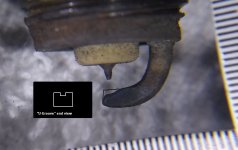
So how many hours do you fly in a year? I run IKH27's out past 200 hours. Doesn't seem to be any real wear to the center electrode. The tip of the ground electrode erodes away, mostly just the legs of the "U".

Eroded Ground Electrode Illustrated.jpg

With 9:1 compression IO360 dual Pmags (jumper in) and Autolite 386s I get rough running at TOC when leaning at 8500ft with WOT. I must reduce MP to get to LOP smoothly. EGTs peak within .2gph of each other and all EGTs decrease, not a singe cyinder probem, when trying to lean with WOT. Why do I get rough if I don't reduce throttle/MP??

Most likely low nozzle bleed pressure delta; at low flow the fuel exiting the nozzle is poorly atomized. Reducing throttle increases the delta.
 
So how many hours do you fly in a year? I run IKH27's out past 200 hours. Doesn't seem to be any real wear to the center electrode. The tip of the ground electrode erodes away, mostly just the legs of the "U".

View attachment 107735


Most likely low nozzle bleed pressure delta; at low flow the fuel exiting the nozzle is poorly atomized. Reducing throttle increases the delta.
Between 100 and 150 hours per year. We established the idea of discarding the plugs at annual based on the general consensus that automotive plugs wont hold up. Seems overly cautious TBH....
 
Try his approach. Change one set this annual, and the other set the next. It means you always have at least one relatively fresh set in there, and any significant difference in mag drop tells you how the older set is doing.
This seems like genius to me. Will apply this protocol starting next year. TY.
 
Back
Top