

Van's Air Force
You are using an out of date browser. It may not display this or other websites correctly.
You should upgrade or use an alternative browser.
You should upgrade or use an alternative browser.
Phillips 66 Victory Aviation Oil 100AW or Phillips 66 Victory AW 20w-50 Aviation Engine Oil
- Thread starter RicoB
- Start date


Auburntsts
Well Known Member
Neither. Phillips 20W-50 x/c with Camguard. IO-540 based in Florida

sansoneservices
Well Known Member
I like the Victory 20w50. I believe it has the Lycoming LW-16702 extreme pressure (EP) anti-scuffing additive mixed in when they bottle it.
Don't let your airplane sit. I second adding camguard of youre going inactive for more than a week.Any inputs on this? I've heard that if you don't fly on weekly basis it's better to use the straight weight. They claim it stays on the parts longer when it's just sitting there.

RicoB
Well Known Member
Both are victory (contains the LW-16702)I like the Victory 20w50. I believe it has the Lycoming LW-16702 extreme pressure (EP) anti-scuffing additive mixed in when they bottle it.
RicoB
Well Known Member
I definitely don't get around to fly every week, sometimes it happens.Don't let your airplane sit. I second adding camguard of youre going inactive for more than a week.

In the IO-540 I run Phillips 100AD (no factory additive) in the summer and Phillips 20w50 Cross Country (no factory additive) in the winter, both with a pint of Camguard. I was talking to an ex Aeroshell exec at Sun N Fun a few years back and asked what oil he used. He said oil without factory additive and then added a quart of Camguard!
I jumped off the Aeroshell train when they dropped down to 6qt packaging and only slightly dropped the price from the previous 12qt packaging. My oil analysis didn’t change when I swapped 700 hours ago so I haven’t looked back.
I jumped off the Aeroshell train when they dropped down to 6qt packaging and only slightly dropped the price from the previous 12qt packaging. My oil analysis didn’t change when I swapped 700 hours ago so I haven’t looked back.
If you are using straight weight for better cling, like the op suggested, you are not achieving your objective as the mmo is reducing the viscosity, likely to less than the 20 50.Winter months: Phillips 20W-50 x/c.
Summer months: 5.5 qts Phillips 100AD plus 1 qt added MMO. Delay runup to 90 degrees oil temp. Delay takeoff until oil temp above 110 degrees.
Flame suit on.
Not sure i buy the argument that st weight oils cling better. Clearly at some level viscosity makes a difference, as grease clings better than oil. With the thinner viscosities i believe surface tension impacts the cling rate and a little thicker oil sticks no better than the thinner stuff. Gear oils don’t stick to the gears because they are thicker, but because of the additive package designed to increase the cling rate. In diffs and manual transmissions, it is critical there is oil on the gears at first movement, not a bit later as the splash starts. Therefore they increase surface tension with additives. Not a chemist, so it may be different properties they are tweaking with the additives. Racers even do this in their cooling systems, but reducing surface tension in that application for better heat transfer. They call the additive package that reduces surface tension water wetter.
Last edited:
I’ve been using Phillips 20/50 for ten years now, the HOBBS shows 1480 as of today and I switched to Aeroshell 100 Plus for Summer use, since then the motor has ten hours and I have added 4 quarts. I was shocked to notice the oil was pretty dark very quick. I am lost as the motor was recently borescopes, the compressions were excellent, and we saw the original cross hatching in each cylinder.
Will changing oil on a motor cause an initial adjustment and then the motor resumes its normal state of operations with oil burn, etc?
Thanks, Thor KAWO RV10 and RV14
Will changing oil on a motor cause an initial adjustment and then the motor resumes its normal state of operations with oil burn, etc?
Thanks, Thor KAWO RV10 and RV14
RicoB
Well Known Member
To ascertain if the consumption persists, I would revert to your previous oil. If you are still interested in using the single weight, I would try the Philipps AW 100Aero shell 15W-5

Pete O Static
Active Member
The instructor at the Lycoming engine overhaul course stated that straight weight oil is better for corrosion protection. It was even published in their course material. Having said that, I run Phillips 20W50 XC mixed at 10% with Phillips 20W50 anti rust oil. During winter months, when I don't fly often enough, it is 100% 20W50 anti rust oil.Any inputs on this? I've heard that if you don't fly on weekly basis it's better to use the straight weight. They claim it stays on the parts longer when it's just sitting there.
Larry DeCamp
Well Known Member
The instructor at the Lycoming engine overhaul course stated that straight weight oil is better for corrosion protection. It was even published in their course material. Having said that, I run Phillips 20W50 XC mixed at 10% with Phillips 20W50 anti rust oil. During winter months, when I don't fly often enough, it is 100% 20W50 anti rust oil.
Larry DeCamp
Well Known Member
The Phillps literature even suggests 10% antirust for infrequent flying. They do specify do not fly anti rust more than 10 hours. So, is Phillips antirust like a Camgard without the anti friction/galling additives ?

Similar issue. (IO390 in a 14A) From early on I used Aeroshell W100 plus and my oil would be very dark in 20 to 25 hrs. then I would change it. An early instructor/A&P told me to change by condition and not time so that's what I did. After ~300 hrs. I wanted to give a multi-viscosity a try and was amazed how much cleaner the oil stayed. After a few hundred hours I began to wonder if the oil was cleaner maybe the cause of the oil being dark (I assumed lead) was being left in the engine, so I went back to W100 plus and the pattern of very dark oil at 20 to 25 hours returned. Ran that for a couple hundred hours. Last summer at the suggestion of multiple members went to AeroShell 15-50 and do see cleaner oil and slightly less oil consumption. BTW oil analysis showed lead around the same level each oil change regardless of oil type used. Compressions all are 78/80 and higher.I’ve been using Phillips 20/50 for ten years now, the HOBBS shows 1480 as of today and I switched to Aeroshell 100 Plus for Summer use, since then the motor has ten hours and I have added 4 quarts. I was shocked to notice the oil was pretty dark very quick. I am lost as the motor was recently borescopes, the compressions were excellent, and we saw the original cross hatching in each cylinder.
Will changing oil on a motor cause an initial adjustment and then the motor resumes its normal state of operations with oil burn, etc?
Thanks, Thor KAWO RV10 and RV14

In the summer I use the 100AD with MMO specifically because Sal the Cylinder Guy told me to after my first valve-stick episode. Between that and Busch’s CHT guidance, no more sticking valves.If you are using straight weight for better cling, like the op suggested, you are not achieving your objective as the mmo is reducing the viscosity, likely to less than the 20 50.
Not sure i buy the argument that st weight oils cling better. Clearly at some level viscosity makes a difference, as grease clings better than oil. With the thinner viscosities i believe surface tension impacts the cling rate and a little thicker oil sticks no better than the thinner stuff. Gear oils don’t stick to the gears because they are thicker, but because of the additive package designed to increase the cling rate. In diffs and manual transmissions, it is critical there is oil on the gears at first movement, not a bit later as the splash starts. Therefore they increase surface tension with additives. Not a chemist, so it may be different properties they are tweaking with the additives. Racers even do this in their cooling systems, but reducing surface tension in that application for better heat transfer. They call the additive package that reduces surface tension water wetter.
i also believe that mmo is helpfull in reducing deposits and speculate it may reduce deposits in the exh valve guides. i add it from time to time.In the summer I use the 100AD with MMO specifically because Sal the Cylinder Guy told me to after my first valve-stick episode. Between that and Busch’s CHT guidance, no more sticking valves.
RicoB
Well Known Member
Yes I heard that on the Lycoming seminar (teardown and assembly) thats why I put the question here just to see what the majority of flyers think.The instructor at the Lycoming engine overhaul course stated that straight weight oil is better for corrosion protection. It was even published in their course material. Having said that, I run Phillips 20W50 XC mixed at 10% with Phillips 20W50 anti rust oil. During winter months, when I don't fly often enough, it is 100% 20W50 anti rust oil.

The instructor at the Lycoming engine overhaul course stated that straight weight oil is better for corrosion protection.
Sure would like to see his evidence.
Oil vs. Corrosion - Aviation Consumer
Rust may be an engines worst enemy. Aeroshell 15W50 and Exxons Elite offer the best protection.
aviationconsumer.com
Some beliefs die hard.

I have always run Aero Shell 15W-50 simi-synthetic, containing Lycoming recommended LW-16702, and also AvBlend at each oil change. Also, MMO in the fuel (0.4 OZ per gallon) makes a big difference! Most engine wear is right after start-up, so a cold-start with multi-viscosity oil gets to critical engine parts mush faster than straight weight oil. And, AvBlend remains on internal engine parts longer than oil because it's a smaller penetrating oil. AvBlend also dissolves carbon, which prevents sticking valves. MMO also prevents sticking valves by dissolving carbon and also keeps rings from getting suck. Aero Shell simi-synthetic 15W-50 costs more per quart than Phillips, but in the long-run, it lubricates much better in my long-time experience with it. Another way to greatly reduce internal engine wear is to start and run the engine at low-idle (under 1000 rpm) until the oil pressure is "green", especially on colder days and after periods of inactivity. Often, I see guys fire-up cold and run their engines at high rpm, and that's what does most of the damage! Also, changing the oil every 25-hours and right before fall season is another great way to prevent water and combustion acids from eating the inside of your engine--and, never short-run your engine. 

Last edited:
Over the years, I've learned that mechanics aren't always the best judge on topics like this since they tend to make less money when engines don't need work or overhauls as often. I tend to listen to what my engine is telling me! And, I must say my little O-320-D2A is now 21-years old since new and not always flown weekly, especially during the winter mouths. We even hangar the airplane in the Pacific Northwest at PAE (Paine Field). The engine has never had a stuck valve, the oil filter and oil sump screen have always been clean with no metal. And, the compression has remained in the high 70's across the cylinders, too. It still runs very smoothly and powerfully with Aero Shell 15W-50, AvBlend and MMO in the fuel (0.4 oz to 1-gallon). We do oil changes every 25-hours without fail and also before fall season, and we place a 60W trouble-light inside the oil door to keep the engine temp more constant.Yes I heard that on the Lycoming seminar (teardown and assembly) thats why I put the question here just to see what the majority of flyers think.
Pete O Static
Active Member
Sure would like to see his evidence.
Oil vs. Corrosion - Aviation Consumer
Rust may be an engines worst enemy. Aeroshell 15W50 and Exxons Elite offer the best protection.aviationconsumer.com
Some beliefs die hard.
I have to assume it is based on what they see at the factory when doing engine rebuilds vs columnists spraying salt water on steel wool pads to test an oil. I will try to find it in the course literature and post it. I believe he said that single weight oil tends to stick longer after shutdown. As a general rule, I do tend to put more stock in the opinions of qualified individuals with 50 plus years of experience in a specific field vs articles from the internet written by someone who could be anyone.

Lycoming recommends :Another way to greatly reduce internal engine wear is to start and run the engine at low-idle (under 1000 rpm) until the oil pressure is "green", especially on colder days and after periods of inactivity. Often, I see guys fire-up cold and run their engines at high rpm, and that's what does most of the damage! Also, changing the oil every 25-hours and right before fall season is another great way to prevent water and combustion acids from eating the inside of your engine--and, never short-run your engine.
After start, do not idle engine below 1000 RPM. It’s not good
practice to idle engines below 1000 RPM at any time.
I try not to but above 1000 must use the brakes or she will taxi too fast especially on a slight incline or downwind.It’s not good
practice to idle engines below 1000 RPM at any time.

I always warm up around 1200RPM, taxi RPM as required.

Yes and no -> depends. I'll never argue for testing results over validation results/real world experience but condition at teardown is an almost worthless observation if the full operational history isn't known: hours, starts, frequency, duration, local environment, etc. Lots of factors to consider.I have to assume it is based on what they see at the factory when doing engine rebuilds vs columnists spraying salt water on steel wool pads to test an oil. I will try to find it in the course literature and post it. I believe he said that single weight oil tends to stick longer after shutdown. As a general rule, I do tend to put more stock in the opinions of qualified individuals with 50 plus years of experience in a specific field vs articles from the internet written by someone who could be anyone.
I was taking about starting a cold engine here! So, show me where Lycoming states that starting and idling a cold engine well above 1000 rpm before the oil pressure rises into the "green" is somehow a better idea. Idling a cold engine at 800 to 900 RPM until the oil pressure rises into the "green" is a good idea, especially an air-cooled engine. But, I welcome you or anyone else to run your engine at high RPM right after a cold start if you desire--it's your engine and your pocketbook! In my case, after the oil pressure rises into the "green" on a cold start, I idle my engines at 1200 RPM with the mixture leaned-back and don't takeoff until the oil temperature is above 100 degrees F. All of my engines over many years have made it to TBO without finding metal in the filters or finding worn cam-lobs, but many other's have. Go ahead Walt--"knock your self out"--it's your engine!Lycoming recommends :
After start, do not idle engine below 1000 RPM. It’s not good
practice to idle engines below 1000 RPM at any time.
Last edited:
This offers very good evidence--especially for cold started engines that aren't run daily!Sure would like to see his evidence.
Oil vs. Corrosion - Aviation Consumer
Rust may be an engines worst enemy. Aeroshell 15W50 and Exxons Elite offer the best protection.aviationconsumer.com
Some beliefs die hard.
Complete marketing BS. Comparing oils with different low visc #s where the test temp benefits one is useless in the scheme of the overall discussion. Wonder why OEMs recommend different types/blends for different operating conditions?This offers very good evidence--especially for cold started engines that aren't run daily!
I guess if marketing hype didn’t work on at least some of the population, there’d be no need for it.
Have you actually owned an aircraft for any significant number of years? Multi-viscosity oils have worked well in many different engines (aircraft, auto and motorcycle) over many years now! AeroShell 15W-50 is also a simi-synthetic oil with the Lycoming LW16702 additive. It also doesn't break-down as quickly as straight petroleum based products. But, keep-on using that straight weight oil during cold starts--nobody's stopping you!Complete marketing BS. Comparing oils with different low visc #s where the test temp benefits one is useless in the scheme of the overall discussion. Wonder why OEMs recommend different types/blends for different operating conditions?
I guess if marketing hype didn’t work on at least some of the population, there’d be no need for it.
johnpaul44
Well Known Member
when I took the Lycoming engine build class they told us that Lycoming recommends idle at or above 1000 rpm because the crankshaft will not throw off alot of oil until you get above this rpm, the oil being throw off the crank is what lubricates the cam
Who TF mentioned straight weight? My point was the Shell video means basically nothing as it’s not comparing apples to apples. I’ve designed lubricating oil systems for large industrial gas turbines and steam turbines. Anyone remotely familiar with the related science can see the demo is a flawed comparison because of the differing formulations -> the best visc grade at -40C is not necessarily the best at 0C. Not that it matters but I’ve owned at least one aircraft since 1987.Have you actually owned an aircraft for any significant number of years? Multi-viscosity oils have worked well in many different engines (aircraft, auto and motorcycle) over many years now! AeroShell 15W-50 is also a simi-synthetic oil with the Lycoming LW16702 additive. It also doesn't break-down as quickly as straight petroleum based products. But, keep-on using that straight weight oil during cold starts--nobody's stopping you!
I’ll differ again to Mr. Samuel Clemens quote about arguing with someone such as yourself. Enjoy.
But, the oil need to get there first--right? As I said before in my first post--I wait until the oil pressure rises into the "green", which allows the oil to reach critical engine components first, such as the cam lobs. After that, I advance the throttle to 1200 RPM with the mixture leaned-back as my normal idle. I was referring to cold starts. And, I was also referring to pilots who advance their throttle too high after initial cold engine starts.when I took the Lycoming engine build class they told us that Lycoming recommends idle at or above 1000 rpm because the crankshaft will not throw off alot of oil until you get above this rpm, the oil being throw off the crank is what lubricates the cam
I think this quote by the same person is more appropriate here if you argue back.Mr. Samuel Clemens quote about arguing with someone such as yourself
"Never argue with a fool, onlookers may not be able to tell the difference."
This previous thread has been referring to straight weight vs. multi-viscosity oils, but maybe you weren't following that fully? And, spoken by a true Engineering Manager "having a very high opinion of their own options".Who TF mentioned straight weight? My point was the Shell video means basically nothing as it’s not comparing apples to apples. I’ve designed lubricating oil systems for large industrial gas turbines and steam turbines. Anyone remotely familiar with the related science can see the demo is a flawed comparison because of the differing formulations -> the best visc grade at -40C is not necessarily the best at 0C. Not that it matters but I’ve owned at least one aircraft since 1987.
I’ll differ again to Mr. Samuel Clemens quote about arguing with someone such as yourself. Enjoy.

Ha. Was referring to a different quote but your point is taken. Thanks.I think this quote by the same person is more appropriate here if you argue back.
"Never argue with a fool, onlookers may not be able to tell the difference."

Paul 5r4
Well Known Member
That test in the video above says the oil has been chilled to MINUS 40 DEGREES FAHRENHEIT! Who in the world is going to be flying in weather that cold. Maybe in alaska.
Even then the engine would be preheated to some acceptable level. I see zero useful information from the above video. Common sense tells us what the video shows. Rant over. I use to use Aeroshell 100W. Couple years ago my engine shop expert suggested I switch to Phillips XC 20W 50 which I did. I like it better for a couple reasons. One my #2 had started using a little oil as noted by pooled oil in the cylinder seen with borescope. After a few hours with the Phillips all that went away. Not using any oil now and no pooling in the cylinder. Also the Phillips is cheaper than Aeroshell. I shook a quart in each hand and the Aeroshell is some really think oil, like molasses! The Phillips easily sloshes around. I feel it's coating everything much quicker after startup even in the summer but especially in the winter months. Just my experience.
Even then the engine would be preheated to some acceptable level. I see zero useful information from the above video. Common sense tells us what the video shows. Rant over. I use to use Aeroshell 100W. Couple years ago my engine shop expert suggested I switch to Phillips XC 20W 50 which I did. I like it better for a couple reasons. One my #2 had started using a little oil as noted by pooled oil in the cylinder seen with borescope. After a few hours with the Phillips all that went away. Not using any oil now and no pooling in the cylinder. Also the Phillips is cheaper than Aeroshell. I shook a quart in each hand and the Aeroshell is some really think oil, like molasses! The Phillips easily sloshes around. I feel it's coating everything much quicker after startup even in the summer but especially in the winter months. Just my experience.
most every auto engine starts its warm up at 1000 or above, based upon temp. Lower temp, higher rpm. Air cooled is no different than a cold soaked water cooled engine. I would say that the VAST majority of engine design engineers disagree with your thinking.I was taking about starting a cold engine here! So, show me where Lycoming states that starting and idling a cold engine well above 1000 rpm before the oil pressure rises into the "green" is somehow a better idea.
Oil gets to where it needs to be in a second, maybe two. Not something to build procedures around. You don’t need much pressure to prevent wear on things getting direct oil flow. If you are twiddling your thumbs waiting for the pressure to rise, you are using too thick of an oil.
Last edited:
Can’t really debate things and get to a consensus if you throw stones at the person you are debating with.This previous thread has been referring to straight weight vs. multi-viscosity oils, but maybe you weren't following that fully? And, spoken by a true Engineering Manager "having a very high opinion of their own options".
the POH in the certified aircraft specifically state to keep the rpm above 1000 during startup until the engine stabilizes. the rpm will slightly increase on its own once the engine is past the initial warmup. then lean the mixture aggressively to prevent lead buildup and the throttle can be pulled back as needed for taxiing. i have never heard about running at low rpm for the cold startup. that must be some new science 
I have been in this business for about 35 years. I have sat through presentations about oils by every product name you can put on a bottle of oil. The best advice I have heard from any of these is from a couple of engine rebuilders.
Their advice for the best oil on the market is "clean." Change the oil often and it will do its job.
I can say that I have added one of these to the hanger, https://www.rpxtech.com/drybot.html, and have been amazed at the amount of moisture it has removed from the engine.
Their advice for the best oil on the market is "clean." Change the oil often and it will do its job.
I can say that I have added one of these to the hanger, https://www.rpxtech.com/drybot.html, and have been amazed at the amount of moisture it has removed from the engine.

I'm a big fan of my engine dryer - I have the "black max". You mentioned that you are amazed at the amount of moisture that it has removed - does the drybot give you data about how how much moisture that it removes?I can say that I have added one of these to the hanger, https://www.rpxtech.com/drybot.html, and have been amazed at the amount of moisture it has removed from the engine.
Here's my black max input and output temp and humidity over a week:
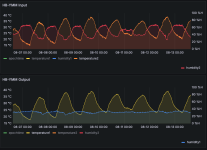
I understand that anything below 40% humidity is dry enough to stop corrosion.


Bonus, Fly often also is best thing for my own well being.by far the best thing you can do for your engine is to fly it often.
I'm a big fan of my engine dryer - I have the "black max". You mentioned that you are amazed at the amount of moisture that it has removed - does the drybot give you data about how how much moisture that it removes?
I weighted my silica gels before and after baking. it evaporated 9oz of moisture from 3 LBS of beads. At that level of saturation they could maintain ~44% humidity. how much actual liquid water was removed from the crank case is a big unknown. My guess is about 1.5 drops

In a little twist of the OP question but related.
Both Cam Guard and Lycoming LW-16702 additives were mentioned in this chat line.
Can someone explain the differences between these two additives? Are they both designed to solve the same issue?
As far as multiple viscosity. I am starting to wonder what the practical difference is between Aeroshell 15-50, Phillips victory, and Phillips XC 20-50 with cam guard added?
All three have essentially the same viscosity range and all three have anti-wear additives.
Just a curious newbie asking a couple honest questions.
Another pragmatic observation. If these straight or multi viscosity oils were linked to bad performance or engine life, I think that would have become evident and the manufacturers sued. Similar to what happened way back with full synthetic Mobile 1 aviation oil.
Full synthetic oils do not scavenge lead out. Which was the problem with mobile 1. And is the reason you no longer see anything except SEMI-synthetic not full synthetic) oils today.
With the possibility of unleaded av fuels in the realtively near future (2030 mandate). Full synthetic aviation oils MAY become a reality again as lead will no longer be a factor. Which will then add fuel to the fire of which is best oil” debate long into the future.
Both Cam Guard and Lycoming LW-16702 additives were mentioned in this chat line.
Can someone explain the differences between these two additives? Are they both designed to solve the same issue?
As far as multiple viscosity. I am starting to wonder what the practical difference is between Aeroshell 15-50, Phillips victory, and Phillips XC 20-50 with cam guard added?
All three have essentially the same viscosity range and all three have anti-wear additives.
Just a curious newbie asking a couple honest questions.
Another pragmatic observation. If these straight or multi viscosity oils were linked to bad performance or engine life, I think that would have become evident and the manufacturers sued. Similar to what happened way back with full synthetic Mobile 1 aviation oil.
Full synthetic oils do not scavenge lead out. Which was the problem with mobile 1. And is the reason you no longer see anything except SEMI-synthetic not full synthetic) oils today.
With the possibility of unleaded av fuels in the realtively near future (2030 mandate). Full synthetic aviation oils MAY become a reality again as lead will no longer be a factor. Which will then add fuel to the fire of which is best oil” debate long into the future.
Your talking "apples and oranges" here and took what I recommended completely out of context. As I said before--you and anyone else are welcome to cold start your own Lycoming engines and rev them up to anything you like before the oil pressure reaches the "green" arc--no one is stopping you. BTW--what type of aircraft and Lycoming engine(s) do you own, how long have you been an aircraft owner, did you build your own RV and when was that completed? It would be helpful for others to better understand your background and experience in owning and maintaining your own aircraft. Personally, I have had many since 1978 and have never found any significant metals in my oil screens or oil analysis--can you say the same thing?most every auto engine starts its warm up at 1000 or above, based upon temp. Lower temp, higher rpm. Air cooled is no different than a cold soaked water cooled engine. I would say that the VAST majority of engine design engineers disagree with your thinking.
Oil gets to where it needs to be in a second, maybe two. Not something to build procedures around. You don’t need much pressure to prevent wear on things getting direct oil flow. If you are twiddling your thumbs waiting for the pressure to rise, you are using too thick of an oil.
Last edited:
Who is they?Any inputs on this? I've heard that if you don't fly on weekly basis it's better to use the straight weight. They claim it stays on the parts longer when it's just sitting there.
I like the idea of following what the engine manual says.
I’m a new fan of lake speed jr, he seems to fall back to what the manual says (at least for oil selection in his daughters car)
Correct--and you have certainly cast many stones in your responses. I simply provide experience from what I know has worked for me and MANY MANY other RV and aircraft owners who I have known since 1978. And, I then let them decide for themselves, but can you say that about your typically harsh responses to my posts? Like I say, cold start and run your engine anyway you like lr172.Can’t really debate things and get to a consensus if you throw stones at the person you are debating with.
