


Van's Air Force

The definitive Van's Aircraft support community! Buying, building or flying an RV? Join our exclusive family of mentors and enthusiasts!

Phillips 66 Victory Aviation Oil 100AW or Phillips 66 Victory AW 20w-50 Aviation Engine Oil

i'm just observing the thread, but the scale seem to be leaning in favor of @RV-9erA due to this:


4. Avoid rapid acceleration after a cold start. Do not exceed idle RPM, recommended in the engine
Operator’s Manual, until oil pressure is stabilized above the minimum idling range. Allow up to one
minute for oil pressure to stabilize, since lines to the gage may remain cold. If oil pressure is not
indicated within 30 seconds, shut down the engine and determine the cause. If no leaks or damage is
found, repeat the pre- heat before restarting.

5. Allow the engine to warm up at idle speed until oil pressure and temperature are stabilized within
normal limits and proceed to ground check in accordance with the airframe manufacturer’s Pilots
Operating Handbook

OTOH:

After start, do not idle engine below 1000 RPM. It’s not good practice to idle engines below 1000 RPM at any time. This is particularly true during cold weather to prevent lead fouling of spark plugs. (Exception – Piper Pressurized Navajo)
 
I'm a big fan of my engine dryer - I have the "black max". You mentioned that you are amazed at the amount of moisture that it has removed - does the drybot give you data about how how much moisture that it removes?

Here's my black max input and output temp and humidity over a week:

View attachment 94884

I understand that anything below 40% humidity is dry enough to stop corrosion.
Nothing other than the water it will eject on the floor. I have it on a cart with a drain.
 
i'm just observing the thread, but the scale seem to be leaning in favor of @RV-9erA due to this:


4. Avoid rapid acceleration after a cold start. Do not exceed idle RPM, recommended in the engine
Operator’s Manual, until oil pressure is stabilized above the minimum idling range. Allow up to one
minute for oil pressure to stabilize, since lines to the gage may remain cold. If oil pressure is not
indicated within 30 seconds, shut down the engine and determine the cause. If no leaks or damage is
found, repeat the pre- heat before restarting.

5. Allow the engine to warm up at idle speed until oil pressure and temperature are stabilized within
normal limits and proceed to ground check in accordance with the airframe manufacturer’s Pilots
Operating Handbook

OTOH:

After start, do not idle engine below 1000 RPM. It’s not good practice to idle engines below 1000 RPM at any time. This is particularly true during cold weather to prevent lead fouling of spark plugs. (Exception – Piper Pressurized Navajo)
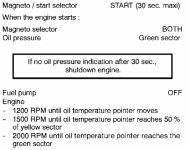
Lycoming O-320-D2A in a certified aircraft Cold Start Procedure:

1755108365145.png

Pretty consistent with what you referenced above.
 
I have heard that too and there is some truth to it Straight weight oil does tend to hang around on the parts a bit longer when the engine is just sitting But in my experience the bigger issue is keeping rust away If the airplane is sitting for weeks at a time a good preservative oil or something with a corrosion inhibitor is worth more than just picking one oil over another
 
i'm just observing the thread, but the scale seem to be leaning in favor of @RV-9erA due to this:


4. Avoid rapid acceleration after a cold start. Do not exceed idle RPM, recommended in the engine
Operator’s Manual, until oil pressure is stabilized above the minimum idling range. Allow up to one
minute for oil pressure to stabilize, since lines to the gage may remain cold. If oil pressure is not
indicated within 30 seconds, shut down the engine and determine the cause. If no leaks or damage is
found, repeat the pre- heat before restarting.

5. Allow the engine to warm up at idle speed until oil pressure and temperature are stabilized within
normal limits and proceed to ground check in accordance with the airframe manufacturer’s Pilots
Operating Handbook

OTOH:

After start, do not idle engine below 1000 RPM. It’s not good practice to idle engines below 1000 RPM at any time. This is particularly true during cold weather to prevent lead fouling of spark plugs. (Exception – Piper Pressurized Navajo)
Good information from Lycoming Service Instruction 1505. As I mentioned previously, my approach to starting and warming-up a cold engine was taken out of context by two of the forum members. The actual time I allow my engine to idle (after a cold start) or after a longer period of engine inactivity, is around 15-seconds at 800 to 900 RPM simply to allow my oil pressure gage to reach the "green" arc. After that, I increase the throttle to 1200 RPM with the mixture leaned-back to prevent plug flowing and idle at 1200 RPM for around 5-minutes. I then typically taxi to the run-up area, using only the minimum amount of power necessary to taxi to the run-up area. I then wait until the oil temperature reaches 100 degrees F, and then perform my run-up at a full-rich mixture. Generally, after a cold start, we are at around 12 to 15 minutes to get the engine oil temp to 100 degrees F. Prior to takeoff, I'm generally at 130 degree F on the oil temp. But, if there's a long delay for takeoff, I may lean my mixture back during the delay to prevent plug fouling. I have to tell you--I have never experienced a fouled plug in my RV-9A over the 21-years of operating it, never had a stuck valve, and my compression still remains in the upper 70's. And, I have not found any metal in my oil filter nor sump screen. However, I think that's also due to using MMO in my fuel (0.4 oz per gallon of 100LL). And, I've always used AeroShell 15W-50 with AvBlend and change my oil every 25-hours--that's how I roll. (y):cool:(y)
 
Last edited:
The Lycoming LW-16702 additive has an anti-scuffing agent that serves to reduce wear.

Per Ed Kollin, the developer of Camguard: "Camguard uses 11 high performance additives most of which are multi-functional. They are all commercially available and expensive. It uses multiple ferrous and non ferrous corrosion inhibitors, multiple anti-wear chemistries, a very potent antioxidant/deposit control package."

Kollin recommends Phillips 20W-50 with Camguard year round. According to Kollin, "the additives in Camguard SWAMP those in Aeroshell 15W-50 and Exxon Elite so why pay for them."

Note that AeroShell’s single weight Plus oils, AeroShell 15W-50, and Phillips Victory 20W-50 oils contain the Lycoming LW-16702 additive package.
Totally unbiased opinion from the developer of CG ;)
 
The recommended carburetor idle speed adjustment for Lycoming engines typically ranges from 600 to 800 RPM. So, if you supposedly can't operate a Lycoming engine below 1000 RPM, then how do you test and adjust your idle speed and idle bypass mixture on a carbureted Lycoming engine? For fuel injected Lycoming engines, most aircraft types (e.g. 180 HP Cessna 172SP) have you drop the throttle to the lowest idle (around 600 to 650 RPM) right after your run-up check to insure the fuel servo is working properly--don't want that engine to die by pulling your throttle to the idle-stop. Also, on a carbureted engine, you can drop your idle speed to around 700 RPM with a full-rich mixture, and slowly decrease the mixture to idle cut-off. If you see an RPM rise of greater than 100 RPM before cut-off, then you might have a sunken carburetor float or a poorly adjusted idle bypass mixture screw--generally done with a fully warmed-up engine. Saved my bacon a few times after experiencing a sunken float during climb-out!
 
The recommended carburetor idle speed adjustment for Lycoming engines typically ranges from 600 to 800 RPM. So, if you supposedly can't operate a Lycoming engine below 1000 RPM, then how do you test and adjust your idle speed and idle bypass mixture on a carbureted Lycoming engine? For fuel injected Lycoming engines, most aircraft types (e.g. 180 HP Cessna 172SP) have you drop the throttle to the lowest idle (around 600 to 650 RPM) right after your run-up check to insure the fuel servo is working properly--don't want that engine to die by pulling your throttle to the idle-stop. Also, on a carbureted engine, you can drop your idle speed to around 700 RPM with a full-rich mixture, and slowly decrease the mixture to idle cut-off. If you see an RPM rise of greater than 100 RPM before cut-off, then you might have a sunken carburetor float or a poorly adjusted idle bypass mixture screw--generally done with a fully warmed-up engine. Saved my bacon a few times after experiencing a sunken float during climb-out!
The 1,000 RPM is a COLD engine and operating recommendation.
IF Idle speed was set at 1,000 RPM, the land roll out would increase and the RV would not be able to accomplish a short field landing within the published numbers.

The Idle speed adjustment should only be set after the engine is at operating temperature.

The idle mixture adjustment on my airplane was adjusted AFTER a flight before putting the airplane away and the adjustment tested after the next flight. May take several flights to get it right. I will manually set the RPM with the throttle, lean the mixture, watch the RPM rise and then adjust the idle mixture after the engine has stopped. Typically I will make a 1/8 to 1/4 turn of the idle mixture screw and test after next flight during the engine shutdown.

I use to fly a lot of formation. As such, I like to have my idle set as low as possible and that may end up being 500 to 550 RPM so it is set LESS than Lycoming recommends. IF you do that, you must be careful after touchdown so that the engine does not stop as the speed decreases. PAX get nervous when the prop stops even when you are on the ground but have not exited the runway yet.

I always use multi-weight oil in my airplane engine. Lycoming says that the engine is warm enough to fly when you can advance the throttle without the engine stumbling. At 70 F oil temp, my engine does not stumble with an increase in throttle. I like my constant speed prop to cycle smoothly also but that is NOT something that Lycoming has in any of their publications that I can find. When using a straight weight oil, my prop does not cycle smoothly till I have 100 F oil temp.

Having a heated hangar makes engine warm up for me in the winter a non-issue for local flights.

Having operated over a decade and a half out of the hot Southwest, I always lean on the ground even for taxi. IF you try to take off with the mixture too lean, my engine will not make full RPM and I know immediately that the mixture is too lean. At a high elevation airport, I once tried to take off with the mixture full rich. The engine would not make full RPM. Pulling the mixture back till the engine was making full RPM was all that was needed to have a normal takeoff on the very long runway.
 
The 1,000 RPM is a COLD engine and operating recommendation.
IF Idle speed was set at 1,000 RPM, the land roll out would increase and the RV would not be able to accomplish a short field landing within the published numbers.

The Idle speed adjustment should only be set after the engine is at operating temperature.

The idle mixture adjustment on my airplane was adjusted AFTER a flight before putting the airplane away and the adjustment tested after the next flight. May take several flights to get it right. I will manually set the RPM with the throttle, lean the mixture, watch the RPM rise and then adjust the idle mixture after the engine has stopped. Typically I will make a 1/8 to 1/4 turn of the idle mixture screw and test after next flight during the engine shutdown.

I use to fly a lot of formation. As such, I like to have my idle set as low as possible and that may end up being 500 to 550 RPM so it is set LESS than Lycoming recommends. IF you do that, you must be careful after touchdown so that the engine does not stop as the speed decreases. PAX get nervous when the prop stops even when you are on the ground but have not exited the runway yet.

I always use multi-weight oil in my airplane engine. Lycoming says that the engine is warm enough to fly when you can advance the throttle without the engine stumbling. At 70 F oil temp, my engine does not stumble with an increase in throttle. I like my constant speed prop to cycle smoothly also but that is NOT something that Lycoming has in any of their publications that I can find. When using a straight weight oil, my prop does not cycle smoothly till I have 100 F oil temp.

Having a heated hangar makes engine warm up for me in the winter a non-issue for local flights.

Having operated over a decade and a half out of the hot Southwest, I always lean on the ground even for taxi. IF you try to take off with the mixture too lean, my engine will not make full RPM and I know immediately that the mixture is too lean. At a high elevation airport, I once tried to take off with the mixture full rich. The engine would not make full RPM. Pulling the mixture back till the engine was making full RPM was all that was needed to have a normal takeoff on the very long runway.
All good stuff--and totally agree with fuel system adjustments only with a heat-soaked engine, which I also mentioned in the post. I tend to be a bit more conservative on my first cold start of the day in terms of engine oil temp for takeoff but keep it leaned-out until run-up and before takeoff. When I was flying out of KFNL (Fort Collins Loveland) Colorado, which is 5020 feet elevation but a density altitude of over 9000 feet on a 90 degree day, so I would always lean before takeoff. I have a fast acting EGT, so I find setting the EGT during the initial takeoff-roll to between 1100 to 1200 degrees F with full power provided very good high density altitude performance. We live in Everett WA now (KPAE where Boeing builds their wide bodies), which is only 600 feet elevation with moderate temps, so full-rich takeoff's are standard here. And yes I agree totally--the idle needs to be set lower than 1000 RPM to allow the airplane to decelerate on rollout but also needs to be done with a heat soaked engine! Having a heated hangar must be really nice! (y):cool:(y)
 
But, the oil need to get there first--right? As I said before in my first post--I wait until the oil pressure rises into the "green", which allows the oil to reach critical engine components first, such as the cam lobs. After that, I advance the throttle to 1200 RPM with the mixture leaned-back as my normal idle. I was referring to cold starts. And, I was also referring to pilots who advance their throttle too high after initial cold engine starts.

Yeah, I would agree with that. I found my course material and the mention of straight weight was in my notes, so it was a statement made by the instructor. When I did my engine build at Aerosport Power, they also mentioned the advantage of straight weight for corrosion protection vs multi-grade. I don't take is as gospel and I am running a multi-grade oil but with a combined experience of almost 100 years of in-field professional engine building and overhauling, I tend to listen to them vs these half brained internet tests done by "enthusiasts" of unkown experience.
 
Yeah, I would agree with that. I found my course material and the mention of straight weight was in my notes, so it was a statement made by the instructor. When I did my engine build at Aerosport Power, they also mentioned the advantage of straight weight for corrosion protection vs multi-grade. I don't take is as gospel and I am running a multi-grade oil but with a combined experience of almost 100 years of in-field professional engine building and overhauling, I tend to listen to them vs these half brained internet tests done by "enthusiasts" of unkown experience.

You do realize the Aviation Consumer test (article linked above) was created and supervised by Ed Kollin, and did not include Ed's CamGuard product? Aviation Consumer was a subscriber-driven printed media, not internet. And specifically, what internet test do you find to be half-brained?

We all listen to experience. The trick is sorting personal experience from anecdote passed person to person until believed to be true.

100 years of collective knowledge? By that measure VAF is far and away the authority leader. With 30,000+ subscribers and average experience of maybe 10 years each, collectively we have 300,000 years. The current AI models collect from the net at large, drawing on the experience of millions. Is AI always right?

At one time, the entire collected body of human knowledge said the world was flat. IIRC, the Pope backed it up, and he got it from God.
 
Last edited:
Yeah, I would agree with that. I found my course material and the mention of straight weight was in my notes, so it was a statement made by the instructor. When I did my engine build at Aerosport Power, they also mentioned the advantage of straight weight for corrosion protection vs multi-grade. I don't take is as gospel and I am running a multi-grade oil but with a combined experience of almost 100 years of in-field professional engine building and overhauling, I tend to listen to them vs these half brained internet tests done by "enthusiasts" of unkown experience.
In general, conventional oils have a better affinity for metal than synthetics. Blend (ratios) and additives add unknowns.

Additive packages are different. The benefit of Camguard vs others is protection after shutdown. Ed Kollin is a stud chemist.

Extreme temps aside, I'm a bit confused by the "waiting for oil pressure to stabilize" comments. A flooded, positive displacement pump starts flowing oil as soon as the pump gears/motor starts turning. Anything forward of system extraction points should have oil almost immediately.

If I didn't see an immediate rise in OP at light-off, I'd insure any associated sense lines were purged. If still saw a lag, I'd be investigating further.
 
Yeah, I would agree with that. I found my course material and the mention of straight weight was in my notes, so it was a statement made by the instructor. When I did my engine build at Aerosport Power, they also mentioned the advantage of straight weight for corrosion protection vs multi-grade. I don't take is as gospel and I am running a multi-grade oil but with a combined experience of almost 100 years of in-field professional engine building and overhauling, I tend to listen to them vs these half brained internet tests done by "enthusiasts" of unkown experience.
The people at Aero Sport Power are top-notch builders in my book, and my O-320-D2A was built by Aero Sport Power in 2003 (22-years ago). As they recommended, I used straight weight mineral oil during the break-in period. But after that, I switched to AeroShell 15W-50 with AvBlend at each oil change (every 25-hours), and I use MMO as a fuel additive. My engine still starts-up and runs like new, with no metal found in the oil filter or sump screen. The compression in still in the upper 70's--spark plugs have always looked dry and clean at each condition inspection over the 22-years I've owned and operated the engine. The guys at Aero Sport Power assume you fly more often than just once-a-week and you pre-heat your engine under cold weather conditions (less than 40 degrees F). But, the reality is that most aircraft owners don't operate this way, especially during the winter months. So, this is where multi-weight oils with anti-corrosion additives really shine! Aero Sport Power is also in the engine overhaul business and get more business when engines don't make their TBO. You are free to use any oil you like--don't let me or anyone on VAF change your mind if you believe straight weight oil is better for you! But, please check-in with us in 20-years or 2000 hours with your engine status. (y):cool:(y)
 
Last edited:
You do realize the Aviation Consumer test (article linked above) was created and supervised by Ed Kollin, and did not include Ed's CamGuard product? Aviation Consumer was a subscriber-driven printed media, not internet. And specifically, what internet test do you find to be half-brained?

We all listen to experience. The trick is sorting personal experience from anecdote passed person to person until believed to be true.

100 years of collective knowledge? By that measure VAF is far and away the authority leader. With 30,000+ subscribers and average experience of maybe 10 years each, collectively we have 300,000 years. The current AI models collect from the net at large, drawing on the experience of millions. Is AI always right?

At one time, the entire collected body of human knowledge said the world was flat. IIRC, the Pope backed it up, and he got it from God.
Well, like I said in my previous post, I tend to listen to professional people working with real world scenarios who have years of experience in a specific field. In this case, professional engine overhaul shops and an engine factory who tear down and overhaul engines daily. The article you posted talks about spraying salt water on steel wool, placing metal plates in condensing humidity chambers using plastic buckets and water diluted hydrochloric acid. Thanks for posting the article and I don't mean any disrespect. I do like to learn as much as possible and in this case, I think the advice of the engine overhaul shops and the Lycoming factory carry more weight for me than a lab test.
 
Last edited:
Back
Top
