


Van's Air Force

The definitive Van's Aircraft support community! Buying, building or flying an RV? Join our exclusive family of mentors and enthusiasts!

O-360 Valve Seat Failure and lost power in cylinder 3. Should I be worried about other cylinders? What can I do better next time?

nickw9815

Well Known Member
My RV6a has an O-360 with ~800 hours on the engine. It was flying fine, I stopped for gas, and on start up cylinder 3 would not fire.
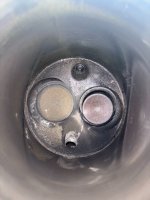
I spun the prop by hand, and had no compression in cyl 3. Borescope and cylinder removal confirmed that the valve seat had dropped. The mechanic at the shop I was stuck at said this was a rare failure. I am interested if anyone else has had this happen and what could've caused it?
Some background:
  • ~800 hours on engine, I bought the plane at 650 hours.
  • This engine has run 91 octane mogas (no ethanol) for 500-600 hours, with Marvel myster oil added to the fuel.
  • Cylinder 3 historically has been the hottest. Previously had baffling issues which lead to overheating cylinder 3.
    • On take off, it would often hit 450 F momentarily. In last 200 tach hours it has spent ~ 20 minutes at 450F.
    • There was an additional carb issue which caused cyl 3 to reach 480 F for a total of 20 seconds over the course of 20 flights.
    • Cylinder 2/4 have never gone over 450.
    • Cylinder 1 has hit 450 due to an intake leak.
    • Cooling issues have since been resolved, now CHTs never go over 420 on take off, cruise at 380ish.
  • At 650 tach hours, the compression was 75-76 across all cylinders. The carb issue then occurred causing overheating. We fixed it, and at 700 hours the compression on Cyl 1,2,4 was the same, but Cyl 3 dropped from 76 to 71.
  • Leaning has always been done ROP
    • Previous owner who ran MOGAS would lean ~150 F ROP
    • On AVGAS, we lean 50 ROP

It seems like the excessive heat in cyl 3 contributed to this failure. I've been reading about valve recession with unleaded fuel, but unsure if this contributed. How can I inspect for this? Is the drop in compression over 50 hours (during the heat issues) related to this?

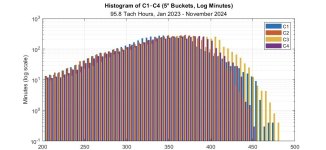
EDM 350 data (log plot), from before we fixed cooling. 1748569602536.jpegIMG_8963.jpeg
 
Last edited by a moderator:
valve recession is when the pounding forces the seat to move further into the head, deforming the alum base or the seat itelf shrinking or wearing down. The seat is an interference fit into the bore in the head. When seats are installed, the installer measures the bore and then needs to find a seat OD size that meets the spec, likely .0015-.002" larger than the bore. If the old one was a bit loose Clearance <.0015), he needs to bore the cavity bigger to accomodate the next size up seat. If he got lazy and said "that seems tight enough" or made a measuring error, resulting in too small of an interference, then that seat is more prone to falling out someday. The fit has to be tight enough to deal with the alum bore expanding more / faster than the steel seat, so shurt cuts are a problem. My guess is the installer didn't keep the fits in tolerance. Unless you are constantly running at 500*, I doubt that alone caused the issue. Though true that a loose fitting seat will require some heat cycles before it let goes. But one in tolerance will not fall out with temps up to 500 or greater. this is not a common problem, so the tolerances work when adhered to. 1000's of engines flying around with similar operating temps and the seats don't fall out.

I would chalk this up to an error of whoever did the valve work on that cylinder, even if it was the factory that did it. Just send it to a cyl overhaul shop and they can fix it - new valve job.
 
Last edited:
My RV6a has an O-360 with ~800 hours on the engine. It was flying fine, I stopped for gas, and on start up cylinder 3 would not fire.
I spun the prop by hand, and had no compression in cyl 3. Borescope and cylinder removal confirmed that the valve seat had dropped. The mechanic at the shop I was stuck at said this was a rare failure. I am interested if anyone else has had this happen and what could've caused it?
Some background:
  • ~800 hours on engine, I bought the plane at 650 hours.
  • This engine has run 91 octane mogas (no ethanol) for 500-600 hours, with Marvel myster oil added to the fuel.
  • Cylinder 3 historically has been the hottest. Previously had baffling issues which lead to overheating cylinder 3.
    • On take off, it would often hit 450 F momentarily. In last 200 tach hours it has spent ~ 20 minutes at 450F.
    • There was an additional carb issue which caused cyl 3 to reach 480 F for a total of 20 seconds over the course of 20 flights.
    • Cylinder 2/4 have never gone over 450.
    • Cylinder 1 has hit 450 due to an intake leak.
    • Cooling issues have since been resolved, now CHTs never go over 420 on take off, cruise at 380ish.
  • At 650 tach hours, the compression was 75-76 across all cylinders. The carb issue then occurred causing overheating. We fixed it, and at 700 hours the compression on Cyl 1,2,4 was the same, but Cyl 3 dropped from 76 to 71.
  • Leaning has always been done ROP
    • Previous owner who ran MOGAS would lean ~150 F ROP
    • On AVGAS, we lean 50 ROP

It seems like the excessive heat in cyl 3 contributed to this failure. I've been reading about valve recession with unleaded fuel, but unsure if this contributed. How can I inspect for this? Is the drop in compression over 50 hours (during the heat issues) related to this?

EDM 350 data (log plot), from before we fixed cooling. View attachment 88891
Sorry for your loss but that is a really cool way to plot that data!
 
Back in the day when I was involved in Lycoming engine overhauls, the valve seat was a shrink fit. I don’t remember the dimensions, but we would heat the head to 450deg f and put the seat in the freezer to assemble the seat in the head. For seat removal, Lycoming has a tool that fit the seat. The cylinder with the seat was heated to something like 500 deg f and then the tool, which had a water saturated sponge, was used to cool the seat, while popping it out with little or no force. If properly installed, I highly doubt the seat would drop like that. In fact, out of hundreds of cylinders we replaced very few seats.
 
When installed new at room temperature they are an interference fit, but after some time they can become, let's say, less interference. Think about the changes in temperature with operation. When started and warming up, to keep some contact force on the perimeter, the seat has to expand equally with the head. The heat transfer from the valve keeps the seat expanded in the hole. There is a wedge angle on the perimeter to retain the seat. Some manufacturer's deform the head to ensure contact.

I know that some aircraft engine valve seats routinely pass through a thermal condition in operation that calculates as a loose seat. And it is proven in fact, but they don't have any discernible field history of failure on the seats as you have recorded setting them apart from designs that "stay tight".

A loose seat is unusual but not unknown. The high temp on the head could have contributed, or maybe it was never well contained. Your CHT's are higher than desired but not excessive from Lycoming standards. My (FWIW) opinion is that it was likely a compromised seat placement from the beginning, aggravated (but not fundamentally caused) by the high temp event.

Replace and return to flying.
 
Back
Top
