Van's Air Force

The definitive Van's Aircraft support community! Buying, building or flying an RV? Join our exclusive family of mentors and enthusiasts!

New "Ti-Down Rings", Lightest, Strongest, with Locking Jack Cups

Tdeman

Well Known Member
Advertiser
Tired of holding my breath every time I lifted an airplane with wing jacks, I set out to design a wing jack system that would be positively locking. If I'm jumping in/out of the airplane, if the hangar door is open and a breeze comes through, or if an overzealous helper leans across a raised wing, I wanted the jack to move with the wing; even if that meant moving UP!

To safely lift via a 3/8" threaded stud, the lift point needed to be kept to a minimum length. Wing dihedral, plus any asymmetry from lifting one side puts a considerable bending moment on the stud and underlying extrusion. A tiny ball-stud would work, but that would only serve a single purpose... Also wanting this lift point to double as a tie-down ring, I hit the drawing board to see what could be made to work...

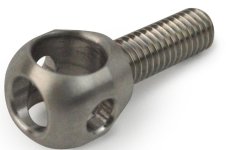
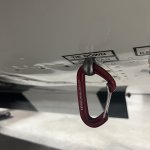
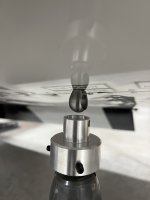
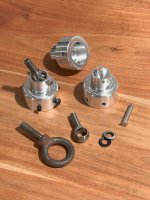
Introducing, the Ti-Down ring. Turned from 6AL-4V Titanium Bar, the Ti-Down ring is strong, light (16g), and inherently corrosion resistant. The 17/32 in. hole allows a half inch nylon rope, 11mm static line (my personal tie-down rope of choice), or a chain-hook to pass through. The bottom of the Ti-Down ring is spherical, for smooth engagement and articulation within the Locking Jack Cup.
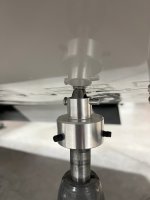
IMG_8851.jpg IMG_8852.jpg IMG_8839.jpg

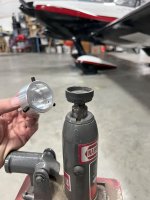
The Locking Jack Cup is machined from 2024-T3 Aluminum (with production units anodized red). The Cup affixes to long-ram jacks or bottle jacks via set screws. Additional screws can be passed through the pin-eye of the ram, ensuring the cup cannot be lifted off the ram. When ready to lift, a stainless quick-release pin is passed through the Lift Cup and the Ti-Down Ring, ensuring the assembly stays together.
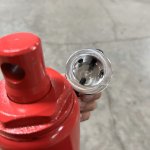
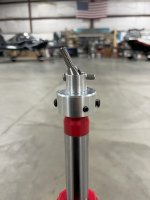
IMG_8813.jpg IMG_8826.jpg IMG_8831.jpg

The Ti-Down Ring can freely articulate 20-degrees within the cup without binding on the pin, more than enough to accommodate typical operations. Additionally, a conical rubber-backed washer is included for snugging up against the wing skin without damaging paint (see last photo).


Testing:
Of course, the first thing everyone asks is, "so how strong is it?"

This test was conducted by machining a 6061-T6 aluminum block at a 15 degree angle (to simulate dihedral, plus 12" of asymmetrical lifting). The Ti-Down Ring was threaded in, leaving 1/8" exposed thread out of the block (to simulate potential gap between the wing skin and tie-down extrusion.

Using a freshly-calibrated load cell, the assembly was placed in the shop press, and I started pumping... Over 4,000 lbf later, the Ti-Down ring sat there unyielded... To my surprise, even the Jack Cup was not deformed in the contact region. (however, the threads in the block were a bit draggy as the ring was unscrewed). I'd say any RV out there can be safely lifted by a pair of them :)
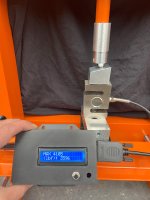
IMG_8502.jpg


Ti-Down Rings are in production now, and will begin shipping this coming week! The first batch of Locking Jack Cups are on their way to anodize, and should be ready to ship early next week.

Currently, jack cups fit rams up to 1.25" diameter (typical of long-ram Torin, Big Red, Harbor Freight etc), or jack-pads of 1.5" for the oversized size. If you guys are using something else, please let me know and we'll make sure there's an option that works for you!

Here's an overview of the components, including the factory tie down rings for comparison.
IMG_8880.jpg
 

Attachments

  • IMG_8630.jpg
    IMG_8630.jpg
    1.2 MB · Views: 107
How about tensile load? As in load applied as a tie-down rather than a lifting pad.
 
Pretty clever. I currently use Harbor Freight-based wing jacks with the tie-down/ram interface per the Kitplanes article. This design would address my main safety concern. I've never had an issue, but still.....

A question....would your jack cups fit the Cleaveland stainless steel wing tie downs (for those of us that already have those devices)?


1743251781664.jpeg
 
Last edited:
With that abrupt edge of the ring, note that using a rope directly on the ring will greatly reduce its strength. You will need to use a carabiner or something like that.

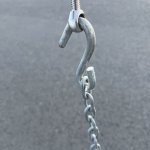
Also, the photo of the hook in the ring shows an attachment which I've seen fail - the hook straightens out under load. Or alternately, if the plane is rocking a lot, it'll just fall out.

The basis for my concern is having seen the effects of a strong wind at the Boulder CO airport in the early '80s. I was an aerospace stress analyst and therefore able to walk around among the dozen or so airplanes that were flipped over and assess how they got loose.

Dave
 
Beautiful work - impressive!
Thank you Mickey!


How about tensile load? As in load applied as a tie-down rather than a lifting pad.
Had a feeling this would be the second question asked! Simulation and past experience suggests tensile load capability will exceed the off-axis compressive load capability. (I realize most tensile applications will be off axis too... still applies.) However, I have some new rigging to verify this soon. Ironically, the weak link in my test setup is the off-the shelf eye bolt that threads into each end of the load cell.

...This design would address my main safety concern. I've never had an issue, but still.....

A question....would your jack cups fit the Cleaveland stainless steel wing tie downs (for those of us that already have those devices)?
That shared concern is exactly what I wanted to address.
As for the Cleveland compatibility, I don't know for sure, but I don't think so. You'll notice the Ti-Down's taper in pretty far at the top of the teardrop, and they're only .5" wide between the flat sides. This is to provide clearance from the cup walls, as well as the pin at the bottom as they're articulating.

- interested. What's the price for both pieces?

Single Ti-Down Ring or Locking Jack Cup are $55 a piece. Full package (2 Ti-Down Rings and 2 Locking Jacking Cups) is $190

Brilliant!
Thanks Paul, took the opportunity to apply for my first patent. Figured I'd see what that process looks like.


With that abrupt edge of the ring, note that using a rope directly on the ring will greatly reduce its strength. You will need to use a carabiner or something like that.

Also, the photo of the hook in the ring shows an attachment which I've seen fail - the hook straightens out under load. Or alternately, if the plane is rocking a lot, it'll just fall out.

The basis for my concern is having seen the effects of a strong wind at the Boulder CO airport in the early '80s. I was an aerospace stress analyst and therefore able to walk around among the dozen or so airplanes that were flipped over and assess how they got loose.

Dave
David, it's hard to tell from the photos, but the inside edges are rounded over with a full radius.
As you mention, a carabiner is a great buffer. I added a couple of lightweight rated climbing carabiners to my tie down kit, but use them for adapting when the chain is a pass-through type.

And yes, I try not to use the hooks when I don't have to, but the reality is they're at a lot of airports, and people like to use them.
My dad once found his RV-8 about 500 feet away from where he parked it, chalked in place by the FBO. Wind that night at the Napa Airport had bent one of the hooks straight on one side, and snapped the factory tie down ring off on the other side. FBO staff founding it dancing around the ramp, somehow unscathed.

IMG_8848.jpeg
 
Pretty clever. I currently use Harbor Freight-based wing jacks with the tie-down/ram interface per the Kitplanes article. This design would address my main safety concern. I've never had an issue, but still.....

A question....would your jack cups fit the Cleaveland stainless steel wing tie downs (for those of us that already have those devices)?


View attachment 84097
Make that 2! What he ^ said.
 
Taylor, well done! You keep reading my mind lol. Just when I get my tail wheel setup perfect and super light, you come up with these. I love the light weight form factor while serving double duty. Just ordered a full set. 👍
 
Thank you Mickey!


Had a feeling this would be the second question asked! Simulation and past experience suggests tensile load capability will exceed the off-axis compressive load capability. (I realize most tensile applications will be off axis too... still applies.) However, I have some new rigging to verify this soon. Ironically, the weak link in my test setup is the off-the shelf eye bolt that threads into each end of the load cell.


That shared concern is exactly what I wanted to address.
As for the Cleveland compatibility, I don't know for sure, but I don't think so. You'll notice the Ti-Down's taper in pretty far at the top of the teardrop, and they're only .5" wide between the flat sides. This is to provide clearance from the cup walls, as well as the pin at the bottom as they're articulating.


Single Ti-Down Ring or Locking Jack Cup are $55 a piece. Full package (2 Ti-Down Rings and 2 Locking Jacking Cups) is $190


Thanks Paul, took the opportunity to apply for my first patent. Figured I'd see what that process looks like.


David, it's hard to tell from the photos, but the inside edges are rounded over with a full radius.
As you mention, a carabiner is a great buffer. I added a couple of lightweight rated climbing carabiners to my tie down kit, but use them for adapting when the chain is a pass-through type.

And yes, I try not to use the hooks when I don't have to, but the reality is they're at a lot of airports, and people like to use them.
My dad once found his RV-8 about 500 feet away from where he parked it, chalked in place by the FBO. Wind that night at the Napa Airport had bent one of the hooks straight on one side, and snapped the factory tie down ring off on the other side. FBO staff founding it dancing around the ramp, somehow unscathed.

View attachment 84114
There are different shape carabiners out there. The D and pear shape (Used above) will bind in one axis if the tie down isn't straight down. It won't hurt the carabiner with tie down loads, but will impart a twist on the mount, and the TI eye will probably chowder up the inside of the carabiner. I would suggest getting an oval profile if possible.

 
There are different shape carabiners out there. The D and pear shape (Used above) will bind in one axis if the tie down isn't straight down. It won't hurt the carabiner with tie down loads, but will impart a twist on the mount, and the TI eye will probably chowder up the inside of the carabiner. I would suggest getting an oval profile if possible.


I have a whole climbing gear wall full of many types of carabiners. As you mention, the oval ones certainly articulate the most freely, but I chose these (Metolius FS Mini II) because they’re one of the lightest available at 24g, and….

Installed in the direction they’re shown, they will cleanly load straight down, or swung out to the outboard direction (which is where most tie down anchors are compared to our stubby little RV wings).

The Ti-Down ring nestles nicely in the little corner. The rounded edge of the tie down ring seems to be much easier on the carabiner than the stamped and bent steel anchors used on most sport climbing routes!

I also have tried girth hitching a short dyneema loop through it. That worked great too, and leaves a loop big enough for any chain to get through.

Many ways to go about it, and I’m sure everybody will have some preference of their own, I just wanted to show some of the things I’ve found to work thus far.

Personally, in my tie down kit for travel, I carry a couple lengths of static rope (which knots nicely), a couple carabiners, and an extra Ti Down ring. It’s just nice to have options!
 
I started Taylor’s regime of weight reduction this weekend with a roughly 1 pound 6 ounces loss from the tail, now with the Ti-Down Rings already. If nothing else there will be a few new items on our 25 year old RV-6 that should have heads turning on the ramp in place of our usual oil leaks.

IMG_0364.jpeg
 
I started Taylor’s regime of weight reduction this weekend with a roughly 1 pound 6 ounces loss from the tail, now with the Ti-Down Rings already. If nothing else there will be a few new items on our 25 year old RV-6 that should have heads turning on the ramp in place of our usual oil leaks.

View attachment 84226
Looks great Chris, the all black sure looks slick.

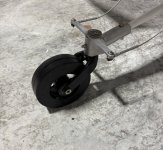
One minor thing I'll clarify is the plastic thrust washer should be installed under the tailwheel yoke (to provide a smooth bearing surface where the fork and yoke rub, and minimize wear on both.)
I did finally get a full installation manual uploaded to the site!
 
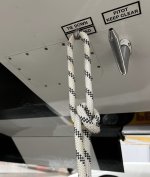
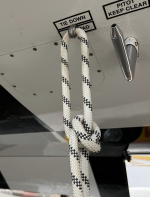
Should have caught this earlier. These knots have a tendency to come loose when the plane is rocking and the line alternately goes tight then slack. They are indeed easy to tie, though. Remember, through the 'biner, not the ring.

DaveBad Knot.png
 
Looks great Chris, the all black sure looks slick.

One minor thing I'll clarify is the plastic thrust washer should be installed under the tailwheel yoke (to provide a smooth bearing surface where the fork and yoke rub, and minimize wear on both.)
I did finally get a full installation manual uploaded to the site!


Now in fairness Taylor, I was operating under free thought (since you didn’t have the instructions up yet) I had a fifty/fifty chance getting the install right. You do have to hand it to me though I did get the wheel going in the right direction. In all honesty, your product is an excellent piece of engineering. Thanks for a quality design.
 
Pretty clever. I currently use Harbor Freight-based wing jacks with the tie-down/ram interface per the Kitplanes article. This design would address my main safety concern. I've never had an issue, but still.....

A question....would your jack cups fit the Cleaveland stainless steel wing tie downs (for those of us that already have those devices)?


View attachment 84097
I do jack my airplane RV-14A, full fuel, on these tie down bolts from cleaveland. And I have an email from them confirming it was designed to hold even RV-10 full fuel. I had no issues what so ever. Very nice product.
 
I started Taylor’s regime of weight reduction this weekend with a roughly 1 pound 6 ounces loss from the tail, now with the Ti-Down Rings already. If nothing else there will be a few new items on our 25 year old RV-6 that should have heads turning on the ramp in place of our usual oil leaks.

View attachment 84226
This installation gives me pause in a number of places. Sometimes weight reduction does not come without penalty.

- Single bolt holding the knuckle to the stinger - no redundancy on a bolt that is known to wear and need replacement.
- Single sided clevises on the cable ends - guaranteeing a bending moment load on the screws holding to the arms.
- Short screws - so likely threaded all the way to the head? Actuation loads will then be concentrated at the base of the thread at the join between the clevis and the arm... And it's worse as the bolt is loaded in bending not in shear.
 
This installation gives me pause in a number of places. Sometimes weight reduction does not come without penalty.

- Single bolt holding the knuckle to the stinger - no redundancy on a bolt that is known to wear and need replacement.
- Single sided clevises on the cable ends - guaranteeing a bending moment load on the screws holding to the arms.
- Short screws - so likely threaded all the way to the head? Actuation loads will then be concentrated at the base of the thread at the join between the clevis and the arm... And it's worse as the bolt is loaded in bending not in shear.

I'd like to point out, the only Aero Garage parts installed there are the Lite Fork and wheel.

-That tail yoke is the old Aviation Products yoke. I can't speak for every installation of it, but I've seen quite a few of the early ones installed single-bolt in the same fashion. Again, not our yoke, we just make a fork that's an improvement over the original AP fork. I know Chris has already gone through one of those aluminum yokes, which seem to show their wear well before the attaching hardware does.
(Chris was kind enough to send his old worn and bent parts in for reference during the AP adaptation of the Lite Fork.)

-Those are Brent Anderson's original Tail Lynx. They have a pretty successful track record over the last 30ish years, though I still tried to address all of their shortcomings with my new Lite Links.

The Aero Garage Lite Links use bronze clamp-up bushings on both ends of the cable, so the bolts are tight. This still allows free pivoting of the cable terminals, reduces bending loads, and eliminates the risk of wallowing out the holes in the control horns. The bolts provided with Lite Links are full grip through the bushing and horns.
 
Last edited:
This installation gives me pause in a number of places. Sometimes weight reduction does not come without penalty.

- Single bolt holding the knuckle to the stinger - no redundancy on a bolt that is known to wear and need replacement.
- Single sided clevises on the cable ends - guaranteeing a bending moment load on the screws holding to the arms.
- Short screws - so likely threaded all the way to the head? Actuation loads will then be concentrated at the base of the thread at the join between the clevis and the arm... And it's worse as the bolt is loaded in bending not in shear.

I also only have a single bolt through my yoke. My Mechanical Engineer buddy who advised me on which alloy of Titanium would be best used for a stinger, was against putting two holes in such close proximity. We fused the yoke and stinger together with a special epoxy which provides the lateral strength. The single bolt is only there for redundancy and rotational forces.

My API was the same. A single bolt but with a much longer sleeve.
 
That epoxying of the yoke and stinger together is similar to what Cessna recommends for the C180 tailwheel assembly and stinger, although they use 2 bolts. For that plane, the static load on the tailwheel, on the ground in a 3-point attitude, was 236 pounds. I expect that's rather more than for RVs.

Dave
 
Should have caught this earlier. These knots have a tendency to come loose when the plane is rocking and the line alternately goes tight then slack. They are indeed easy to tie, though. Remember, through the 'biner, not the ring.

DaveView attachment 84233
I agree this style knot will come loose when using relatively slick ropes. Learn how to tie a bowline while under tension, should keep things relatively secure when tied properly. And using a correct finishing knot on the tail.
 
I’ve got 950 hours on my Tail Lynx, rigged this same way, “single clevis”.
I have taken it apart several times and measured/inspected the bolt holes and bolts. Holes still round. Bolts still to spec. No wear or tear.
Brent was a hangar neighbor and good engineer. I have no concerns.

However, I purchased the Aero Garage links and this new tie down ring. Why?
I support the small community that invests in us, and, make a compelling product. I’ll swap out the Tail Lynx during this CI. I’ll get rid of my old tie rings and grade 8 bolts I machined down and go with this….. ‘My jacks have dished out rams, and you couldn’t knock the airplane off if you tried, but I like the cups, and if there ever was an earthquake……

Agree with the two bolts. I pressed in oversized bolts. Hasn’t budged.
 
Back
Top