Hello all-
Just completed my third flight in a new-to-me (builder-buyer-me) F-1 Rocket. Early serial number, not an Evo wing. My power-off stall speed and slow flight speeds seem really off, and I'm looking for suggestions as to why.
Up Front:
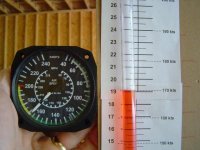
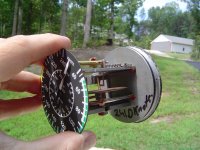
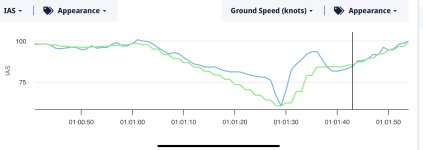
I'm flying at a GW of 1,800 lb, and a CG of 91.5. My full-flaps power-off stall has an initial buffet at 80 KIAS, and a definite stall break at 74 KIAS. I'm seeing similar numbers for slow flight with full flaps: I can sustain above 70 KIAS using power, but have an abrupt stall at 70 KIAS. I have similar results with flaps up - there's about a 2-4 kt increase in both buffet onset and stall. The Phase I testing entry in the logbook indicates a power-off stall speed of 45 KIAS. I'm at a loss to come up for a reason for such a big difference. After downloading the Skyview data from the flight, the TAS is very close to GS when the wind is 90 degrees off, so I don't (at the moment) suspect a pitot-static problem.
Background:
In my initial flight testing in this plane, it seemed very nose-heavy, and I couldn't get slower than 70 KIAS in slow flight and was unable to get to a power-off stall - with full aft stick, the plane would just transition to a 1000+ fpm descent with the stick at the aft stop. After accomplishing a new W&B, I determined that the plane was very near the forward CG limit (plane was at 88.2, published fwd limit is 87.7).
For the testing reported above (under "Up Front"), I used ballast to move the GC to 91.5. I now (seem to) have appropriate pitch authority - but the airplane stalls 25 KIAS higher than expected. My downloaded Skyview data indicates that the pitch attitude never exceeded 15 degrees at essentially a zero sink rate. My understanding is that the RV airfoil (NACA 23013.5) will typically stall at an AOA of about 20 degrees. Even accounting for the wing's incidence angle, I don't think I'm coming within 4-5 degrees of the (expected) critical angle of attack.
Does anyone here have ideas that would explain the behavior described above?
Just completed my third flight in a new-to-me (builder-buyer-me) F-1 Rocket. Early serial number, not an Evo wing. My power-off stall speed and slow flight speeds seem really off, and I'm looking for suggestions as to why.
Up Front:
I'm flying at a GW of 1,800 lb, and a CG of 91.5. My full-flaps power-off stall has an initial buffet at 80 KIAS, and a definite stall break at 74 KIAS. I'm seeing similar numbers for slow flight with full flaps: I can sustain above 70 KIAS using power, but have an abrupt stall at 70 KIAS. I have similar results with flaps up - there's about a 2-4 kt increase in both buffet onset and stall. The Phase I testing entry in the logbook indicates a power-off stall speed of 45 KIAS. I'm at a loss to come up for a reason for such a big difference. After downloading the Skyview data from the flight, the TAS is very close to GS when the wind is 90 degrees off, so I don't (at the moment) suspect a pitot-static problem.
Background:
In my initial flight testing in this plane, it seemed very nose-heavy, and I couldn't get slower than 70 KIAS in slow flight and was unable to get to a power-off stall - with full aft stick, the plane would just transition to a 1000+ fpm descent with the stick at the aft stop. After accomplishing a new W&B, I determined that the plane was very near the forward CG limit (plane was at 88.2, published fwd limit is 87.7).
For the testing reported above (under "Up Front"), I used ballast to move the GC to 91.5. I now (seem to) have appropriate pitch authority - but the airplane stalls 25 KIAS higher than expected. My downloaded Skyview data indicates that the pitch attitude never exceeded 15 degrees at essentially a zero sink rate. My understanding is that the RV airfoil (NACA 23013.5) will typically stall at an AOA of about 20 degrees. Even accounting for the wing's incidence angle, I don't think I'm coming within 4-5 degrees of the (expected) critical angle of attack.
Does anyone here have ideas that would explain the behavior described above?