Van's Air Force

The definitive Van's Aircraft support community! Buying, building or flying an RV? Join our exclusive family of mentors and enthusiasts!

My stall speed seems really high...

GyroF-16

Well Known Member
Patron
Hello all-
Just completed my third flight in a new-to-me (builder-buyer-me) F-1 Rocket. Early serial number, not an Evo wing. My power-off stall speed and slow flight speeds seem really off, and I'm looking for suggestions as to why.

Up Front:
I'm flying at a GW of 1,800 lb, and a CG of 91.5. My full-flaps power-off stall has an initial buffet at 80 KIAS, and a definite stall break at 74 KIAS. I'm seeing similar numbers for slow flight with full flaps: I can sustain above 70 KIAS using power, but have an abrupt stall at 70 KIAS. I have similar results with flaps up - there's about a 2-4 kt increase in both buffet onset and stall. The Phase I testing entry in the logbook indicates a power-off stall speed of 45 KIAS. I'm at a loss to come up for a reason for such a big difference. After downloading the Skyview data from the flight, the TAS is very close to GS when the wind is 90 degrees off, so I don't (at the moment) suspect a pitot-static problem.

Background:
In my initial flight testing in this plane, it seemed very nose-heavy, and I couldn't get slower than 70 KIAS in slow flight and was unable to get to a power-off stall - with full aft stick, the plane would just transition to a 1000+ fpm descent with the stick at the aft stop. After accomplishing a new W&B, I determined that the plane was very near the forward CG limit (plane was at 88.2, published fwd limit is 87.7).
For the testing reported above (under "Up Front"), I used ballast to move the GC to 91.5. I now (seem to) have appropriate pitch authority - but the airplane stalls 25 KIAS higher than expected. My downloaded Skyview data indicates that the pitch attitude never exceeded 15 degrees at essentially a zero sink rate. My understanding is that the RV airfoil (NACA 23013.5) will typically stall at an AOA of about 20 degrees. Even accounting for the wing's incidence angle, I don't think I'm coming within 4-5 degrees of the (expected) critical angle of attack.

Does anyone here have ideas that would explain the behavior described above?
 
From what you described of the stick feel, it sounds like there is a real aerodynamic issue, which I'm not qualified to help you with.

I just wanted to say be careful if you're using the wind data from the Skyview to conclude that you don't have a pitot-static issue: the true airspeed it calculates from the OAT, pitot and static pressures is an *input* to the wind calculation - i.e. if its (mis-)calculated TAS is the same as GPS ground speed, it will always think the wind is 90 degrees off because that's how it determines the headwind / tailwind component in the first place!

If you know you were flying perpendicular to an external reference for the wind (like a smoke plume or something) then you can disregard that, but if you're looking at the Skyview data in a vacuum then you need to make sure you know which data points are potentially impacted by the issue you're trying to diagnose.
 
I’d definitely go up and do a four-course Airspeed calibration, just to nail down if it is/isn’t an accurate speed. A static leak in the cabin can cause high airspeed readings (among other potential causes). This is going to be a “let’s rule that out” process, so you might as well make sure that you can rule it IAS errors.
 
There was a thread here just a couple days ago with similar airspeed accuracy issues. Go take a read. Cutting to the chase a bit... which static ports are installed?

[I am making a bit leap in assuming an airspeed accuracy issue]
 
I’d definitely go up and do a four-course Airspeed calibration, just to nail down if it is/isn’t an accurate speed. A static leak in the cabin can cause high airspeed readings (among other potential causes). This is going to be a “let’s rule that out” process, so you might as well make sure that you can rule it IAS errors.
Yes- I’m planning a circuit tomorrow to compare average TAS to GS.
I’d laid out an equilateral triangle. Is a square somehow better? And if so, why?
 
There was a thread here just a couple days ago with similar airspeed accuracy issues. Go take a read. Cutting to the chase a bit... which static ports are installed?

[I am making a bit leap in assuming an airspeed accuracy issue]
Was this the “stall on final” thread? I saw that one.
I’m leaning towards a pitot static issue, too. Just need to figure out what’s going on.
The airplane passed a transponder pitot static check in August as part of the pre-purchase inspection. All the static-based altitude readouts were deemed valid. Doesn’t it seem like that indicates that the static portion of the system is working? (At least on the ground with devices attached to the static ports).
I’m not arguing with you, just trying to narrow it down to where the problem may reside.
 
A few years ago we purchased an RV7A. It too was stalling around 70KIAS full flaps. The airspeed did not seem unreasonably high at cruise, but was clearly off on the lower speeds. After some trouble shooting, we replaced the airspeed indicator with a new one from Vans and that fixed the issue. I don't know what could have caused the airspeed indicator to be off in only the slower phases of flight, and I don't know if your system would somehow be able to have a similar error.
 
Last edited:
Echoing what others have said, check for static leaks. I assume it's not likely to be as bad as mine, but a disconnected hose somewhere would dramatically overstate your IAS/TAS.

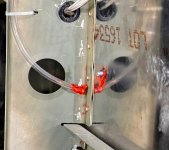
PXL_20241110_222113927~2 (1).jpg


I've always felt my 8A stalls faster than expected. I can't land much slower than 55kias (admittedly fwd CofG). Discovered the elevator up range was at the minimum extent so started adjusting it for more travel. Maybe not the issue, but worth a look. That's 5-10kts faster than Vans spec for an 8A with my engine.

Which raises the question: If an RV-8/8A stalls at roughly 45-50kts depending on weight, wouldn't a rocket stall significantly faster with the big engine and the short wing?
 
Yes- I’m planning a circuit tomorrow to compare average TAS to GS.
I’d laid out an equilateral triangle. Is a square somehow better? And if so, why?
Too many many religious wars have been started by the triangle versus square debate - do either one, so long as you use the right spreadsheet/method to reduce the data….😉
 
Was this the “stall on final” thread? I saw that one.
I’m leaning towards a pitot static issue, too. Just need to figure out what’s going on.
The airplane passed a transponder pitot static check in August as part of the pre-purchase inspection. All the static-based altitude readouts were deemed valid. Doesn’t it seem like that indicates that the static portion of the system is working? (At least on the ground with devices attached to the static ports).
I’m not arguing with you, just trying to narrow it down to where the problem may reside.
Actually I meant this one: four-leg-gps-speed-test-6-knots-difference-help
The pitot static test, if performed at the port, would confirm airflow continuity and no leaks. If they T'd in the line somewhere and blocked the ports, it confirms no leaks...

A huge number of folks have installed "better" (as in pretty, and more $$) static ports and discovered the static readings at speeds are off. In other words they perform worse than the Van's 'pop rivet port'. Hence my question about *which* ports you have.
 

Issue has been around for years. Search static port.
 
The airplane passed a transponder pitot static check in August as part of the pre-purchase inspection. All the static-based altitude readouts were deemed valid. Doesn’t it seem like that indicates that the static portion of the system is working?
That's good, but this test does not take into account the shape of the static port, and the influence of the airflow over it.
 
It seems like non-standard static ports are always the smoking gun in this scenario, but according to the original post, something doesn't add up.

The OP stated the phase 1 entry cited a 45 kias power off stall speed, but his real world testing demonstrates 70 kias.

Seems to me that unless the static ports magically changed (like maybe they were changed out after phase 1, or phase 1 was done pre-paint and then an overzealous sand and fill in the paint shop job goofed up the shape), then one of two things happened;

1. The initial number was pencil whipped and it's always had a 70 kias number, which is likely wildly inaccurate, or

2. Something has gone goofy with the static system not related to the shape of the ports.

Assuming you determine that you have vans standard static ports or equivalent, and also assuming that flight test is going to reveal a big airspeed error, I'd start troubleshooting by looking for a blockage in the plumbing.

Here's my reasoning. If you look at Vans design philosophy, they tend to operate on a "simpler is always better" model. Yet they felt the need to put two static ports on the plane. A common reason to do that is to neutralize the slip/skid and prop slipstream errors that some airframes would be prone to if they only had a port on one side.

A guy could hypothesis that if one side of the plumbing was blocked, As long as the avionics folks randomly picked the other one to draw a vacuum on it could likely pass a static cert test but still show errors in flight.

I'm not saying that any of this is 100% certain. It's just one possibility to look at as you move forward.
 
Was this the “stall on final” thread? I saw that one.
I’m leaning towards a pitot static issue, too. Just need to figure out what’s going on.
The airplane passed a transponder pitot static check in August as part of the pre-purchase inspection. All the static-based altitude readouts were deemed valid. Doesn’t it seem like that indicates that the static portion of the system is working? (At least on the ground with devices attached to the static ports).
I’m not arguing with you, just trying to narrow it down to where the problem may reside.
The pitot static test only measures two things. The accuracy of the instruments and leaks in the two systems. It has nothing to do with positional error or the static ports or the pitot tube.
 
Too many many religious wars have been started by the triangle versus square debate - do either one, so long as you use the right spreadsheet/method to reduce the data….😉
To add, as it may not be obvious, the "right spreadsheet" that paul mentions is NOT just an average of grd speeds. There seems to be a common misconception that you can just take an average of the ground speeds.
 
1. The initial number was pencil whipped and it's always had a 70 kias number, which is likely wildly inaccurate, or
I've seen a number of RVs, including mine, where the testing numbers were basically copy-pasted from someone else's POH or Vans' published numbers. This is probably because the builder didn't have the confidence to fly accurate testing to determine the values, or didn't get the answer they were expecting when they tried.

2. Something has gone goofy with the static system not related to the shape of the ports.

Assuming you determine that you have vans standard static ports or equivalent, and also assuming that flight test is going to reveal a big airspeed error, I'd start troubleshooting by looking for a blockage in the plumbing.

Here's my reasoning. If you look at Vans design philosophy, they tend to operate on a "simpler is always better" model. Yet they felt the need to put two static ports on the plane. A common reason to do that is to neutralize the slip/skid and prop slipstream errors that some airframes would be prone to if they only had a port on one side.

A guy could hypothesis that if one side of the plumbing was blocked, As long as the avionics folks randomly picked the other one to draw a vacuum on it could likely pass a static cert test but still show errors in flight.

I'm not saying that any of this is 100% certain. It's just one possibility to look at as you move forward.
This is a solid point.
 
This kind of testing is what everyone is referring to. Pitot static checks only check for leaks downstream of where they tapped in and instrument accuracy, as noted above. It does not test for placement error, or port shape error in a dynamic, air-flowing-across-the-fuselage environment. Fly 3 or 4 leg circuits, at a range of airspeeds and then crunch the numbers using one of the widely available spreadsheets. Only then can you move on to other sources of stall speed variations if the testing reveals your speeds are correct. In your case I would make sure I tested at speed brackets around where it appears to be stalling. I had placement error on mine, but it was dead on in the slow regime, and 10+ knits off at higher speeds. Static port placement is a black art, but per the plans style and location is a known working version.
 
Not just the type of static port. I've seen errors because then portside were not located per plan. Little things matter.
 
Not just the type of static port. I've seen errors because then portside were not located per plan. Little things matter.
For not more than a couple hours work, you can build a simple calibrated manometer to test your pitot/ static system. You can do that on the ground before risking your bird, or your butt...plenty of insight on the internet "DIY Manometer, aircraft"

Also wouldnt rule out airspeed indicator itself. Water in the system can also cause havoc...I'd clear all the lines before I went flying. For a quick and dirty check...a simple balloon zip tied onto a barb fitting you can slip into your tubes is pretty easy....blow the balloon up and stick a finger over the blow end...and see what happens.

my neighbor had weird airspeed indications and we found it like this, that a nylon fitting broke clean off up in his wing between the pitot probe on its way into the cabin. blew in the tube and only heard a hiss...in the wing. found in 5 minutes and all well....

My Rocket stalled at 58mph solo at 1650 lbs. Not an EVO wing.

Learning a new airplane and having un-reliable airspeed is one of those "stack the odds" things to be avoided.

Be dang careful.
 
Many inconsistencies in the first post, ranging from a given "stall speed" to the CG. The problem has probably more than one reason, cumulative in the results.
An easy method to start troubleshooting would be to fly in close formation (careful if not trained) with a buddy with an aircraft with reliable speed indications, calling (or recording) the respective IAS, and then compare the readings. This would be quick in determining the precision of your IAS.
Once this is done, eventually correcting the IAS (leaks in the system, static ports, etc), checking the flight control travels, wings/HS angles of incidence, and a re-weighting, all to be done, not necessarily in that order.

With this out of the way, a new test flying program could be established and flown to validate the new data.
 
....I don't know what could have caused the airspeed indicator to be off in only the slower phases of flight,...

AIrspeed is derived from total pressure measured at the pitot and referenced to static P. It is not linear across the range -> a function of the square of the speed.

So, it this case it's not unusual for a discrepant instrument to only be accurate at one point. The further away from that point, the larger the deviation. Lots of variables but this is the sub-basics

Edit = Dynamic - > Total. Sorry for the brain fart.
 
Last edited:
AIrspeed is derived from dynamic pressure measured at the pitot and referenced to static P. It is not linear across the range -> a function of the square of the speed.

So, it this case it's not unusual for a discrepant instrument to only be accurate at one point. The further away from that point, the larger the deviation. Lots of variables but this is the sub-basics
Ram air pressure vs. static pressure
  • An airspeed indicator uses the difference between ram air pressure and static air pressure to measure speed.
  • Ram pressure: The total pressure measured by the pitot tube, which is pointed directly into the oncoming airflow.
  • Static pressure: The ambient air pressure that is measured at a right angle to the airflow.
  • Dynamic pressure: The difference between ram pressure and static pressure, which is used to calculate airspeed.
  • Importance: This comparison is crucial for accurate speed indication, as static pressure decreases with altitude, while ram pressure is affected by both speed and altitude.
  • That's what A.I. says...........
 
Echoing what others have said, check for static leaks. I assume it's not likely to be as bad as mine, but a disconnected hose somewhere would dramatically overstate your IAS/TAS.

View attachment 101266
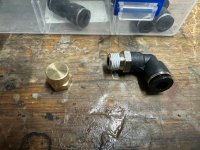
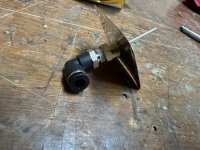
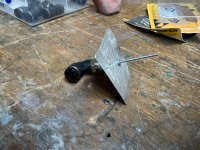
If yours is bad like this, I used a (textual) description of what someone else did to use the Vans pop rivet, but still have good connections, and did the same on mine which worked very well, and I now have accurate speeds. I took pictures to describe the process:
1. Buy brass 1/8 NPT caps from the usual places
2. Drill a hole to match the rivet you are going to use, in the cap and the skin, in the correct position on the fuselage
3. Put some pro seal/whatever on the face and glue to inside skin, using the unpulled rivet as an alignment pin
4. Wait for it to dry
5. Pop the rivet
6. Use a small punch or pulled mandrel to drive the remaining mandrel out of the rivet, leaving it now an open hole
7. Find a small person to climb in there with 2 wrenches and put on the quick disconnect fitting, making sure the pro seal is completely solid, cause the one unfilled rivet will allow the base brass cap to spin, and you'll have to start over with the sealant
8. Hook up hoses per plans
9. Deburr the outside of the rivet head just a hair if the mandrel mangled it when pulling. Should be nice and smooth transitions, even at the micro level.
10. Profit!

IMG_0854.jpeg
IMG_0855.jpegIMG_0856.jpeg
 
Ram air pressure vs. static pressure
  • An airspeed indicator uses the difference between ram air pressure and static air pressure to measure speed.
  • Ram pressure: The total pressure measured by the pitot tube, which is pointed directly into the oncoming airflow.
  • Static pressure: The ambient air pressure that is measured at a right angle to the airflow.
  • Dynamic pressure: The difference between ram pressure and static pressure, which is used to calculate airspeed.
  • Importance: This comparison is crucial for accurate speed indication, as static pressure decreases with altitude, while ram pressure is affected by both speed and altitude.
  • That's what A.I. says...........
Ram air pressure vs. static pressure
  • An airspeed indicator uses the difference between ram air pressure and static air pressure to measure speed.
  • Ram pressure: The total pressure measured by the pitot tube, which is pointed directly into the oncoming airflow.
  • Static pressure: The ambient air pressure that is measured at a right angle to the airflow.
  • Dynamic pressure: The difference between ram pressure and static pressure, which is used to calculate airspeed.
  • Importance: This comparison is crucial for accurate speed indication, as static pressure decreases with altitude, while ram pressure is affected by both speed and altitude.
  • That's what A.I. says...........
Yep. Should have said "total". I know better. Changed in my previous post. Below is a link to a thread I started and subsequently received some sh!t for.

Pressure Thread
 
For not more than a couple hours work, you can build a simple calibrated manometer to test your pitot/ static system. You can do that on the ground before risking your bird, or your butt...plenty of insight on the internet "DIY Manometer, aircraft"

Also wouldnt rule out airspeed indicator itself. Water in the system can also cause havoc...I'd clear all the lines before I went flying. For a quick and dirty check...a simple balloon zip tied onto a barb fitting you can slip into your tubes is pretty easy....blow the balloon up and stick a finger over the blow end...and see what happens.
If you are flying with a steam gauge analog airspeed instrument, assume it is lying to you. I had three, one was close, one read 6-7 knots low at the low end (so I was landing way too fast), the last one was high in the cruise range.

Using the manometer discussed above I was able to calibrate the instruments over the full airspeed range. This is an iterative process but with a little patience it does work.

I found the SkyView EFIS airspeed readouts to be very accurate.

Side note. On another occasion I was checking for static leaks before paying money to do the every two year pitot static check. This time I had a leak that alluded me. I finally pulled the analog airspeed instrument and found the leak to between the case and the glass. A dab of RTV and all was well.

Carl
 

Attachments

  • IMG_0623.jpeg
    IMG_0623.jpeg
    69.8 KB · Views: 30
  • DSC00782 (2).jpeg
    DSC00782 (2).jpeg
    772.7 KB · Views: 30
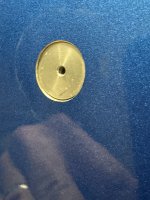
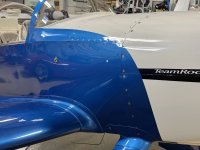
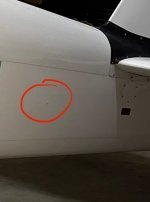
Post a pic of your static ports on the side of the plane.IMG_4888.jpeg
Here’s a close-up. The static ports are smallish- maybe the size of a nickel.

Below is where they sit on the plane.
 

Attachments

  • IMG_4891.jpeg
    IMG_4891.jpeg
    2.1 MB · Views: 168
Well there you go! The ports are recessed ???!!! And forward of the wing ????!!!
I know this has been studied to death by NACA or somebody before I was born, but intuitively I'm guessing a recessed port generates a pressure drop a la Bernoulli/Venturi and increases the apparent dynamic pressure differential from pitot to static, resulting in a high reading.
 
Thanks to all who replied.
I flew a known-distance triangular closed course twice yesterday. Once at 100 KIAS, and then at 160 KIAS.
Didn’t use a spreadsheet (thanks for posting the link- I’ll look at that). I used total route time and the known route distance to calculate an average groundspeed, then used the average TAS from Skyview for the course.
These are my results:
At 100 KIAS: Groundspeed was 122 kts. TAS was 117.5. Indicates low by 3.7%
At 160 KIAS: Groundspeed was 196.8 kts. TAS was 186. Indicates low by 5.5%

Unless I did something significant wrong, I’d conclude that, from 100-160 KIAS, I’m getting pretty valid readings.

I’d like to test at lower airspeeds, but 10-15 minutes of essentially slow flight (75 KIAS) isn't really feasible from an engine cooling standpoint. Remember that I’m stalling at about 72 KIAS, so 75-80 INDICATED is likely even slower in reality.


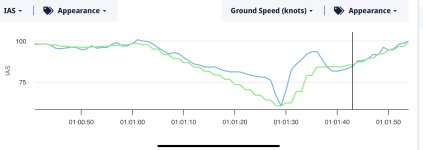
Then I looked at the Skyview data for the one power-off stall I did, pointed into the indicated wind direction. I saw that at 100 KIAS, the GS was consistently 10 KIAS slower that IAS. On a constant heading (+/-5°) and altitude (less than 100’ variation), I slowed until the stall. Then lowered the nose, added power and recovered. The IAS/GS graph looks like this:


IMG_1724.jpeg

Note that at time 01:01:15, the blue line (IAS) starts to diverge from the green line (GS). The difference in values increases from about 10 kts to a maximum of 29 kts right before the stall. After recovery, the difference decreases again and stabilizes at time 01:01:42.
The IAS At both the divergence and convergence points is about 85 KIAS.

From all the above data, I’m thinking that my IAS is pretty valid above 85 KIAS (and certainly is at higher speeds). But something is causing the airspeed to indicate significantly high below 85 KIAS right down to the stall (about 70 KIAS, but probably somewhere in the 50’s in reality).

Thoughts on what could be causing this, and suggestions for troubleshooting and correction?
 
Last edited:
Wow. Guessing both installation and location are contributing to your error. Was the builder trying to save on tubing costs?
Almost certainly not, since the Dynon ADAHRS is located in the tail section, so all the tubing has to go all the way back there.

Can anyone tell me whether other (most?) Rockets have static ports forward of the cockpit?
 
I know this has been studied to death by NACA or somebody before I was born, but intuitively I'm guessing a recessed port generates a pressure drop a la Bernoulli/Venturi and increases the apparent dynamic pressure differential from pitot to static, resulting in a high reading.
I’m thinking the same thing. Except that my IAS seems to be valid at 100 KIAS and above. And appears to decrease proportionally with GS down to 85 KIAS. Below that, it gets whacky (see my post #35 above).
 
Almost certainly not, since the Dynon ADAHRS is located in the tail section, so all the tubing has to go all the way back there.

Can anyone tell me whether other (most?) Rockets have static ports forward of the cockpit?
That was an attempt at bad humor. Placing the port in an area with a lot of flow disturbance contributes to the error. Others have more experience but a static port NOT between the wing and tail stabs and NOT with some decent margin above the wing trailing edge is completely contrary to my experience and common sense. The location in your pix would introduce sensing error even before considering any prop wash. Keep us informed.
 
I’m thinking the same thing. Except that my IAS seems to be valid at 100 KIAS and above. And appears to decrease proportionally with GS down to 85 KIAS. Below that, it gets whacky (see my post #35 above).
Could be boundary layer effects. Thicker boundary layer at speed may help negate the recess. Could also be AoA where at low speed the gear leg or propwash is changing flow that reaches the static port, though that does seem farfetched.
 
I have zero experience with where Rockets place static ports. But given their offshoot from Van's RV's, I can say the Van's location is fuselage sides AFT of the wing, so I'd expect Rockets to do the same. Piper static ports are odd ducks (built in to the pitot mast), but are WELL outboard of the prop. Cessna ports are similarly located to Van's. I've never seen a plane with static ports where these are.

Propwash should cause interesting effects.

Also, #Untainted123, nice write up w/pictures of the design I used on my 6A.
 
Can anyone tell me whether other (most?) Rockets have static ports forward of the cockpit?
All the HRII’s and F1’s that I’ve seen share the -4 port placement: aprox 14” in front of the leading edge of the horizontal stab.
My HRII’s IAS is accurate with this placement and with the Van’s rivet-head port.
 

Attachments

  • IMG_2907.jpeg
    IMG_2907.jpeg
    38.6 KB · Views: 44
Last edited:
"...Cessna ports are similarly located to Van's. I've never seen a plane with static ports where these are..."
At this point all Cessna singles have ports just aft of the firewall. But that's completely irrelevant. Cessna did flight test and determined they worked there on those airframes. Vans presumably did some testing and determined that the aft tailcone worked well for them.

OP- It seems pretty likely that the non-standard static port shape and location is the root cause of what you're seeing
 
At this point all Cessna singles have ports just aft of the firewall. But that's completely irrelevant. Cessna did flight test and determined they worked there on those airframes. Vans presumably did some testing and determined that the aft tailcone worked well for them.

OP- It seems pretty likely that the non-standard static port shape and location is the root cause of what you're seeing
My memory of Cessna ports has clearly failed me. Mea Culpa.
 
At this point all Cessna singles have ports just aft of the firewall. But that's completely irrelevant. Cessna did flight test and determined they worked there on those airframes. Vans presumably did some testing and determined that the aft tailcone worked well for them.

OP- It seems pretty likely that the non-standard static port shape and location is the root cause of what you're seeing
I reached out to Vince Frazier (Team Rocket), and learned that the aft-of-firewall static port placement was common on Rockets 20 years ago (mine was completed in 2004), but he’s not seen recessed ports like those on mine. At this point I’m going to take a close look at the ports and see if I can easily change them to sit slightly proud, and test them that way. If that’s not a simple change, I guess I’ll put some new ones in the “conventional” location and adapt the plumbing accordingly.
 
This is going to show my ignorance, but what would happen if you disconnect the lines to the static ports and fly it with them open to the inside of the fuse.
 
This is going to show my ignorance, but what would happen if you disconnect the lines to the static ports and fly it with them open to the inside of the fuse.
Then you will be able to adjust your indicated airspeed and altitude by opening and closing cabin vents.

I've done these tests!
 
Last edited:
I reached out to Vince Frazier (Team Rocket), and learned that the aft-of-firewall static port placement was common on Rockets 20 years ago (mine was completed in 2004), but he’s not seen recessed ports like those on mine. At this point I’m going to take a close look at the ports and see if I can easily change them to sit slightly proud, and test them that way. If that’s not a simple change, I guess I’ll put some new ones in the “conventional” location and adapt the plumbing accordingly.
Post a pic of what they look like on the inside.


This is going to show my ignorance, but what would happen if you disconnect the lines to the static ports and fly it with them open to the inside of the fuse.
Same as mine, probably: wildly high IAS and TAS due to low pressure inside. Starts bad, gets worse with speed.
 
Thanks to all who replied.
I flew a known-distance triangular closed course twice yesterday. Once at 100 KIAS, and then at 160 KIAS.
Didn’t use a spreadsheet (thanks for posting the link- I’ll look at that). I used total route time and the known route distance to calculate an average groundspeed, then used the average TAS from Skyview for the course.
These are my results:
At 100 KIAS: Groundspeed was 122 kts. TAS was 117.5. Indicates low by 3.7%
At 160 KIAS: Groundspeed was 196.8 kts. TAS was 186. Indicates low by 5.5%

Unless I did something significant wrong, I’d conclude that, from 100-160 KIAS, I’m getting pretty valid readings.

Yes, you did that wrong. Try it again with the spreadsheet.
 
I don't know if this was the article, but I remember reading an article on 'why is there always a headwind'.

If I recall correctly, you can fly two legs, 180 degrees apart, and average speeds... ONLY IF the heading flown (NOT TRACK) is perpendicular to the ACTUAL wind aloft. Since that is never going to be accurately determined one of the spreadsheets (I use the NTPS one) is simpler.
 
Back
Top