Van's Air Force

The definitive Van's Aircraft support community! Buying, building or flying an RV? Join our exclusive family of mentors and enthusiasts!

How to check the Timing of my Slick Magnetos

design4p

Active Member
I would like to check the timing of my slick magnetos on my RV14A. I know there are many YouTube videos but would like a few things clarifying.

I would like to use my home made buzzer (buzzer & battery & 2 crocodile leads). I am aware cylinder 1 needs to be on the compression stroke with top spark plugs remove, then rotate backwards just past the 20 degree BTDC.

With the master switch on and the key switch to Both connect one buzzer lead to the P terminal and one buzzer lead to ground on one of the magnetos and rotate the prop very gradually towards the 20 degrees BTDC where I should here the buzzer start or maybe the opposite occurrence the buzzer stops buzzing.

Will this arrangement work with the buzzer and/or do I need to disconnect the P leads from the magnetos before connecting my buzzer lead?

Any advice would be welcome.

John
 
Will this arrangement work with the buzzer and/or do I need to disconnect the P leads from the magnetos before connecting my buzzer lead?

It should work without disconnecting P leads if your homemade buzz box is working.
 
There are numerous you tube videos on the procedure. I assume that your homemade "buzz box" is more than a battery and a buzzer.
 
Kitplanes has written several articles on this subject, below is a link to one of them. I read your procedure in your above post - because of gear train lash, you do not time the engine by rotating the prop backwards. You have to rotate the prop forwards, until the impulse coupler “clicks”, then rotate backwards enough so you are checking the timing by rotating forward (because of gear train lash). Probably best to have someone who knows what they are doing, help you the first time - you don’t want to mess this up.
 
You may be great at DIY electronics but you’re saying you don’t know how to properly time your magnetos and you want to do it with a home made magneto timer!😧
Maybe you should have someone show you how to do it with proven, reliable timing box and then see if you get the same results with your homemade one.
You don’t want to mess up the timing on your expensive engine just to save a few bucks.
 
I also would advise using a real buzz box. These measure capacitence and are designed to work in a way that mechanics understand. I often just use an ohmmeter when setting egap on the bench. But once installed, the capacitor in parallel with the coil side of the points changes things and need to be measuring capacitence not just ~ ohms. The P lead runs through the capacitor, where you are connecting the lead.
 
I also would advise using a real buzz box. These measure capacitence and are designed to work in a way that mechanics understand. I often just use an ohmmeter when setting egap on the bench. But once installed, the capacitor in parallel with the coil side of the points changes things and need to be measuring capacitence not just ~ ohms. The P lead runs through the capacitor, where you are connecting the lead.
No capacitance measuring in a buzz box...The buzz box works by detecting the change in magnetic field/coil induction when the points open.
Mag switch must be 'on' or P lead disconnected also.

1753727689842.png
 
Last edited:
Except for Walt every one is misreading the OP statement. He is correct in activating the impulse on #1 compression stroke and then rotating backward just past the desired timing mark and then forward to the mark. The 20 degree setting is normally for angle valve and some modified engines.
 
No capacitance measuring in a buzz box...The buzz box works by detecting the change in magnetic field/coil induction when the points open.
Mag switch must be 'on' or P lead disconnected also.

View attachment 93653
Let me step in it. If I learned this incorrectly, someone will jump my sh!t.

A “modern” magneto timing box doesn’t measure capacitance, it uses said measurement to indicate when the timing (opening?) point is reached. They chose this approach versus continuity to avoid incorrect indications.

That’s what I think I learned a long time ago. Once again if I learned it/remember it incorrectly, someone will be quick on the draw to tell me.
 
Let me step in it. If I learned this incorrectly, someone will jump my sh!t.

A “modern” magneto timing box doesn’t measure capacitance, it uses said measurement to indicate when the timing (opening?) point is reached. They chose this approach versus continuity to avoid incorrect indications.

That’s what I think I learned a long time ago. Once again if I learned it/remember it incorrectly, someone will be quick on the draw to tell me.
A continuity measurement won't work because you're always measuring thru the primary winding, which would read zero.
 
1753727689842.png
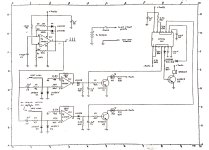
so looking at a one of the buzzbox schematics. the LM324 circuit generates short pulses and feeds them through the magneto. When points open the coil in the magneto becomes part of the circuit and, since it has inductance, the shape of the pulses changes into something resembling a sine wave (the inductor resists rapid change in the pulse fronts). this "sine" wave is then amplified and drives the buzzer and also triggers the LED lights. so i guess technically the buzz box detects the presence of the inductance, not capacitance . Someone with a more thorough EE background may be able to explain this better :)

1753731892976.jpeg
 
Good "timing" on the discussion. I will start my condition inspection soon. I bought a professional buzz box from Aircraft Spruce. I was watching Paul Dye video when I did my magneto timing. I don't do them often enough like an AP so I will be referring Paul's video plus the link to the article above when I do mine this year.

Note: For the gentlemen who have the high magneto IQ, it helps us new aircraft owners/maintainers if you guys avoid diving bombing into the weeds, but instead explaining them in details so us low magneto IQ people can understand what you guys are talking about. At least for me, I just want to learn.
 
Inductance sounds right/I remembered wrong. Was afraid of that. Thanks for setting me straight.

Once again, I believe this approach was to avoid incorrect indications.

If not, a multimeter would be all that was required.
 
I would like to check the timing of my slick magnetos on my RV14A. I know there are many YouTube videos but would like a few things clarifying.

I would like to use my home made buzzer (buzzer & battery & 2 crocodile leads). I am aware cylinder 1 needs to be on the compression stroke with top spark plugs remove, then rotate backwards just past the 20 degree BTDC.

With the master switch on and the key switch to Both connect one buzzer lead to the P terminal and one buzzer lead to ground on one of the magnetos and rotate the prop very gradually towards the 20 degrees BTDC where I should here the buzzer start or maybe the opposite occurrence the buzzer stops buzzing.

Will this arrangement work with the buzzer and/or do I need to disconnect the P leads from the magnetos before connecting my buzzer lead?

Any advice would be welcome.

John
Leave the master switch OFF.
 
Inductance sounds right/I remembered wrong. Was afraid of that. Thanks for setting me straight.

Once again, I believe this approach was to avoid incorrect indications.

If not, a multimeter would be all that was required.
One side of the points are ground. The other side is only accessible externally via the p lead and this line runs through a capacitor before hitting the other side of the points, therefore continuity will not give a good indication. A more involved measurement approach is required. I stand corrected on measuring capacitance. Also recalled that incorrectly.
 
There was a great article on mag timing with step by step details and photos in the Oct. 2013 issue of Kit Planes magazine, Maintenance Matters article. If you are a subscriber, you should be able to access past issues on-line.

If you want to build a mag timer box from a kit, you can order one from https://brewingtontech.com/ I'm assuming they still sell these as I bought mine back in 2017. It has worked great for me, and saved me a few $.

Regards
 
One side of the points are ground. The other side is only accessible externally via the p lead and this line runs through a capacitor before hitting the other side of the points, therefore continuity will not give a good indication. A more involved measurement approach is required. I stand corrected on measuring capacitance. Also recalled that incorrectly.
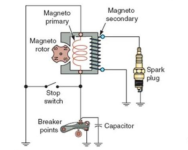
The capacitor is in parallel with the points, nothing runs 'through' it. It's there to prevent arcing when the points open.
 
The capacitor is in parallel with the points, nothing runs 'through' it. It's there to prevent arcing when the points open.
What we call the condensor (i.e. capacitor) is installed in the mag body upper cover. One side of that capacitor has a screw post (the P lead) and the the other side has a wire soldered on and that wire connects to the points on the same side as the coil output. Unsure elecctrically how those two ends connect up (speculate that both sides are connected to the anode and the case is connected to the cathode), But the p lead cannot do its job if it is not running through the capacitor, as that is how your ignition switch grounds the coil to prevent excitation of the secondary coil (i.e. spark). I would call that running through the capacitor, but probably should have said running through the condensor. Electrically this appears as the capacitor in parallel with the points, but it also means it is also in parallel eith the P lead, as their connection runs together bridged to the capacitor.

It is my belief that this arrangement (p lead having a capacitor in parallel) is why a simple continuity measurement is unreliable (capacitor storing energy) for determining points opening. The only way to externally access the other side of the points has a capacitor on it, messing with the results. Once the cap is off and the capacitor out of the circuit, simple continuity works fine for determining points opening.
 
Last edited:
I think you are referring to the Bendix magneto which does have a feedthrough capacitor unlike the Slick mags.
Function is the same regardless, but I think the Bendix guys also considered it a noise filter for the P lead.
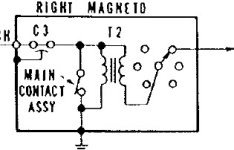
The reason a continuity check can't be used for timing is the points are tied to ground thru the primary winding of the coil.

1753798658127.jpeg
 
I think you are referring to the Bendix magneto which does have a feedthrough capacitor unlike the Slick mags.
Function is the same regardless, but I think the Bendix guys also considered it a noise filter for the P lead.
The reason a continuity check can't be used for timing is the points are tied to ground thru the primary winding of the coil.

View attachment 93704
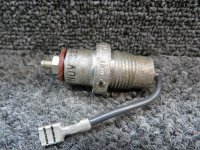
Slick condensor pic below. In the slick application it is not a noise filter. It doubles as the capacitive buffer to stop arcing and a method to ground the coil to stop sparking. The condensor lead goes to same side of the points that the coil is attached to. The other side of the points go to case ground. So, without the condensor in line, you would be able to use continuity to see points opening without going through the coil, but the parallel condensor messes it up, i believe and that is why we need to pump juice and observe to see points opening.
SA0612--462__27565.jpg
 
Last edited:
The reason a continuity check can't be used for timing is the points are tied to ground thru the primary winding of the coil.
that is the correct answer. the P lead always has DC continuity to ground so we need AC (pulses) to detect when points open.
 
that is the correct answer. the P lead always has DC continuity to ground so we need AC (pulses) to detect when points open.
yes, should have been more clear. you see resistance change from points open to points closed. continuity to ground is through coil with points open and direct to ground when closed. The resistance through the coil is likely low enough that the meter would see it as continuity.

Sorry for taking this down an unnecessary path. This whole process has helped me better understand the reasons now. Just hadn't thought about it enough.
 
Last edited:
Safety first!
Nobody has yet pointed out that you should have one complete set of plugs removed before messing around with the prop. No compression - no nasty surprise.

Ed
 
I stand corrected on the feedthru cap on the slick. But a cap looks like an 'open' to DC, so it makes no difference doing a continuity test.
 
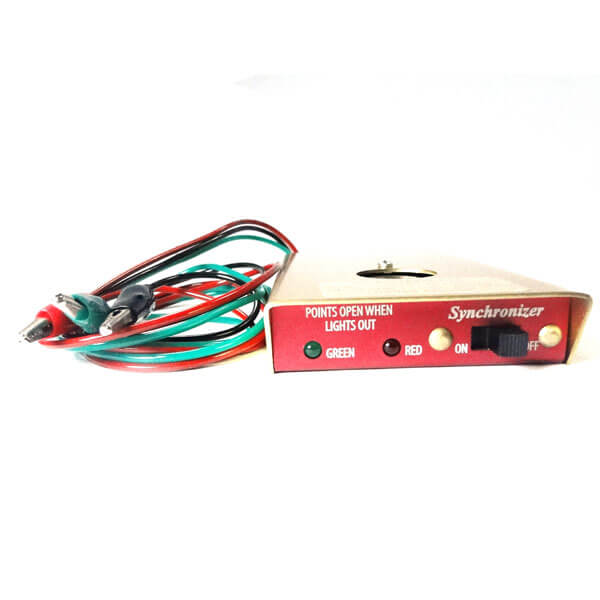
For only $89, I bought this nice little "buzz box" from Spruce and Specialty many years ago, and I'm still using it! Yes--all top spark plugs removed, and all plug wires disconnected (top and bottom). I turn the prop in the normal rotation direction until I hear the impulse coupler "click", then rotate it to the 25-degree BTC timing mark for my engine O-320-D2A timing. Then rotate the prop back-n-froth very slowly until you see the red and green lights and buzzer all trigger simultaneously--sync test should always be done in the normal engine rotation direction. Adjust the mag or mags that are not triggering on the proper timing mark. Remember to go passed the impulse coupler "click" before synchronizing the mags. Note--different engine types time at different timing BTC numbers, so check your specific engine type for proper timing value.

 
Last edited:
For only $89, I bought this nice little "buzz box" from Spruce and Specialty many years ago, and I'm still using it! Yes--all top spark plugs removed, and all plug wires disconnected (top and bottom). I turn the prop in the normal rotation direction until I hear the impulse coupler "click", then rotate it to the 25-degree BTC timing mark for my engine O-320-D2A timing. Then rotate the prop back-n-froth very slowly until you see the red and green lights and buzzer all trigger simultaneously--sync test should always be done in the normal engine rotation direction. Adjust the mag or mags that are not triggering on the proper timing mark. Remember to go passed the impulse coupler "click" before synchronizing the mags. Note--different engine types time at different timing BTC numbers, so check your specific engine type for proper timing value.

I think most would recommend (1) go past the impulse ‘click’, (2) go backwards to 30 BTDC; (3) go forwards to 25 and check. Going forward (normal rotation direction) removes any lash in the gear train.
 
I think most would recommend (1) go past the impulse ‘click’, (2) go backwards to 30 BTDC; (3) go forwards to 25 and check. Going forward (normal rotation direction) removes any lash in the gear train.
It does... But does it remove the lash on the right side of the gear train due to the fact that you are driving the prop with your hand so the lash is on the opposite side of the gears as would be when the crank is driving the prop.

Confirm the timing with a timing light and good timing marks and you will know what you have.
 
But does it remove the lash on the right side of the gear train due to the fact that you are driving the prop with your hand so the lash is on the opposite side of the gears as would be when the crank is driving the prop.

The gear lash we're interested in here is in the accessory case. Since the propeller and crankshaft are effectively one solid unit, the magneto drive gears don't care where the force that's turning the crankshaft comes from!
 
Wow so may spurs to the topic. I use the Eastern Buzz box and just checked my dual Slick mag(s) timing yesterday.

Key off - hook up leads to each mag
Key on, Use 1/16" drill in hole for reference point, pen light to make a shadow to eliminate parallax.
Rotate one rev until lights come on (box check), back up 15 deg (removing backlash) and go slower approaching timing marks, bump prop tip with hand.
Get first light - record, get both lights record positions. Mine was 25 and 25.5 deg, so decided not to try and reset.

I remove the lower plugs and all leads when differential pressure testing followed my the mag timing check.

The whole thing took longer to get the buzz box & leads out and hooked up than to rotate and check the timing. Resetting timing is a repetitive process to get accurately set near perfect.

The shadow technique is just me trying to make it easier.
 
And if you have a Slick mag with impulse on one side and a Lightspeed e on the other side. You are only half done!. On setting that Slick to "correct BTC" value, the e mag has to now be set. SEE your mfgs instructions because some of those are set with their own led indicator light and are set to TDC. But not trying to drift the OPs thread . This is another thread in itself.
 
It does... But does it remove the lash on the right side of the gear train due to the fact that you are driving the prop with your hand so the lash is on the opposite side of the gears as would be when the crank is driving the prop.

Confirm the timing with a timing light and good timing marks and you will know what you have.
Don't know about you, but I'm not standing in front of a swinging prop with a timing light. Yes--accessory gear drives both magnetos, so if you're turning your prop in the normal engine rotation, after the impulse coupler has "clicked", and you have moved the prop back before the specified BTDC timing mark, you simply "nudge" the prop into the specified BTDC timing mark (25-degrees BTDC for my O-230-D2A), which accounts for any gear lash in both the accessory to magneto drive gears and the internal plastic magneto gears.
 
I think most would recommend (1) go past the impulse ‘click’, (2) go backwards to 30 BTDC; (3) go forwards to 25 and check. Going forward (normal rotation direction) removes any lash in the gear train.
Exactly correct. This procedure has been the recommended one for at least 65 years , probably decades longer. Amazing how many are completely lost on this procedure.
 
No capacitance measuring in a buzz box...The buzz box works by detecting the change in magnetic field/coil induction when the points open.
Mag switch must be 'on' or P lead disconnected also.

View attachment 93653
Agree, simple continuity checking buzz box won't work - need to discern a short of the breaker points from the near short but inductance of the magneto primary. But that said, there is nothing wrong with DIY - Jim Weir had an excellent article to build your own in the October 1999 Kitplanes magazine. Here's a link to it on Jim's pages: http://www.rstengineering.com/kitplanes/KP9910/KP9910.htm

Mine built to his plans has been doing the job for over 25 years, that is until I moved into the Surefly world!:devilish:
 
Exactly correct. This procedure has been the recommended one for at least 65 years , probably decades longer. Amazing how many are completely lost on this procedure.
Many new pilots acquiring RV's as their first airplane--not everyone is an old-timer, old-hand like you and me! But, not as old as you! (y):cool:(y)
 
For only $89, I bought this nice little "buzz box" from Spruce and Specialty many years ago, and I'm still using it! Yes--all top spark plugs removed, and all plug wires disconnected (top and bottom). I turn the prop in the normal rotation direction until I hear the impulse coupler "click", then rotate it to the 25-degree BTC timing mark for my engine O-320-D2A timing. Then rotate the prop back-n-froth very slowly until you see the red and green lights and buzzer all trigger simultaneously--sync test should always be done in the normal engine rotation direction. Adjust the mag or mags that are not triggering on the proper timing mark. Remember to go passed the impulse coupler "click" before synchronizing the mags. Note--different engine types time at different timing BTC numbers, so check your specific engine type for proper timing value.

That's what I use. Batteries last forever, audible buzz and led lights. The audible is a little high pitched and my 70yr old ears need a quiet shop to hear it
 
Back
Top