Van's Air Force

The definitive Van's Aircraft support community! Buying, building or flying an RV? Join our exclusive family of mentors and enthusiasts!

Hot Fuel issue

Bcone1381

Well Known Member
I have a non-RV experimental with a lycoming IO-360 with a Bendix RSA Fuel Injection. I am in phase one flight testing with about 20 hours on the enigine. I am starting to fix a hot fuel issue. I have a very tight cowl/baffle installation and a very tight engine intake. So I have very little waisted air going around the engine that has not cooled something. I am wondering now after 20 hours of flying about heat on teh low pressure side of the cowl.

But for now, and for this thread, I am specially curious about cooling the fuel down. The principle is that at very low power settings (Like in the traffic pattern) the speed of a drop of fuel thru a fuel line slows way down and so heat has a longer time to raise that Fuel Drop's temperature. What have others done to fabricate a fuel bypass system to keep fuel moving and thus keep it cooler. Is the bypass done after the engine driven fuel pump, or spider? Is there any documentation to show how to install this?
 
I have a non-RV experimental with a lycoming IO-360 with a Bendix RSA Fuel Injection. I am in phase one flight testing with about 20 hours on the enigine. I am starting to fix a hot fuel issue. I have a very tight cowl/baffle installation and a very tight engine intake. So I have very little waisted air going around the engine that has not cooled something. I am wondering now after 20 hours of flying about heat on teh low pressure side of the cowl.

But for now, and for this thread, I am specially curious about cooling the fuel down. The principle is that at very low power settings (Like in the traffic pattern) the speed of a drop of fuel thru a fuel line slows way down and so heat has a longer time to raise that Fuel Drop's temperature. What have others done to fabricate a fuel bypass system to keep fuel moving and thus keep it cooler. Is the bypass done after the engine driven fuel pump, or spider? Is there any documentation to show how to install this?
Brooks----I assume that you have somehow measured the temperature of the fuel, and it is vaporizing. In most stock mechanical injection systems, this isnt a problem. But since we dont know of your specific application, I would suggest talking to Don or Kyle at AirFlow Performance.
Tom
 
1. What's the nature of the "hot fuel issue"?
2. I had a fuel recirculating line installed that was supposed to keep the fuel moving and cool. It made things worse! I took it out years ago and threw it away before it killed me.
3. Adding more lines, pumps, fans, whatever.. just adds complication, and complication almost always beings on more problems.
 
Brooks----I assume that you have somehow measured the temperature of the fuel, and it is vaporizing. In most stock mechanical injection systems, this isnt a problem. But since we dont know of your specific application, I would suggest talking to Don or Kyle at AirFlow Performance.
Tom
Hey Tom. We've talked in the past and I have your lines installed in my experimental. Everyone who sees them comments on them. They love them!

I talked with Don at Airflow Performance yesterday. The red cube is mounted to the firewall and was surprisingly hot to touch about 7 minutes after shutdown. I could hold my finger it. I think I cooled it some as I held it there. 120F is uncomfortable after 4 seconds. So maybe it was 118F. The fuel Pump has a cooling shroud and was hotter. In order to inspect the fuel flow to the flow devider, we removed the fuel line at the flow devider, hooked up a clear plastic tube and watched fuel flow into a container. Air Bubbles came out with the fuel which provides for us a solid data point of vaporized fuel.

Don is having me remove the Red Cube from the firewall, and change the fuel lines to get them as short as possible. I am improving the airflow to the cooling shroud by replacing 3/4" corrugated plastic tubing with 1" Ceet. We think we might double the flow to it. The Vetterman Crossover Exhaust has a lot of feet of hot tubing in the cowl. Minimal airflow through the bottom of the cowl due to tight baffling are some of the contributing factors I think.

Lets not let the thread drift too far off my origonal post. Its great to discuss things. I think the fuel pump's heat sink from the hot engine case might be the #1 heat contributor. But I do not know how hot the low pressure side of the cowl is, nor do I know how hoth these can get. The OAT on my latest flight was 50F. We will collect real temp data on my cowl in the future. For now I follow Don Riviera's instructions. I have a friend/engineer (retired) at the airport...auto...hot summer testing...etc. It would be nice to know how hot it gets around Mags, and firewall area.

I question...
-how long does it take a drop of fuel to travel thru my cowl to the cool side of the baffling.
-how hot is the air thru which the fuel travels.
-Can I speed fuel travel so its not influenced by the heat for such a long time?
-I have read that some have burn auto fuel in the summer with a Bendix Style injection system, so they are doing somehting to keep it cool and I think fuel return is the method.

71549, I'd like to know more about your install. There is a scientific reason yours failed, and others suceed. I'm curious to hear both experiences.
 
If you know the inside diameter of the fuel line and the fuel flow, it's possible to
calculate the liquid speed in the fuel line.
The air temperature around the mecanical fuel pump is 120-140F.
It's important to insulate the fuel lines as
much as you can. If you have 90 deg fittings in the fuel lines, removing them will help as they cause pressure drop.

Good luck
 
V = 0.408*Q/d^2
V-> ft/s
Q-> GPM
d-> internal diameter

Using some assumed/made up numbers (1/2 tube, 0.049 wall, 8GPH, etc)
you're looking at ~1/3 foot/min.

Adjust for your installation (tubing dimensions) and factor your length of tubing forward of the wall.

I used a calculator today. Can I go home now?
 
Last edited:
V = 0.408*Q/d^2
V-> ft/s
Q-> GPM
d-> internal diameter

Using some assumed/made up numbers (1/2 tube, 0.049 wall, 8GPH, etc)
you're looking at ~1/3 foot/sec.

Adjust for your installation (tubing dimensions) and factor your length of tubing forward of the wall.

I used a calculator today. Can I go home now?
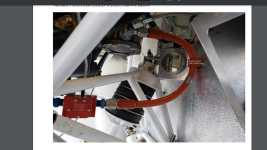
Brooks---we have seen/heard of vapor issues when mounting the transducer to the firewall. WE did some hoses for a client several years ago where Don suggested the transducer be mounted about 3 inches from the servo. Updraft FM150. For reference, the next pic is of our revised version of our RV10 install.
Tom
 

Attachments

  • left side view.jpg
    left side view.jpg
    69.1 KB · Views: 160
  • New RV10 install.png
    New RV10 install.png
    549.1 KB · Views: 159
Just an extra piece of information: Our plane (not RV, but IO-360) had a flow sensor (Flowscan? gray aluminium thing) in the firewall, between pump and servo, and some 90 degree elbows in the fuel tubes. We had an issue that fuel flow was showing consistently way too big numbers above 4000 ft altitude, lower it was accurate.

As part of avionics update, we replaced it with red cube under left side cylinders above air intake tubes, but the same problems continued. As soon as we climb from 4000ft to 5000 ft, the flow indication increases +40-50%. We've found isolated cases of this in web for both Lycomings and Rotaxes which are supposedly caused by pump pulses. Now we are in process of moving the sensor to the top of the engine between servo and spider, hoping it will help...
 
Follow up: I moved the transducer off the firewall. I re-designed the fuel line route to reduced the length of line going thru the cowl area. The redcube now resides between cylinders 1&3 in cool air when we are flying. I have fixed the hot fuel issue in flight at 60F OAT. I will stay vigilant as summer heats up.

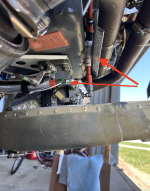
You can see that my Bearhawk Patrol IO-360 installation has vertical induction and Vetterman exhaust. This setup is not ideal. The best practice to keep the fuel injection lines short to keep heating up the fuel. But it requires they are threaded them between the exhaust and oil sump. If you look for my red arrows you will see the issue. I avoided this installation in version 1 which had the fuel line exit out the back of the servo to the firewall mounted red cube. Then the fuel traveled up the back of the cowl area thru the aft baffle at cylinder 3 and to the flow divider. The hot firewall communicated heat to the red cube, and long lines soaked up heat.

What you see here is typical industy best practice for the fuel line route and I am managing the risk of threading the fuel line thru the exhaust - oil sump pinch point. The exhaust shield is covered with fiberfrax and reflective aluminum tape to limit heat from radiating aft towards the sump. The fuel line is wrapped in fiberfrax to insualte and protect it. The line is extreamly secure and has clearance there. it cant touch anything (but its tight). I then installed a cooling tube to keep air flowing into the pinch point during flight.

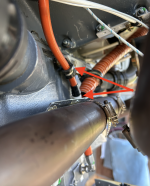
How hot does it get there? We need that data to feel safe. It stabilized at 153F running 75% power and 1500F EGT. We gathered data using thermocouple placed in this choke point. One arrow points to a thermocouple I also installed on the fuel line fitting at the servo input. Look for a wire that terminates under aluminum tape.

Red Arrows below point out the modified heat shield, an example of a thermocouple (white/blue wire) , Loop Clamp for securing the line, and the cool air supply line.

Screenshot 2025-04-28 at 3.15.24 PM.png

Screenshot 2025-04-28 at 3.14.58 PM.png
 
Just wanted to chime in, we have a 14A with an EXP119. We have wrestled with hot fuel issues since day 1. The airplane would run poorly on the ground after a fuel stop, or a long taxi on a hot day. We did many things to try and remediate, including double fire sleeving and shortening all the runs as best we could. In the end, the best change was to open up more airflow in the bottom of the cowl (in our case using the opening for the nose gear leg and removing the closeout panel, and fairing it over so as to create some negative pressure. In the end, the problem is very tolerable but still present.
 
I have the same servo set up on my RV-9 with IO-320. My fuel lines routs up from the servo in the tight space between the oil sump and crossover exhaust. I also installed the shield on the exhaust but didn't add the cooling air.

My fuel flow box is installed right above the sump. I have standoffs attached from the sump bolts and use p-clamps on either side of the fuel flow sensor so it sits pretty much horizontal and parallel with the sump mating line. From there my fuel line goes up between #2 & #4 cyl to Airflow Performance purge valve and then to the flow divider.

On the ground, when the engine is warm and the temps are 70 F and above the engine doesn't run as smooth as it does with lower temps. I have found if I keep idle at 1000 rpm the engine will keep running (possibly more airflow through the cowling keeping things cool). But it's not as smooth as when the outside temps are cooler. If I let it get below 700 rpm it will get rough and sometimes even stop. Once in the air, with the flow of air going through the cowling, the engine runs fine with no hint of hesitation. So my solution on the ground has been to keep the RPM at 1000 once the engine has been up to operating temps.

I know if my engine stops in the condition I mentioned previously, even the purge valve provides little relief. It takes about 15 min to let things set before I can get it started from a vapor induced stop. I do think the purge valve helps out on things like fuel stops and starting up quickly (my opinion).

Wondering if you have any data on temps before and after adding the cooling air. Would like to know how much cooling that provides on the ground at idle.
 
Following this thread if there’s any updates. I’ve been battling the same issue with my RV-8. With the cowling off it’ll idle and run smooth as silk. As soon as I install it, it idles on but still runs slightly rough with an occasional hiccup if you will. I’ve insulated the red cube, I’m close to a point of relocating it with different fuel lines etc. (insulating the red cube was a low cost method that greatly improved but didn’t solve the problem)
 
Following this thread if there’s any updates. I’ve been battling the same issue with my RV-8. With the cowling off it’ll idle and run smooth as silk. As soon as I install it, it idles on but still runs slightly rough with an occasional hiccup if you will. I’ve insulated the red cube, I’m close to a point of relocating it with different fuel lines etc. (insulating the red cube was a low cost method that greatly improved but didn’t solve the problem)
Its a work in progress. I've collected data.

RIght now my aircraft is down for modifications. Before I took it down I insulated fuel lines with an alminized heat shield wrap made of fiberglass cloth. I have discovered fuel flows over about 7.5 gph no heat issues exist at OAT of 75F When power is pulled back and fuel slows down then fuel speed slows down and has time to heat up. The fuel heats up in the lines, in the pump and in the fuel servo.

The data shows my cowl aft of the oil filter was 140F. The fuel pump heats up fuel 10-14F. The servo inlet fitting heated up the fuel with a power reduction. At 65% power it was reasonable. When power was reduced it increased from 118F to 132F. I think the high power with high fuel flow and more air flow kept the servo cooler. WHen I reduced power then the cooling force is removed from a hot engine and it takes time to cool. That when I saw some signs of stress.....specifically I saw my fuel flow give bad numbers....impossible numbers. I'm calling it vapor in the paddle wheel.

All these issues cause poor idle. I made progress with insulating the fuel lines. I had a fuel line on my bench and inserted a thermocouple inside of it then put it in my Turkey Roaster at 250F. I saw a 100F temp rise (from 60F to 160F) in 4 minutes. Fuel hose with integral fire sleeve has little insulation value. When I wrapped it with the reflective aluminized wrap it took 11 minutes.

I want
-my cowl cooler.
-my fuel cool enough to be able to climb then pull power back and fly at 5 gph with no signs of stress.
- to pull the power back abeam the numbers and not hear any hot fuel issues when its 90F. I hear other aircraft at my airport, and i think some have similar issues.

I will be
-using more firesleeve to improve insulation value.
-finshing up installing my Ceramic Treated Vetterman Crossover Exhaust. It is a cornerstone culprit to my hot cowl. I removed it to have it treated.
-flying with fabricated parts that will allow direct cool air flow thru a 1" diameter sceet tubing that enshrouds one of the longer fuel lines in my cowl.
-I will not be able to test these changes for another week.
-incorporating cowl exit modifications iaw this thread. See post #9 & #18. (My cowl has the vans lower cowl scoop installed)

I wonder about
-cooling down the servo....blow cool air on it, or try to insulate it from the oil sump by installing a piece of phenolic sheet between the two.
-finding where the low pressure areas are on the outside lower cowl and installing louvers there to get more heat out of it.


I glad that others don't have fuel heat issues and glad you asked. This issue is fixable. Its always great to collaborate and brainstorm together.

I reached out to another on this forum and his suggestion was to insulate the lines with a double layer of fire sleeve and install a dual electric fuel pump module (Like SDS) and ditch the engine driven fuel pump. I'd like to take 10-15F degrees of heat out of the system and that would do it.

 
Last edited:
I've also toyed with giving up Bendix Fi and go with a Carburetor. I the SDS duel fuel pump will need a regulator and bypass fuel so then I replumbing. At some point I am going to want to fly without the hassle. I dont know if I'll be flying or driving to EAA next month.
 
or try to insulate it from the oil sump by installing a piece of phenolic sheet between the two.
Late model 172’s have this on IO-360L2A engines. I have it on my -7, no fuel issues.
 

Attachments

  • IMG_1836.jpeg
    IMG_1836.jpeg
    76.7 KB · Views: 129
or try to insulate it from the oil sump by installing a piece of phenolic sheet between the two.
Late model 172’s have this on IO-360L2A engines. I have it on my -7, no fuel issues.
Thats is just the kind of feedback I needed! You moved it from a theory and idea to my "To Do List" Thanks!!
 
Update on Post #14. It seems I have made great progress in my Hot Fuel Issue.

I lost 20F in the aft cowl area by adding a lip to my cowl air exit. It improve my differential pressure between the upper and lower cowl rom 7 Inches of water to 7.7 inches of water. It lowered my oil temp by 20f.

I shortened my fuel lines as much as I could fathom. I have fresh air encompassing my pump to servo fuel line. I cermic coated my exhaust...I have no factual data to determine its effect, but it felt like I fixed my issue by 66%. So not 100%.

Lowered my fuel temperature before it got to the firewall by about 13F. I added four thermocouples below my floor to see if fuel was heating down there. It was, so I insulated the lines and the area and I dropped the rise to 3F. At OAT of 85f I can not get any abnormal indications in flight no matter the fuel flow. On the ground after landing its 75% better at 85F than it was at 75F before the lines were insulated.

I very happy that I took the effort to get good data.
 
I know your project isn’t an RV. Your last post showed some success with improving the air exit.

Could your project benefit from a cowl flap?

IMG_7921.webp
 
Update on Post #14. It seems I have made great progress in my Hot Fuel Issue.

I lost 20F in the aft cowl area by adding a lip to my cowl air exit. It improve my differential pressure between the upper and lower cowl rom 7 Inches of water to 7.7 inches of water. It lowered my oil temp by 20f.

I shortened my fuel lines as much as I could fathom. I have fresh air encompassing my pump to servo fuel line. I cermic coated my exhaust...I have no factual data to determine its effect, but it felt like I fixed my issue by 66%. So not 100%.

Lowered my fuel temperature before it got to the firewall by about 13F. I added four thermocouples below my floor to see if fuel was heating down there. It was, so I insulated the lines and the area and I dropped the rise to 3F. At OAT of 85f I can not get any abnormal indications in flight no matter the fuel flow. On the ground after landing its 75% better at 85F than it was at 75F before the lines were insulated.

I very happy that I took the effort to get good data.
I love your scientific and methodical approach! Can you point me to the thermocouples you used to measure fuel temp?
 
I love your scientific and methodical approach! Can you point me to the thermocouples you used to measure fuel temp?
Thermocouple reader for K Type thermocouple


K type Thermocouple (5 pack) that are 3 meters long


To be very specific...I measure the temp of fittings....The fuel inside influences the fitting's temp and gives us an indirect indication of the fuel temp. I do not know how to directly measure the fuel temp. I clean the outside of the fitting with 91% rubbing alcohol, then hold the tip of the thermocople in place with Aluminum adhesive tape. I then run the thermocoupl wires on the outside of the boot cowl into the cabin and hold them with adhesive tape.

Buying two of the readers and two packs of five thermocoupls cost me about 17 gallons of gas and I was able to instument both the engine cowl and the underfloor part of the fuselage at the same time. Thermocouples are fragile, so having an extra or two is nice.
 
Last edited:
I know your project isn’t an RV. Your last post showed some success with improving the air exit.

Could your project benefit from a cowl flap?

View attachment 90570
I like those cowl flaps. The Cowl Lip may have made the largest difference in my cowl temps and lower oil temp.

The following is a viewpoint for us experimental builders to consider. We are experimental. What I am doing is experimental. My cowl lip is experimental. It took me an hour to fabricate it and install it. It's so ugly its cute. I laugh at it. All materials were on hand and the biggest part was in my scrap collection. I know it works now due to my temp prob installation in the cowl and the piccolo tubes to measure Delta P. DanH provides us with the pressure measurement procedure that I used.

MVP: My cowl lip falls into what the automotive engineering industry calls a Minimally Viable Product. MVP for short. So my lip is an MVP solution. "Just try this out and see if it works then we refine things later on." is how Toyota and Ford engineers efficiently prove their hypothesis.

I will continue to experiment with MVP cowl lip designs, changing its size, shape, and maybe I will in the end install a true cowl flap. I am intersted in a saw tooth cowl lip next. Version 1 is 1.75" long with some Gorilla Tape. I judge the effect using my piccolo tubes. I seek out pressure differential (delta P) between the upper and lower parts of the cowl...

One last viewpoint....maybe a question I ask myself. In my application (Bearhawk Patrol) if achieve outstanding delta P, then squeeze the exit to lower cooling drag, then my engine cowl temps will be higher. With 11' of exhaust pipe from the Vetterman X-over design I just need airflow to reject all that heat. For example, 160 F air temp near my oil filter is too warm. 130 F is better.
 
Last edited:
I like those cowl flaps. The Cowl Lip may have made the largest difference in my cowl temps and lower oil temp.

The following is a viewpoint for us experimental builders to consider. We are experimental. What I am doing is experimental. My cowl lip is experimental. It took me an hour to fabricate it and install it. It's so ugly its cute. I laugh at it. All materials were on hand and the biggest part was in my scrap collection. I know it works now due to my temp prob installation in the cowl and the piccolo tubes to measure Delta P. DanH provides us with the pressure measurement procedure that I used.

MVP: My cowl lip falls into what the automotive engineering industry calls a Minimally Viable Product. MVP for short. So my lip is an MVP solution. "Just try this out and see if it works then we refine things later on." is how Toyota and Ford engineers efficiently prove their hypothesis.

I will continue to experiment with MVP cowl lip designs, changing its size, shape, and maybe I will in the end install a true cowl flap. I am intersted in a saw tooth cowl lip next. Version 1 is 1.75" long with some Gorilla Tape. I judge the effect using my piccolo tubes. I seek out pressure differential (delta P) between the upper and lower parts of the cowl...

One last viewpoint....maybe a question I ask myself. In my application (Bearhawk Patrol) if achieve outstanding delta P, then squeeze the exit to lower cooling drag, then my engine cowl temps will be higher. With 11' of exhaust pipe from the Vetterman X-over design I just need airflow to reject all that heat. For example, 160 F air temp near my oil filter is too warm. 130 F is better.
Any further updates on your progress? Could you post a pic of the cowl lip you installed?

I have issues with the idle on my 8 after a hot start. Engine surges and doesn't run smooth but runs OK at high rpm. I have tried leaning and rich, boost pump on or off, nothing seems to matter. It idles fine on a cold start. IO-360 with a Precision FI system. So far I have doubled up the fire sleeve on all fuel lines, insulated the red cube, flow divider and gascolator (required in Canada). I have ordered .024 restrictors for the injectors as I have read this helps. Wondering what other things I can try.
 
Any further updates on your progress? Could you post a pic of the cowl lip you installed?

I have issues with the idle on my 8 after a hot start. Engine surges and doesn't run smooth but runs OK at high rpm. I have tried leaning and rich, boost pump on or off, nothing seems to matter. It idles fine on a cold start. IO-360 with a Precision FI system. So far I have doubled up the fire sleeve on all fuel lines, insulated the red cube, flow divider and gascolator (required in Canada). I have ordered .024 restrictors for the injectors as I have read this helps. Wondering what other things I can try.
I think I have mostly solved my heat issues by doing everything you did above plus removed the tunnel filter and added a blast tube to the engine driven fuel pump. I am also in Canada and have a flush mount gascolator in each wing root with finer screens than the tunnel filter had. I found removing the tunnel filter made the biggest difference.
 
Any further updates on your progress? Could you post a pic of the cowl lip you installed?

I have issues with the idle on my 8 after a hot start. Engine surges and doesn't run smooth but runs OK at high rpm. I have tried leaning and rich, boost pump on or off, nothing seems to matter. It idles fine on a cold start. IO-360 with a Precision FI system. So far I have doubled up the fire sleeve on all fuel lines, insulated the red cube, flow divider and gascolator (required in Canada). I have ordered .024 restrictors for the injectors as I have read this helps. Wondering what other things I can try.
Idle mixture is a possibility. Hot engines like a lean mixture and cold ones like rich. If your idle mixture is overly rich, as many come from the factory, this would explain your symptoms - happy when cold, unhappy when hot. This should be properly set on every engine, so if you are not sure it has ever been done, I would start there. If that doesn’t work, you can move to hot fuel issues that are not that common in causing rough idle except for extreme conditions.
 
Any further updates on your progress? Could you post a pic of the cowl lip you installed?

I have issues with the idle on my 8 after a hot start. Engine surges and doesn't run smooth but runs OK at high rpm. I have tried leaning and rich, boost pump on or off, nothing seems to matter. It idles fine on a cold start. IO-360 with a Precision FI system. So far I have doubled up the fire sleeve on all fuel lines, insulated the red cube, flow divider and gascolator (required in Canada). I have ordered .024 restrictors for the injectors as I have read this helps. Wondering what other things I can try.
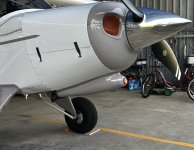
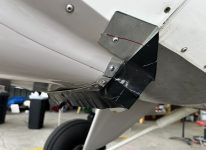
Below are the photos you asked for. The first and second photo are the minimally viable ugly cowl exit lip. The third photo is the final product and was fabricated from CF.

Updates.....improved airflow thru my cowl fixed my hot fuel issue, my hot oil issue, and lowered my CHT's at least 20F during flight. I still have hot start issues I can live with. I did install the .024 restrictors, but that was after the lip was installed, and I like them....but have no data on how it helped me.

You wont like what I'm going to say next. Temp Data showed me that the engine driven fuel pump is the single most violating unit in my fuel system. I am glad I have a cooling shroud on mine. You might consider that. That fix is not an easy fix because removing the fuel pump is time consuming.

What is the temp rise of your fuel before it enters the firewall? My exhaust rises the air temp under my floor and impacted my fuel temp before it hit the firewall. Insulating those is easy and cheap. Data collection drives understanding.

I have an advantage. I have a cowl that is easy to open I can cool it down after I land by opening up the cowl doors. Because I measured my cowl temperatures at 5 locations, I know when and how hot things get inside my engine cowl. Regarding hot start issues: I know when my flow divider is over 65c my engine wont start. I no longer try. I let it cool. I can hear the fuel boil in the lines today after I landed when I pulled it in the hangar. The cowl temps peak about 15 minutes after shutdown, and a taxi with a tailwind drives up the temp too. When you watch the temp rise that data exceeds knowledge and it becomes an experience. Order some thermocouples to gain that experience. Its worth the price. You will find, learn and grow.

Larry talked about Idle Mixture. You addressed that. Call me new to GA (after a two decade hiatus). But I want lean mixture when I taxi and have gotten very proficient at controlling mixture to the point where it almost dies during taxi.....I can control the rpm to a degree with the red knob. That will slow down the fuel speed thru the lines, and make it a bit hotter. Seems like enough heat exists in your cowl where your RICH mixture still is not enough to cool things.

My issues were most pronounced during taxi in and I find it a bit odd that you have more problems after a hot start. But when I had my issues I was just doing test flights, and not doing any hot starts. I still don't have issues on taxi out. Go learn the temps of the fuel line fittings, and the hardware that the fuel travels thru, then give us the feedback and fabricate a hot fuel mitigation strategy.


Screenshot 2025-08-15 at 8.57.32 PM.pngScreenshot 2025-08-15 at 8.57.16 PM.pngScreenshot 2025-08-15 at 8.58.24 PM.png
 
Last edited:
Temp Data showed me that the engine driven fuel pump is the single most violating unit in my fuel system. I am glad I have a cooling shroud on mine. You might consider that. That fix is not an easy fix because removing the fuel pump is time consuming.
Someone clever recently suggested cutting the shroud in half to install it without removing the fuel pump.
 
Someone clever recently suggested cutting the shroud in half to install it without removing the fuel pump.
Would not recommend that. The spring is quite strong and is loaded, so as you loosen the bolts, the pump flange will push away from the case. That will break the gaskets seal and possibly tear it, depending upon if/what sealant was used. In my exeperience breaking a gaskets seal and reinstalling results in a pretty high likelihood of leaks
 
It spring time. OAT is warming up and some may here may discover heat issues that I battled last year. I just updated some links above.

I think its prudent to close the loop and update some lessons and actions I did that was not documented above.
  1. All Fuel Lines under the floors and in the engine compartment have double wall fiberglass fire-sleeve for insulation. Today it was 80F. The Fuel Line going beneath the floor was only 1.5F warmer at 5GPH than the fuel line coming up from thru the floor on the way to the firewall.
  2. Red Cube is moved to cabin to so its no longer a heat sink. (This install is not recommended for an RV to place it here. My High wing Bearhawk has + fuel pressure at the red cube.)
  3. I disconverd the R. Heat box heated air was going under the floor. Air entered the cabin from it on a downward slope, thru a gap where the floor ended, under the floor to warm the area where the fuels lines are. Air is now shrouded from sneaking down under and warm air stays above the floor.
  4. The exit lip was removed in the fall due to excess cooling. I suspect it will be re-installed in May.
Bad Data that I now question or Good Data I did not consider then:
  1. I no longer think that ceramic coating of the exhaust made a significant difference.
  2. Each Heat box exhausts 140F air in the winter. Its got to be 160+ in the summer.
  3. Thats a tramedous amount of very hot air that must be evacuated. I suspect that the L. heat Box was a large contributer to problems. By my bad judgment I installed it on a 45 degee angle due to its control cable hook-up design. It probably dumped its hot air into the aft cowl on flow vector that led to circulation, instead of evacuation. So that heat box is gone now. An exit shroud on the R. box now drives its 160F air at the cowl exit.
What I did not do that I considered earlier last year.
  1. I did not add any exit louver or cowl flap other than a very simple fixed 45 degree angle lip on the cowl exit. I do think a cowl flap would improve the install in cruise at over square operations. I've seen low oil and CHT's that I wish were warmer.
 
Last edited:
Back
Top