Van's Air Force

The definitive Van's Aircraft support community! Buying, building or flying an RV? Join our exclusive family of mentors and enthusiasts!

Have I ruined my new engine?

Well, it seems that having a well known and regarded shop supply me with pre gapped rings didn’t pan out. And yeah lesson very much learned.

The Lycoming cylinders I bought from a distributor here in the UK were supplied with the piston and rings etc.. all neatly packed in the box as supplied by Lycoming. So maybe this is a recent change, or just something different overseas. It would be good to know what others have experienced on this?
I think the key difference is "regarded engine shop" vs authorized Lycoming dealership. I called a Lycoming factory rep this morning and he said they get fewer new returned cylinders when their authorized Lycoming dealerships fit and install the rings and piston before shipping new cylinders--there we go! I got a pair of Lycoming O-360 cylinders back in 1998 that came that way, and they worked until TBO with no issues. Given other people I know, they must still be shipping this way. However, I now run Superior Millennium cylinders on my RV because Aero Sport Power uses and highly recommends them--they have run for nearly 25-years now without any issues!

 
You’re saying then that some Lycoming distributors gap rings/install piston before shipping the cylinder to the customer. I guess that is a pretty quick job when you’re good at it, and if it cuts down on warranty returns and the related headaches then it could make sense.

So yeah, Lycoming don’t supply the cylinders with the rings and pistons installed, that’s done by a reseller if they choose to do so.

FWIW my engine had superior cylinders on it originally, they were OK except the engine was well down on power by the time I got it, but I don’t think this was actual fault of the cylinder rather than lack of use causing corrosion.
 
which is nearly... meaningless. Please give us the hours that they ran during this nearly 1/4 of a century?
It's nearing TBO now but still running like new with no metal in the filter or sump screen. The compression is still measuring in the upper 70's across all cylinders, as well. Dan, after flying regularly, owning serval airplanes, building an RV and maintaining various airplanes ever since 1978, I have found that lack of flying an airplane is much more damaging than total time on the engine. What's your story? :cool:
 
Last edited:
thanks for the details. Some people here do fly very little, and "nearly 25 years" could have meant 300 as well as 1000 hours.

My story about running piston banging engines is nothing special, owned several airplanes, had the usual exhaust valve guide cleaning chores... on my present ride I ran the previous O-360 for 2K hours (in 7 years) and the total engine was 2.3K hours when I sold it to a -7 builder. Compressions all +/- 70, and close to nil oil consumption.
First flight with a brand new TB YO-360 happened just a month ago, and the engine is now happily clocking more than 70 hours. Never flown behind an engine as smooth as this one, no doubt aided by the overhauled 3 bladed MT.
 
FWIW, I've been told by a highly reputable US engine shop that every ring needs to be individually gapped, regardless of who from and regardless of the engine type.
 
FWIW, I've been told by a highly reputable US engine shop that every ring needs to be individually gapped, regardless of who from and regardless of the engine type.
As I mentioned previously, This is SOP for any engine build process. I would say anybody not doing it is taking a shortcut. Not doing this 5 minute step can lead to several serious problems.

That said, if a professional shop prepared the cylinders and left the piston in the barrel, it was likely done. However that becomes a trust and responsibility issue. Does the guy building the engine trust the guy building the cylinder. If I will be left holding the bag so to say, then I would pull the piston and measure. If the cyl shop will be held accountable, I might consider just installing them.
 
Last edited:
As an aircraft owner of 23 years, I can tell you that any talk of responsibility is a waste of electrons, especially if you are in Europe and the stuff comes from the US. Even across borders here in Europe there is de facto no warranty on anything. I don't think this has a solution other than trusting nobody, and if buying a complete engine, go for a reputable US shop. If I bought a new Lyco engine I would send it to Barrett (who have done two engines for me so far) to be opened up and put back together, which is actually not all that expensive, but everything takes such a long time nowadays.
 
I think the key difference is "regarded engine shop" vs authorized Lycoming dealership. I called a Lycoming factory rep this morning and he said they get fewer new returned cylinders when their authorized Lycoming dealerships fit and install the rings and piston before shipping new cylinders--there we go! I got a pair of Lycoming O-360 cylinders back in 1998 that came that way, and they worked until TBO with no issues. Given other people I know, they must still be shipping this way. However, I now run Superior Millennium cylinders on my RV because Aero Sport Power uses and highly recommends them--they have run for nearly 25-years now without any issues!

I have a brand new set of Lycoming IO-390 cylinder kits that I received recently from Airpower and the rings did not come pre-installed. Airpower is supposed to be one of the largest authorized lycoming distributors.

Skylor
 
some good remarks above...
In the good old days a cylinder kit from Conti for my C-90 engine were costing well below a grand, I replaced a couple. These came packaged in a sealed box, new from the factory, with the piston inserted and rings hopefully gaped. Never checked them and never had a problem.

If I bought a new Lyco engine I would send it to Barrett (who have done two engines for me so far) to be opened up and put back together

Well, having shelled close to 40K$ for an OEM brand new TB, I fully expect this engine to have been properly assembled and run at the factory... producing it. And all people being for the moment humans, and prone to whatever they're good for, disassemble a perfect good engine and reassemble it inducing problems. On top of the time delay and additional cost, doubling the risks doesn't seem worth it IMHO.
Fingers crossed on mine ;)
 
I have a brand new set of Lycoming IO-390 cylinder kits that I received recently from Airpower and the rings did not come pre-installed. Airpower is supposed to be one of the largest authorized lycoming distributors.

Skylor
I would call them and ask them why. And yes, Air Power of Van Bortel Air in Arlington Texas is one of the largest US Lycoming distributors. My experience was some years back since I now use Superior Millennium cylinders. However, we have done considerable business with them over the years with multiple aircraft, and their new Lycoming cylinders have always been prepped for us and others we know, too. Your question is for them--not me.
 
I just called Air Power and they said they don't touch the cylinders, they don't even open the box. Apparently the only cylinders that come with pistons pre installed from the factory are ECI cylinders, so no idea what's going on here.

Maybe that's a separate thread, I really do not care about who ships what type of cylinder when/where with whatever installed. It's not particularly relevant anyway - besides knowing that not checking an assembled cylinder yourself is a bad idea. I'm more interested in why Superior seem to have poorer tolerances on their cylinders/rings and why they have so much more choke than lycoming ones.
 
I just called Air Power and they said they don't touch the cylinders, they don't even open the box. Apparently the only cylinders that come with pistons pre installed from the factory are ECI cylinders, so no idea what's going on here.

Maybe that's a separate thread, I really do not care about who ships what type of cylinder when/where with whatever installed. It's not particularly relevant anyway - besides knowing that not checking an assembled cylinder yourself is a bad idea. I'm more interested in why Superior seem to have poorer tolerances on their cylinders/rings and why they have so much more choke than lycoming ones.
Here's what I got back from Lycoming support today when I asked this question:

In the past, did Lycoming Cylinders come with rings already fitted? So, what you found confuses me??

Yes, in the past (and still today), Lycoming cylinders typically come with piston rings already installed on the pistons when they are sold as complete cylinder assemblies.
  1. Factory-New or Rebuilt Cylinders:
    • These come as a complete assembly, which includes the piston, piston rings, and valves already installed.
    • The rings are fitted and installed by Lycoming (or an authorized rebuilder) to match the piston and cylinder bore.
    • These are essentially "plug-and-play" for installation on the engine
  2. Cylinder Kits or Bare Cylinders:
    • In some cases (especially with overhaul kits or "bare" cylinders), the rings may be shipped separately to be fitted and installed by the mechanic during assembly.
    • But this is less common with Lycoming unless you're buying parts individually rather than a complete cylinder assembly
 
. I'm more interested in why Superior seem to have poorer tolerances on their cylinders/rings and why they have so much more choke than lycoming ones.
it’s likely just being cheap. You have likely never bored a cylinder. It is not an easy chore. You have four stones that are both cutting the cyl walls and wearing themselves down at the same time. Any variances in the bore diameter cause the stones to wear unevenly. Simply maintaining the stone's to cut a consistent bore size throughout the process on an untaperred cylinder is a challenge. You are frequently filling the stones either back to flat or tweaking them to deal with a unique challenge with the wall. I have never bored a choked cylinder, but suspect this is an art and not a science as I believe you would have to custom taper the stones and they are constantly changing as they cut.

In the end, wider tolerances mean less time to complete the task.

Also possible that lyc holds much tighter tolerances on the cylinders casting process, making it much easier to do the final finishing work.

This is all just speculation, as i have no idea what the cylinders look like before the finishing process.
 
Last edited:
It is not an easy chore.
True - almost half a century ago I used to work in a machine shop, and one task I had was boring and honing motorcycle cylinders. Much smaller than what we have in lycoming cylinders. Most of our competitors just honed them to get the final size, but we took pride in cutting them, and then honing the finish. These had no choke. I doubt the lathe we had could even do a choked cylinder. If you don't have good QA processes for this kind of thing, you're going to produce bad parts.

I think the real value that the quality engine builders bring to the table is that extra set of eyes that really care about what they are doing, and have the experience to recognize problems.
 
"doubling the risks doesn't seem worth it IMHO"

One is not doubling the risks. Assuming full disassembly, inspection and reassembly, the risk is with the last company, only :)
 
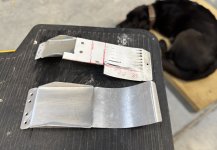
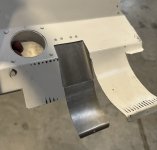
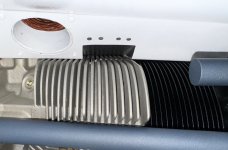
I’ve now done the baffle mod for #3, as originally built the baffle wrap on the cylinder head was actually made incorrectly so there was no wrap for about 1/2” of the fins. I had to completely cut away the baffle wrap and make a new one with the duct as per Dan H’s thread, and this has completely solved the #3 CHT issue, dropping the average temp by 30F.

Old wrap section cut away. I had made a small duct previously but this was far too small and didn’t go low enough.
IMG_1288.jpeg

IMG_1289.jpeg

EE7A4799-7C23-4D9C-A029-5DDAD735640D.jpeg
 
Back
Top