Sorry. I guess you didn't like my Flintstone comment.
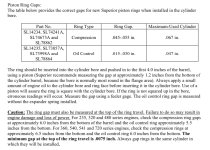
I should have been more specific. The general rule is for water cooled auto engines. That was my point. Our aircraft engines need much more end gap then the general rule for water cooled auto engines. Especially when the cylinder has a choke or taper at the top of the cylinder, just an inch or so under the combustion chamber. In my view, that would be the top of the cylinder.
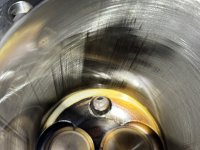
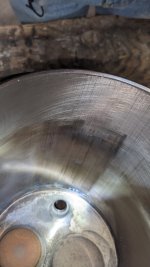
And FYI, Lycon took 0.005 out of the taper at the top of my cylinders. My cylinder walls are more parallel then stock cylinder all the way to the combustion chamber.
In water cooled, large mass blocks, the bore size never expands from heat (at least not of significance), however, the rings and pistons do. Therefore we need a good sized ring gap to accomodate that expansion, lest the ring becomes larger than the bore and you get what the OP here got and more likely a cracked ring. An 1/8" thick Lycoming cylinder WILL expand from heat, along with the rings and pistons, and therefore, in theory, we need less gap than our water cooled siblings; Not more.
Also, our engines do have a larger ring gap than water cooled engines. A comparably sized SBC would have around 035 and we have 045+ Likely due to issues around differential heating, with the rings expanding before the cyl does. However, the cyl area in the choke will expand rapidly from combustion heat and grow in size quickly. If you don't reduce the size of the ring gap to account for this, it becomes excessive and pressure loss robs you of available power. Lets say you were uncomfortable with 0075 and went to 015 in the choke. Now your gap will be around 090 once it comes out of the choke area and this doubles your blow by. The whole point of the choke is to make the cyl walls parallel at operating temp; This problem is unique to stand alone cylinders and not seen in blocks.
Not an expert here, but thought Lyc only put in about an 005" taper for the choke, but could be wrong. If lycon took out 005", it is probably now pretty close to a straight bore cylinder. Back in the early days,most of the Lyc cylinders were straight bore; I have these in my 60's vintage IO-320. Lycon must have a reason for boring out the choke and I trust that they have a good reason for doing so.
FYI, I took no offense to the flinstone comment. If you have installed pistons before, you get that it is not a delicate task and the risk of breaking rings is quite real. I should have been more clear that they are tapped in with the wood handle of the hammer.
I should mention that the large ring gap is mostly due to accomodation for the taper. The 0075 is the critical dimension and the others are you get what you get, based upon how the cyl was cut. My straight bore cylinders have a specified ring gap of aound .030, not the 045+ seen with the choke bore cylinders. They have to accept alarger ring gap to deal with the choke. This is probably why lycon makes them closer to staight bore. Due to the expansion, this is a set of trade offs.
Larry