Van's Air Force

The definitive Van's Aircraft support community! Buying, building or flying an RV? Join our exclusive family of mentors and enthusiasts!

Have I ruined my new engine?

The OP has rechecked the ring end gap so the next likely scenario is that the ring(s0 with the taper were improperly marked and the angle face of the ring was on top when it should have been on the bottom. Reference photos in previous post.
The very small metal particles would pass thru the sump screen.
 
The OP has rechecked the ring end gap so the next likely scenario is that the ring(s0 with the taper were improperly marked and the angle face of the ring was on top when it should have been on the bottom. Reference photos in previous post.
The very small metal particles would pass thru the sump screen.

This is not possible because the rings won’t fit into the pistons if they are upside down. You wouldn’t be able to assemble an engine with upside down rings.

I’ve been trying to find an obvious smoking gun with no luck, which is sad
 
Any chance the wrong rings were used? Not compatible with cylinder bore? What kind of cylinder bore are Superior cylinders. I thought about cylinders for a long time and finally went with Lycoming. One of the best decisions I ever made. I used some Superior parts in my engine but will never use Superior cylinders.
Also I was paranoid about Mahlon's limits of never above 400 CHT until rings are seated. As temp approached 400 I leveled off and reduced power.
Lycon having their head in the sand doesn't surprise me.
 
OP,

Given this post, I would go look at the bevel orientation. The pic you posted sure looked like the bevel was facing up. And if it was, this would force the ring to sit proud of the piston and put heavy pressure on the ring once installed. It would explain the problem, so worth investigating.
I’m looking at a 2000 hour stock Lycoming IO-360 piston I have in my hangar, and the ring bevels are clearly facing up as well, There are no P/N’s or dots visible on these rings but it appears that they are oriented correctly because the bevel is also on the top (crown side) of the ring lands and the rings definitely cannot be installed upside down (bevel down) because they won’t sit all the way into the land grooves.

Skylor
 
Last edited:
Any chance the wrong rings were used? Not compatible with cylinder bore? What kind of cylinder bore are Superior cylinders. I thought about cylinders for a long time and finally went with Lycoming. One of the best decisions I ever made. I used some Superior parts in my engine but will never use Superior cylinders.
Also I was paranoid about Mahlon's limits of never above 400 CHT until rings are seated. As temp approached 400 I leveled off and reduced power.
Lycon having their head in the sand doesn't surprise me.

Everything checks out in terms of part numbers etc, superior sells the same ring for both their steel bores and Lyco nitrided bores
 
We checked ring gaps on all 4 cylinders and they were all within limits, 0.045-0.055 in the bottom of the bore and over 0.0075 at the top.

I bought a new set of Lyco cylinders before I discovered the bottom end damage, so I compared these to the superiors.

Interestingly, the superior cylinders have .005 more choke at the top of the bore than the Lyco cylinders but the bottom of the bore measures exactly the same. This seems like a lot but is it enough to be a problem?

Sadly Lycon have ignored me for a week, so I’m going to contact superior.
Not a problem as long as you measure and respect the ..007” clearance in the top of the choke.
 
Not a problem as long as you measure and respect the ..007” clearance in the top of the choke.
  • General Rule:
    A common guideline is to multiply the cylinder bore diameter by 0.004 inches to determine the desired end gap for the top compression ring. And that's with a straight cylinder without taper.

  • Given the general rule, does .007 of an inch end gap sound right for the top of the bore with a hot piston and cylinder? The bore is over 5 inches. 5 X 0.004 is 0.020 ! If Lycon hones the cylinders, they usally take about 0.005 taper out of the cylinder and that opens the end gap considerably.
 
Last edited:
Disclaimers =

A - I have not read the entire forum
B - I am way outside of my briarpatch

Have the experts here have verified parts comparability? No mixed material application which could cause galling and subsequent rapid wear? The data points and related damage to date are a head scratcher to someone at my level. Trying to get smarter here.

 
  • General Rule:
    A common guideline is to multiply the cylinder bore diameter by 0.004 inches to determine the desired end gap for the top compression ring. And that's with a straight cylinder without taper.

  • Given the general rule, does .007 of an inch end gap sound right for the top of the bore with a hot piston and cylinder? The bore is over 5 inches. 5 X 0.004 is 0.020 ! If Lycon hones the cylinders, they usally take about 0.005 taper out of the cylinder and that opens the end gap considerably.
I am familiar with the general guidelines. However, those are for water cooled engine blocks and that is a bare minimum. Most small block chevys are in the 025-028” range. The block is A huge amount of mass that sheds heat readily. Therefore, we assume that the bore will not grow. We know that the ring will expand from the heat and therefore must provide an allowance in the ring gap. This is all heat based. Your guidance is for normality aspirated. Add boost or nitrous and the gap needs to be even bigger due to the extra combustion heat involved.

With a boxer engine, we don’t have mass or efficient cooling. The cylinder walls are only about an 1/8” thick. They will expand with heat, unlike the blocks. Most of the heat is in the top inch or two of the barrel. We taper the cylinder at the top, because we know it will expand in operation. We choke it down the amount we expect it to expand at operating temp. Sooo, when we set the ring gap we are doing it cold, so we shrink it to account for that. At operating temperature, assuming the engineers got the numbers right, the ring gap will grow to match the bottom gaps.

Long story short, your general rule for engine blocks doesn’t really work with tapered bore boxer engines.

Fyi, the taper shrinks at the top; the top of the bore is smaller than the bottom. They do not take 005” out of the top.
 
Last edited:
I am familiar with the general guidelines. However, those are for water cooled engine blocks and that is a bare minimum. Most small block chevys are in the 025-028” range. The block is A huge amount of mass that sheds heat readily. Therefore, we assume that the bore will not grow. We know that the ring will expand from the heat and therefore must provide an allowance in the ring gap. This is all heat based. Your guidance is for normality aspirated. Add boost or nitrous and the gap needs to be even bigger due to the extra combustion heat involved.

With a boxer engine, we don’t have mass or efficient cooling. The cylinder walls are only about an 1/8” thick. They will expand with heat, unlike the blocks. Most of the heat is in the top inch or two of the barrel. We taper the cylinder at the top, because we know it will expand in operation. We choke it down the amount we expect it to expand at operating temp. Sooo, when we set the ring gap we are doing it cold, so we shrink it to account for that. At operating temperature, assuming the engineers got the numbers right, the ring gap will grow to match the bottom gaps.

Long story short, your general rule for engine blocks doesn’t really work with tapered bore boxer engines.

Fyi, the taper shrinks at the top; the top of the bore is smaller than the bottom. They do not take 005” out of the top.
Sorry. I guess you didn't like my Flintstone comment.

I should have been more specific. The general rule is for water cooled auto engines. That was my point. Our aircraft engines need much more end gap then the general rule for water cooled auto engines. Especially when the cylinder has a choke or taper at the top of the cylinder, just an inch or so under the combustion chamber. In my view, that would be the top of the cylinder.

And FYI, Lycon took 0.005 out of the taper at the top of my cylinders. My cylinder walls are more parallel then stock cylinder all the way to the combustion chamber.
 
.... Lycon took 0.005 out of the taper at the top of my cylinders. My cylinder walls are more parallel then stock cylinder all the way to the combustion chamber.
Did they get a technical rational? The choke/wall profile has been validated for the better part of a century. Would seem the risk of ring material fatigue has been increased.
 
Sorry. I guess you didn't like my Flintstone comment.

I should have been more specific. The general rule is for water cooled auto engines. That was my point. Our aircraft engines need much more end gap then the general rule for water cooled auto engines. Especially when the cylinder has a choke or taper at the top of the cylinder, just an inch or so under the combustion chamber. In my view, that would be the top of the cylinder.

And FYI, Lycon took 0.005 out of the taper at the top of my cylinders. My cylinder walls are more parallel then stock cylinder all the way to the combustion chamber.
In water cooled, large mass blocks, the bore size never expands from heat (at least not of significance), however, the rings and pistons do. Therefore we need a good sized ring gap to accomodate that expansion, lest the ring becomes larger than the bore and you get what the OP here got and more likely a cracked ring. An 1/8" thick Lycoming cylinder WILL expand from heat, along with the rings and pistons, and therefore, in theory, we need less gap than our water cooled siblings; Not more.

Also, our engines do have a larger ring gap than water cooled engines. A comparably sized SBC would have around 035 and we have 045+ Likely due to issues around differential heating, with the rings expanding before the cyl does. However, the cyl area in the choke will expand rapidly from combustion heat and grow in size quickly. If you don't reduce the size of the ring gap to account for this, it becomes excessive and pressure loss robs you of available power. Lets say you were uncomfortable with 0075 and went to 015 in the choke. Now your gap will be around 090 once it comes out of the choke area and this doubles your blow by. The whole point of the choke is to make the cyl walls parallel at operating temp; This problem is unique to stand alone cylinders and not seen in blocks.

Not an expert here, but thought Lyc only put in about an 005" taper for the choke, but could be wrong. If lycon took out 005", it is probably now pretty close to a straight bore cylinder. Back in the early days,most of the Lyc cylinders were straight bore; I have these in my 60's vintage IO-320. Lycon must have a reason for boring out the choke and I trust that they have a good reason for doing so.

FYI, I took no offense to the flinstone comment. If you have installed pistons before, you get that it is not a delicate task and the risk of breaking rings is quite real. I should have been more clear that they are tapped in with the wood handle of the hammer.

I should mention that the large ring gap is mostly due to accomodation for the taper. The 0075 is the critical dimension and the others are you get what you get, based upon how the cyl was cut. My straight bore cylinders have a specified ring gap of aound .030, not the 045+ seen with the choke bore cylinders. They have to accept alarger ring gap to deal with the choke. This is probably why lycon makes them closer to staight bore. Due to the expansion, this is a set of trade offs.
Larry

 
Last edited:
The Superioor chart makes no sense.
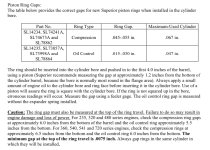
Here is the Superior guidance on ring gap:

Superior L04-01A

View attachment 84654

Here is the Superior guidance on ring gap:

Superior L04-01A

View attachment 84654
Did they get a technical rational? The choke/wall profile has been validated for the better part of a century. Would seem the risk of ring material fatigue has been increased.
RE the Superior end gap info-I have found this same info from various other sources. All reprints of Superior information. The parallel valve 360 in most cases uses the same pistons and rings as 0 320, 160 hp. So why does the 320 use .045 minimum and the 360 in the text specifies .0075 minimum and no maximum. One possibility is that Lycon misread the .045 minimum and used .0045 instead.
 
RE the Superior end gap info-I have found this same info from various other sources. All reprints of Superior information. The parallel valve 360 in most cases uses the same pistons and rings as 0 320, 160 hp. So why does the 320 use .045 minimum and the 360 in the text specifies .0075 minimum and no maximum. One possibility is that Lycon misread the .045 minimum and used .0045 instead.

L04-01 says to gap the compression rings to 0.045-0.055 at 1.2 and 4.0 inches up for both the 320 and 360. And then check the choked gap at 6.0 inches (6.5 inches for the 360) at 0.0075 minimum.
 
The Superioor chart makes no sense.


RE the Superior end gap info-I have found this same info from various other sources. All reprints of Superior information. The parallel valve 360 in most cases uses the same pistons and rings as 0 320, 160 hp. So why does the 320 use .045 minimum and the 360 in the text specifies .0075 minimum and no maximum. One possibility is that Lycon misread the .045 minimum and used .0045 instead.
Poor documentation. Superior considers the 320 steel cylinders to be the no choke version and therefore the ring gap is different. See my explanation above. Clearly this is not correct though. While it is poorly documented, you MUST know whether your cylinder is profiled with or without a choke taper before sizing the ring gaps, as the clearance and measuring points are different. Pretty much everything new is tapered. Don’t think they have made straight bores for many decades.
 
Last edited:
Could you please explain those number to me?
Call the cyl diameter 5” for simplicity and assume no ring gap in the choke. The rings circumference (the linear outside length) is Pi r2. 3.1414*(2.5*2.5)=19.634” at the top of the barrel. Circumference at the bottom of the barrel, assuming an 005” taper is 3.1414*(2.5025*5.25025)=19.673”. So, a 0 gap in the choke grows to 0039” gap outside the choke. Going from a 0 gap to an 005 gap will double that to 0078”. You can do the math on that one.
 
Last edited:
Call the cyl diameter 5” for simplicity and assume no ring gap in the choke. The rings circumference (the linear outside length) is Pi r2. 3.1414*(2.5*2.5)=19.634” at the top of the barrel. Circumference at the bottom of the barrel, assuming an 005” taper is 3.1414*(2.5025*5.25025)=19.673”. So, a 0 gap in the choke grows to 0039” gap outside the choke. Going from a 0 gap to an 005 gap will double that to 0078”. You can do the math on that one.
Larry........We are not looking for the area of a circle. We are looking for the circumference of a circle
 
Larry........We are not looking for the area of a circle. We are looking for the circumference of a circle
Sorry late at night. Data is almost the same though.

2*2.5*3.1414=15.707
2*2.5025*3.1414=15.738

The ring gap expands from 0 to 031from the choke area to the bottom of the 005 taper. Also, if the top of the cylinder expands 005” from heat, the gap is 031 throughout the travel range.

I was also wrong in my logic. If you went from 0 to an 005 ring gap in the choke, the base gap would only grow 005 + the same 031, not double.
 
Last edited:
I fly behind a US-rebuilt IO540 (my 2nd one from the same very reputable shop) so have no dog in this dreadfully sad story, but - speaking as an engineer - surely a 0.0075" ring gap is awfully tight? It is just 0.05% of the length of the ring, and with temperature coefficient of expansion of steel being roughly 12ppm/K (0.0012%/K) it takes only about 50K (50 degrees C) delta to close this gap.

If that gap closes, and then goes ever so slightly beyond that point, there will be instant massive damage to the cylinder bore, with loads of metal being shed. The thermal inertia of the ring is going to be practically zero; you could raise it by the required 50K in a fraction of a second with combustion products.

I realise the 0.0075 is the minimum value but how on earth can you know that is what you will be getting? The gap measured in the bore is given in the Superior data sheet as roughly 0.050 which will also close to zero pretty easily, at combustion temperatures.

There must be some interesting assumptions being made in these numbers... Whatever they are, they clearly work in the field, but you need only a very slightly undersize cylinder to get what happened to two unrelated people here. And I've been told by one builder that Superior rings cannot be used as they come; every single one needs dressing.
 
I fly behind a US-rebuilt IO540 (my 2nd one from the same very reputable shop) so have no dog in this dreadfully sad story, but - speaking as an engineer - surely a 0.0075" ring gap is awfully tight? It is just 0.05% of the length of the ring, and with temperature coefficient of expansion of steel being roughly 12ppm/K (0.0012%/K) it takes only about 50K (50 degrees C) delta to close this gap.

If that gap closes, and then goes ever so slightly beyond that point, there will be instant massive damage to the cylinder bore, with loads of metal being shed. The thermal inertia of the ring is going to be practically zero; you could raise it by the required 50K in a fraction of a second with combustion products.

I realise the 0.0075 is the minimum value but how on earth can you know that is what you will be getting? The gap measured in the bore is given in the Superior data sheet as roughly 0.050 which will also close to zero pretty easily, at combustion temperatures.

There must be some interesting assumptions being made in these numbers... Whatever they are, they clearly work in the field, but you need only a very slightly undersize cylinder to get what happened to two unrelated people here. And I've been told by one builder that Superior rings cannot be used as they come; every single one needs dressing.
Your concerns here assume that the cyl bore remains the same size. See my explanations above about the cyl expanding as well.
 
I realise the 0.0075 is the minimum value but how on earth can you know that is what you will be getting? The gap measured in the bore is given in the Superior data sheet as roughly 0.050 which will also close to zero pretty easily, at combustion temperatures.

There must be some interesting assumptions being made in these numbers... Whatever they are, they clearly work in the field, but you need only a very slightly undersize cylinder to get what happened to two unrelated people here. And I've been told by one builder that Superior rings cannot be used as they come; every single one needs dressing.
You measure the 0.0075 with a feeler gauge. If it fits you're good to go. Cylinder variance is why you measure the ring gaps. One of the worst things you can have happen is for the rings to close.
 
One tooth off is like 7 degrees of cam timing. + or - .
and would probably be reflected by some hi CHTs right?

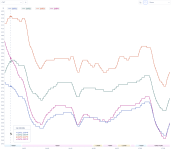
I'm looking at the FlySto log, not sure that was the first flight but my best guess is that was the last one, and the hottest is CHT #3 at 419°.
Would any of the experts reflect on how bad they perceive these 419 to be, keeping in mind the Lycoming max limit of 500 and this text off the operator's manual:
GENERAL RULES
Never exceed the maximum red line cylinder head temperature limit.

For maximum service life, cylinder head temperatures should be maintained below 435°F (224°C) during high performance cruise operation and below 400°F (205°C) for economy cruise powers.


1.png
 
Here is the Superior guidance on ring gap:

Superior L04-01A

View attachment 84654
The Superior protocol for measuring ring gap is state of the art WIERD. Approximately is not a word I want to see for something this critical. Is the Superior starting point 1.2 or 4.0 from the bottom of the cylinder?? The Superior cylinders have a reputation of running significantly hotter than Lycoming. The higher temperature combined with inadequate ring gap is the cause of this.
Mahlon's standard for break in is not over 400 until rings are seated. I followed Mahlon's procedures exactly and at 325 hours on Lycoming cylinders Very low oil consumption and nothing in the screens. I do not have a filter.
 
Is the Superior starting point 1.2 or 4.0 from the bottom of the cylinder??

You measure at both stations. Along with 6" or 6.5" for the choke. Approximately is good enough here considering the rings slide up and down the cylinder.
 
Sorry late at night. Data is almost the same though.

2*2.5*3.1414=15.707
2*2.5025*3.1414=15.738

The ring gap expands from 0 to 031from the choke area to the bottom of the 005 taper. Also, if the top of the cylinder expands 005” from heat, the gap is 031 throughout the travel range.

I was also wrong in my logic. If you went from 0 to an 005 ring gap in the choke, the base gap would only grow 005 + the same 031, not double.
As I measure it, the taper in the cylinder would have to be about 0.012 to make the ring gap clearance meet the spec of the chart minimums.

If the cylinder is 5.125 and the choke is 0.012 than the choke diameter is 5.113 at the top of the cylinder bore.
Cylinder circumference is diameter times Pi. (5.125 X 3.14159) = 16.1006
Cylinder choke circumference is 5.113. (5.113 X 3.14159) = 16.0629
(16.1006-16.0629) = 0.03769

So, If you take the (0.045) minumun end gap clearance in the bottom of the bore and subtract the choke clearance (0.037 you get about 0.00731 end gap in the choke.
Pretty close to 0.0075

YMMV
 
The choke on my Superior cylinders is 0.020”

That is the difference in diameter from the bottom 4 inches of the bore to the top of where the top ring would end up in operation.

By comparison the Lycoming cylinders had 0.015 taper
 
The choke on my Superior cylinders is 0.020”

That is the difference in diameter from the bottom 4 inches of the bore to the top of where the top ring would end up in operation.

By comparison the Lycoming cylinders had 0.015 taper
OP said. "I did not check the ring gap, as this was done by LyCon. The 8130 says “rings were fit”

Well, now you have a smoking gun.
 
OP said. "I did not check the ring gap, as this was done by LyCon. The 8130 says “rings were fit”

Well, now you have a smoking gun.
The Lycoming cylinders and the Superior cylinders use different processes for casting the cylinder heads. Lycoming are rough surface which results in good cooling. Superior are smooth which results in less efficient cooling. The Superior cylinders with too narrow ring gap are much more likely to self destruct.
The increased choke on the Superior likely plays a small part in this
 
OP said. "I did not check the ring gap, as this was done by LyCon. The 8130 says “rings were fit”

Well, now you have a smoking gun.
I checked the ring gaps after disassembling the engine and they were all fine, but perhaps they are fine now that the cylinder bores are majorly worn?

Lycon have not responded to my correspondence for a week now so I’ll chase them up. Sadly I can’t imagine anyone is going to help any time soon, so I’m going to be ~20k in the hole getting this sorted.

Luckily Aircraft Specialties and Divco have been great and both offered expedited turnarounds to get the bottom end repaired, which is nice of them.
 
Last edited:
I checked the ring gaps after disassembling the engine and they were all fine, but perhaps they are fine now that the cylinder bores are majorly worn?

Lycon have not responded to my correspondence for a week now so I’ll chase them up. Sadly I can’t imagine anyone is going to help any time soon, so I’m going to be ~20k in the hole getting this sorted.

Luckily Aircraft Specialties and Divco have been great and both offered expedited turnarounds to get the bottom end repaired, which is nice of them.
I always wondered how close superior cuts it on the choke ring gap. I installed their cylinders on my 540 when i overhauled it. I was pretty careful with the ring gaps. At my first ci, one cylinder blew 50/80. Pulled the cylinder and the top ring was cracked. Fortunately superior sent my a new one under warranty. My suspicion is that their hone process is not very tightly controlled and on that cylinder, the taper starts much lower in the bore than it should have (the lower you go, the less it expands from heat). I still have the cylinder, as it was still in great shape, and one day will measure it with the bore gauge. Also, my chokes were tighter than normal, as all my lower bore ring gaps were in the 055-060+ range after i got the upper gap to 008”. At that time, the spec was 045-055. I think because of this production issue, they changed the spec to 045 minimum, to prevent calls like mine, saying I can’t get my ring gaps in tolerance.
 
Last edited:
I always wondered how close superior cuts it on the choke ring gap. I installed their cylinders on my 540 when i overhauled it. I was pretty careful with the ring gaps. At my first ci, one cylinder blew 50/80. Pulled the cylinder and the top ring was cracked. Fortunately superior sent my a new one under warranty. My suspicion is that their hone process is not very tightly controlled and on that cylinder, the taper starts much lower in the bore than it should have (the lower you go, the less it expands from heat). I still have the cylinder, as it was still in great shape, and one day will measure it with the bore gauge. Also, my chokes were tighter than normal, as all my lower bore ring gaps were in the 055-060+ range after i got the upper gap to 008”. At that time, the spec was 045-055. I think because of this production issue, they changed the spec to 045 minimum, to prevent calls like mine, saying I can’t get my ring gaps in tolerance.
 
The numbers on the Superior chart appear to be identical to Lycoming. Given the greater choke on the Superior cylinders the minimum for the upper measurement should be greater. The position for the upper measurement should be exact, not approximate.
 
Last few years I have stuck with ECI/Titan/Continental Prime engine parts. Their pistons come with a DFL coating on the skirt. I just installed a new Superior cylinder on a O-470 a few days ago and the piston the cylinder kit came with was coated. Interesting to note the pistons here had no skirt coating.
 
The Superior pistons had coating on the crown, and the new Lycoming pistons have no coating at all.

Any engine experts have any ideas as to why the Superior cylinders have such an aggressive choke compared to the Lycomings?

I’m pleased to say that Lycon have now been in touch and offered to help, though it’s not yet clear what/if will be at no charge to me… US customer service is… different.
 
Superior replaced my #4 cylinder under warranty. I installed it last week. The gaps on the original cylinders were set to Superior specs. In some cases the gap at the bottom of the bore was slightly over spec to meet .008 gap at the top (I didn't use .0075). The minimum gap at the top was my controlling dimension. However, the ring side clearance was below spec. I could fit a 0.0015 feeler gauge but it was a snug fit. I couldn't push the gauge in. I had to insert the gauge with the ring away from the piston and then push the ring flush with the side of the piston. This may ultimately be the problem and was mentioned by the OP. The primary wear on #4 cylinder was at the 12:00 position which would make it on the compression stroke. One theory would be that the rings expanded normally on the intake stroke and wedged in the expanded position on the compression (or exhaust) stroke. However, the rings floated freely on the piston and increasing temperature would increase the side clearance.
On my RMA return I asked if Superior would let me know what they think happened.
 
Any engine experts have any ideas as to why the Superior cylinders have such an aggressive choke compared to the Lycomings?
Superior just may be a different head/barrel dimension delta at room temperature prior to assembly. The process today is undoubtedly different than my observation 40 yrs ago, but then the heads were in a 400F oven and the honed barrels (as a cylinder) were dipped into a pool of liquid nitrogen until the boil was happy for the operator. He then spun the chilled barrel into the hot head. When thermally equalized his would then shrink the barrel at the head interface and create the "choke" . The process is likely more controlled than the past, but dimensions for various reasons could easily be different.

You can imagine that the head will expand and reduce (eliminate?) the choke when at operating temperature. This is one reason you want things warm before take-off and a 370F ish temp is recommended, IIRC, for continuous operation. Building an engine with zero ring gap at the top at room temp then starting an engine at some temperature below that could be . . . well . . . problematic.

Just as another reference for ring/bores - - I talked to a friend that worked in a heavy duty diesel engine factory (another world) trouble shooting production issues. The final test pumped hot water through the engine to prewarm it for end of line power test. Following preheat they were run up to full power in just a few minutes from start. Maybe 15 min total time running in test cell. With the millions of bores passing with him as factory engineer he said he never had a single issue with rings making unhappy marks in the bore. A different animal though, no choke. Just saying that rings/bores can be made to have no issues.
 
I have an update on this and I'd also like opinions from you all.

After tearing down the engine, I found the thrust face on the crankcase was torn up from metal circulating in there, and the crank had damage. I sent the cases back to Divco and the crank back to Aircraft Specialties (returned the rods too for inspection and yellow tag again).

Divco repaired the thrust face within a week and I have the cases back already - only charged me $500 to boot. Very pleased with this.

Aircraft Specialties sorted the crank... but accidentally polished the already minimum size oil seal area, so that crank is now scrap. They have told me they will find me a replacement crank at their cost, so I will just pay the repair fee. It's a shame but at least I'm not out of pocket.

As for Lycon, well because I bought new Lycoming cylinders they said they'd port and polish these at no charge for the time being, while they deal with the damaged Superiors. Also they asked for the carb so they can check it's flowing enough fuel. My carb is a 10-3678-32 which has the highest flow available for an O320 and takeoff fuel flow was 13.7GPH.

Anyway, I shipped them the 4 damaged superior cylinders and the 4 new Lyc ones... which sat in customs for 3 weeks [ed. Deleted the rest of the sentence as it was politics. Please read the posting rules. V/r,dr]. They finally arrived at Lycon a couple weeks ago. I've had to chase a bit to get updates, but they told me the following:

- The new cylinders are nearly done and should be finished this week. All good with me, no problems there.
- The Superior cylinders (damaged ones) had the "darkest combustion chambers they've seen". Strange, but they were burning oil, and only 4 hours run time, so doesn't surprise me personally?
- They have not provided any opinion on what happened with the Superiors, nor have they sent the cylinders to Superior. They've sent the cylinders to an "outside engineering company for evaluation, before sending to the manufacturer". I don't know who this engineering company is. I asked Lycon why was this necessary, since Lycon see loads of cylinders, but haven't received a straight answer.

I am surprised because I expected Lycon to want to return the cylinders to Superior ASAP and make it Superior's problem to deal with. Maybe they are concerned that they screwed up a ring gap and don't want Superior to know? Right now I guess they are being careful to not offer any suggestions as to what's gone wrong in case they say anything that might make them liable for the failure.

Bottom line is I need to get the engine back together but I also need to find out what caused this problem and depending on the outcome, who's going to pay for all of this. Anyone have any thoughts as to what's going on, and what I should be expecting? This whole experience is just strange. I run a company that repairs drones, so I'm not new to customer service in this type of work, and we do our best to keep customers in the loop with all information, good or bad, it just makes the whole process so much easier for everyone.

You can see in post #37 that the main damage is from the top piston ring, and it's remarkably similar to Mike's damage in post #88. Maybe Superior aren't hardening these cylinders properly?
 
Last edited by a moderator:
My gut feeling is that this is a problem with Superior cyls simply because of similar damage reported by others.

My cylinder:

IMG_8721.jpeg

Mike_tailwind's cylinder from post #88

PXL_20250403_223032001.jpg

Too similar for this to be coincidence?

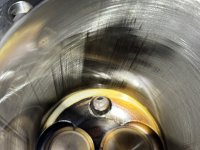
Mine had a groove cut into it (pictured) that measured nearly 3 thou deep, that would put a LOT of metal into the oil which I believe resulted in the rest of the damage.
 
They've sent the cylinders to an "outside engineering company for evaluation, before sending to the manufacturer". I don't know who this engineering company is. I asked Lycon why was this necessary, since Lycon see loads of cylinders, but haven't received a straight answer.
Because superior doesn't stand behind their products
 
We have found a problem which I believe to be the cause of the failure.

Compression ring to piston gap is supposed to be between .0025 and .0055, and we can’t even get a .0015 feeler in there.

The old pistons measure fine within this range, despite 800hrs of carbon buildup.

This would suggest that the rings could become stuck as the ring groove is so narrow.
I believe you misplaced your decimal above. Should be 0.025 and 0.055 and 0.015.
 
I'm very interested in knowing what the outside engineering company finds out. I've installed the new cylinder on mine, but haven't been able to run it yet waiting on a warranty replacement on my prop hub. I got that today, so Friday I will be breaking the new cylinder in. I will say that Superior was fast with the warranty replacement (2 days) and they paid for the return shipping of the old cylinder.
 
I believe you misplaced your decimal above. Should be 0.025 and 0.055 and 0.015.
This is ring land clearance, so the values are correct. 2.5-5.5 thou, not 25 and 55. In the end I don’t think this was of consequence
 
Edited post:

So it sounds like Lycon have had issues with other Superior cylinders so have sent them off to find out what’s going on. Hopefully the outcome will be positive for me but I’ll post updates on here as I get them…
 
Last edited:
Back
Top