Van's Air Force

The definitive Van's Aircraft support community! Buying, building or flying an RV? Join our exclusive family of mentors and enthusiasts!

Hangar security

, and a Glock 10-mm for the things outside.
The bears are never a problem until springtime when they come out of hibernation extremely hangry. As long as they remain outside leave them be; if they breach a door or window and come inside I had my .45-70 at the ready to protect my family. I no longer live at 8,400' up in the mountain 15 miles (the last few miles dirt road) from the nearest town with a population of 1,200 but I do know of what you speak. Now the big cats were a different issue altogether; they are always on the prowl.

We did have voles and mice at that altitude that we could never get under control. Tried everything. Having a cat around helped a bit but not 100%. One cat can only eat so many.
 
Regarding mice, I had a live and let live philosophy that worked for quite a few years ... until they got to some aluminum parts, wiring, chewing spare upholstery etc as well as leaving excrement in my cabinets and drawers. Now this means WAR.

I tried the traditional mouse traps, and they did not work for me.

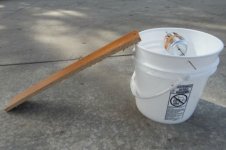
My nephews (farmers) told me that they use the bucket and beer can method with great success. Basically you get yourself a 5 gallon bucket, an empty beer can (if it is full, you know what to do), a metal coat hangar, and 1 gallon of automotive antifreeze (not the RV plumbing ecological stuff).

Here is what I did:
  • Drill axial holes in the (empty, of course) beer can
  • Drill two holes 180 degrees apart, near the top of the bucket
  • Straighten the coat hangar and cut yourself a straight piece of wire that is a couple of inches longer than the diameter of the bucket diameter.
  • run the coat hangar wire through the bucket and beer can.
  • Using some pliers, make a small bend at each end of the can to keep the can in your preferred position. I placed the can an inch or two away from the edge of the bucket.
  • Bend the wire portions that are outside the bucket to prevent the wire from drifting out of these holes.
  • Place some peanut butter on the can. Don't need much, just spread it near the center of the can along its circumference.
  • For this step you can use water if you are in warm climates, but up here it gets really cold. In my case I used automotive antifreeze mixed 1:1 with water giving 2 gallons and poured it into the bucket.
  • Make a small ramp of wood to the lip of the bucket. Any piece of wood will do. You can attach it, but I have just leaned it to the bucket and it has worked for me for almost a decade without falling.
Do not use RV plumbing antifreeze. I tried that the first year, trying to be ecological and all, and caught no mice. Why? Well, that type of antifreeze turns into a slush when cold and allows the mice to hop out of the bucket. After the first month, I replaced it with automotive antifreeze and I eliminated 13 mice that winter.

Some salient points about this system:
  • No bait reloading required for the season. Just empty the floating contents whenever you get to the hangar next.
  • Auto resetting. Even when seeing their brethren at the bottom, the mice have this bravado that they can do much better than the previous guys... almost like when pilots armchair read accident reports and feel that they would have fared so much better if they were placed in that same situation :-)
  • I have found up to half dozen mice (well preserved) at one time in the antifreeze. Just do not allow wildlife to feed on the corpses (unless you use only water).
  • Low cost, quick to build, very effective.
  • When off season (spring, summer, early fall), I filter and store the antifreeze, clean the can and store everything for the next winter.
Now after a few years, my catch is one or two mice every winter season. Works great for me. Many thanks to my nephews for the suggestion.

Here is one site with some instructions/images to give you a better idea: https://www.trap-anything.com/homemade-mouse-trap.html

Check with Mr. Google or YouTube for more information.

mousetrap.JPG
 
Last edited:
Our mouse problem in the storage shed was less of an issue when we had a family of foxes on the property, but that convenience was tempered by the noisy late-night tussles with my feral barn cats...what an obnoxious racket!. They apparently all died (mange) or moved on. We then had weasels/ermine for awhile, very effective mousers but I think the cats won that one too. People keep seeing cougars around but I never have. Coyotes are the bigger nuisance. We've seen a couple of rabid ones.

Bears are a recurring issue. They're just black bears, pretty harmless, so weapons not required, but one must be aware of where the cubs might be if encountered on the property, road, or mountain bike trails.

 
If you want a number of good ideas how to deal with mice, look up "mousetrap Monday" on YouTube. Make a bowl of popcorn, there are a lot of videos of mousetrap tests, most are pretty interesting.

If I needed rodent control in my hangar, i would build the Mascall trap. It's a 400 year old design that still works well:
 
Last edited:
Snap traps work well except I’ve had lousy results with peanut butter butter because bugs eat the peanut butter and don’t set off the trap. Instead I use an almond and drill a hole thru it and tie it to the trigger with a piece of wire. The rodent has to tug on the nut which does a much better job of releasing the trigger.
Sweet!! I use pecans and have to replace them each year. Scatter traps where I can see them around the interior walls. Usually get 1 or 2 each year as they seek permanent winter refuge. Thanks for that almond tip; stronger than pecans!!
 
I rely entirely on cat protection so don't get an accurate body count, only the many carcasses I see around the property, in the storage barn, and on my front porch where the cats often leave them as gifts. I assume they're doing the job but can't prove it with data.
 
Regarding mice, I had a live and let live philosophy that worked for quite a few years ... until they got to some aluminum parts, wiring, chewing spare upholstery etc as well as leaving excrement in my cabinets and drawers. Now this means WAR.

I tried the traditional mouse traps, and they did not work for me.

My nephews (farmers) told me that they use the bucket and beer can method with great success. Basically you get yourself a 5 gallon bucket, an empty beer can (if it is full, you know what to do), a metal coat hangar, and 1 gallon of automotive antifreeze (not the RV plumbing ecological stuff).

Here is what I did:
  • Drill axial holes in the (empty, of course) beer can
  • Drill two holes 180 degrees apart, near the top of the bucket
  • Straighten the coat hangar and cut yourself a straight piece of wire that is a couple of inches longer than the diameter of the bucket diameter.
  • run the coat hangar wire through the bucket and beer can.
  • Using some pliers, make a small bend at each end of the can to keep the can in your preferred position. I placed the can an inch or two away from the edge of the bucket.
  • Bend the wire portions that are outside the bucket to prevent the wire from drifting out of these holes.
  • Place some peanut butter on the can. Don't need much, just spread it near the center of the can along its circumference.
  • For this step you can use water if you are in warm climates, but up here it gets really cold. In my case I used automotive antifreeze mixed 1:1 with water giving 2 gallons and poured it into the bucket.
  • Make a small ramp of wood to the lip of the bucket. Any piece of wood will do. You can attach it, but I have just leaned it to the bucket and it has worked for me for almost a decade without falling.
Do not use RV plumbing antifreeze. I tried that the first year, trying to be ecological and all, and caught no mice. Why? Well, that type of antifreeze turns into a slush when cold and allows the mice to hop out of the bucket. After the first month, I replaced it with automotive antifreeze and I eliminated 13 mice that winter.

Some salient points about this system:
  • No bait reloading required for the season. Just empty the floating contents whenever you get to the hangar next.
  • Auto resetting. Even when seeing their brethren at the bottom, the mice have this bravado that they can do much better than the previous guys... almost like when pilots armchair read accident reports and feel that they would have fared so much better if they were placed in that same situation :-)
  • I have found up to half dozen mice (well preserved) at one time in the antifreeze. Just do not allow wildlife to feed on the corpses (unless you use only water).
  • Low cost, quick to build, very effective.
  • When off season (spring, summer, early fall), I filter and store the antifreeze, clean the can and store everything for the next winter.
Now after a few years, my catch is one or two mice every winter season. Works great for me. Many thanks to my nephews for the suggestion.

Here is one site with some instructions/images to give you a better idea: https://www.trap-anything.com/homemade-mouse-trap.html

Check with Mr. Google or YouTube for more information.

View attachment 99427

Did you deburr the holes in the can before proceeding?

What kind of deburring tool is used on almonds?

This was an awesome read, I live in South FL and I thought this was going to be about security against humans. At my $1350/mo shared hangar, I don't think anyone empties the garbage cans. If any mice make it into my airplane, after a few flights with me, they'll definitely prefer one of the other 3 planes that never move.
 
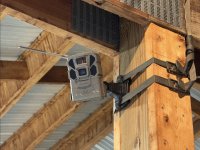
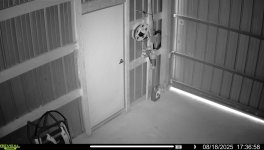
Taking this a slightly different direction, but I highly recommend the “Reveal” brand of trail cameras with a cellphone connection for hangar security. We have one pointed towards the entry door and it is placed high enough out of the way that it is fairly discrete. After six months of testing I am happy to report that it is working great! The basic subscription sends us two images a day (taken twelve hours apart) plus near real-time images when the camera senses motion. The battery life is incredible and overall it has been a very positive experience.
 

Attachments

  • IMG_1201.jpeg
    IMG_1201.jpeg
    727.3 KB · Views: 21
  • IMG_1200.jpeg
    IMG_1200.jpeg
    314.3 KB · Views: 21
i guess i am very careful handling dead whitefooted mice . that is the kind that usually shows up in rural areas. everyone has heard of lymes disease. spread by ticks, a real health hazard where i live. did you know the tick gets the disease from whitefooted mice?
 
And for anyone wondering about cell signal, we have great signal strength inside the hangar. The camera will send images via the “Reveal” app and saves short video clips to the internal SD card. The camera uses a Verizon carrier connection and the battery lasts for months before showing any drain. I know a subscription is not the solution for everyone but if you are in the fence I highly recommend it - there’s something nice about being able to see the airplane twice a day no matter what!!
 

Attachments

  • IMG_1208.png
    IMG_1208.png
    233.6 KB · Views: 30
  • IMG_1210.png
    IMG_1210.png
    879.1 KB · Views: 27
1. We live in a rural area and it is time to prevent mouse intrusions. I've seen and sprayed for ants at my public airport hangar. Do I need to put out stuff for mice? I am doing so at home.
2. If I am flying locally, say for up to an hour, I leave my hangar open. I increasingly have more stuff in the hangar, should I do a better job shutting the door?
3. Does anyone worry to the point of something like putting a game camera in a hangar?

Thanks.

1. keep food cleaned up. Don't leave crumbs and if you keep food at the hangar, keep it either in the fridge or in a tightly closed container. Leave a bait trap or 2 in the corners and check them regularly.
2. Yes. I regularly see random cars cruise past my hangar. and there are way too many valuable things around that would be easy to carry off.
3. Before I got broadband (included in hangar utilities now) I shared a Starlink with a hangar neighbor. I have a Blink camera in the hangar that is active 24/7 with alerts to my iphone.

I also keep one of those canned air-horns at the hangar to scare the birds out before closing the hangar doors. There are certain times of the year that if you open the hangar door the birds see it as an invitation to come in and roost in the overhead. Bird poop is not something I want inside my hangar.
 
We have more rodent problems at home than the hangar. Dang chipmunks love wire. I use electronic traps. I bait them with a section of Boba tea straw filled with peanut butter. They can't eat it, because by the time they get to it, they are on the zapper. Trap is easy to dump, but I caution everyone messing with rodents to wash your hands and maybe even disinfect with alcohol. I keep a trap in my garage, but haven't caught anything in years. I think they tell each other.

Please don't use poisons. Animals pick up the poisoned creatures and die a horrible death. We occasionally have bald eagle die from injesting a poison rodent. Could also happen to your pet dog or cat.

I keep soft air for bear, wolf, coyote, fox, badger or unwelcome humans. 400fps really stings. Life in the mountains!

I also have a 12ga with non lethal sand bags for really persistent creatures like Big Foot. Never seen one but there's a huge believer community up here. We see them observing sometimes.
 
A friend of mine swears by Bounce dryer sheets, he’s a camping nut but not an aviation guy…. Different hardware but similar battle.

I’ve never seen evidence of mice in my hangar, though I’ve preemptively tried everything listed above, I can’t say whether it works as I’ve never seen evidence of mice so I’ve never seen a reduction in the zero mice I’ve witnessed. Prevention seems like less work than the cure, let them reside in the other airplanes and hangars at my home drome.

All of that said, whether or not dryer sheets work or not, I keep them in my ‘67 172H, and if they work for mice, great! They have the added bonus of hiding 60 years worth of July human swamp that’s soaked into the seats that most aircraft of that vintage have. The ‘ol Skyhawk smells like a fresh spring day instead of an army tent from the Korean War.

The RV is still being built so I’d imagine the mice like it even less as there’s nothing to eat in it, but I’ve yet to see evidence of them in either the 172, the Rv-8, or the hangar overall.

I’ve considered sprinkling used cat litter outside the hangar around the perimeter, but never really carry used cat litter around on a whim, so I haven’t done that yet. Not sure if the scent of a cat would scare off critters of the destructive variety, but it probably wouldn’t hurt
 
A friend of mine swears by Bounce dryer sheets, he’s a camping nut but not an aviation guy…. Different hardware but similar battle.
Storing and spreading used cat litter is a line I won’t cross and isn’t something I’ve ever tried, but I can definitely report that Bounce dryer sheets fall into the broad category of OWTs that don’t work as a mouse deterrent.
 
I used mousetraps until I got a few of those sonic devices. I leave one plugged in at every outlet. It tool a little while but I haven't had mice in the hangar for over a year.

Dave
 
Moth balls seem to work well too
Moth balls did not work for me at all. I put a couple of packets of them in a Ford crewcab during storage over the winter and the mice still moved in and did what mice do.

In addition, the chemical fumes from the moth balls permeated the upholstery and foam. The fumes were strong enough to require driving with the windows open when using the vehicle over the entire following summer. It took nearly a year before the fumes could no longer be detected when opening the door.

Not recommended in an enclosed vehicle.

Kevin
 
Back
Top