

Van's Air Force
You are using an out of date browser. It may not display this or other websites correctly.
You should upgrade or use an alternative browser.
You should upgrade or use an alternative browser.
Garmin G3X Touch POWER Indication vs Lycoming Chart
- Thread starter supik
- Start date

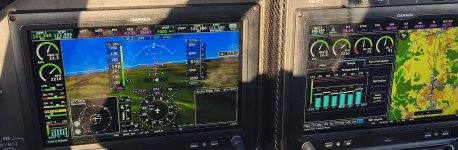
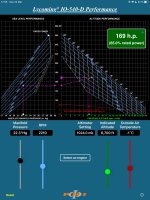
Have you checked what HP and RPM settings are in the G3X configuration? Two percent seems within engine-to-engine HP variation.
Agree probably within margin of error. For that matter, how old is the engine? Was it recently dyno'd and you know what it actually produces? May not like to hear it, but even new they don't all make their numbers. As far as the Garmin software is concerned, as a sample of 1 on my I/O-390, it seems to be right on.
To the best of my knowledge (which is limited!) no EFIS power calculation takes the mixture setting into consideration. And the Lycoming charts do but you have to read all the fine print. It’s often ‘recommended cruise’ mixture, about 50 F rich of peak. Since I usually cruise lean of peak the EFIS usually displays a higher power than actual. Around best power mixture the numbers tend to be what Lycoming says they should be.

I believe the Garmin uses RPM, MAP, and FF to determine % power which would imply it does take mixture into consideration. I know that when my k factor was way off in phase 1, the % power was also way off...To the best of my knowledge (which is limited!) no EFIS power calculation takes the mixture setting into consideration. And the Lycoming charts do but you have to read all the fine print. It’s often ‘recommended cruise’ mixture, about 50 F rich of peak. Since I usually cruise lean of peak the EFIS usually displays a higher power than actual. Around best power mixture the numbers tend to be what Lycoming says they should be.
I think that’s correct. But, power is not linear with fuel flow. Rich of peak power changes slowly with fuel flow; lean of peak power tends to change proportional to fuel flow. I don’t think the algorithym knows which side of peak egt you’re on, e.g., results are pretty good rich of peak, but not as good lean of peak. I would assume the data is corrected for air temperature but do not know.I believe the Garmin uses RPM, MAP, and FF to determine % power which would imply it does take mixture into consideration. I know that when my k factor was way off in phase 1, the % power was also way off...
Thanks for the reference.Dynon's algorithm does take into account whether the engine is running ROP or LOP. Although somewhat dated and missing some figures (and Dynon’s algorithm has been tweaked over the years), this article by Dynon explains how they approach percent power calculations:….

Found it... https://apps.apple.com/us/app/aircraftpower/id718023187Hi Igor
Where does the active chart you use in your post come from.
Would like try it out.
Regards
Rob
WhenI put the -3X in my IO-360 powered RV-8 I found the power indications off by 5% compared to using the power charts from the C-177 the engine came from. Garmin insisted that theirs took more factors into consideration and that theirs is correct. Since my cruise performance is now closer to Vans published numbers, I have decided that Garmin's figures are, indeed, more accurate.

Garmin insisted that theirs took more factors into consideration and that theirs is correct.
Well, I don't know about that, but it's good that the person on the phone was feeling confident!
To the best of my knowledge (which is limited!) no EFIS power calculation takes the mixture setting into consideration.
The G3X system in my airplane definitely takes fuel flow into account when calculating percent power, which works both ROP and LOP.
Yes, this one and I think they have a phone version as well..
I would expect the indicated % Power to increase slightly when going from full rich to approx. best power setting.Well, I don't know about that, but it's good that the person on the phone was feeling confident!
The G3X system in my airplane definitely takes fuel flow into account when calculating percent power, which works both ROP and LOP.
But I haven't observed any changes until going LOP - only then the indicated % power started decreasing.
This makes perfect sense for
EDIT: even at Peak EGT the indicated % power should already be less then Best Power
Last edited:
Bob, this was at approx Best Power Setting when I took the picture.To the best of my knowledge (which is limited!) no EFIS power calculation takes the mixture setting into consideration. And the Lycoming charts do but you have to read all the fine print. It’s often ‘recommended cruise’ mixture, about 50 F rich of peak. Since I usually cruise lean of peak the EFIS usually displays a higher power than actual. Around best power mixture the numbers tend to be what Lycoming says they should be.
What's the method?Different calculation method, I wouldn't expect it to be precisely in agreement with every published chart.
I thought the PHI ios app follows the official Lycoming power chart
Last edited:
The fall off rich of best power is pretty slight, at least to 200 or so, so no surprise they don't bother.I would expect the indicated % Power to increase slightly when going from full rich to approx. best power setting.
But I haven't observed any changes until going LOP - only then the indicated % power started decreasing.
This makes perfect sense forthe Peak andLOP ops, but doesn't seem to reflect the power increase from full rich to Best Power setting?
EDIT: even at Peak EGT the indicated % power should already be less then Best Power

Just to confirm the required inputs for engine power on a G3X. The installation manual states the following:
30.4.32.31 Engine Power
Estimated engine power can be calculated for Lycoming and Continental engines, using inputs from RPM, manifold pressure, and fuel flow sensors (all three are required for engine power calculation).
Having run many engines on a dyno, I can state with certainty that engine power can definitely be tracked fairly accurately with those three value (RPM, MAP and FF) as long as torque is known at redline RPM and peak torque RPM. The more known Torque/RPM points (hence HP), the more accurate the model, but having at least those two known points will provide a fairly accurate model that can then be tracked and provide the nice "% Power" number on the EFIS.
I'd say that 2% variance falls well within the range of "estimated".
30.4.32.31 Engine Power
Estimated engine power can be calculated for Lycoming and Continental engines, using inputs from RPM, manifold pressure, and fuel flow sensors (all three are required for engine power calculation).
Having run many engines on a dyno, I can state with certainty that engine power can definitely be tracked fairly accurately with those three value (RPM, MAP and FF) as long as torque is known at redline RPM and peak torque RPM. The more known Torque/RPM points (hence HP), the more accurate the model, but having at least those two known points will provide a fairly accurate model that can then be tracked and provide the nice "% Power" number on the EFIS.
I'd say that 2% variance falls well within the range of "estimated".
Last edited:

RV8Squaz
Well Known Member
Another thing that could play into the discrepancy is the indicated MP versus actual. I remember a while back going through a similar exercise and discovered that the indicated MP was off by 0.3 or 0.4”. You have to consider field elevation and barometric pressure to determine the actual manifold pressure vs indicated with the engine not running.
For example, if the sea level pressure is 30.20” and the field elevation is 1000’, then the indicated MP should be 29.20”. My old Vision Microsystems had the capability to calibrate the indicated MP. I haven’t found a way to do it on the G3X.
For example, if the sea level pressure is 30.20” and the field elevation is 1000’, then the indicated MP should be 29.20”. My old Vision Microsystems had the capability to calibrate the indicated MP. I haven’t found a way to do it on the G3X.
In addition, if the G3X doesn’t consider OAT, then that will introduce an error too.
It definitely uses and requires air temperature data, as you can see the calculated power number disappear if you unplug your OAT probe.

Which maths are the most accurate - the Garmin, the Dynon, or the Slide Rule Lycoming used?
Answer: none of them...They're all off by a little bit, one way or the other. There are too many inputs (variables) to consider that contribute to combustion efficiency and then there are the mechanical losses (e.g. friction) that aren't considered in any of the calculations.
The only "real" number is what would be produced by a strain gauge (which we don't have -- unless it's a test cell) from there it's (ft.lbs * RPM)/5252 => HP...
Answer: none of them...They're all off by a little bit, one way or the other. There are too many inputs (variables) to consider that contribute to combustion efficiency and then there are the mechanical losses (e.g. friction) that aren't considered in any of the calculations.
The only "real" number is what would be produced by a strain gauge (which we don't have -- unless it's a test cell) from there it's (ft.lbs * RPM)/5252 => HP...

Having been a guy who made the performance charts like these for production engines and spend a few thousand hours in a test cell, I can say if it is within 2% that is fantastic. Lube oil temps can make that much change.
As mentioned there are many (many) variables that go into the variability of engine performance.
As mentioned there are many (many) variables that go into the variability of engine performance.
RV8Squaz
Well Known Member
That’s good to know! Thank you.It definitely uses and requires air temperature data, as you can see the calculated power number disappear if you unplug your OAT probe.
I frankly would be quite surprised if lycoming chart was based on theoretical data. I would be pretty confident those charts were based on dyno data, though the altitude derivatives may have done with math. Agree that there are many variables not addressed in those charts that will affect actual output lWhich maths are the most accurate - the Garmin, the Dynon, or the Slide Rule Lycoming used?
Answer: none of them...They're all off by a little bit, one way or the other. There are too many inputs (variables) to consider that contribute to combustion efficiency and then there are the mechanical losses (e.g. friction) that aren't considered in any of the calculations.
The only "real" number is what would be produced by a strain gauge (which we don't have -- unless it's a test cell) from there it's (ft.lbs * RPM)/5252 => HP...
I somehow overlooked the 'estimated power' wording in the manual. Now your suggestions helped me to understand that there are too many factors involved to have a precise interpretation of the power settings; air inlet, fuel servo type, exhaust etc. Nevertheless, I'm still curious what formula Garmin uses.
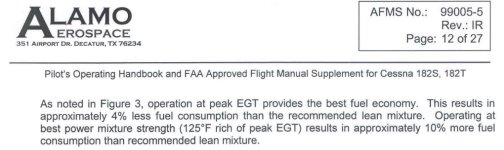
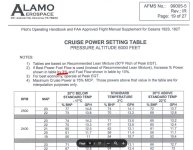
Below is a screenshot from a C182S AFM Supplement with an IO-540-D4B5 engine
It suggests a difference in power of about 3% between 50F ROP and 125F ROP (I'm not debating if flying 50F ROP is the right thing to do)
So moving the mixture from Best Power (125F ROP) to 50F ROP should display approx. 3% less power.
On my G3X T I don't see any change in the displayed % power while leaning from Full Rich to Peak EGT.

Below is a screenshot from a C182S AFM Supplement with an IO-540-D4B5 engine
It suggests a difference in power of about 3% between 50F ROP and 125F ROP (I'm not debating if flying 50F ROP is the right thing to do)
So moving the mixture from Best Power (125F ROP) to 50F ROP should display approx. 3% less power.
On my G3X T I don't see any change in the displayed % power while leaning from Full Rich to Peak EGT.
Attachments

Last edited:
I too tried to understand how the G3X Touch calculates % power (E%). After looking at the second-by-second logs with various engine settings, it looks like the algorithm is very close to the following. Measurements are probably slightly filtered over time for stability.
The limiting factor is either air (ROP) or fuel (LOP). E% is therefore the lower of E%ROP and E%LOP.
E%ROP = (RPM / RPMmax) * (MP / MPstandard_sea_level) * SQRT(standard_sea_level_temperature_in_kelvin / OAT_in_kelvin)
As an example, for my IO540,
E%ROP = (RPM / 2700) * (MP / 29.92) * (288.15 / OAT_in_kelvin)^0.5
E%LOP = FF_in_gallons_per_hour * 14.95 / rated_sea_level_engine_power_in_hp
Perhaps I am missing some subtle parameter, but this seems to track very well with engine % power displayed by my G3X Touch.
The limiting factor is either air (ROP) or fuel (LOP). E% is therefore the lower of E%ROP and E%LOP.
E%ROP = (RPM / RPMmax) * (MP / MPstandard_sea_level) * SQRT(standard_sea_level_temperature_in_kelvin / OAT_in_kelvin)
As an example, for my IO540,
E%ROP = (RPM / 2700) * (MP / 29.92) * (288.15 / OAT_in_kelvin)^0.5
E%LOP = FF_in_gallons_per_hour * 14.95 / rated_sea_level_engine_power_in_hp
Perhaps I am missing some subtle parameter, but this seems to track very well with engine % power displayed by my G3X Touch.
