



Now that I'm in phase 1, I have burned off sufficient fuel from my tanks that I can now refill them and calibrate my fuel senders. I also decided to see if I could mathematically and programmatically estimate the fuel quantity based on a ruler, wing tilt (dihedral) and pitch (tail dragger).
In my plane, the dihedral is around 3.5 deg, and the pitch (on the top of the spar) is about 11 deg. I inserted a ruler into my tank and measured essentially 0" straight below the filler hole. I took a bunch of measurements for the size of the tank, and the location of the filler hole, and wrote a python script to estimate how much fuel would be in the tank. I could still see fuel slightly behind where the filler hole was, due to the tail low attitude, and of course the inboard part of the tank still had fuel being lower than the outboard. The program estimated about 5.6 gallons remained in the tank. I repeated this on the other side, which had a bit more fuel, 1.5" and the program estimates 10.5 gallons.
Well, I removed the drain, and emptied the lower tank into my 5 gallon can, and filled it up beyond the 5 gallon mark, right up to the point it almost spilled out. I then got a second tank for the tiny amount left over. I weighed the completely full can at ~33 lbs, resulting in ~5.5 gallons, and I bet about a tenth or so in the second tank...a lot closer to the math than I was expecting.
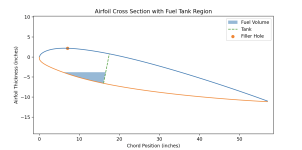
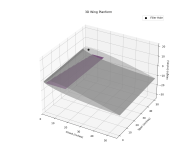
Here are some screenshots of the plots visualizing the fuel level. The script is fully configurable, including tilt angle (dihedral), pitch angle, filler location, rear tank measurement (tank chord), etc. The script generates the 23013.5 airfoil that vans uses on the -7, and all the calculations are based on that airfoil and the input measurements.
In spite of doing all this fun programming, I will of course be verifying it as I calibrate my tanks 2 gallons at a time to configure the Dynon float senders, and a homemade dipstick.
Anyways, I thought I'd share in case anyone else might be interested, I know there are other nerds out here who find this type of stuff fun
In my plane, the dihedral is around 3.5 deg, and the pitch (on the top of the spar) is about 11 deg. I inserted a ruler into my tank and measured essentially 0" straight below the filler hole. I took a bunch of measurements for the size of the tank, and the location of the filler hole, and wrote a python script to estimate how much fuel would be in the tank. I could still see fuel slightly behind where the filler hole was, due to the tail low attitude, and of course the inboard part of the tank still had fuel being lower than the outboard. The program estimated about 5.6 gallons remained in the tank. I repeated this on the other side, which had a bit more fuel, 1.5" and the program estimates 10.5 gallons.
Well, I removed the drain, and emptied the lower tank into my 5 gallon can, and filled it up beyond the 5 gallon mark, right up to the point it almost spilled out. I then got a second tank for the tiny amount left over. I weighed the completely full can at ~33 lbs, resulting in ~5.5 gallons, and I bet about a tenth or so in the second tank...a lot closer to the math than I was expecting.
Here are some screenshots of the plots visualizing the fuel level. The script is fully configurable, including tilt angle (dihedral), pitch angle, filler location, rear tank measurement (tank chord), etc. The script generates the 23013.5 airfoil that vans uses on the -7, and all the calculations are based on that airfoil and the input measurements.
In spite of doing all this fun programming, I will of course be verifying it as I calibrate my tanks 2 gallons at a time to configure the Dynon float senders, and a homemade dipstick.
Anyways, I thought I'd share in case anyone else might be interested, I know there are other nerds out here who find this type of stuff fun


