Van's Air Force

The definitive Van's Aircraft support community! Buying, building or flying an RV? Join our exclusive family of mentors and enthusiasts!

Filter Test Results

I use the same filter on my Corvette and actually used one on my 540 for an oil change. Then I remembered that my Corvette uses 5W30 oil which is like water compared to even the 20/50 aviation oil and I chickened out and went back to the 1068 NAPA. Interestingly, those tiny LS style filters have a fairly low burst pressure. I would have thought the smaller surface area of the can (vessel) would increase the rating. Not according to the Wix specs.

Owners manual calls for 15W50 for track days using same filter.
 
while looking for info on oil film thickness (to help understand what size grit may be exceeding the "OFT") I ran across this:

" Phillips 66 Lubricants laboratory testing has definitively shown that all aviation engine oils drain off the parts down to a residual oil film thickness of 3 to 4 microns (25 microns = 1/1,000 of an inch) after just a few hours – regardless of whether the oil is a multi-viscosity or a straight grade oil."

Mike B however recommends using the single viscosity Aeroshell W100 whenever possible because, he claims, it does not run off the parts as easily as the multi grade oil. It sounds like more intuition science from Mike.. He's just not getting much love this week from VAF, does he? :LOL:
 
Mike B however recommends using the single viscosity Aeroshell W100 whenever possible because, he claims, it does not run off the parts as easily as the multi grade oil. It sounds like more intuition science from Mike.. He's just not getting much love this week from VAF, does he? :LOL:

Mike has a lot of experience, and even if I might disagree with him on some minor thing, I'm not going to discard everything based on a technicality. Let's remember that there are all kinds of things championed by experts - how hot is "too hot" for CHTs, whether using MOGAS is ok or not, whether running LOP is ok or not, and so on. Smart people not only often disagree, but they understand why they disagree.
 
The stuff that makes the oil black is lead that is not affected by the filter.

Car oil darkens and there is no lead. Planes that run on mogas get dark oil.

Darkening of the oil is a combination of oil oxidation and soot.

It’s interesting to see so much comment on efficacy of filters but not about the buffering capability of oil. As oil ages, it loses the ability to keep the oil from becoming acidic. Ever see the old standard of 50 hours OR 4 months between changes?

Personally, I like to change around 30 to 35 hours which works out to 3-4 times a year.
 
Last edited:
Car oil darkens and there is no lead. Planes that run on mogas get dark oil.

Darkening of the oil is a combination of oil oxidation and soot.

It’s interesting to see so much comment on efficacy of filters but not about the buffering capability of oil. As oil ages, it loses the ability to keep the oil from becoming acidic. Ever see the old standard of 50 hours OR 4 months between changes?

Personally, I like to change around 30 to 35 hours which works out to 3-4 times a year.

Car oil darkens but not nearly to the extent of aircraft oil. When the oil is analyzed, there are buffering elements remaining in both. I have some cars I change the oil annually. If I changed oil at 25 hours I would be changing once a month.
 
Ever see the old standard of 50 hours OR 4 months between changes?
Then why does oil have a shelf life in the bottle exceeding 4 months?

Obviously a bit tongue-in-cheek there - but the question has some validity. If I change oil on my engine, run it twice in 4 months and it sits quietly the rest of the time, is it really worn out and needing change at 4 months? What part of it is "worn out"? The additives package? The buffering? What is it that expires as the end of 4 months and what causes it? Oxidation from the atmosphere? If it only runs once, twice, or not at all, there is not much atmosphere change available in the engine for the additives to react with - or water condensation either - so with degrees in both chemistry and physics, and 30 years of engineering experience (not to mention a lifetime of exposure to "marketing") behind me, I have to look at that a little bit sideways and ask why.

The answer, of course, means more lab tests because the oil and engine companies will be no help, they'll just point to published guidelines. "Chapter 7, verse 10, Book Of Lycoming - And the engineers sayeth..."
 
Last edited:
Show me ONE, just ONE, certificated, Wix, whatever, in-service filter that has accumulated anything in the sub-40 micron range. This would appear in the filter as a paste.

Double dog dare you any of you guys.

I cut open ~60 filters annually for inspections and have never seen this. EVER!

Ironically I only see a small amount of black ferrous paste around the circumference of the magnet in Challenger filters.
The human eye can only resolve features down to about 100um (100 micron).
 
Show me ONE, just ONE, certificated, Wix, whatever, in-service filter that has accumulated anything in the sub-40 micron range. This would appear in the filter as a paste.

Interesting challenge. So how much dirt would it take to be visually detected as a paste?

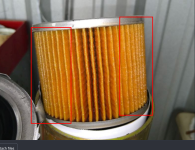
I posted this photo previously. Looks pristine, perfectly clean, yes?

Champion looks clean.jpg

In reality, it's the Champion returned from the test lab. You're looking at the element that caught 25.6 grams of ISO 12103-1 A3 Medium test dust.

Grab the calculator. A3 has a specified density of 1025 kg/cubic meter. Converting to grams and cubic inches, we have:

1025 kg = 1025000 grams
1 cubic meter = 61024 cubic inches

1025000 / 61024 = 16.79 grams per cubic inch

In fairness, some of the A3 washed off the element into the can during shipping, so the element as pictured above doesn't contain all 25.6 grams. Let's be generous, and say 1/3 of it washed off. The element above is holding roughly one cubic inch of silica grit ranging from 1 to 250 microns, and you can't see any of it.

Now Bob, I love a double dog dare as much as anyone, but here you're offering a sucker bet. No sound Lycoming operating with a depth media filter and an air cleaner would ever collect enough material in the filter to be apparent as paste.
 
Has anyone here looked at their Challenger or K&P element, and thought it was "aluminum perforated by a laser"?
images
 
What makes the oil turn brown/black in aircraft that use only MoGas?
Mostly combustion byproducts leading to acid formation, wear metals, and then a lot of the brown is just good ol' silicon (dirt) ingested from intake air. These very small, as in sub-micron (PbO2 is typically 0.5µ and silicon is measured in nanometers, or a 1000th of a micron), particles accumulate in suspension which in time turns the color darker. Lead oxide, which is what is formed from combustion with leaded fuel, is much darker turning the oil color nearly black much sooner than unleaded fuel.
 
Last edited:
I agree with you. I too am skeptical that the results that Dan has paraphrased represent any real-world scenario; the test is by design a HALT-type test and isn't intended to replicate real world usage.

Brad, what is a "HALT-type"?

ISO 4548-12 is the current world standard for filtration efficiency. Argue the point with the senior engineers at GM, Ford, Toyota, Honda, et al. You know, the folks who serve on the SAE and ISO committees.

Moreover, although the "bubble point" test is poo-poo'ed, actual test labs such as Ascent Filtration Testing (among others) actually do run them in addition to other tests as they do provide some value (according to them - call them and they'll explain it).

The test standard quoted by K&P is ASTM F-316.

It's a bubble point test for membrane filters assumed to have discrete pores similar to capillary tubes. It's based on capillary attraction and surface tension within those tubes, and is thus inappropriate for a screen. From the standard:

The bubble point test is based on the principle that a wetting liquid
is held in these capillary pores by capillary attraction and
surface tension, and the minimum pressure required to force
liquid from these pores is a function of pore diameter.
The standard is limited to pore sizes between 0 and 15 microns.


Further...

5.3 The results of this test method should not be used as the
sole factor to describe the limiting size for retention of
particulate contaminants from fluids. The effective pore size
calculated from this test method is based on the premise of
capillary pores having circular cross sections, and does not
refer to actual particle size retention.


Most of the major labs can do an ASTM F-316, including Assent and the lab who did our ISO 4548-12. However, if they're doing F-316's to validate filtration efficiency, they're way outside the standard.

What I do trust is the particle count analysis I've got from Blackstone for a couple OCIs with different filters. This is separate from the the spectrographic analysis and an extra charge option. For my flying and my engine, there just isn't a lot of difference between any of the filters I've tried in that (or in the regular "insoluable % " included in the baseline oil analysis they do) . If your style of flying includes lots of flying in very dusty areas with no air filter (or if you're pre-disposed to pouring a few ounces of sand down the filler neck during your preflight), that's different than mine and YMMV.

Here's where we return to reality. Filtration efficiency is a science, with standards. It's based on fact. However, good enough is highly variable, and based on opinion. It is absolutely true to say very little filtration is required for a healthy engine, on short oil change intervals, and running exclusively in a clean environment. If there is no dirt, there is no need for a filter. Unfortunately, those three conditions are not universal.
 
Last edited:
Brad, what is a "HALT-type"?
Accelerated life tests ("ALT") and highly accelerated life tests ("HALT"), is tests which stresses a product well beyond intended design parameters in an effort to find weaknesses or points of failure. For electronics, for example, it'd be running the device in a hotter environment (exceeding design temperature limits) than planned for while shaking it (exceeding design vibratory limits). In the case of oil filters, it's subjecting them to temperatures, pressures, and so on beyond their design criteria.

ISO 4548-12 is the current world standard for filtration efficiency. Argue the point with the senior engineers at GM, Ford, Toyota, Honda, et al. You know, the folks who serve on the SAE and ISO committees.
I have no point in arguing the merits of the test; I just am happy to argue that it's not representative of a real world scenario. You might ask the SAE or ISO committees, or more practically, the lab doing the test if they believe ISO 4548-12 is representative of real world tests; the lab I talked to said it absolutely was not.

The test standard quoted by K&P is ASTM F-316.

It's a bubble point test for membrane filters assumed to have discrete pores similar to capillary tubes. It's based on capillary attraction and surface tension within those tubes, and is thus inappropriate for a screen. From the standard:

The bubble point test is based on the principle that a wetting liquid
is held in these capillary pores by capillary attraction and
surface tension, and the minimum pressure required to force
liquid from these pores is a function of pore diameter.
The standard is limited to pore sizes between 0 and 15 microns.


Further...

5.3 The results of this test method should not be used as the
sole factor to describe the limiting size for retention of
particulate contaminants from fluids. The effective pore size
calculated from this test method is based on the premise of
capillary pores having circular cross sections, and does not
refer to actual particle size retention.


Most of the major labs can do an ASTM F-316, including Assent and the lab who did our ISO 4548-12. However, if they're doing F-316's to validate filtration efficiency, they're way outside the standard.

Once again, I'm not arguing for or against but simply pointing out that at least one lab will run the test and believes it has at least some merit. Whether anyone on this forum would agree or disagree is their prerogative, of course. Neither presents a complete picture of a filter's performance (burst pressure is not addressed, for example) and anyone who says otherwise is selling something, IMO.

Here's where we return to reality. Filtration efficiency is a science, with a standard. However, good enough is highly variable. It is absolutely true to say very little filtration is required for a healthy engine, on short oil change intervals, and running exclusively in a clean environment. If there is no dirt, there is no need for a filter.

Yes, back to reality and I agree with your statement. I've run Tempest, Wix, and Challenger units and based on the insolubles percentage and particle count analysis, I don't think filtration efficiency is a differentiator for my typical usage. There are definitely differences in the aforementioned tests, but they don't reflect real world scenarios (nor are they designed to). It's like the discussion about low pressure vs. medium pressure hoses for the engine oil system - a 3000PSI rating is objectively higher ("better") than a 250 PSI rating, but either is sufficient for a lubrication system that nominally operates at less than 90 PSI with a maximum spec of around 115 PSI.
 
("HALT")..., is tests which stresses a product well beyond intended design parameters... In the case of oil filters, it's subjecting them to temperatures, pressures, and so on beyond their design criteria.

HALT = Highly Accelerated Life Test. Got it.

ISO 4548-12 doesn't do that. It's 6 gallons per minute at 100F. The 100F value merely adjusts viscosity of the test fluid to approximate 50w or multigrade at normal running temperature.

You might ask the SAE or ISO committees, or more practically, the lab doing the test if they believe ISO 4548-12 is representative of real world tests; the lab I talked to said it absolutely was not.

So what are these mysterious "real world tests"?

Once again, I'm not arguing for or against but simply pointing out that at least one lab will run the test and believes it has at least some merit.

ASTM F-316? Of course it has merit, and all the labs run it...to determine the pore size of a membrane filter. It does not measure retention, nor does it address effective diameters more than 15 microns.

Neither presents a complete picture of a filter's performance (burst pressure is not addressed, for example) and anyone who says otherwise is selling something, IMO.

Static burst pressure is ISO 4548-6. Resistance to pulsed pressure is 4548-5. And so on.

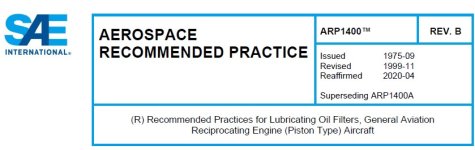
Closer to home, burst pressure (and much more) is covered by another standard, SAE ARP-1400B, specific to recip aviation oil filters (i.e. Tempest and Champion).

ScreenHunter_2610 Jan. 16 19.58.jpg

Filtration efficiency is specified:

4.5.5 Filtration Efficiency:
The filter assembly, when tested per 5.4.15, shall have a minimum time weighted average filtration ratio as follows:

"90% Cumulative Rating" >40 μm (β40 > 10)
"75% Cumulative Rating" >25 μm (β25 > 4)

Kindly note K&P/Challenger don't perform anywhere near these values.

So how is it measured?

5.4.15 Filtration Efficiency:
The filtration efficiency shall be measured during the multipass test described

in 5.4.7.

5.4.7 Contaminant Capacity:
The filter element shall be installed in a housing and test system as shown in Figure 17. The filter element contaminant holding capacity shall be determined using the multipass method for evaluating filtration performance per SAE J1858 (NOTE: This test is run with MIL-H-5606 hydraulic oil at 100 °F). The test shall be run to the terminal pressure drop at the flow rate and contaminant add rate as specified in 4.5.6 and must meet or exceed the minimum
contaminant holding capacity specified therein.


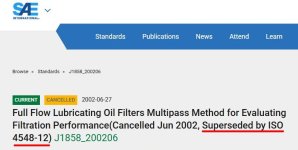
Now then, care to guess how an SAE J1858 is conducted? Here's a big 'ole hint:

ScreenHunter_2609 Jan. 16 19.52.jpg

Yes, the filtration test specified for your trusty Champion or Tempest aviation filter is ISO 4548-12.


Yes, back to reality and I agree with your statement. I've run Tempest, Wix, and Challenger units and based on the insolubles percentage and particle count analysis, I don't think filtration efficiency is a differentiator for my typical usage.

No problem here. Run what you like.
 
Last edited:
HALT = Highly Accelerated Life Test. Got it.

ISO 4548-12 doesn't do that. It's 6 gallons per minute at 100F. The 100F value merely adjusts viscosity of the test fluid to approximate 50w or multigrade at normal running temperature.

Given that the anonymous lab ran the test until hitting a specific delta P, I think it'd be comparable to a HALT test. We'll have to agree to disagree on this one.

So what are these mysterious "real world tests"?

I don't know - you tell me. Something representative of typical usage. Pouring sand into the sump isn't typical of real world usage, and I'm sure you know that, right? Put another way, find the highest quality filter per ISO 4548-12 and install it on your engine. Would you feel confident dumping the ASTM test media down the filler neck and running it for 50 (or even 25) hours? Of course you wouldn't - nobody would. If I recall correctly, even one of the paper aviation filters clogged up and went into bypass mode in that scenario, right?

ASTM F-326? Of course it has merit, and all the labs run it...to determine the pore size of a membrane filter. It does not measure retention, nor does it address effective diameters more than 15 microns.

Nor does it claim to, obviously. BTW, Ascent recommends instead SAE ARP-901B for the bubble point test. Not sure of the specifics (not gonna spend $100 bucks) but it seems at least one lab thinks it's more relevant than F-326.

Burst pressure (and much more) is covered by another standard, SAE ARP-1400B, specific to recip aviation oil filters (i.e. Tempest and Champion).

View attachment 78727

Filtration efficiency is specified:

4.5.5 Filtration Efficiency:
The filter assembly, when tested per 5.4.15, shall have a minimum time weighted average filtration ratio as follows:

"90% Cumulative Rating" >40 μm (β40 > 10)
"75% Cumulative Rating" >25 μm (β25 > 4)

Kindly note K&P/Challenger don't perform anywhere near these values.

So how is it measured?

5.4.15 Filtration Efficiency:
The filtration efficiency shall be measured during the multipass test described

in 5.4.7.

5.4.7 Contaminant Capacity:
The filter element shall be installed in a housing and test system as shown in Figure 17. The filter element contaminant holding capacity shall be determined using the multipass method for evaluating filtration performance per SAE J1858 (NOTE: This test is run with MIL-H-5606 hydraulic oil at 100 °F). The test shall be run to the terminal pressure drop at the flow rate and contaminant add rate as specified in 4.5.6 and must meet or exceed the minimum
contaminant holding capacity specified therein.


Now then, care to guess how an SAE J1858 is conducted? Here's a big 'ole hint:

View attachment 78728

Yes, the filtration test specified for your trusty Champion or Tempest aviation filter is ISO 4548-12.

That's an awfully long (albeit more detailed) way of saying what I said when I mentioned that neither ISO 4548-12 or ASTM F-326 are comprehensive. So we agree on that.

No problem here. Run what you like.
Same. Thanks for taking the time to interact on this; it's an interesting subject for sure.
 
Last edited:
I don't know - you tell me.

That's weak.

BTW, Ascent recommends instead SAE ARP-901B for the bubble point test.

Of course. It's specified in ARP- 1400B to determine the largest pore size. It does not establish filtration efficiency, retention capacity, or a pressure drop vs loading curve.

That's an awfully long (albeit more detailed) way of saying what I said when I mentioned that neither ISO 4548-12 or ASTM F-326 are comprehensive. So we agree on that.

No, we don't. Do the work.

ISO 4548-12 is merely the twelfth of fifteen parts. Be assured, 4548 is comprehensive.

ASTM F-326 has nothing to do with filtration.
 
I don't know - you tell me. Something representative of typical usage. Pouring sand into the sump isn't typical of real world usage, and I'm sure you know that, right?

I think we are losing sight of the fact that we are not trying to procure an oil filter as a device to exactly match the “real world” operating conditions of each engine. We are simply trying to clean the oil as much as practical to keep it as close to “bottle fresh” for as long as possible. After all, if we were willing to change the oil after every flight there is an argument that we need no filter or screens at all. Cleaner oil is better. Period. Dot.

The testing we are discussing shows the relative performance of the products with regards to fluid filtration capacity and efficiency. That’s it. No attempt was made to draw conclusions about how that relative effectiveness relates to engine life. That is a whole other discussion and frankly, that ship sailed decades ago when the cellulose filter was adopted by the OEM’s. So in the light of “filtration effectiveness”, the reusable products are significantly deficient compared to the cellulose products. Further, since the cellulose product is now the aviation “standard”, the reusable product can not be classified as anything but a step backwards.

Lycoming, as risk averse as it is, DOUBLED the oil change interval with the introduction of the cellulose filter element. Are we now trying to make the argument that this capability is wildly excessive to our needs? Are we really going that far to justify the use of such a demonstrably inferior performing product? The spin on cellulose filter is “too good”? Really?
 
Last edited:
1737129427295.png

I concur with one thing was discussed in Mike Busch's podcast, that mechanics never see damage done by poor filtration of small particles. That mirrors my experience.

The above is a recent photo I took of a Barrett IO-360 with 315 hours since new, with new Lycoming cylinders. Engine was 5 years old. This was not the worst cylinder, but you can see the crosshatch gone, light scoring, and glazing. I see this FAR more often than not.

Botttom line: "poor" filtration doesn't stop and has nothing to do with this occurring. Yet this is what I see in at least 90% of engines I look at. Hand wringing over filter effectiveness in the micron ranges of bacteria isn't what will get you to TBO and beyond. Flying often and mitigating corrosion will get you there.
 
View attachment 78758

I concur with one thing was discussed in Mike Busch's podcast, that mechanics never see damage done by poor filtration of small particles. That mirrors my experience.

The above is a recent photo I took of a Barrett IO-360 with 315 hours since new, with new Lycoming cylinders. Engine was 5 years old. This was not the worst cylinder, but you can see the crosshatch gone, light scoring, and glazing. I see this FAR more often than not.

Botttom line: "poor" filtration doesn't stop and has nothing to do with this occurring. Yet this is what I see in at least 90% of engines I look at. Hand wringing over filter effectiveness in the micron ranges of bacteria isn't what will get you to TBO and beyond. Flying often and mitigating corrosion will get you there.
Point taken Sir. No one should dispute this.

The thread title = FILTER TEST RESULTS
 
Reading through this thread (and Toobuilders bypass filter thread) reminded me how engineer types turn everything into a science fair project. A big part of my day job is to keep engineers from doing that haha. So I got a bit annoyed at first.

But then I remembered this is experimental aviation, it's supposed to be a science project! And I like science projects! I've just learned enough about oil, filtration, and mechanical wear to understand the application and not be interested in further discussion of it. I'm more interested in learning from DanH's experiments with drag reduction, Toobuilders cooling solutions, airguys pump gas with compression, and a ton of other stuff. Love you guys and this forum. Carry on!
 
I must say I have been very entertained at the uproar caused by Dan's idea of doing a lab test on the performance of a few oil filters. I for one am very appreciative of his taking the time and putting in the effort to do this. Many YouTube tests on auto filter comparisons but not aviation/auto comparisons.

One of the previous 400+ posts mentioned that Lycoming did not approve the Challenger on their engines but that if one was to use it they recommended reducing the oil change frequency to somewhere between 25 and 50 hrs. If cost reduction was the goal this frequency would tend to offset the filter cost savings since oil is the major cost in an oil change. If filtration is the issue then the lab results, real world or not, speak for themselves as to filter performance. If a high level of filtration is not required in the real world then forget the filter and continue using the part number screen and change the oil every 25 hrs or less. Lycoming SI 1009BE on TBO times does not have any different TBO times for engines with or without filters. I did not see filtration mentioned in any of the notes affecting TBO or the 12 yr OH limit.

Personally, I will continue using K&N HP1002 filters as recommended by Bill at Casper Labs when I installed their right angle filter adapter. He mentioned that the K&N 1002 filter was originally a certified aviation filter before being purchased by K&N and has a thick wall can and the 1" nut etc. I have used these for the past 12 years (about 26 filters so far) on 40-50 hour changes and will be using them on my overhauled IO360 in my soon to fly 8. The last thing on my mind will be the oil filter.

Back to my popcorn....🍿
 
Well I was a Tempest guy, then Challenger guy, now first auto brand on my O320 , a Napa/Wix 1068. I have a K&N 1002 on shelf for next oil change. I try not to be discouraged by one time events, unfavorable stuff happens to most any product in its lifetime.
 
Well I was a Tempest guy, then Challenger guy, now first auto brand on my O320 , a Napa/Wix 1068. I have a K&N 1002 on shelf for next oil change. I try not to be discouraged by one time events, unfavorable stuff happens to most any product in its lifetime.
I had a K&N split on a motorcycle in the blinding heat in Sudan. When I looked into it, a saw several tracks had banned them because of issues. Maybe one period of time, but not a one off. I’m using the Mobil 1 filter on my Continental. Thicker can than average and looks well made.

Dan H- thank you for fantastic testing and data. Quality work.
 
Well I was a Tempest guy, then Challenger guy, now first auto brand on my O320 , a Napa/Wix 1068. I have a K&N 1002 on shelf for next oil change. I try not to be discouraged by one time events, unfavorable stuff happens to most any product in its lifetime.
Why are you moving from the 1068 to the 1002?
 
Champion for me, definitely not interested in saving a couple of bucks on such a critical part.
And yes, thanks Dan for all your hard work on this.
 
I’d always been insistent on using the ‘Correct / Approved’ items, but ~6 years ago I gave up on PMA filters.
Not for reasons of availability or cost, but due to their anti drain-back valves being somewhat unreliable/defective.

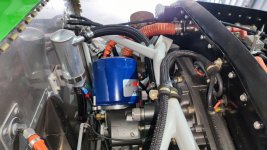
I have an ECi engine with the 90 degree mount which has the filter can pointing up.
Quite often the filters would empty out between flights, meaning a dry start next time. I only noticed it by chance once when I needed to temporarily remove the filter, after that I paid more attention to subsequent filters and noticed it was not a one-off.

In searching for comparable non aviation filters I wanted similar specs in filter surface area, pressure (400 psi min, same as oil cooler), and most importantly an effective silicone anti drain-back valve.
There are not many options with 400+ psi rating.

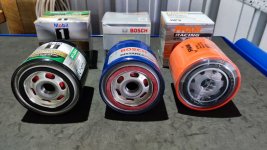
I’ve used:
- Fram Racing - HP3
- Bosch ‘Distance Plus’ - D3402, by Purolator, (now discontinued)
- Mobil1 - M1-204A (same as the Bosch Distance plus, also by Purolator)

Been using them for ~6yrs & 700hrs+, the oil filters always stay full and oil pressure is instant on startup.
I mark the filters but don't safety wire them, if it's good enough for Robinson Helicopter, its good enough for me.

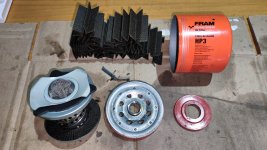
From a construction perspective the HP3 is most like an aviation filter, the can is the same thickness and it’s weight is within a few grams of the aviation ones, the Purolator manufactured filters are slightly lighter but still very robust. I’ll be trying the Purolator Boss PBL14670 at some stage when I’ve used up my current stocks.

If you have a 90 degree filter mount, tap on the filter after the engine has been sitting overnight or a couple of days & see if it sounds empty.

Of course it is possible I got the only bad batches of PMA filters ever made, but it was enough to turn me off.

Chris
 

Attachments

  • Filter1.jpg
    Filter1.jpg
    245.1 KB · Views: 80
  • Filter2.jpg
    Filter2.jpg
    245.7 KB · Views: 68
  • Filter3.jpg
    Filter3.jpg
    281.2 KB · Views: 77
  • Filter4.jpg
    Filter4.jpg
    311 KB · Views: 81
In searching for comparable non aviation filters I wanted similar specs in filter surface area, pressure (400 psi min, same as oil cooler), and most importantly an effective silicone anti drain-back valve. There are not many options with 400+ psi rating.

I’ve used:
- Fram Racing - HP3
- Bosch ‘Distance Plus’ - D3402, by Purolator, (now discontinued)
- Mobil1 - M1-204A (same as the Bosch Distance plus, also by Purolator

Side note...

Product marketing often includes the word "racing", mostly to imply superiority. Reality is sometimes different.

The feature most often promoted for racing filters is low flow resistance, with the implication that less resistance means more horsepower available. All good, but what happens when you quantify the gains vs the losses?

The Fram Racing HP-3 Chris mentions appears to be a pretty good filter. Like Chris, I like the burst rating. I only say "appears" because we have not seen a IOSO-4548-12 report, only the manufacturer's marketing materials. Fram claims 94% efficiency at 20 microns. That's very good. Reading the fine print we see it's actually an average for a whole line of filters. Ok, that's a bit sketchy, but it's still waaaaay better than a screen. Nice catch sir.

ScreenHunter_2647 Jan. 29 09.07.jpg

Jump over to the Wix line. We're familiar with the 51515 from our own 4548-12 tests, but did you know Wix also makes a 51515R, a racing version? is it better?

In my opinion, no.

A standard 51515 has a published Beta rating of 2/20=6/20, which when deciphered means it catches 50% of all particles 6 microns and larger, and 95% of all particles 20 microns and larger. Our testing says the claim is reasonably accurate. In addition, Wix gives it a nominal rating of 20 microns.

The 51515R has no published Beta rating. Its nominal rating is 61 microns.

Nominal ratings have no established basis in a universal standard. They are simply assigned by someone, maybe in engineering, maybe in marketing. It means a nominal rating is semi-useless for comparing between brands. However, within a single manufacturer's line it's probably valid. Here, based on nominal, the 51515R does not filter nearly as well as the ordinary 51515.

So, what does a user get in return? Wix publishes a deltaP chart for another racing filter with the same T-71 media, the 51222R. At the 7 GPM flow rate of an RV-sized Lycoming, the deltaP is about 1.7 psi at 180F. Our own 4548-12 data says the 51515 has a deltaP of 8.1 psi at 6 GPM and 100F. The difference in flow rate and temperature (i.e. viscosity) makes direct comparison difficult, but clearly the racing filter trades filtration for low resistance.

Note resistance to flow is not the same as flow rate. Both would deliver essentially the same quantity of oil, as they are installed behind a constant displacement pump.

So, the bottom line? Don't assume "racing" automatically means "better". It can mean "different". The difference may be desirable, or not, so do the homework. Personally I don't think the lower deltaP of a racing Wix is of any benefit to our application. We're generally not looking for the last 0.5 HP, and we run rather high system pressure anyway. We could just screw out the pressure regulator by a few lbs for the same result. On the flip side, an operator running 100W in a cold climate might be better off with the racing filter, just to buy some bypass margin on cold starts. And, if we assume the nominal 61 micron rating is accurate, it's as good or better than the screens we tested, and would have a lot more dirt capacity.

Along similar lines, don't assume "racing" means anything when comparing manufacturer's offerings. Here the racing Fram and the racing Wix don't appear to be much alike, based on what we can see in published literature...which really ain't much for either.

 
Last edited:
I’d always been insistent on using the ‘Correct / Approved’ items, but ~6 years ago I gave up on PMA filters.
Not for reasons of availability or cost, but due to their anti drain-back valves being somewhat unreliable/defective.

I have an ECi engine with the 90 degree mount which has the filter can pointing up.
Quite often the filters would empty out between flights, meaning a dry start next time. I only noticed it by chance once when I needed to temporarily remove the filter, after that I paid more attention to subsequent filters and noticed it was not a one-off.

In searching for comparable non aviation filters I wanted similar specs in filter surface area, pressure (400 psi min, same as oil cooler), and most importantly an effective silicone anti drain-back valve.
There are not many options with 400+ psi rating.

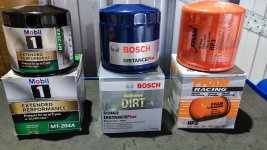
I’ve used:
- Fram Racing - HP3
- Bosch ‘Distance Plus’ - D3402, by Purolator, (now discontinued)
- Mobil1 - M1-204A (same as the Bosch Distance plus, also by Purolator)

Been using them for ~6yrs & 700hrs+, the oil filters always stay full and oil pressure is instant on startup.
I mark the filters but don't safety wire them, if it's good enough for Robinson Helicopter, its good enough for me.

From a construction perspective the HP3 is most like an aviation filter, the can is the same thickness and it’s weight is within a few grams of the aviation ones, the Purolator manufactured filters are slightly lighter but still very robust. I’ll be trying the Purolator Boss PBL14670 at some stage when I’ve used up my current stocks.

If you have a 90 degree filter mount, tap on the filter after the engine has been sitting overnight or a couple of days & see if it sounds empty.

Of course it is possible I got the only bad batches of PMA filters ever made, but it was enough to turn me off.

Chris
When I was looking at different automotive filters, I noticed Fram HP but the technician/advisor at Fram advised against using it for the daily driver type without giving any reason. I used XG16 which is synthetic but cutting it is very difficult as it has a layer of metal mesh behind the filter media. The result of using that filter has been posted a couple of pages earlier.
 
When I was looking at different automotive filters, I noticed Fram HP but the technician/advisor at Fram advised against using it for the daily driver type without giving any reason.
Found this in my link archive: https://bobistheoilguy.com/forums/t...heir-racing-filter.288891/page-2#post-4750832
Because Racing guys change oil before every race and will not pay for it. We use a blend of cellulose/synthetic glass that flows between 10gpm (HP17) to 22 gpm (HP6). Our racing filters are 94%@ 20 microns, silicone adbv, suitable for 6k OCI's on high performance street cars, 200psi constant pressure, 500 psi burst strength, Screen over high flow bypass valve all for the lowest price in racing filters.

6K filter change interval indicates a relatively low capacity of those filter.
 
When I was looking at different automotive filters, I noticed Fram HP but the technician/advisor at Fram advised against using it for the daily driver type without giving any reason. I used XG16 which is synthetic but cutting it is very difficult as it has a layer of metal mesh behind the filter media. The result of using that filter has been posted a couple of pages earlier.

I agree, the HP3 is not a filter i would be installing on my car either.

Found this in my link archive: https://bobistheoilguy.com/forums/t...heir-racing-filter.288891/page-2#post-4750832


6K filter change interval indicates a relatively low capacity of those filter.

I suspect the reason for the '6k oil change' suggestion by that poster on BITOG would probably be to still guarantee that very high flow rate with gradual build up of debris, as one gets traded off against the other. I recall reading that convesation all those years ago around the time when I made the switch.
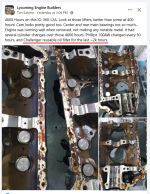
We use these filters for 50 hrs, if it were a car at ~40mph, that's only 2k miles, so well within that posters suggested limit.

From a purely unscientific visual observation, the filter media is quite a bit thicker than automotive filter media, it is also obvious that it is not as 'tight/dense' as typical automotive media. I recall when i started using the HP3 & comparing the filter media next to a Tempest with a magnifying glass, they appeared to be very similar.
(The HP3 has about 4% less surface area than the Tempest 48108-2)

Having finer oil fitration was not my objective, it was having a filter that reliably held oil between starts, with an equivalent level of filtration performance and construction strength to the PMA filters. I'm quite conservative with these types of things, I frequently fly over water, also do a fair bit of night flying & I do not like surprises.

Holding oil between starts was very important to me, as just prior to making this switch I'd had spalled cam & lifter (at only 550hrs & 5yrs) and after i rebuilt it I wanted to ensure I did everything to preserve the life of my engine i.e. No dry starts ever again.

As DanH mentioned, the HP3 would probably be a good option for aircraft using single grade W100 oil.

I use Aeroshell W 15W-50.
I have been very satisfied with all 3 filters and will continue to use them without hesitation & will be trying the Purolator Boss PBL14670 at some stage, same casing as the Mobil 1 & Bosch D+ but with synthetic media.

Purolator Boss vs Fram HP

I couldn't see if this has been linked in this thread so far, these guys have done a series of DIY filter comparisons on their test rig.
 
Last edited:
We use these filters for 50 hrs, if it were a car at ~40mph, that's only 2k miles, so well within that posters suggested limit.

I think I saw somewhere on bobistheoilguy.com that a car typically generates 1g of dirt per 1000 miles (I hope I remember it correctly). Which gives you an approximate capacity for the HP-xx filters maybe 10g? Compare it with Champion and Tempest, they are much higher. I don't think it's correct to compare car engine time with aircraft engine time, aircraft engines are much dirtier. Don't know. Something to think about.

 
I don't think it's correct to compare car engine time with aircraft engine time, aircraft engines are much dirtier.
There are some good studies of airborne dirt and its effect on motor vehicles. Although our engines accumulate lead byproducts not seen in current motor vehicles, I suspect the soot component is not much different, and the airborne silicon is typically far less. Roads are dirty, dirt roads more so, and then consider the filtration requirements for construction equipment.

That said, I have a Baldwin fiber air filter on the way right now. It may or may not fit my airbox; we'll see. I noted more grit than usual in the oil filter washout following desert operations and a few dry lake landings last spring, meaning the K&N wasn't getting the job done. Plus the fresh repaving around my hangars is shedding sand. Hmmm!
 
Last edited:
the K&N wasn't getting the job done
That I can guarantee. If you ran a test on air filters like you did for the oil filters, we'd have another long thread to keep us busy for a few years. K&N air filters are very ineffective as an air filter, but they do at least keep out small birds and most insects - that's all I really need on my aircraft. Having seen what they let through on motorcycles, I can strongly recommend not using them when you really want clean air going into the engine.
 
Hours per year?
How is this relevant to filter media?
Oil change interval?
He said 50 hrs
Typical oil temps?
Does a "better" filter affect oil temps?
Typical wear-out points for the same engine?
Oil pressure trend?
Cylinder failure points typical for same engine?
Again how are these relevant? 4600hrs is 4600hrs.
Dyno test with "Arizona" test dust showed 35 micron screens allow faster wear.
Yea, dumping sand in an engine will do that.
 
Yea, dumping sand in an engine will do that.
So the last 2000 hours is relevant? 2600 hours sets the trends and already beat any "TBO"...

The sand of concern may contain a head...

I'd ask for the same data for any claims- boat, water cooled, lawnmower, .049. Think of the "data" bandits/outlaws from Bach's "A Gift of Wings", p 124, "Found at Pharisee"... It starts with an oil change...

What sets a relevant "Eureka" vs. a one off-? Data.

A properly run and maintained lower can make 5000 hours on no filter and short oil change interval IF it never sits.
Uncommon, one does not make a ripple, but it can start a wave.

DanH, our, "Drake".
 
Last edited:
Back
Top