Van's Air Force

The definitive Van's Aircraft support community! Buying, building or flying an RV? Join our exclusive family of mentors and enthusiasts!

Electronic ignition vs magneto misinformation

RV8Squaz

Well Known Member
Ran across this podcast episode. There appears to be significant misinformation in the short segment between 5:00 -11:00. https://podcasts.apple.com/us/podca...-cool-shit/id1531900057?i=1000553714609&r=319

What do you engine gurus think? Sure would be nice to have a table that compares the various ignition systems that includes spark energy, size, and duration and compares timing maps. My understanding is that most electronic ignition systems will replicate the standard mag timing at high power settings using RPM and manifold pressure. I don’t know of any, except for possibly SDS, that use a fuel flow/mixture input. I’ll admit that I don’t know much about SDS.

What do you guys think about that podcast segment?
 
Ran across this podcast episode. There appears to be significant misinformation in the short segment between 5:00 -11:00. https://podcasts.apple.com/us/podca...-cool-shit/id1531900057?i=1000553714609&r=319

What do you engine gurus think? Sure would be nice to have a table that compares the various ignition systems that includes spark energy, size, and duration and compares timing maps. My understanding is that most electronic ignition systems will replicate the standard mag timing at high power settings using RPM and manifold pressure. I don’t know of any, except for possibly SDS, that use a fuel flow/mixture input. I’ll admit that I don’t know much about SDS.

What do you guys think about that podcast segment?
I only read enough to get the gist, but I’ll comment anyway…..

Spark energy, size and duration are, in my opinion, down the list of things to worry about. The issue is, did the plug light the fire or not? The corollary is when high and LOP, does the timing advance light the fires at or near the point of highest efficiency (the main drawback to mags as they do not advance timing). I will note that the massive aircraft plugs do not have a larger spark compared to standard auto plugs. Consider the gap setting of the two, the auto plugs are ~0.030” or so, twice that of the aviation plugs.

The overly general conclusion (and I paraphrase) is not perfect but ok for discussion:
- If you want the most power from the amount of fuel burned (as in MPG) use electronic ignition.
- If you want the most power available from the engine regardless of the amount of fuel you are dumping into it, use mags. Note - this characteristic goes away with altitude (dropping manifold pressure) and overly rich mixtures.

I run dual pMags and will never go back to mags. Understanding how they work, how to set timing, and how to operate the plane to get the most cross country MPG is, however, a requirement.

Carl
 
Discussion of ignition systems seems to “spark” a lot of debate around here. I’ve been very happy with a combination of old school mag and EI. It seems to provide good real-world redundancy. With that said, for our Zenith 801 project we’re replacing the dual mag from an H2AD with full EI.
 
Spark energy only does so much, there comes a point where a hotter spark does nothing for flame propagation and just wears out plugs faster. I fell for the "Pulsstar" plugs in high school. installed them and they wore out/failed quickly, they claimed to have a "capacitor" in the plug that stepped up voltage. Now i just run NGK or E3 plugs.
 
In the case of the podcast, the two air show performers are focused on getting the most power out of their engines and not concerned with fuel flow. I guess mags are better in this case? I wouldn’t have thunk it. Why is that? Don’t the electronic ignition systems replicate standard mag timing at high power settings? The air show performers fly their airplanes at wide open throttle and at very high RPM.
 
Starting aside, spark energy matters for conditions of aggressive leaning as that charge is harder to ignite. If that's not part of your expected operating regime, then it won't matter. There is no perfect approach or related discussions/debates wouldn't happen.
 
Leeme think about this....

I can listen to a podcast called "Cool Shit", or read reference texts from Taylor, Heywood, Schwaner, Bell, DenHartog, Wilson, et al?
I don’t listen to Fly Cool Shit for any real information. I do have a couple of those reference texts and have read those. I mainly get most of my real info from manufacturers’ manuals. I occasionally listen to FCS for entertainment value only. I know many of the guests and have some friends that appear on the podcast.

I just wanted to know what you guys thought of that 6 minute segment. That particular podcast came up in another forum and I wanted to help the person that asked a question. As y’all know, sometimes you have to filter through a bunch of b.s. to get good info. And even on FCS, there are some gems of good info.

Now back to my question. Why do you think it was mentioned that mags are better to extract the maximum power out of the engine at wide open throttle and max RPM at maximum fuel flow?

Thanks for the info regarding spark energy and size.
 
Look for the Cafe Report of the comparison of EI to magnetos. If my recollection is correct, it demonstrated that magnetos produced more power at full power than the specific EI tested.
 
Now back to my question. Why do you think it was mentioned that mags are better to extract the maximum power out of the engine at wide open throttle and max RPM at maximum fuel flow?

Broad statements like that can make someone look foolish.

The mag timing would have to be optimized for those conditions.
AFR would have a stronger influence on combustion efficiency than throttle position.
Max RPM would equate to the max spark energy from a mag.
Only looking at one point of the operational regime is a bit shortsighted.

The goal of most people on any type of broadcast forum is to increase viewership/followers/etc. One of those ways is to be provocative or at least sound that way. A statement like "the benefits between EI and traditional mags are essentially nil at XX, YY conditions" doesn't pick a side/isn't polarizing.

I have a monopoly on this truth and any moron that doesn't see that is not only an idiot but certainly headed for damnation.

Provocative enough? Happy Friday
 
Now back to my question. Why do you think it was mentioned that mags are better to extract the maximum power out of the engine at wide open throttle and max RPM at maximum fuel flow?
Lack of knowledge. Max power is a function of many variables, one of which is ignition timing. There is absolutely nothing about a mag that would allow it to make more power than EI. One exception is that it doesn't advance. In max power scenarios, std mag timing on a lyc is near optimal at full power, yet some EI, outside of user control, start advancing and this can reduce power. Correctly designed and setup EI will perform on par or better than a mag. Sadly many EI systems in GA are not well executed.

The weaker spark in a mag, while typically not a factor, can only degrade performance. It never helps. If fixed timing magnetos extracted the most performance, you would find them on race cars. That said, many hot rods still use distributors for simplicity, as EI has no real advantage in their application.
 
Last edited:
Wait, would that be Hellfire and Damnation? Or just Damnation?

Asking for a friend...
I grew up in the bible belt so my attempt was obviously sub par. My apologies.

If anyone remembers. When Hartzell's Info Manual was posted here on VAF, they made propeller application restrictions based on application of generic EI; zero mention of timing. The since deleted response from Hartzell (along with a whole lot of other posts) mentioned the increased spark energy from EI being the limiting factor thus cause for application restriction. Didn't buy it then and not buying it now. It runs contrary known issues with combustion instability and dynamics.
 
Ran across this podcast episode. There appears to be significant misinformation in the short segment between 5:00 -11:00. https://podcasts.apple.com/us/podca...-cool-shit/id1531900057?i=1000553714609&r=319

What do you engine gurus think? Sure would be nice to have a table that compares the various ignition systems that includes spark energy, size, and duration and compares timing maps. My understanding is that most electronic ignition systems will replicate the standard mag timing at high power settings using RPM and manifold pressure. I don’t know of any, except for possibly SDS, that use a fuel flow/mixture input. I’ll admit that I don’t know much about SDS.

What do you guys think about that podcast segment?
I haven't had time to listen to the podcast, but I'll give you my personal experience.

When the left, impulse-coupled Slick mag failed on my RV-4, I replaced it with Lightspeed Engineering Plasma II+. Having changed nothing but that magneto, I can give a direct comparison apples to apples.

I did not find any detectable change in max power or fuel efficiency in cruise. With two mags the airplane normally cruises 174 KTAS at 12,500 ft on 7.8 gph. With one Plasma II and one mag those numbers remained so close to the same that I can't tell any difference.

The significant difference I noted, however, is that the peak EGT when leaning for cruise is 150 deg F lower with the Plasma II than with two mags. That results from the ignition starting earlier and the fuel charge burning more completely before the exhaust valve starts to open. The second difference I noticed is easier starting behavior, never having to lean during runup to clear fouled plugs, and absolutely perfect Denso plugs at every oil change. They simply look almost brand new with a fine gray ash, no wear, no change in gap. I replace them at annual anyway, but I would be happy to install them in a car or lawn mower and run them for many more years.
 
What do you engine gurus think?

Not a guru, but I have done timing sweeps on the LyCon dyno. A Lycoming ignition sequence is not complex nor hard to accomplish. Pretty sure you could light a fat mixture with a piece of flint - maybe even two sticks rubbed together. The guys on the podcast have not offered many technical details to support their theories, but I’d bet the low power and high CHTs were due to over advanced timing.

As for best power, the engine does not know or care what the SOURCE of the spark is - only that it happens at the right time. I want max power for my Pitts. It will likely never be leaned, the throttle will be wide open 90% of the time, and it’s never going high enough to get to thin air. If magnetos offered actual performance gains I’d use them, but Im going with SDS CPI.
 
Now back to my question. Why do you think it was mentioned that mags are better to extract the maximum power out of the engine at wide open throttle and max RPM at maximum fuel flow?

It's a collection of half truths mixed with totally wrong, plus some got-it-backwards mix ups. There is no rational why.

Skip doesn't mention the particular EI, but based on reference to a timing light setup and short spark duration, it was probably a Lightspeed CDI. That raises the first problem with his generalization about mag vs EI...most EI's are inductive systems.

In general, inductive systems have a slower voltage rise rate, and are thus more prone to shunt fouling. However, spark duration is quite a lot longer than the typical CDI system, ballpark >1ms vs 0.1ms. To supply a roughly equivalent spark duration, CDI manufacturers move toward multi spark, a series of short duration discharges, one after another. I have no data specific to max HP when the test variable is continuous discharge (inductive system) vs a series of short sparks (multi-spark CDI), but I suppose a there could be a difference in the initial generation of a flame kernel based on the performance of a particular CDI brand.

Second problem is the fundamental issue of a "mag vs EI" generalization. "EI" really only refers to the method used for charging and triggering. "Magneto" only indicates how the primary current is generated. Need an example? Your traditional Slick interrupts self-generated primary current with mechanical points and a cam, but it could be done electronically with a transistor trigger and reluctor or Hall sensor. And pretty soon it will be; Champion has already announced the new system. At the far end, the MSD system for a Top Fuel car is a self-generating system with extremely capable EI controls.

There was a reference to "1000 times stronger spark". Don't recall which was stronger; doesn't matter, BS either way. Spark plug gap statements were backward. And so on.

The significant difference I noted, however, is that the peak EGT when leaning for cruise is 150 deg F lower with the Plasma II than with two mags. That results from the ignition starting earlier and the fuel charge burning more completely before the exhaust valve starts to open.

Nope. It's due to lower cylinder pressure at valve opening. Timing advance moves peak pressure closer to TDC and higher, resulting in lower pressure at valve opening. Temperature is proportional to pressure when temperature is expressed in degrees Kelvin. See the PV diagrams in the textbooks.

The second difference I noticed is easier starting behavior

Yep. Full primary voltage, even at zero RPM.
 
Last edited:
They achieved what they wanted, more viewers. The content isn’t important. Even our less than faithful news outlets now use this strategy to boost “clicks” to impress their advertisers.
If people are talking about you it doesn’t matter what you said, good or bad, right or wrong….
Unknowingly, VAF just propagated the link.
Sad….
 
Ran across this podcast episode. There appears to be significant misinformation in the short segment between 5:00 -11:00. https://podcasts.apple.com/us/podca...-cool-shit/id1531900057?i=1000553714609&r=319

What do you engine gurus think? Sure would be nice to have a table that compares the various ignition systems that includes spark energy, size, and duration and compares timing maps. My understanding is that most electronic ignition systems will replicate the standard mag timing at high power settings using RPM and manifold pressure. I don’t know of any, except for possibly SDS, that use a fuel flow/mixture input. I’ll admit that I don’t know much about SDS.

What do you guys think about that podcast segment?
Well, they lost me at the name of the program. I'm out.
 
If anyone remembers. When Hartzell's Info Manual was posted here on VAF, they made propeller application restrictions based on application of generic EI; zero mention of timing. The since deleted response from Hartzell (along with a whole lot of other posts) mentioned the increased spark energy from EI being the limiting factor thus cause for application restriction. Didn't buy it then and not buying it now. It runs contrary known issues with combustion instability and dynamics.
I have not deleted, nor requested deletion of, any of my responses. Nor is this an accurate summation of our guidance on the use of electronic ignitions and their effects on propeller compatibility.

To (try to) be clear:
  1. We are not saying EI systems are "bad" but are rather saying that
    1. The ignition system plays a role in propeller stresses
    2. EI systems are different from magnetos
    3. Different EI systems are different from each other
  2. We can postulate/argue about how much effect the different factors (timing, spark energy, spark duration, firing precision, etc.) may contribute, but the gages tell the final story. Test data (strain gages on propellers measuring loads in operation) show that:
    1. EI systems can alter the propeller loads compared to magneto ignitions for the same engine/propeller combination
    2. Different EI systems can alter the loads differently for the same engine/propeller combination
  3. Because of 2), the data from magnetos cannot be assumed to be applicable to EI systems
    1. The vasty majority of data collected so far has been with mags, so there is limited data for EI combinations
    2. Data collection is a slow process, so data for combinations with EI systems is slowly growing
  4. Because of 2(2) we only publish specific EI combinations that have been tested and found to be compatible to the same criteria used for certified aircraft
    1. All others fall under the category of "we haven't tested it, so margins are unknown"
      1. Because it's not tested, and because it has been observed to alter propeller loads, prudence requires assuming that usage could be consequential to safety and is advised as such, this is the "generic" advice
        1. This is the same as guidance for other, untested, modifications that may alter propeller loads such as altered magneto timing or increased compression ratios

The best guidance we can currently provide is in Hartzell Manual 193, Volumes 1 and 2.
 
I have not deleted, nor requested deletion of, any of my responses. Nor is this an accurate summation of our guidance on the use of electronic ignitions and their effects on propeller compatibility.

To (try to) be clear:
  1. We are not saying EI systems are "bad" but are rather saying that
    1. The ignition system plays a role in propeller stresses
    2. EI systems are different from magnetos
    3. Different EI systems are different from each other
  2. We can postulate/argue about how much effect the different factors (timing, spark energy, spark duration, firing precision, etc.) may contribute, but the gages tell the final story. Test data (strain gages on propellers measuring loads in operation) show that:
    1. EI systems can alter the propeller loads compared to magneto ignitions for the same engine/propeller combination
    2. Different EI systems can alter the loads differently for the same engine/propeller combination
  3. Because of 2), the data from magnetos cannot be assumed to be applicable to EI systems
    1. The vasty majority of data collected so far has been with mags, so there is limited data for EI combinations
    2. Data collection is a slow process, so data for combinations with EI systems is slowly growing
  4. Because of 2(2) we only publish specific EI combinations that have been tested and found to be compatible to the same criteria used for certified aircraft
    1. All others fall under the category of "we haven't tested it, so margins are unknown"
      1. Because it's not tested, and because it has been observed to alter propeller loads, prudence requires assuming that usage could be consequential to safety and is advised as such, this is the "generic" advice
        1. This is the same as guidance for other, untested, modifications that may alter propeller loads such as altered magneto timing or increased compression ratios

The best guidance we can currently provide is in Hartzell Manual 193, Volumes 1 and 2.
Standing 100% by my comments. EI was listed as the only variable. Timing was not in the original release. Spark Energy was the since deleted reasoning for the generic EI application and I called BS then. Reference your not deleted reply below. Still no mention of ignition timing. I assume the manual has been made a bit more complete since its introduction.


Does EI really have anything to do with the application? I would assume that is a "catch-all" for any timing that isn't fixed I.A.W. the engine data plate. If I'm missing something or oversimplifying, someone here will let me knmow.
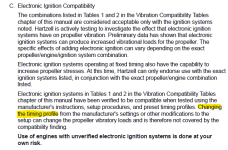
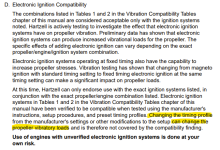
Yes, EI can matter to the application, as noted "Preliminary data has shown that electronic ignition systems can produce increased vibrational loads for the propeller" and "Electronic ignition systems operating at fixed timing also have the capability to increase propeller stresses.". The catch all here is not for things that are not fixed IAW the dataplate, it's for any configuration detail that falls outside the published details for the compatible combination; whether that's a change in ignition, compression ratio, or any of the other details discussed in Manual 193.
 
We can postulate/argue about how much effect the different factors (timing, spark energy, spark duration, firing precision, etc.) may contribute, but the gages tell the final story. Test data (strain gages on propellers measuring loads in operation) show that:
  1. EI systems can alter the propeller loads compared to magneto ignitions for the same engine/propeller combination
  2. Different EI systems can alter the loads differently for the same engine/propeller combination

Just to make sure I understand what you are saying here:

You have instrumented data that shows that there is a “difference” between magnetos and EI at the same fixed timing? In other words, a magneto firing at 25 degrees is different than an EI firing at 25 degrees?
 
Standing 100% by my comments. EI was listed as the only variable. Timing was not in the original release. Spark Energy was the since deleted reasoning for the generic EI application and I called BS then. Reference your not deleted reply below. Still no mention of ignition timing. I assume the manual has been made a bit more complete since its introduction.
We have always altered timing to be a variable of concern; it's specifically mentioned on our Type Certificates, see Note 9, and it's specifically mentioned in the warnings in the owner's manuals as well. It certainly was not my intent to imply that spark energy was the only variable that matters, I was responding to your question (though I may have misinterpreted it, and apologize if so) and I referenced other variables and the details in the Manual.

Here is the text from the original revision of 193 Vol 1, which specifically mentions altered timing:
1758915780397.png
And now the current revision of the same section:
1758916442334.png

Just to be further, extra, super clear: Timing changes can alter propeller loads regardless of ignition system type.

Just to make sure I understand what you are saying here:

You have instrumented data that shows that there is a “difference” between magnetos and EI at the same fixed timing? In other words, a magneto firing at 25 degrees is different than an EI firing at 25 degrees?
Yes.
 
Leeme think about this....

I can listen to a podcast called "Cool Shit", or read reference texts from Taylor, Heywood, Schwaner, Bell, DenHartog, Wilson, et al?
I’m about to go the SDS route and would like to dig into some reading.

Can you link or send titles of the documents you recommend?
 
Hartzell has plenty of data. It's Black Magic and they choose not to give it up. They do stand behind their products until you break them. Then it's corporate policy and lawyers v/s your bank account. They make the rules and we are on our own.
 
Last edited:
Leeme think about this....

I can listen to a podcast called "Cool Shit", or read reference texts from Taylor, Heywood, Schwaner, Bell, DenHartog, Wilson, et al?
I should not shoot from the hip but it is a fair bet they have never heard of Taylor & Heywood. They can't be a good source of data anyway, they don't have a Tik Tok page do they :)
 
I am not interested in debating, so call this a data point and you can choose to ignore this if you wish, but hundreds have not and they all report exactly what I tell them works.

All EI systems need setting up in the 2-3 degree less advance than the data plate says. If it's 20 degrees, set it to 18. EI if far quicker to respond than a magneto which has lag. The extra advance gives you higher cylinder pressures, higher CHT and more stress on all engine components besides maybe the oil filter.

Of the systems to buy, based on my experience with many friends and customers with all of them, the only choice for me is SDS. If you are not tech savvy and I mean reasonably so, please stick to the Slick mags.

I am sure Dan will concur and probably add to this, for he is far more patient than me.

And if you want to learn about this stuff, so that when Dan starts sharing information and data you actually understand it, spend the time and a few dollars and take the APS online class. And do it over and over. That is how Mike Busch got to where he is today, he did the live class three times. Not because he was dumb, he became a student of the science and data, not peoples opinions.
 
Hartzell has plenty of data. It's Black Magic and they choose not to give it up. They do stand behind their products until you break them. Then it's corporate policy and lawyers v/s your bank account. They make the rules and we are on our own.

Kinda rough, given Trevor is here trying to tell us what he can.
 
All EI systems need setting up in the 2-3 degree less advance than the data plate says.

Understandable point. And given the difference between set timing and “actual” timing (when the plug fires), would be interesting to see if instrumented data can detect a power difference between EI and mags if you wash out the mechanical monkey motion of all those gears, cams and points on a mag. That said, It’s long been known that when you are looking for a max effort 1/4 mile run or dyno pull, a brand new set of plugs will give you a touch of power for a very short time before the performance stabilizes at a normal level.
 
I’m about to go the SDS route and would like to dig into some reading.

Can you link or send titles of the documents you recommend?

If forced to pick just one wide-ranging reference work, I'd go with Internal Combustion Engine Fundamentals, John B. Heywood.

Charles Fayette Taylor's The Internal Combustion Engine in Theory and Practice is a classic with an extensive bibliography.

Contrary to common belief, there is some very good material on the web. I've long admired Jack Kane's work. His book list here.

Never purchased a book specific to electronic fuel injection. I just grew up with it in the car business.
 
Last edited:
If forced to pick just one wide-ranging reference work, I'd go with Internal Combustion Engine Fundamentals, John B. Heywood.

Charles Fayette Taylor's The Internal Combustion Engine in Theory and Practice is a classic with an extensive bibliography.

Contrary to common belief, there is some very good material on the web. I've long admired Jack Kane's work. His book list here.

Never purchased a book specific to electronic fuel injection. I just grew up with it in the car business.
And they are gluten free!
 
Well, they lost me at the name of the program. I'm out.
My question had nothing to do with the title of the podcast.

While the show does have a lot of banter, b.s., and jocularity, the guests are often famous air show performers, aerobatic competitors, equipment manufacturers, and sometimes pilots just beginning to delve into aerobatics.
 
Last edited:
I should not shoot from the hip but it is a fair bet they have never heard of Taylor & Heywood. They can't be a good source of data anyway, they don't have a Tik Tok page do they :)
You should not, especially not having listened to the podcast.
 
@DanH

Can you explain what you mean by inductive vs CDI? I looked a bit on the net, and could not figure out what you are referencing.

Thanks,

Tim
 
Understandable point. And given the difference between set timing and “actual” timing (when the plug fires), would be interesting to see if instrumented data can detect a power difference between EI and mags if you wash out the mechanical monkey motion of all those gears, cams and points on a mag. That said, It’s long been known that when you are looking for a max effort 1/4 mile run or dyno pull, a brand new set of plugs will give you a touch of power for a very short time before the performance stabilizes at a normal level.

I have previously read some guidance by Hartzell; they never mentioned power. They specifically stated stress; and highly implied but not stated was vibration and pulse changes. But this is far enough outside my wheel house (IT), that take it with a very large grain of salt.

Tim
 
@DanH

Can you explain what you mean by inductive vs CDI? I looked a bit on the net, and could not figure out what you are referencing.

Thanks,

Tim
A stardard ignition coil is inductive. Use a power source to charge a smaller winding, creating a magnetic field. When you disconnect the power source, the magnetic field collapses and is absorbed by and transferred from the larger winding. The delta in wire length in the windings (essentially a transformer) determines the output voltage, usually at least 1000:1. With CDI (capacitive discharge ign), the power input charges a capacitor and then use electronics to divert that charge to the output at the appropriate time. Unsure how they step up the voltage, but likely a transformer before the cap. Dan partially explained the unique characteristics of these different styles. Will let him eloborate.
 
Last edited:
Can you explain what you mean by inductive vs CDI?

Larry has most of it right.

Ok, practical view, no equations or specifically defined terms.

Recall we can induce a current in a wire by moving the wire through a stationary magnetic field, or by moving a magnetic field along a stationary wire. We can also do it by building a magnetic field around a wire coil, then collapsing the field. The collapse is essentially the same as moving the field relative to the wire. The rate at which the field moves in relation to the wire, or the rate at which the field is built or collapsed, is a major factor in the magnitude of the induction.

Inductive ignition systems build and collapse a magnetic field around a laminated iron core wrapped with two coils of wire, primary and secondary. The primary winding is supplied at main bus voltage. When the primary current is interrupted, the rapid collapse of the magnetic field induces a current in both coils. The collapse is faster than the rate at which it was built, so the product is greater. The classic turns ratio is 100:1, so (for example) if the collapse induces 200V in the primary, the voltage in the secondary, connected to the spark plug, can rise as high as 20,000.

Capacitive Discharge Ignition uses a small transformer (another use of inductance) to boost bus voltage to some higher level (often given as 400V), which is then used to charge a capacitor. When ignition is desired, the capacitor is discharged as a burst into another transformer, which again steps up the voltage in proportion to a turns ratio. Here the key is the speed at which the discharging capacitor builds a magnetic field in the second transformer, rather than the speed at which it is collapsed...but as before, the moving field induces a current in the secondary winding connected to the spark plug.

As a practical matter, inductive ignition stores energy in the magnetic field, while CDI stores it in a capacitor.

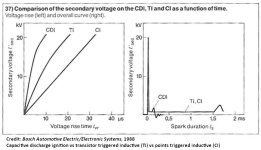
Voltage is a measure of electrical potential, which here we can think of a rapidly rising pressure. That pressure builds at the plug electrode until reaching a level high enough to ionize the molecules in the gap and create a conductive path, after which the voltage drops rapidly as electrons flood across. The rate at which the pressure builds prior to breakdown, and the total available energy, characterize the differences between inductive coil and CDI delivery.

Here's a classic illustration. CDI has a very rapid rise time, but a very short discharge time. Electronically trigged indictive coil ignition has a slower rise time, but the discharge (current flow across the plug gap) lasts about 10x longer. This particular text was published in 1988, so it also included rise time for a points trigger. The rise time is slower yet, because the points can't interrupt the primary current quite as sharply as a transistor...there is some small arcing across the points when they are opening.
Inductive vs CDI Rise & Duration.jpg

As previously noted, a CDI can be configured to rapidly and repeatedly charge and discharge the capacitor, the result being multi spark...a string of sparks, one after another. It's a rough equivalent to the longer duration of an inductive coil's output.

A spark plug electrode tends to build conductive deposits. As the voltage rises at the electrode, some of the electrons try to escape along those alternative conductive pathways. The rapid rise time of a CDI means less energy escapes through those shunts. When compared to early points-triggered ignitions, CDI was far more resistant to plug fouling. The more rapid rise time of transistor triggered ignitions negated some of that advantage, which is why we don't see so many new CDIs today.

 
Last edited:
@DanH

Thanks. And from what I recall from the APS class years ago, running ROP until you are super ROP, there is minimal need for a strong spark. When you go super rich, or go LOP you need a "hotter/stronger" spark to ensure complete ignition. The stronger spark when running LOP for max efficiency, not max power, is why electronic ignition systems "might" perform better (this ignores the whole timing discussion). Back then, the statement was something along the lines of EI systems often have higher voltages and longer sparks than mags. Again, there were a lot of variables in play so it was hard to make generalizations.

Tim
 
Thanks. And from what I recall from the APS class years ago, running ROP until you are super ROP, there is minimal need for a strong spark. When you go super rich, or go LOP you need a "hotter/stronger" spark to ensure complete ignition. The stronger spark when running LOP for max efficiency, not max power, is why electronic ignition systems "might" perform better (this ignores the whole timing discussion).

Understanding is helped by quantifying terms like hotter and stronger, if possible. Sometimes it's best to simply dismiss them as advertising puffery.

Hotter: During the breakdown phase, temperature within the ionized gas column can reach as high as 60,000 Kelvin, with 20,000 being common for almost any spark. The arc and glow phases can be 5000K and 3000K respectively, in the same ballpark as the surface of the sun. How much hotter do you want?

Regarding mixture vs energy required, only about 0.2 mJ is needed for a mixture near stoichiometric, but near the rich and lean limits the energy required may be an order of magnitude greater, i.e. 2. So yes, LOP operation requires more spark energy. However, Slick mags, Bendix mags, and all the EI's can deliver far more at running RPM, the ballpark range being 10 to 30 mJ.

Want a good example? In our Lycoming world, one of the lowest output ignitions in current use is a P-mag. In response to competitor claims, Brad made the case that his system was designed for what is really needed, not what sounded good, and he was obviously right. Know anyone complaining about misfire when running LOP with P-mags?
 
Understandable point. And given the difference between set timing and “actual” timing (when the plug fires), would be interesting to see if instrumented data can detect a power difference between EI and mags if you wash out the mechanical monkey motion of all those gears, cams and points on a mag. That said, It’s long been known that when you are looking for a max effort 1/4 mile run or dyno pull, a brand new set of plugs will give you a touch of power for a very short time before the performance stabilizes at a normal level.
Not on our engines loafing along at 2500RPM.
 
David, do you have a link to this class? I found some training with the label APS but not sure it's the same you are referring to. Thanks!

Sure do. And no, I do not benefit from this link.

 
Understanding is helped by quantifying terms like hotter and stronger, if possible. Sometimes it's best to simply dismiss them as advertising puffery.

Hotter: During the breakdown phase, temperature within the ionized gas column can reach as high as 60,000 Kelvin, with 20,000 being common for almost any spark. The arc and glow phases can be 5000K and 3000K respectively, in the same ballpark as the surface of the sun. How much hotter do you want?

Regarding mixture vs energy required, only about 0.2 mJ is needed for a mixture near stoichiometric, but near the rich and lean limits the energy required may be an order of magnitude greater, i.e. 2. So yes, LOP operation requires more spark energy. However, Slick mags, Bendix mags, and all the EI's can deliver far more at running RPM, the ballpark range being 10 to 30 mJ.

Want a good example? In our Lycoming world, one of the lowest output ignitions in current use is a P-mag. In response to competitor claims, Brad made the case that his system was designed for what is really needed, not what sounded good, and he was obviously right. Know anyone complaining about misfire when running LOP with P-mags?

And this is why a high power (60% or more) in flight mag check done LOP is more diagnostic on the system than any other combination.
 
Back
Top