Can you explain what you mean by inductive vs CDI?
Larry has most of it right.
Ok, practical view, no equations or specifically defined terms.
Recall we can induce a current in a wire by moving the wire through a stationary magnetic field, or by moving a magnetic field along a stationary wire. We can also do it by building a magnetic field around a wire coil, then collapsing the field. The collapse is essentially the same as moving the field relative to the wire. The
rate at which the field moves in relation to the wire, or the rate at which the field is built or collapsed, is a major factor in the magnitude of the induction.
Inductive ignition systems build and collapse a magnetic field around a laminated iron core wrapped with two coils of wire, primary and secondary. The primary winding is supplied at main bus voltage. When the primary current is interrupted, the rapid collapse of the magnetic field induces a current in both coils. The collapse is faster than the rate at which it was built, so the product is greater. The classic turns ratio is 100:1, so (for example) if the collapse induces 200V in the primary, the voltage in the secondary, connected to the spark plug, can rise as high as 20,000.
Capacitive Discharge Ignition uses a small transformer (another use of inductance) to boost bus voltage to some higher level (often given as 400V), which is then used to charge a capacitor. When ignition is desired, the capacitor is discharged as a burst into another transformer, which again steps up the voltage in proportion to a turns ratio. Here the key is the speed at which the discharging capacitor builds a magnetic field in the second transformer, rather than the speed at which it is collapsed...but as before, the moving field induces a current in the secondary winding connected to the spark plug.
As a practical matter, inductive ignition stores energy in the magnetic field, while CDI stores it in a capacitor.
Voltage is a measure of electrical potential, which here we can think of a rapidly rising pressure. That pressure builds at the plug electrode until reaching a level high enough to ionize the molecules in the gap and create a conductive path, after which the voltage drops rapidly as electrons flood across. The rate at which the pressure builds prior to breakdown, and the total available energy, characterize the differences between inductive coil and CDI delivery.
Here's a classic illustration. CDI has a very rapid rise time, but a very short discharge time. Electronically trigged indictive coil ignition has a slower rise time, but the discharge (current flow across the plug gap) lasts about 10x longer. This particular text was published in 1988, so it also included rise time for a points trigger. The rise time is slower yet, because the points can't interrupt the primary current quite as sharply as a transistor...there is some small arcing across the points when they are opening.
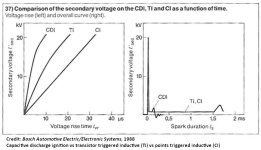
As previously noted, a CDI can be configured to rapidly and repeatedly charge and discharge the capacitor, the result being multi spark...a string of sparks, one after another. It's a rough equivalent to the longer duration of an inductive coil's output.
A spark plug electrode tends to build conductive deposits. As the voltage rises at the electrode, some of the electrons try to escape along those alternative conductive pathways. The rapid rise time of a CDI means less energy escapes through those shunts. When compared to early points-triggered ignitions, CDI was far more resistant to plug fouling. The more rapid rise time of transistor triggered ignitions negated some of that advantage, which is why we don't see so many new CDIs today.