Van's Air Force

The definitive Van's Aircraft support community! Buying, building or flying an RV? Join our exclusive family of mentors and enthusiasts!

Dynon AoA utility?

Ivan,

That's exactly the right approach to take. And you ask a great question: yes a 60% lift condition is "on speed" in any airplane. Here's the aero and math...this is actually explained in the fractional lift discussion in the paper linked in the previous post:

Fractional Lift. We tend to think of alpha in degrees, but there is another way measure it as well. This is called fractional or “percent” lift. There is an AOA at which the wing produces no lift. Engineers call this the “zero lift line.” A cambered airfoil achieves zero lift at a negative alpha, whereas a symmetrical airfoil is at zero lift when AOA is zero. Just prior to the stall and loss of longitudinal stability, the wing is generating 100% lift. This simple “0-1” scale is another way to think about how hard the wing is working. It’s also another way to display AOA to the pilot. The easiest way to think of this is how much work the wing must do “right now” depending on how hard the pilot is pulling on the stick or yoke relative to the maximum amount of lift the wing can produce. For example, in a 60-degree banked turn, 2 g’s are required, and your 1500-pound airplane requires 3000 pounds of lift to maintain altitude. If you encounter a 1 g gust load in that turn, the wing now needs to generate 4500 pounds of lift. We’ve learned that AOA always follows g, and stall speed varies with a change in weight, whether that change is the result of fuel burn (gross weight) or g load (maneuvering).

Like angle of attack, fractional lift is directly proportional to effective weight (gross weight times g-load). All airplanes reach maximum lift at some critical AOA, usually about 15-20 degrees for the typical straight winged, piston engine GA airplane. At critical AOA, the wing is generating 100% lift. All airplanes approach at 60% lift and all straight wing airplanes achieve L/Dmax at 50% lift. The fractional lift associated with maneuvering speed at 1 g is determined by dividing 100 by the g limit of the airplane. Thus, a normal category airplane is at maneuvering speed when fractional lift is 26% (100/3.8 = 26). This means that if fractional lift is greater than 26%, the airplane is below maneuvering speed and will stall before reaching the structural limit and no restrictions on the use of flight controls exist. This value is 23% for a utility category and 17% for an aerobatic category airplane. If fractional lift exceeds these values, then the airplane will stall before reaching the structural limit of the airplane, and flight control use is not restricted.
1728307732913.png
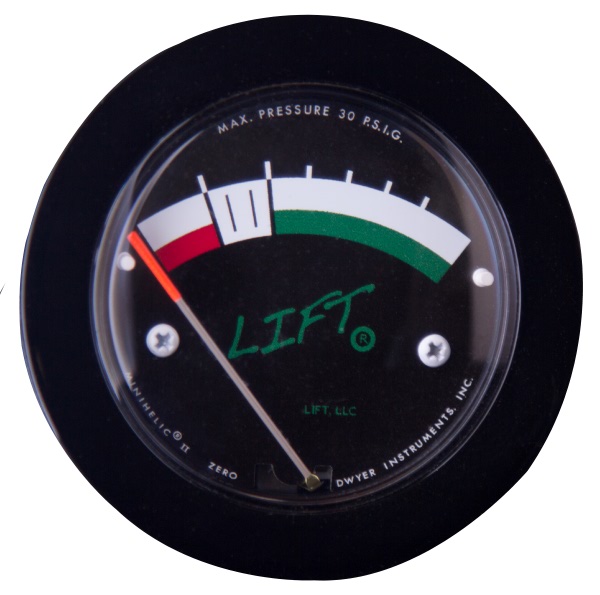
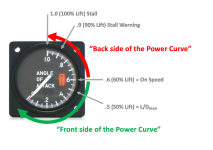
Figure 1. Classic mechanical fractional Lift AOA Instrument. Notice that 60% lift (ONSPEED) is at the right three o’ clock position. This was an early military standard. It correlates with a properly scaled airspeed indicator where Vref is at roughly the same position.​

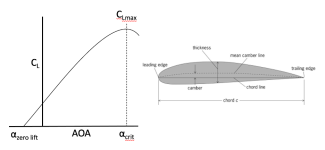
Figure 2 is a generic coefficient of lift (CL) vs AOA plot for a cambered airfoil. The CL is a dimensionless number that quantifies the amount of lift an airfoil produces relative the fluid (air) dynamic forces acting on it. In other words, how much lift the wing can generate as a function of speed, angle of attack, density and wing area. The higher the CL, the more lift the wing produces and the harder it is “working.” A cambered airfoil means that the mean camber line is curved, and zero lift occurs at a negative AOA. This is shown on the right side of the figure. Most GA airfoils are cambered. We can use the CL vs alpha plot to illustrate why an ONSPEED condition occurs at 60% lift. To do that, we need to do some simple proportional math to figure out how hard the wing is currently working vs it’s maximum capacity and figure out our approach condition relative to stall:

1728307837024.png

1728307870335.png

Figure 2. A generic CL vs alpha plot and a cambered airfoil. Most GA airfoils are cambered, and a zero-lift condition occurs at a negative angle of attack.​

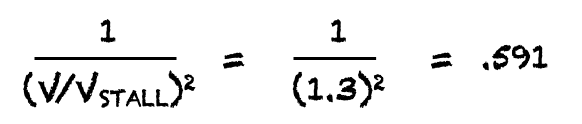
To look at the ratio of lift we use for approach, we need to work backwards from our normal Vref = 1.3 Vs to make sure that we accommodate change in weight and g load. Vref is a kinetic condition, and we are simply using AOA to control our airspeed. In 1 g flight, Vref is sufficient as a reference for approach, but if we maneuver at Vref, actual stall margin is reduced. Since we know that airspeed for critical angle of attack varies with the square root of the g load, we’ll just calculate the reciprocal of our approach speed ratio squared:
1728307913893.png


Our display combines fractional lift information and trend information with a conventional “doughnut/chevron” military-style alpha indexer. This is shown in Figure 3. Note that at an L/Dmax condition the trend indicator (white line) is aligned with the pips and fractional lift is 50%.
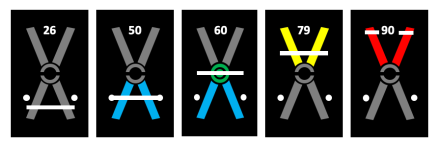
1728308027131.png

Figure 3. Fractional lift and visual indexer display for key performance conditions. Left to right: maneuvering speed for a Normal Category Airplane (3.8 g limit), L/DMAX, ONSPEED, “slow condition,” stall warning.
We use this display because it's what yours truly grew up with with some additions. Not necessarily better or more ergonomic than any other visual means to display AOA, but I do find the fractional lift and trend info to be very useful.

Fly safe,

Vac
 
For those of you who have a Dynon Skyview HDX, have you found a way to make the angle of attack (AoA) feature useful? I'm thinking of something like the recent video by Paul Dye of KITPLANES showing how to use AoA as a primary reference during approach instead of airspeed.

All mine seems good for is being a sophisticated stall warning horn.

Any experiences to share?

thanks

Ivan
It would be so easy for Dynon to adopt the OnSpeed indicators (both tone and visually) as an option.
Visually you need a symbol with a separate color for maneuvering speed at 60% lift.
Audio solid tone at maneuvering speed (Onspeed).
 
Lately I’m prioritizing keeping it at 70kts or above until I’m straight in for landing. I’m a believer in DEFINED minimum maneuvering speed
I've tried to fly an approach at 70 until on final but found that it's hard to bleed off speed and altitude (I have a fixed pitch prop). I'd have to slip or make the pattern wider than I'm used to. I'm now slowing down to roughly Vx on base (as in the Vac's transition training doc) or even slightly slower (low 60s). Does this reduce the safety margin too much?

the DMMS formula posted elsewhere (1.404 x Vs1) feels too fast on base for an RV9. With the AOA on speed audible tone, if we can manage to get it working right with Dynon, I hope that it's safe to slow down to slightly above the on speed condition even on base. I could be totally wrong though - lots to learn here.
 
When I was getting mandatory insurance transition training in my RV8 the CFI had me over the fence at 75knots. Afterwards I flew my plane for about an hour alone and by the 2nd hour had it down to 65MPH and I never felt worried. Used up half of the runway instead of the entire runway like during the training.
 
the DMMS formula posted elsewhere (1.404 x Vs1) feels too fast on base for an RV9. With the AOA on speed audible tone, if we can manage to get it working right with Dynon, I hope that it's safe to slow down to slightly above the on speed condition even on base. I could be totally wrong though - lots to learn here.
Lots of variables and options, to be sure. I can see where it might be too fast with a FP prop, as the 9 is surprisingly slick compared to the certified bug smashers most of us trained in. One thing I’ve done lately is to consciously expand the size of my pattern a bit, so that I have more time to be deliberate, nail each speed, and get stable.
 
You’ve mixed the speed units. 65 MPH or 65 Kts?

And two-up versus one-up makes a difference in the minimum approach speed.
For the tests that I've done, my base is above 75kts, and final approach speed for two up was above 70 kts at 1320 rpm.

For one person, my final approach speed was between 65 kts to 70 kts at around 1200 rpm. I am not sure what the over the fence speed was but I started to retard the throttle when going past the fence. Anything slower the wings started to get sluggish.

My touch down point was usually about 650ft past the number. Usually I get a beep or two just before touch down and then a constant beep. With a 3-point attitude landing, I could turn off at the 1300 foot taxiway with brakes. With light braking, I could turn off the taxiway at 1700ft at my home airport. In other airport that has a clearer path instead of the tree obstruction at the end, I could turn off a bit closer

When doing wheel landing, I usually exit the runway at 1700 ft with decent headwind with light braking. With calm wind, I could roll off the runway at 2300 ft with light braking.
 
You’ve mixed the speed units. 65 MPH or 65 Kts?

And two-up versus one-up makes a difference in the minimum approach speed.
Nope, I was spot on. They wanted me to be over the fence at 75 KTS but after flying it I was able to always bring it in at 65 MPH. I went back to review my videos and yep 65 MPH. I also didn't fly my plane hanging from the prop either. I hate doing shallow approaches like I see on YT where one little hickup and they won't make the runway. My approaches are full power off once I'm stabilized on the final approach.
 
It would so much easier to compare notes if we could just figure out what % of the critical AOA we are flying at various points of the approach.

May be the AOA should be a simple numeric dial similar to the airspeed indicator (or the speed tape on the PFD), as opposed to a color coded shevrons and bars.
 
It would so much easier to compare notes if we could just figure out what % of the critical AOA we are flying at various points of the approach.

May be the AOA should be a simple numeric dial similar to the airspeed indicator (or the speed tape on the PFD), as opposed to a color coded shevrons and bars.
Ask and you shall receive. :cool: Like this one?

 
ve0kog,

That's the glory of AOA, you don't fly different AOA's at different parts of the pattern, all you're really doing is slowing down to on speed for approach. There is an on speed AOA for each flap setting. In the transition training manual, there is a pretty detailed description of overhead and rectangular traffic patterns, so I won't go into that here. In the diagrams, I include AOA references (just L/Dmax [50% lift] and on speed [60% lift]).

I prefer a simple pattern that gets me to landing configuration abeam the touchdown, on speed. After that, all I do is concentrate on flying the airplane. In a perfect world, I've sized the pattern for winds and don't have to touch the throttle from the time I pull it to idle "rolling off the perch" (starting the base turn). The base turn is a single, 180-degree turn flown to final. This makes controlling ground track easy, stabilizes g and AOA throughout the turn (i.e., no "square corners"). I like a final long enough to assess wind prior to transition to landing. This is all purely technique, and allows me to transition from a cruise condition on upwind (initial) to landing in about 2 minutes, always having sufficient energy to make the runway if I don't screw up. I use pitch to control AOA (based on feedback from the tone), power to adjust glide slope (I don't have too many perfect patterns and generally have to either add power or slip a bit) and use bank to control ground track. How to be a good neighbor and peacefully exist with traffic flying a rectangular traffic pattern is all discussed in the manual, as are the techniques I'm using to fly closed and adjust pattern size for winds. How to fly a "conventional" pattern at different configurations using a rectangular ground track is also discussed. Oh, and Vfe is a dynamic (airspeed) limit, but flaps up L/Dmax AOA (80 KIAS at 1500 lbs in my RV-4 vs 92 KIAS for flaps 40 Vfe [96 KIAS flaps 20 Vfe]) is close enough that when the tone starts, I know it's safe to deploy flaps. Or I just look at the airspeed indicator. There is also a "trust but verify" routine you do when you fly AOA: you cross-check against a known 1 g airspeed appropriate for gross weight to get a warm fuzzy AOA is working correctly. In jets, we have a specific routine for computing this reference, but in the mighty RV-4 I've just got a couple of references, one for solo and one for trunk occupied:


At 1:58, I demonstrate a "slow" condition in the base turn. Note that after the initial pitch correction to on speed, there is a secondary slow condition. Without AOA, this would not be readily apparent in the cockpit as I've got a normal pitch picture. If you look carefully at the mechanical airspeed indicator, you can see the speed and AOA "catching up" with the attitude and power setting. The airplane is vulnerable to a gust upset during this transition.

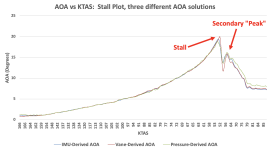
Let's look at the aerodynamics of why this occurs. The easiest way to visualize this is to plot a stall in terms of AOA. Look at your Dynon data in post 37. Notice that after the stall, there is a sharp drop and subsequent steep climb to a secondary peak before things drop off. You'll see this "artifact" any time you plot a stall using AOA, regardless of how it's measured. Here's another example using a vane, pressure-derived AOA and IMU (inertial)-derived AOA:

Screenshot 2024-10-09 at 9.11.48 AM.png

The important takeaway is that secondary peak is always there, no matter how fast you reduce AOA after a low g (say less than 2) stall. Things are a bit different at high g, but most of us aren't pulling 4+ g's in the traffic pattern. The air molecules simply can't react as fast as the flight controls move and the airplane rotates in pitch, it takes a bit for flow to stabilize. It's this secondary effect you see in the video at the 1:58 point and is why during stall recovery you have to be judicious with your pitch input to avoid a secondary stall. This effect has brought lots of good aviators to grief, unfortunately; but note the AOA is yelling during this condition. IAS is low, but stable and not nearly as attention grabbing, and you can't see the AOA looking out the window. The only way to know how hard the wing is working is to measure AOA. OK, that horse is officially dead; so let's talk airspeed a bit...

The first consideration is that the only airspeed we can compare in discussion is calibrated airspeed, adjusted for gross weight. IAS is airplane specific in the EAB world. Not so in the certified airplane world, and I understand that's where most of us grow up, so it's logical that we carry that assumption with us; but it's simply not valid. As Van likes to point out, in the EAB world, we're all experimental test pilots, whether we've been to school for that or not. So any "I use X airspeed for y condition" sounds good at the bar, but doesn't work in the real world unless it's a calibrated airspeed for an identical airplane, rigged identically at at the same gross weight.

Now let's consider a concept that we can call "effective weight" or how hard the wing has to work right now. That's simply a function of actual gross weight and g load. The way this relates to stall speed is straight-forward, but requires math in public. The indicated stall speed increases with the square root of the g-load. An easy way to picture this is a 60 degree bank, which requires 2 g's if we want the airplane to turn. The square root of 2 is about 1.4, so the indicated airspeed associated with stall increases by 40%. There is a way to apply the concept in the pattern by building some maneuvering constraints. Not nearly as easy as just flying an AOA, and not quite as efficient for landing, but doable. Most of us have been doing it our entire flying career.

As we've learned, approach is a kinetic condition. It's the right blend of maneuverability, stall margin and power required associated with a speed commensurate with landing. It would be super easy to fly the pattern at 100 indicated, lots of maneuverability, plenty of stall margin and plenty of power, but it would be a bear to try to get the wheels to stick to the ground, and taxiing would be a challenge. We also know that the wheels stick to ground when the wing quits working, which happens when it stalls; but we can't safely fly base and final at stall speed. So we can look at certification standards to figure out a way to be safe and still get the wheels to stick to the ground when we need them to. That concept is what we call Vref. If we compute it correctly, and limit maneuvering to known parameters, we can build some margin in. We can further improve that if we have some sort of stall warning installed and it's calibrated correctly (there's that calibration thing, again). Remember a stall warning system (say that little vane or slot on the leading edge of the wing) is an angle of attack system--it just has a really small operating range: about 5 knots or 1.4 g's if it's calibrated in accordance with FAR 23 criteria. But let's say we install a vane, and calibrate it (or install it IAW instructions and then flight test performance), now we've got a "poor man's" AOA technique we can apply.

A long time ago in the newsletter days, there was some discussion of using 1.4 Vs in the "classic wing" RV's as a starting point for Vref. This was a consideration given to the relatively low aspect ratio and has some merit in discussion; but let's keep it simple and simply define Vref as 1.3 Vs for the current flap setting (remember IAS associated with stall will change with flap setting, since the critical AOA changes with flap setting). We also can figure out a g-load associated with a bank angle. Let's pick 30 degrees, and we'll set that as our maneuvering limit. To figure that out, grab a scientific calculator (or just turn you phone sideways with the calculator app pulled up). Find the cosine of 30, and then just compute the reciprocal (i.e., divide 1 by the cosine of 30). The answer is about 1.2 g's. Unfortunately, there is no requirement for stall warning in an EAB, but if you have it, AND it gives you at least 5 knots of warning, you've got about a 0.2-0.3 g buffer in a 30-degree bank. That's imperceptible from a seat-of-the pants perspective, but the technique we can apply is "fly Vref and honor the stall warning." Any "horn" requires a reduction in AOA (and remember the secondary peak!), and you may even see an IAS above Vref. It's all good though, because IAS associated with a specific maneuvering condition will always change with g load. The reason we have "gust additives" for airspeed is to accommodate gust loads, any gust can give us a nearly instantaneous increase in g-load; and we know that AOA always follows g, so even if we are dutifully maintaining a computed airspeed with a specific margin, Mother Nature can erase that margin faster than we can react with the flight controls. But, of course, if we keep adding margin, eventually we run into problems sticking the wheels to the ground, so eventually we have to slow down. We do this at a height we don't mind falling from, but eat up runway in the process.

Flying AOA is just easier. It's different and our pilot culture is built using speed approximations when we really mean AOA. No matter where you come down on the airspeed/AOA argument, you can't beat AOA for progressive stall warning. And, ultimately airspeed and AOA are joined at the hip, and it's not really an argument at all. What we do know, is that in the past 50 years, we haven't made any progress with changing the way we do business in GA/EAB, we are still losing pilots at the same rate due to loss-of-control. AOA and the way we think about flying changed in the military, and we reduced mishaps. Airplanes are airplanes, and pilots are pilots. Just because we currently lack performance and display standards doesn't mean we can't get there. One concept that translates easily is an "on speed" condition.

Fly safe,

Vac
 
Last edited:
doing more digging into the dynon data files. the BLACKBOX file is the most useful (up to 16 samples per second) Found out that AOA tone comes on at 60% which corresponds to 50 ias at a given gross weight and full flaps. This is probably too slow for on-speed.

Once in the ground effect the IAS seem to drop by 5 to 10kts for the same AOA (since the air molecules are getting more crowded under the wings). I think it explains why I never hear the AOA until late in the flare.

Session Time GPS Date & Time Description ias aoa AOA Tone Value
8421 5633.12 2024-10-12 21:35:02 AOA_02_16 49.8 61 2
8422 5633.62 2024-10-12 21:35:03 AOA_02_16 49.5 61 2
8423 5634.12 2024-10-12 21:35:03 AOA_01_16 48.0 60 1
8426 5639.62 2024-10-12 21:35:09 AOA_02_16 43.0 62 2
8428 5640.12 2024-10-12 21:35:09 AOA_05_16 42.6 65 5
8430 5640.62 2024-10-12 21:35:10 AOA_02_16 42.3 62 2
8432 5641.12 2024-10-12 21:35:10 AOA_05_16 41.6 65 5
8434 5641.50 2024-10-12 21:35:11 AOA_05_16 41.2 66 5
8435 5641.62 2024-10-12 21:35:11 AOA_06_16 41.2 67 6
8437 5642.12 2024-10-12 21:35:11 AOA_02_16 41.0 61 2
8440 5643.12 2024-10-12 21:35:12 AOA_01_16 40.0 61 1
8442 5643.62 2024-10-12 21:35:13 AOA_05_16 39.4 65 5
8444 5644.12 2024-10-12 21:35:13 AOA_05_16 39.6 66 5
8445 5644.62 2024-10-12 21:35:14 AOA_02_16 39.1 62 2
8448 5645.62 2024-10-12 21:35:15 AOA_03_16 38.3 63 3
8450 5646.12 2024-10-12 21:35:15 AOA_02_16 37.7 62 2
8452 5646.62 2024-10-12 21:35:16 AOA_05_16 37.2 65 5
8454 5647.12 2024-10-12 21:35:16 AOA_01_16 37.1 60 1
8456 5647.62 2024-10-12 21:35:17 AOA_09_16 37.2 71 9
8458 5648.12 2024-10-12 21:35:17 AOA_01_16 36.2 61 1
8460 5648.56 2024-10-12 21:35:18 AOA_01_16 36.3 54 1
 
Last edited:
Shucks Buck.....

You Boys are over thinking this !

We have AoA in our 7, done it on an 8A, 4 12's and just today in a 10.

I am half way through the fly off schedule of a new RV10, we did the 2 hour endurance flight today at 8,500' - slightly pointless, but has to be done.

Came down, watched the BFR launch, land and re entry and then went back up to calibrate the AoA.

Noticed things had changed - followed the instructions, did the initial calibration of the pitot in the hangar etc and then flew.

Simple - did several stalls in various flap settings and saved. Then played with it !!!

Spot on - peeped, got the tone as it went red. threw it around in turns, configs etc - just spot on.

First approach, got a few beeps in the flare, stopped on touchdown.

Dynon - you have it correct ;)
 
First approach, got a few beeps in the flare, stopped on touchdown.

Dynon - you have it correct ;)
Based on your post, wouldn't you getting a few beeps on flare mean you're landing a lot faster than needed? I don't have a Dynon and OnSpeed sounds different at that stage, that's why I ask.
 
Based on your post, wouldn't you getting a few beeps on flare mean you're landing a lot faster than needed? I don't have a Dynon and OnSpeed sounds different at that stage, that's why I ask.

Not as I see it - down approach in the green, decreasing as you cross the threshold - you are up the ladder, the green has gone, you are in the amber in the flare, peeps start...... hold off, touchdown. Peeps stop.
 
First approach, got a few beeps in the flare, stopped on touchdown.
this is a long thread but we are trying to configure dynon to emulate Vac’s on speed indication and alert. hearing the tone just in the flare is a stall warning and that part works fine. the AOA logic can be more effective - ie a slow beep for the entire approach that would indicate a safe speed margin without flying too fast.
 
Not as I see it - down approach in the green, decreasing as you cross the threshold - you are up the ladder, the green has gone, you are in the amber in the flare, peeps start...... hold off, touchdown. Peeps stop.
So no sound when it's in the green? Disregard, I don't know how the Dynon displays AOA so to me it just sounds like it's acting like a stall warning and not a lift indicator
 
this is a long thread but we are trying to configure dynon to emulate Vac’s on speed indication and alert. hearing the tone just in the flare is a stall warning and that part works fine. the AOA logic can be more effective - ie a slow beep for the entire approach that would indicate a safe speed margin without flying too fast.

Having flown with Dynon AoA on several aeroplanes. I think they have it about right. It is a protection and warning system that in my eyes alerts you to an impending issue with AoA and hence an approaching stall.

The AoA ladder on Skyview, or indeed on our legacy D100 is within your scan and is easily monitored. The audio is an alert to the inevitable SSCBD event :eek:
 
Having flown with Dynon AoA on several aeroplanes. I think they have it about right. It is a protection and warning system that in my eyes alerts you to an impending issue with AoA and hence an approaching stall.

The AoA ladder on Skyview, or indeed on our legacy D100 is within your scan and is easily monitored. The audio is an alert to the inevitable SSCBD event :eek:
I guess that makes sense for those who just want to use it as a stall warning and not for VX, VY, best glide speed, etc. Just by tones, without having to look at anything like the OnSpeed system does.

It's still definitely better than the Cessna suction vane horn sound that I'm sure has saved pilots millions of times.
 
Last edited:
Having flown with Dynon AoA on several aeroplanes. I think they have it about right. It is a protection and warning system that in my eyes alerts you to an impending issue with AoA and hence an approaching stall.

The AoA ladder on Skyview, or indeed on our legacy D100 is within your scan and is easily monitored. The audio is an alert to the inevitable SSCBD event :eek:
But if you pull the stick in a 60 deg bank are you going to hear a tone?
 
So no sound when it's in the green? Disregard, I don't know how the Dynon displays AOA so to me it just sounds like it's acting like a stall warning and not a lift indicator
This information has been discussed a few times in this thread. By default the Dynon AOA beeps are a bit more glorified than the analog stall vane buzzer. It will beep deep in the yellow chevron region, but at the speed very close to the calibrated stall speed. You get a few knots of margin at the flair due to the proximity to the ground.
 
But if you pull the stick in a 60 deg bank are you going to hear a tone?
It depends it you pull to get an accelerated stall. It you do something like a lazy 8 where the wing will naturally rolls then no beep. Also, the speed where the slow speed will activate is not consistent, it can vary by 3-4 knots. It I fly at idle power, the the trigger speed is more consistent but when descending approach with 1200-1300 rpm range with my fixed pitch propeller, then the trigger speed will vary more. Don’t know why, just reporting what I observed in my testing
 
Having flown with Dynon AoA on several aeroplanes. I think they have it about right. It is a protection and warning system that in my eyes alerts you to an impending issue with AoA and hence an approaching stall.

The AoA ladder on Skyview, or indeed on our legacy D100 is within your scan and is easily monitored. The audio is an alert to the inevitable SSCBD event :eek:
Yes this is how I use it. If I hear a slow beep then it means I am behind the power curve and the nose should start to drop now
 
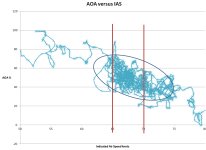
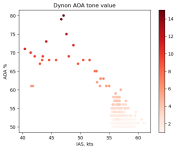
I had a chance look at the BLACK_BOX data from my latest flight. I plotted the IAS to the AOA % at the landing phase. IAS is in the x-axis. AOA % is in the Y axis. During the final approach, I would try to keep my speed above 65 knots, closer to 65 when I am solo or closer to 70 when I have a passenger. Over the fence, or about 50ft AGL, I would be less than 65 kts.

The AOA data was from the calibration where the stall speed was deliberated set at 60 kts with zero flap.

I notice the small band of AOA% around these two IAS values. I also mentioned in the previous post that the beeps were not consistent. This plot shows the vertical spread of the AOA at around at any IAS you pick.

1728866640470.png
 
I made the video of my landing using the flight analysis tool Flysto.net. There are three RVs in the video. One RV7 and two RV8s. You can see three of us were in the pattern at the same time, even though we took off from Apple Valley airport a few minutes apart and took slightly different routes to arrive at Corona Airport.

With regard to the AOA beep, I got one slow beep in the final approach. The stall beep didn't sound until I was over the runway.

Here is the link to the playback video. The AOA plot in the previous post was extracted from the same landing.

 
Last edited:
This plot shows the vertical spread of the AOA at around at any IAS you pick
I think this shows why the classic GA square pattern is not as safe and is NOT stable approach - the relatively sharp base and final turns result in a big jump of the AOA when we pull back on the stick in the turn to maintain rate of descent and the airspeed. We need to fly faster to account for the increase of AOA during transitions to base and final.

my understanding is that a shallow continious turn from the downwind to final is how the military does it to keep the AOA and airspeed constant.
 
Don't forget - this is an AoA system, and not a speed referenced system. A wing will stall at most speeds from minimum to over 100kts if the critical AoA is reached. If you unload in a lazy 8, it will always drop to in the green, because you are not loading the aeroplane.
 
I think this shows why the classic GA square pattern is not as safe and is NOT stable approach - the relatively sharp base and final turns result in a big jump of the AOA when we pull back on the stick in the turn to maintain rate of descent and the airspeed. We need to fly faster to account for the increase of AOA during transitions to base and final.

my understanding is that a shallow continious turn from the downwind to final is how the military does it to keep the AOA and airspeed constant.
Yeah, I try to make my pattern turns as shallow and constant as much as possible. At my home field, most of my landings would be almost like power off 180.
The spread of AOA is one of the reasons I fly by the reference speed because there isn't a readily available progressive AOA system, except for OnSpeed or other 3rd party systems that are not Dynon, and they will require more work and more time to install, which I don't have much at this time. In the video above, my pattern is larger than normal because I wanted separation from the landing RV7. My normal pattern would look like the RV7. The only slow beep I got was during the final even when I was right in the middle of 1.3Vs0 and Vs0. I would expect a slow tone at this time but didn't get it.
 
Nope, I was spot on. They wanted me to be over the fence at 75 KTS but after flying it I was able to always bring it in at 65 MPH. I went back to review my videos and yep 65 MPH. I also didn't fly my plane hanging from the prop either. I hate doing shallow approaches like I see on YT where one little hickup and they won't make the runway. My approaches are full power off once I'm stabilized on the final approach.
Vans brochure lists RV7 stall speed at 51mph (44.5 KTS). They say solo weight ? 1600 lbs?
I am sure this is no flaps. I can't find Vans spec for flaps.

I just calibrated my On Speed system again. My RV-7A clean stall speed at 1550 lbs is 53 mph (46KTS).
All flap positions are 49 mph (42.5 KTS)

Onspeed no flaps 1.3x 46KTS =60 KTS. Flaps 1.3 x 42.5=55KTS.
Onspeed has the sold tone and Green doughnut at these speeds.

I was taught to fly 70-80 and around 70 over the numbers by a non owner instructor.
I am still too chicken to fly Onspeed base to final at around 55 KTS.
I still fly about 70 in the pattern then slowing on finial 60 KTS by the time I am over the numbers.
 
Vans brochure lists RV7 stall speed at 51mph (44.5 KTS). They say solo weight ? 1600 lbs?
I am sure this is no flaps. I can't find Vans spec for flaps.

I just calibrated my On Speed system again. My RV-7A clean stall speed at 1550 lbs is 53 mph (46KTS).
All flap positions are 49 mph (42.5 KTS)

Onspeed no flaps 1.3x 46KTS =60 KTS. Flaps 1.3 x 42.5=55KTS.
Onspeed has the sold tone and Green doughnut at these speeds.

I was taught to fly 70-80 and around 70 over the numbers by a non owner instructor.
I am still too chicken to fly Onspeed base to final at around 55 KTS.
I still fly about 70 in the pattern then slowing on finial 60 KTS by the time I am over the numbers.
I understand the trust issue, but you trust your other instruments, why not trust OnSpeed? As soon as you trust OnSpeed you'll see how short your roll out really is.

Here's what I recommend to pilots who like to speed down the approach instead of flying at the correct approach speed then end up floating down the entire runway: Go fly patterns 1000' above your regular pattern altitude and think of the runway 1000' above the real MSL. Do that and keep flying the pattern slower each time until you get comfortable and your trust increases, then go for the real approach to land.

In your case do this first in calm winds then do it again in gusty winds and you'll be loving Onspeed. This coming from a guy who is trusting OnSpeed and I haven't been able to even calibrate it correctly for this plane. Every time I sell a plane I keep my little red box (OnSpeed box) and install it in my next plane. I was going to calibrate it correctly this weekend but this is what I had to deal with so I couldn't. Hopefully when I get back next week.
 

Attachments

  • IMG_5506.PNG
    IMG_5506.PNG
    475.2 KB · Views: 24
I understand the trust issue, but you trust your other instruments, why not trust OnSpeed? As soon as you trust OnSpeed you'll see how short your roll out really is.

Here's what I recommend to pilots who like to speed down the approach instead of flying at the correct approach speed then end up floating down the entire runway: Go fly patterns 1000' above your regular pattern altitude and think of the runway 1000' above the real MSL. Do that and keep flying the pattern slower each time until you get comfortable and your trust increases, then go for the real approach to land.

In your case do this first in calm winds then do it again in gusty winds and you'll be loving Onspeed. This coming from a guy who is trusting OnSpeed and I haven't been able to even calibrate it correctly for this plane. Every time I sell a plane I keep my little red box (OnSpeed box) and install it in my next plane. I was going to calibrate it correctly this weekend but this is what I had to deal with so I couldn't. Hopefully when I get back next week.
It is the rule of primacy. Misconceptions are hard to overcome. I had been thinking 70-80 knots on the approach is the standard.

If I was taught fly the downwind to finial at 65 knots and final at 60 it would be easier to adapt.

I will teach myself that I can trust maneuvering at Onspeed around 55 knots with the flaps down at a higher altitude than the pattern.
I did not trust my calibrations for a long time.

Now I get R values at .99 or better( This is a calibration correlation stat for non Onspeed users ) and the calibrations look vary consistant.
 
I was able to tune my AOA to start slow beep at full flaps and 55-57 KIAS which I believe is 1-2kts faster than onspeed (1.3 Vso). In a turn it may start chirping as early as 60 KIAS. I tested in a "simulated landing" 1000 above the CPA and in the actual pattern

I had to push the stick very gently forward in the shallow turns in order to maintain onspeed. If I tried to bank while pulling back to maintain altitude, the feedback from the AOA tone was nearly instant!

My AOA is set to start at 50% and full solid tone at 83%. I'm pretty happy with the result

1729478245816.png
 
Max makes a salient observation: most of us fly too fast when trying to land using airspeed. It does take a while to gain enough confidence in an AOA system to trust it, but once you do, you'll find yourself more consistently arriving over the TDZ with just the right amount of energy to land, vs carrying an extra five knots for "mom," etc.

ve0kog, that's awesome work, and exactly the way to apply the tone!

This has been a great discussion overall, and to circle back to Ivan's original post, the big takeaway is the difference between an AOA system that is designed to provide progressive stall warning with multiple user-selected audio cues and variable calibration results and a system that has only one tone pattern and automated calibration that produces consistent, standardized results from airplane to airplane. The old McDonnell-Douglas logic adopted to straight-winged airplanes also provides cues that allow the pilot to optimize performance using AOA independent of current gross weight (or g load)—all the while knowing what stall margin is, no matter how much or aggressively the airplane is maneuvered or how bumpy the air is. It greatly simplifies the esoteric topic of energy management and allows any pilot to benefit from over a half century of military experience and lessons learned. It also improves landing consistency, and improves your ability to stick the wheels exactly where you want them. That's why its roots are in carrier aviation.

It's impressive to watch everyone try to get the most out of the system, especially considering the ubiquity of a basic AOA available with any EFIS, assuming the airplane is equipped with a suitable pitot/AOA sensor--and some even use IMU-derived alpha, which requires no sensor at all. Hopefully the cost of the two-port sensor and some ¼” OD nylon tubing doesn’t prevent builders from using the capability, regardless of manufacturer. The various issues highlighted are simply indicative of the shortcomings of some of the commercially available AOA solutions and why we started our R&D work in the first place. The full potential of AOA won’t be realized until all of us have access to accurate, standard cues and are taught how to apply them. I’m confident that as more and more pilots come to appreciate knowing how hard the wing is working relative to stall and other key performance parameters, we’ll coalesce around a standard that's as intuitive as reading an airspeed indicator. In the meantime, AOA is the best stall, and hence LOC, avoidance tool available, regardless of how it’s “mechanized.” Nothing at all wrong with a "sophisticated stall warning horn" as a first step, and even better if you can get it dialed in like ve0kog. This is what experimental aviation is all about :)

It's a pleasure to be part of this community. Fly safe,

Vac
 
Last edited:
Back
Top