Ivan,
That's exactly the right approach to take. And you ask a great question: yes a 60% lift condition is "on speed" in any airplane. Here's the aero and math...this is actually explained in the fractional lift discussion in the paper linked in the previous post:
Fractional Lift. We tend to think of alpha in degrees, but there is another way measure it as well. This is called fractional or “percent” lift. There is an AOA at which the wing produces no lift. Engineers call this the “zero lift line.” A cambered airfoil achieves zero lift at a negative alpha, whereas a symmetrical airfoil is at zero lift when AOA is zero. Just prior to the stall and loss of longitudinal stability, the wing is generating 100% lift. This simple “0-1” scale is another way to think about how hard the wing is working. It’s also another way to display AOA to the pilot. The easiest way to think of this is how much work the wing must do “right now” depending on how hard the pilot is pulling on the stick or yoke relative to the maximum amount of lift the wing can produce. For example, in a 60-degree banked turn, 2 g’s are required, and your 1500-pound airplane requires 3000 pounds of lift to maintain altitude. If you encounter a 1 g gust load in that turn, the wing now needs to generate 4500 pounds of lift. We’ve learned that AOA always follows g, and stall speed varies with a change in weight, whether that change is the result of fuel burn (gross weight) or g load (maneuvering).
Like angle of attack, fractional lift is directly proportional to effective weight (gross weight times g-load). All airplanes reach maximum lift at some critical AOA, usually about 15-20 degrees for the typical straight winged, piston engine GA airplane. At critical AOA, the wing is generating 100% lift. All airplanes approach at 60% lift and all straight wing airplanes achieve L/Dmax at 50% lift. The fractional lift associated with maneuvering speed at 1 g is determined by dividing 100 by the g limit of the airplane. Thus, a normal category airplane is at maneuvering speed when fractional lift is 26% (100/3.8 = 26). This means that if fractional lift is greater than 26%, the airplane is below maneuvering speed and will stall before reaching the structural limit and no restrictions on the use of flight controls exist. This value is 23% for a utility category and 17% for an aerobatic category airplane. If fractional lift exceeds these values, then the airplane will stall before reaching the structural limit of the airplane, and flight control use is not restricted.
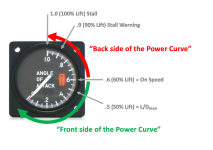
Figure 2 is a generic coefficient of lift (CL) vs AOA plot for a cambered airfoil. The CL is a dimensionless number that quantifies the amount of lift an airfoil produces relative the fluid (air) dynamic forces acting on it. In other words, how much lift the wing can generate as a function of speed, angle of attack, density and wing area. The higher the CL, the more lift the wing produces and the harder it is “working.” A cambered airfoil means that the mean camber line is curved, and zero lift occurs at a negative AOA. This is shown on the right side of the figure. Most GA airfoils are cambered. We can use the CL vs alpha plot to illustrate why an ONSPEED condition occurs at 60% lift. To do that, we need to do some simple proportional math to figure out how hard the wing is currently working vs it’s maximum capacity and figure out our approach condition relative to stall:

To look at the ratio of lift we use for approach, we need to work backwards from our normal Vref = 1.3 Vs to make sure that we accommodate change in weight and g load. Vref is a kinetic condition, and we are simply using AOA to control our airspeed. In 1 g flight, Vref is sufficient as a reference for approach, but if we maneuver at Vref, actual stall margin is reduced. Since we know that airspeed for critical angle of attack varies with the square root of the g load, we’ll just calculate the reciprocal of our approach speed ratio squared:
Our display combines fractional lift information and trend information with a conventional “doughnut/chevron” military-style alpha indexer. This is shown in Figure 3. Note that at an L/Dmax condition the trend indicator (white line) is aligned with the pips and fractional lift is 50%.
Fly safe,
Vac
That's exactly the right approach to take. And you ask a great question: yes a 60% lift condition is "on speed" in any airplane. Here's the aero and math...this is actually explained in the fractional lift discussion in the paper linked in the previous post:
Fractional Lift. We tend to think of alpha in degrees, but there is another way measure it as well. This is called fractional or “percent” lift. There is an AOA at which the wing produces no lift. Engineers call this the “zero lift line.” A cambered airfoil achieves zero lift at a negative alpha, whereas a symmetrical airfoil is at zero lift when AOA is zero. Just prior to the stall and loss of longitudinal stability, the wing is generating 100% lift. This simple “0-1” scale is another way to think about how hard the wing is working. It’s also another way to display AOA to the pilot. The easiest way to think of this is how much work the wing must do “right now” depending on how hard the pilot is pulling on the stick or yoke relative to the maximum amount of lift the wing can produce. For example, in a 60-degree banked turn, 2 g’s are required, and your 1500-pound airplane requires 3000 pounds of lift to maintain altitude. If you encounter a 1 g gust load in that turn, the wing now needs to generate 4500 pounds of lift. We’ve learned that AOA always follows g, and stall speed varies with a change in weight, whether that change is the result of fuel burn (gross weight) or g load (maneuvering).
Like angle of attack, fractional lift is directly proportional to effective weight (gross weight times g-load). All airplanes reach maximum lift at some critical AOA, usually about 15-20 degrees for the typical straight winged, piston engine GA airplane. At critical AOA, the wing is generating 100% lift. All airplanes approach at 60% lift and all straight wing airplanes achieve L/Dmax at 50% lift. The fractional lift associated with maneuvering speed at 1 g is determined by dividing 100 by the g limit of the airplane. Thus, a normal category airplane is at maneuvering speed when fractional lift is 26% (100/3.8 = 26). This means that if fractional lift is greater than 26%, the airplane is below maneuvering speed and will stall before reaching the structural limit and no restrictions on the use of flight controls exist. This value is 23% for a utility category and 17% for an aerobatic category airplane. If fractional lift exceeds these values, then the airplane will stall before reaching the structural limit of the airplane, and flight control use is not restricted.
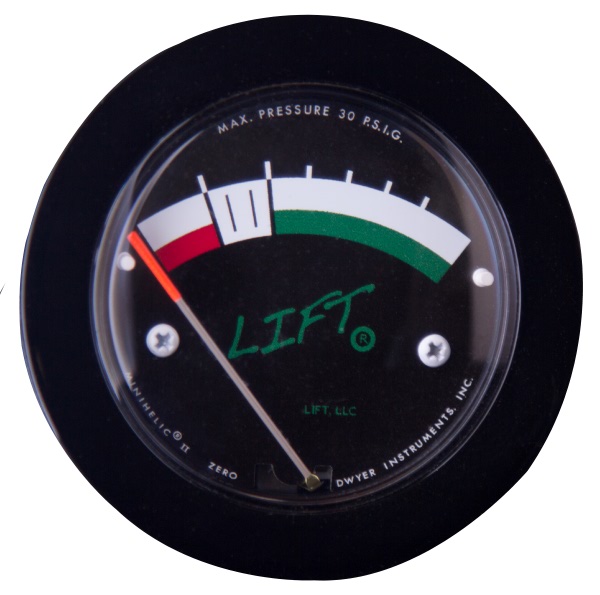
Figure 1. Classic mechanical fractional Lift AOA Instrument. Notice that 60% lift (ONSPEED) is at the right three o’ clock position. This was an early military standard. It correlates with a properly scaled airspeed indicator where Vref is at roughly the same position.
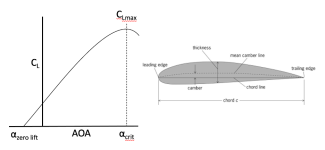
Figure 2 is a generic coefficient of lift (CL) vs AOA plot for a cambered airfoil. The CL is a dimensionless number that quantifies the amount of lift an airfoil produces relative the fluid (air) dynamic forces acting on it. In other words, how much lift the wing can generate as a function of speed, angle of attack, density and wing area. The higher the CL, the more lift the wing produces and the harder it is “working.” A cambered airfoil means that the mean camber line is curved, and zero lift occurs at a negative AOA. This is shown on the right side of the figure. Most GA airfoils are cambered. We can use the CL vs alpha plot to illustrate why an ONSPEED condition occurs at 60% lift. To do that, we need to do some simple proportional math to figure out how hard the wing is currently working vs it’s maximum capacity and figure out our approach condition relative to stall:
Figure 2. A generic CL vs alpha plot and a cambered airfoil. Most GA airfoils are cambered, and a zero-lift condition occurs at a negative angle of attack.
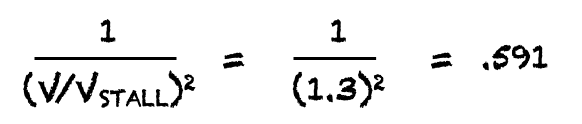
To look at the ratio of lift we use for approach, we need to work backwards from our normal Vref = 1.3 Vs to make sure that we accommodate change in weight and g load. Vref is a kinetic condition, and we are simply using AOA to control our airspeed. In 1 g flight, Vref is sufficient as a reference for approach, but if we maneuver at Vref, actual stall margin is reduced. Since we know that airspeed for critical angle of attack varies with the square root of the g load, we’ll just calculate the reciprocal of our approach speed ratio squared:
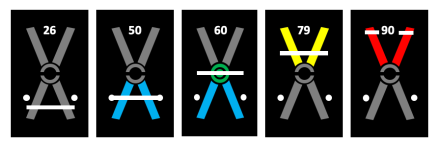
Our display combines fractional lift information and trend information with a conventional “doughnut/chevron” military-style alpha indexer. This is shown in Figure 3. Note that at an L/Dmax condition the trend indicator (white line) is aligned with the pips and fractional lift is 50%.
Figure 3. Fractional lift and visual indexer display for key performance conditions. Left to right: maneuvering speed for a Normal Category Airplane (3.8 g limit), L/DMAX, ONSPEED, “slow condition,” stall warning.
We use this display because it's what yours truly grew up with with some additions. Not necessarily better or more ergonomic than any other visual means to display AOA, but I do find the fractional lift and trend info to be very useful.
Fly safe,
Vac


 Like this one?