Van's Air Force

The definitive Van's Aircraft support community! Buying, building or flying an RV? Join our exclusive family of mentors and enthusiasts!

Ducts Matter

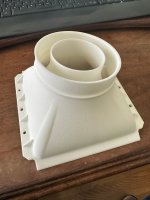
Since I originally started this thread 5 years ago, I thought I'd go see how much these parts would cost today. My favorite 3d printing broker today is craftcloud.com and their offer (from a vendor in Texas), is for $207 shipped. That's about 50% cheaper than 5 years ago! I just had Johnson Prototyping make some plastic parts for my Sling A/C project last week and they are very nice, so I can recommend them.

This is for SLS nylon-12, which materials property-wise is about equivalent to the HP-MJF process, and is what you should be using for an "underhood" application like this which will get hot. I'd stay away from FDM or other hobby printers for an end-use product here.

View attachment 103641
I was just looking at craftcloud last night. Which vendor in TX were you considering? I want to buy from a US based company
 
Since I have a printer (Bambu Lab P2S), I'm also considering printing the parts myself using their PPA-CF filament. Any thoughts about PPA-CF?
 
Since I have a printer (Bambu Lab P2S), I'm also considering printing the parts myself using their PPA-CF filament. Any thoughts about PPA-CF?
Mark, I don't have any recent experience with FDM printers, so I can't say yea or nay. That material sounds good, but the problem with FDM is strength in the Z axis due to how the part is made in the machine.

It's probably not a safety-of-flight deal if the part broke, so why not try it on your Bambu? If you do have a concern, you could always apply one layer of thin fiberglass to the outside of the part to hold it together... but that mostly defeats the convenience of printed parts. Could also carry a roll of aluminum duct tape in your toolbag to do field repairs.
 
Mark, I don't have any recent experience with FDM printers, so I can't say yea or nay. That material sounds good, but the problem with FDM is strength in the Z axis due to how the part is made in the machine.

It's probably not a safety-of-flight deal if the part broke, so why not try it on your Bambu? If you do have a concern, you could always apply one layer of thin fiberglass to the outside of the part to hold it together... but that mostly defeats the convenience of printed parts. Could also carry a roll of aluminum duct tape in your toolbag to do field repairs.
Got it, thanks!
 
Mark, I don't have any recent experience with FDM printers, so I can't say yea or nay. That material sounds good, but the problem with FDM is strength in the Z axis due to how the part is made in the machine.
That's a commonly stated issue with FDM, however it really needs to be kept in perspective with the filament. The described material, PPA-CF, has a X-Y axis tensile strength of about 168 MPa and Z axis tensile strength of about 57 MPa; you multiply MPa by 145 to achieve pounds-force, meaning if the part is printed and annealed properly, the strength will well exceed the application need.

I've used a version of PPA-CF for several parts, including my intake ducts, which is about as strong as fiberglass in the Z axis and stronger than fiberglass in the X-Y direction. My own tensile strength testing using a standard specimen resulted in me not being able to break the part with my test rig. It's well strong enough to route air at temps far exceeding FWF temps, unless of course you're on fire - in which I case I'd actually prefer less incoming air.

FDM printers can make parts with safety and strength in mind, just need to be mindful of the filament and printing orientation with regard to the stresses that will be applied in service.
 
That's a commonly stated issue with FDM, however it really needs to be kept in perspective with the filament. The described material, PPA-CF, has a X-Y axis tensile strength of about 168 MPa and Z axis tensile strength of about 57 MPa; you multiply MPa by 145 to achieve pounds-force, meaning if the part is printed and annealed properly, the strength will well exceed the application need.

I've used a version of PPA-CF for several parts, including my intake ducts, which is about as strong as fiberglass in the Z axis and stronger than fiberglass in the X-Y direction. My own tensile strength testing using a standard specimen resulted in me not being able to break the part with my test rig. It's well strong enough to route air at temps far exceeding FWF temps, unless of course you're on fire - in which I case I'd actually prefer less incoming air.

FDM printers can make parts with safety and strength in mind, just need to be mindful of the filament and printing orientation with regard to the stresses that will be applied in service.
Yes, and I am still educating myself in re these important factors. I have some paht-cf on my Christmas list and plan to print some things that won't be exposed to the engine heat as much. Intake scoops, etc. Much learning to be done!
 
I’m all for creative solutions like this. Just reinforce it so it doesn’t cause a problem. There was a general aviation crash recently (I think fatal) from a DIY 3d printer project. The air intake was soft plastic, got hot and then collapsed on itself causing engine failure.
 
@hgerhardt It's been said that Imitation is the sincerest form of flattery --- See this [Airflow Systems Bearhawk Duct]

You should get some remuneration for this...
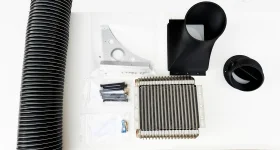
Quite the astute observation, Brian; I've been collaborating with Bill Genevro for a few years now. He handed off to me the Sling A/C gig. Anyway, he saw my OC duct when he was at my hangar one day and asked if he could use that idea for his own line of oil coolers. I said sure and gave him the STEP files. He had a 21-yr-old working for him at the time who was learning CAD and that was the result.

Which reminds me of how this all started: Jose (@Radioflyer) posted here that he was wanting an RV-6 ride. I offered one and apparently my A/C system impressed him more than the airplane. He wrote a post here, which @Dustyone (Ashley) saw and forwarded to Bill at Airflow Systems. Bill called me and the rest is history. So, a guy from Boston gets a ride in Torrance, CA and posts about, which a guy in Australia sees and forwards to Bill in Costa Mesa (30 mi south of Torrance).

 
I’m all for creative solutions like this. Just reinforce it so it doesn’t cause a problem. There was a general aviation crash recently (I think fatal) from a DIY 3d printer project. The air intake was soft plastic, got hot and then collapsed on itself causing engine failure.
And that's why I keep preaching to use SLS or MJF process with PA12 material in an underhood application which gets hot.
 
Quite the astute observation, Brian; I've been collaborating with Bill Genevro for a few years now. He handed off to me the Sling A/C gig. Anyway, he saw my OC duct when he was at my hangar one day and asked if he could use that idea for his own line of oil coolers. I said sure and gave him the STEP files. He had a 21-yr-old working for him at the time who was learning CAD and that was the result.

Which reminds me of how this all started: Jose (@Radioflyer) posted here that he was wanting an RV-6 ride. I offered one and apparently my A/C system impressed him more than the airplane. He wrote a post here, which @Dustyone (Ashley) saw and forwarded to Bill at Airflow Systems. Bill called me and the rest is history. So, a guy from Boston gets a ride in Torrance, CA and posts about, which a guy in Australia sees and forwards to Bill in Costa Mesa (30 mi south of Torrance).

So, about that Crypto-currency you've been working on.... ;)
 
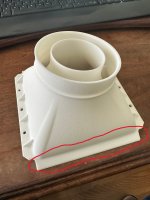
Can't remember if I said this before, but the angled strip (red) is to have weatherstrip tape applied to seal against the end tanks. 1/4" thick or so.

View attachment 104858
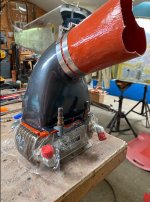
Another way to get a good custom fitted duct to cooler seal. Saran Wrap covers the cooler and a thick bead of red RTV. Trim off the squeeze out after it cures.

Don Broussard
RV9 Rebuild in Progress
57 Pacer
 

Attachments

  • IMG_1245.jpeg
    IMG_1245.jpeg
    769.7 KB · Views: 90
...

Which reminds me of how this all started: Jose (@Radioflyer) posted here that he was wanting an RV-6 ride. I offered one and apparently my A/C system impressed him more than the airplane. He wrote a post here, which @Dustyone (Ashley) saw and forwarded to Bill at Airflow Systems. Bill called me and the rest is history. So, a guy from Boston gets a ride in Torrance, CA and posts about, which a guy in Australia sees and forwards to Bill in Costa Mesa (30 mi south of Torrance).

Actually, I was impressed by other particulars of the plane as well, but they weren't as novel as the AC system.
 
Back
Top