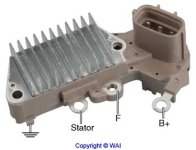
Supposedly this Denso 126000-0600 regulator has over voltage protection. If so, perhaps one could start there and look for the 55-60A alternators that it fits, and see if one is airworthy?
If you have one of these in hand, how would you test it and it's over voltage protection without having it on an alternator? Benched as it were....?
One candidate is the "12V 55A Alternator 19630-64013", 55A, uses this regulator.
Careful here -- the 126000-0600 seems to have a few different configurations, one of them being Self Exciting (one wire).
If you want to "test" the OV capability - just disconnect the battery from the alternator while it's running; I've demonstrated that the ripple current will jump from 20 - 30mV to >2Vac, which will sum to over 16.4Vdc...should trigger any OV sense/protection.
Rambling thoughts -- apologies in advance:
Aside from the normal behavior of "A-circuit" internal regulators using over- and under-voltage conditions to regulate the current flow through the rotor windings, I doubt there's any other kind of OV protection, despite marketing claims.
This traces back to the original concern with these Internal Regulated alternators: The device that controls the "A" side of the rotor field current to ground, be it a Transistor or N-FET, could fail or be caused to fail "closed" resulting in full field (100%) voltage. If the field supply is "tapped" from the alternator's output (B+) and not an external, current limited (5A CB IG/Sense - seen on Plane Power, some modded ND's), then the OV condition would continue unabated until the ANL melted or 60-80A CB on the B+ wire opened.
So, it's inelegant, crude, the 1800's called and they want it back, but the Crowbar Circuit + externally controlled field supply, is the only reliable Overvoltage protection available in an IR alternator...




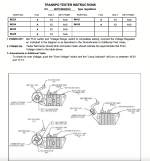
 See picture: