Van's Air Force

The definitive Van's Aircraft support community! Buying, building or flying an RV? Join our exclusive family of mentors and enthusiasts!

Denso Alternator Regulator 126000-0600 Testing

JDA_BTR

Well Known Member
Patron
Supposedly this Denso 126000-0600 regulator has over voltage protection. If so, perhaps one could start there and look for the 55-60A alternators that it fits, and see if one is airworthy?

If you have one of these in hand, how would you test it and it's over voltage protection without having it on an alternator? Benched as it were....?
 
Supposedly this Denso 126000-0600 regulator has over voltage protection. If so, perhaps one could start there and look for the 55-60A alternators that it fits, and see if one is airworthy?

If you have one of these in hand, how would you test it and it's over voltage protection without having it on an alternator? Benched as it were....?
One candidate is the "12V 55A Alternator 19630-64013", 55A, uses this regulator.

Careful here -- the 126000-0600 seems to have a few different configurations, one of them being Self Exciting (one wire).

If you want to "test" the OV capability - just disconnect the battery from the alternator while it's running; I've demonstrated that the ripple current will jump from 20 - 30mV to >2Vac, which will sum to over 16.4Vdc...should trigger any OV sense/protection.

Rambling thoughts -- apologies in advance:

Aside from the normal behavior of "A-circuit" internal regulators using over- and under-voltage conditions to regulate the current flow through the rotor windings, I doubt there's any other kind of OV protection, despite marketing claims.

This traces back to the original concern with these Internal Regulated alternators: The device that controls the "A" side of the rotor field current to ground, be it a Transistor or N-FET, could fail or be caused to fail "closed" resulting in full field (100%) voltage. If the field supply is "tapped" from the alternator's output (B+) and not an external, current limited (5A CB IG/Sense - seen on Plane Power, some modded ND's), then the OV condition would continue unabated until the ANL melted or 60-80A CB on the B+ wire opened.

So, it's inelegant, crude, the 1800's called and they want it back, but the Crowbar Circuit + externally controlled field supply, is the only reliable Overvoltage protection available in an IR alternator...

 
I agree, and thought as much. But it's the only one I've seen that actually says over voltage protection anywhere in the ND literature. Was wondering if the regulator could be bench tested without installation.... methodology and such.
 
I agree, and thought as much. But it's the only one I've seen that actually says over voltage protection anywhere in the ND literature. Was wondering if the regulator could be bench tested without installation.... methodology and such.

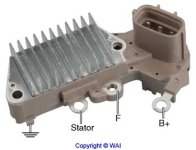
Noodling on this -- forgive me if magic smoke comes out :) See picture:

IN453.jpg

You will have to rig up something to spin the alternator -- the ND architecture uses the stator input on the regulator (the screw lug on the left side) to determine if it's spinning and in need of regulation. Maybe you can synthesize this by putting a nominal starting DC voltage (12v) on the stator input.

You will also need a load between the B+ lug and the F lug - use the brushes/rotor assembly here. Use jumpers to connect between B+ & slip ring 1, slip ring 2 & Voltmeter +, Voltmeter - to F lug. If you don't want to use the rotor, swap in a 5 Ohm, 100 Watt resistor to simulate the rotor.

Connect the ground lug (bottom) to ground on the supply. Connect the IG plug wire to your + DC supply, this will serve as the activation signal. Connect + DC to B+ lug on regulator (the one with the arm sticking out from the connector). This will simulate the alternator's voltage output.

Start with 12Vdc on the supply and slowly increase the voltage. What does the voltmeter show? As you increase the supply voltage you should see the voltmeter value decrease -- play with this a bit around 14 - 14.5 V. If there is OV protection (non Crowbar), you should see the voltmeter suddenly drop to 0V as you approach ~16.5V on the supply.

Make sense?
 
So, it's inelegant, crude, the 1800's called and they want it back, but the Crowbar Circuit + externally controlled field supply, is the only reliable Overvoltage protection available in an IR alternator...

Used in multi megawatt inverters too because of mega-buck costs when hearing that "crack".
 
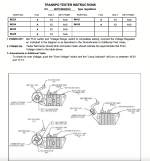
Just found an interesting "blurb" in the user documentation for the Transpo VRC2010 Regulator Tester. It references testing the over voltage condition *and* what happens with the Lamp output; The regulator will "alert" if it hits 16.0 - 17.1 Volts by driving Lamp output (actually short the lamp output to ground).

Screenshot 2025-06-30 at 3.46.30 PM.png

Cool...
 
Just found an interesting "blurb" in the user documentation for the Transpo VRC2010 Regulator Tester. It references testing the over voltage condition *and* what happens with the Lamp output; The regulator will "alert" if it hits 16.0 - 17.1 Volts by driving Lamp output (actually short the lamp output to ground).

View attachment 91392

Cool...
Very interesting.... so there is an over voltage protection, but should I assume it is still subject to that one failure mode where it won't work...? In addition to the lamp circuit ground, does the output also get shut off or is it just a warning?
 
Just found an interesting "blurb" in the user documentation for the Transpo VRC2010 Regulator Tester. It references testing the over voltage condition *and* what happens with the Lamp output; The regulator will "alert" if it hits 16.0 - 17.1 Volts by driving Lamp output (actually short the lamp output to ground).
So is it safe to say that this is the complete list of regulators that have OV functionality? The 12179N I've been using for many years on several RVs uses the IN824 regulator. A few years back I was buying these new on Amazon for $39.99 and I haven't seen one fail yet.

Niagara Air Parts used to sell the 100211 alternator for experimentals which cross-references the 12179N.
 

Attachments

Last edited:
So is it safe to say that this is the complete list of regulators that have OV functionality? The 12179N I've been using for many years on several RVs uses the IN824 regulator. A few years back I was buying these new on Amazon for $39.99 and I haven't seen one fail yet.

Niagara Air Parts used to sell the 100211- alternator for experimentals which cross-references the 12179N.
Hardly - there are dozen's in that plug/form-factor -- I only know what's documented in that attachment.

The 12179N (ND 100211-1680) uses the Transpo IN254 (ND 126000-1160) regulator; it's listed as having Over Voltage in the Test Fixture document, but other documents doesn't list OV as a feature. Also, I believe this is an OV detection function, not OV protection.

Also, for what it's worth, the 12179N uses a smaller stator/rotor than the PP, and is a 40A class device. It can probably provide 60A if you spin it at Lycoming speeds...but - I wouldn't load it like that -- be careful with those Lithium batteries.
 
Last edited:
Is there a way to simply full field my Denso IR 100211-1680 like I did with my Delco 10DN that uses an external VR? It was easy to do with the 10DN, just bypass the external VR and apply 12volts directly to the field terminal.. shot right up to 18 volts as I increased engine rpm
 
Is there a way to simply full field my Denso IR 100211-1680 like I did with my Delco 10DN that uses an external VR? It was easy to do with the 10DN, just bypass the external VR and apply 12volts directly to the field terminal.. shot right up to 18 volts as I increased engine rpm
Sure - just rewire the brush connections to use an external wire instead of the two lugs on the brush holder.
 
Back
Top