Van's Air Force

The definitive Van's Aircraft support community! Buying, building or flying an RV? Join our exclusive family of mentors and enthusiasts!

Baffle Mod

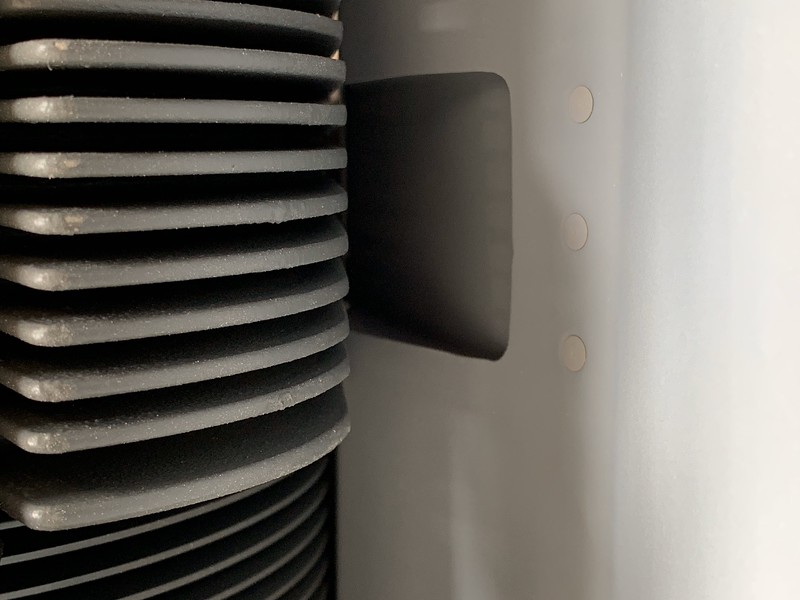
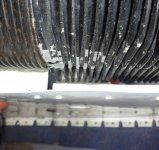
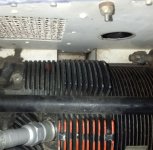
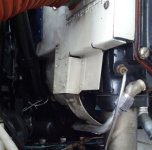
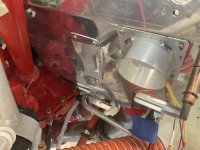
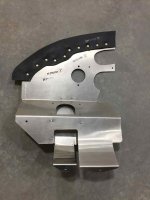
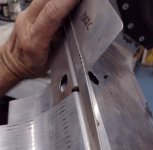
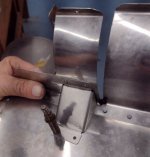
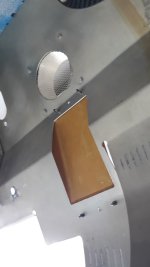
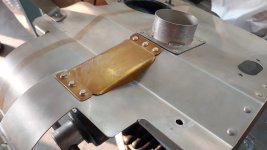
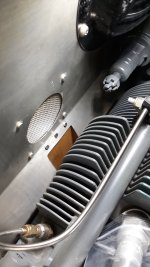
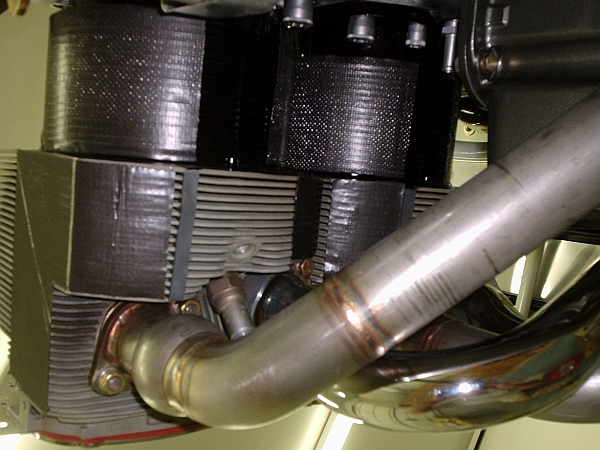
I went with a mini-duct per a later DanH post ..it was easy to make and gives more cross sectional area for the air to get through. YMMV, but my #3 has no cooling issues. I did a similar thing on the front of #2, tucked behind the IO-360 snorkel. The only cooling mod I had to do after break-in was to remove the dam in front of #1.

(photos prior to sealing with RTV)
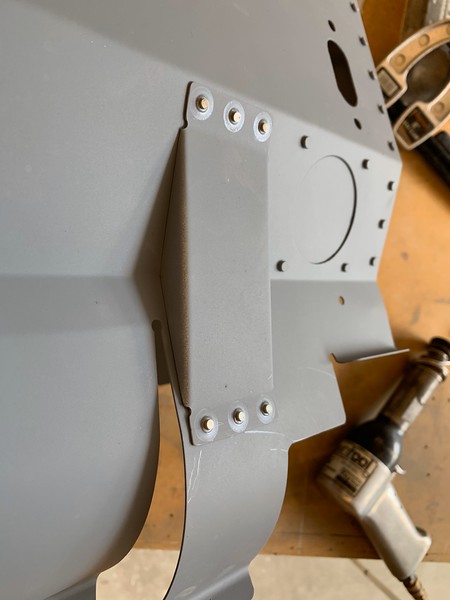
051219-IMG_0041-L.jpg


051219-IMG_0037-L.jpg


051219-IMG_0042-L.jpg
 
Thanks for posting

Thanks for posting. I am going to copy you.

As my college teacher said: plagiarism is good. Oh wait, that was my college roommate. Never mind.
 
Yeah, but...

Perfection is the enemy of good enough.

I've heard that quote just about every time I've tried to fix something that was giving us problems at work in my career as an aerospace structural engineer. My response? "Yeah, but first you have to be 'Good Enough'..." :D
 
I went with a mini-duct per a later DanH post ..it was easy to make and gives more cross sectional area for the air to get through. YMMV, but my #3 has no cooling issues. I did a similar thing on the front of #2, tucked behind the IO-360 snorkel. The only cooling mod I had to do after break-in was to remove the dam in front of #1.

(photos prior to sealing with RTV)
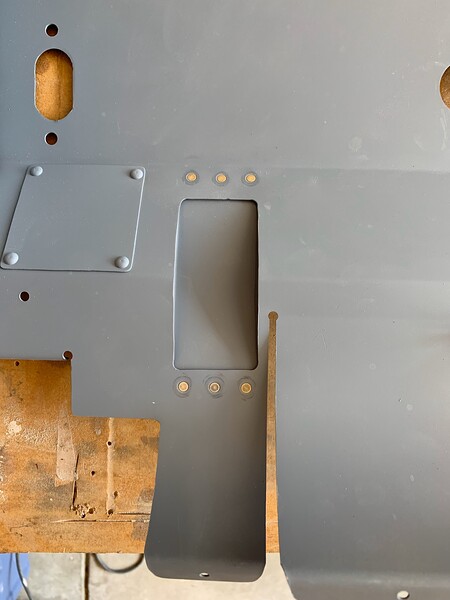
051219-IMG_0041-L.jpg


051219-IMG_0037-L.jpg


051219-IMG_0042-L.jpg

Bill, This is the exact mod I used in 2015.

Here are the flow areas based on the starting gap at the centerline (.4") then below, as the head wraps around. The chute above has .20"+ at the centerline and has the flow area plotted in post #56 above. 8 fins (1.9") is about the max there are 8 fins that get deeper down to the bottom. The other fins remain constant as they are limited by the exhaust port. The chart plot for .063 is the flow area for a washer. Note the area difference for the chute. I ran no temperature data for the difference, only present the area comparison.

2015 Baffle MOD plot.jpg

Template for the chute. Just print, verify your printed circle is 4", make a poster board prototype, then when satisfied, use some .032" to make the final. Note the need for CS rivets to eliminate interference. See my posts beginning at #56 for more photos.

View attachment RR_Baffle_Template.pdf
 
Last edited:
Bill, This is the exact mod I used in 2015. A template is posted somewhere here for it.

Here is the flow areas based on the gap at the centerline and below as the head wraps around.

View attachment 23669


Thanks for the data, great information.

As for the template for this mod...If anyone could post a link or share a photo, please do...I came up goose eggs on a search.
 
So how do the certified planes handle this issue? Ignore it or do they have some sort of bypass too?

I've seen one OEM install with a bypass tube. Photos below are from a Grumman.
.
 

Attachments

  • Grumman Tiger LF.jpg
    Grumman Tiger LF.jpg
    92.7 KB · Views: 510
  • Grumman Tiger RR Top.jpg
    Grumman Tiger RR Top.jpg
    106.4 KB · Views: 502
  • Grumman Tiger RR.jpg
    Grumman Tiger RR.jpg
    80.6 KB · Views: 505
So how do the certified planes handle this issue? Ignore it or do they have some sort of bypass too?

One thing to remember is that the 2 low flow areas (In front of #2 and behind #3 or #5 (depending)) are on the intake side of the cylinder. That side of the cylinder is cooled by the internal airflow (and fuel flow) and doesn't need as much cooling as the exhaust side. Lycoming engineered the fin depth with that in mind.

But to answer your question - the approaches vary. Some manufacturers do nothing, others build in ducts and the like.

The washer solution is a very low effort mod that helps if you have a need for more cooling on the back of the aft cylinder on the right side of the airplane. If it doesn't do enough, you can always add ducting.
 
Same can be said for "over-engineering". We seem to think of these somewhat crude little airplanes as akin to the Saturn V command module. I'd say spend 10 minutes putting a washer in there and enjoy the rest of the day out flying.

The best got that way detail by detail.

I've been side by side with another RV8 which was burning 50% more fuel and running 80 F warmer.
 
One thing to remember is that the 2 low flow areas (In front of #2 and behind #3 or #5 (depending)) are on the intake side of the cylinder. That side of the cylinder is cooled by the internal airflow (and fuel flow) and doesn't need as much cooling as the exhaust side. Lycoming engineered the fin depth with that in mind....

The bypass duct is not to allow "cooling" on the side of the cylinder, rather, it is to supply air to the bottom fins. Without an adjacent cylinder to provide that air path, the lower fins are starved of air. The baffle wrap we all install needs air from above to function. The "washer trick" gets you part of the way there but spills a bunch out the sides in the process. Kind of like trying to fill a wine bottle by pouring from a 5 gallon paint bucket. Messy.
 
Same can be said for "over-engineering". We seem to think of these somewhat crude little airplanes as akin to the Saturn V command module. I'd say spend 10 minutes putting a washer in there and enjoy the rest of the day out flying.

Curious why this after the thread's been inactive for over a year... in any case I was glad to run across it a as it's a fairly simple mod - not over engineered though maybe over-analyzed (hey, that's what engineer types do :rolleyes:). Not rocket science but on warm days my #3 gets hot on climbout like with a lot of us here, every little bit helps.
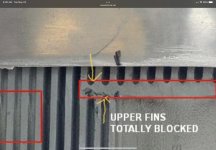
 
It looks like the cleanup on the cylinders after the casting could have been better.

Is there any reason not to remove what looks like it shouldn’t be there?
 

Attachments

  • IMG_0869.jpg
    IMG_0869.jpg
    146.5 KB · Views: 274
Last edited:
It looks like the cleanup on the cylinders after the casting could have been better.

Is there any reason not to remove what looks like it shouldn’t be there?

I think a bypass duct is less risky then touching a cylinder. I think the price of a Lycoming is about the same as a Ferrari engine. JMHO
 
On my -14 I think that a little 3/8 duct from the top of the baffle shelf aft of the filter down to the front of the #2 cylinder lower fins would be the final answer to dropping the #2 temps. My Arrow had that on its engine. What I cant quite figure out is how to do it with the way the shelf is built. I don’t want to just open a path to the back of the snorkel.
 
The airflow was completely blocked on cylinder #3…….not anymore. Thank you everyone for the ideas on how to tackle the issue.
 

Attachments

  • IMG_1528.jpeg
    IMG_1528.jpeg
    4.2 MB · Views: 493
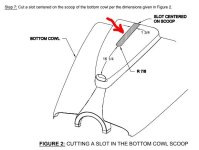
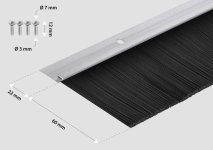
What is your opinion on using a brush seal in the slotted area bottom cowl? The brush seal has nylon brushes (should be good up to 250 F)Door Brush in bottom cowl.JPGBrush Seal Nylon.JPG
 
Last edited by a moderator:
Thanks for the data, great information.

As for the template for this mod...If anyone could post a link or share a photo, please do...I came up goose eggs on a search.
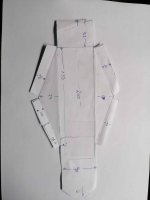
There is a flat pattern template over on the Husky forum. The factory has started including this modification. The values in the photo are in millimeters. And the V looking number is a one (German engineer Thomas Dietrich designed the prototype). To be fair this came along long after Dan's similar modification design and might have even been based upon it.

Flat_Pattern.jpg

Baffle.jpg

Here is a link to the thread on this: FlyHusky Baffle Link
 
What would be the purpose of the brush seal? I wouldn't think it'd block much air.
Maybe at high angles of attack (Vx / Vy climbs), unwanted air is entering the lower cowling through the slot open before the nose gear (this slot gets bigger as soon as there is no weight on the front axle), thus reducing deltaP between the upper sealed area and and lower cowl exit. This is a theory only, I haven't done any measuring or detailed research on this..
 
Between the nose gear leg upper fairing, and the cowl attach bracket (at the aft end of the cowl slot), there is NO remaining open slot to seal on my -6A.
I was thinking about the forward open part where the front leg is allowed to move on gnd..
 
There is a flat pattern template over on the Husky forum. The factory has started including this modification. The values in the photo are in millimeters. And the V looking number is a one (German engineer Thomas Dietrich designed the prototype). To be fair this came along long after Dan's similar modification design and might have even been based upon it.

The concept has been around forever on a bunch of certified birds. This thread is about the multiple ways to skin the cat.

Here's another, a quick way to mod an existing #2 baffle. Just two holes, and add the duct...done.

ScreenHunter_2551 Dec. 04 07.35.jpg

ScreenHunter_2550 Dec. 04 07.34.jpg
 
I was thinking about the forward open part where the front leg is allowed to move on gnd..

The attached photo is from an RV-8A. The 2-3 inch (50-75mm) slot forward of the gear leg is covered by the fairing. This is for the Van’s original design front gear leg. I do not know if this works for the more recent gear leg design with the pivot bolt and rubber “springs” at the top.
 

Attachments

  • IMG_1950.jpeg
    IMG_1950.jpeg
    2.5 MB · Views: 112
The attached photo is from an RV-8A. The 2-3 inch (50-75mm) slot forward of the gear leg is covered by the fairing. This is for the Van’s original design front gear leg. I do not know if this works for the more recent gear leg design with the pivot bolt and rubber “springs” at the top.
I don't understand how the relative movement between the nose gear leg and the cowling doesn't damage that fairing. There is some movement, even up near the socket...
 
I don't understand how the relative movement between the nose gear leg and the cowling doesn't damage that fairing. There is some movement, even up near the socket...
Look at the gear leg taper from the mounting socket to the wheel. It is almost full diameter up near the socket, tapering smaller moving down the leg. The result is most of the gear leg flex motion happens on the bottom half of the leg….well below the upper intersection fairing. Also, hard to see in the picture, but there is about 1/16-1/8” clearance between the upper fairing and gear leg fairing.

Upper intersection fairings on RV tail draggers work the same way.
 
Last edited:
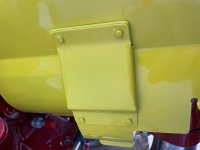
Cyl #5 mod done. No flight data yet.
Thank you all for the ideas!
 

Attachments

  • 20250607_170621.jpg
    20250607_170621.jpg
    397.4 KB · Views: 172
  • 20250609_191611.jpg
    20250609_191611.jpg
    876.1 KB · Views: 175
  • 20250609_192623.jpg
    20250609_192623.jpg
    1.1 MB · Views: 174
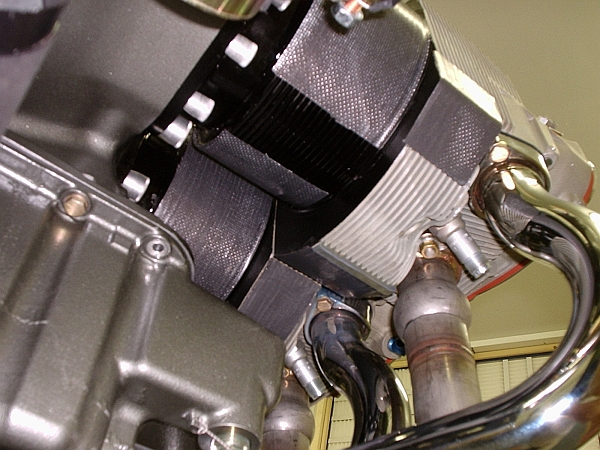
Thanks for all the info in this thread. I hammered a dent in my baffle to help with the shallow area, and put fiberglass and 598 on my fins underneath the baffle. Lots of messy sealing afterwards. It's ugly but the results speak for themselves. I'm rebuilding an O-360 and I'll do the baffling and RTV during assembly so I can minimize mess for the future. I now consider fin wraps and cylinder 3 bypass a "mandatory service bulletin" on parallel valve RVs.

These were my temps climbing at Vy after 3 full power touch and goes at 98F OAT. This is about the worst case cooling conditions I could ever see. I was struggling to keep the engine this hot!

Cylinder 1: 365
Cylinder 2: 345
Cylinder 3: 355
Cylinder 4: 340

Beforehand cylinder 3 was typically running 50F - 75F hotter than the coldest cylinder. I have one data log showing 76 degree spread. I pretty much couldn't fly if it was warmer than 85F.
 
Good results, and touch and goes aren't the worst case scenario. A full power climb out will test the cooling system's ability to maintain CHTs and oil temp much more. The pattern only requires full power for a short time. Then, power must be reduced a lot to keep some sort of reasonable speed in the downwind and reduced to almost zil on base and final. The engine has plenty of time to cool down before the next application of power. Climb out for 4 or 5 thousand feet at fairly low airspeed and you'll really know how the cooling is going.

Dan's mods are great, I repeat great, but not all of them absolutely essential for good temperature control. Well sealed baffles have proven adequate for most. Personally, I did the large inlet and restricted outlet a la Dan along with a plenum cover and sealed inlet transitions. (I became aware of his fiberglass and goop cylinder baffles mod after I had finished my install and I never went back and did that.) I installed large cowl flaps which I used for my initial break-in flight with everything forward, circling at 2500ft and about 95 degrees OAT. I've hardly ever opened them even a lit bit since. The only time I've had trouble controlling CHTs has been when my ignitions were advancing when they shouldn't have and no amount of extra airflow from open cowl flaps could control that.

Ed
 
Thanks for all the info in this thread. I hammered a dent in my baffle to help with the shallow area, and put fiberglass and 598 on my fins underneath the baffle. Lots of messy sealing afterwards. It's ugly but the results speak for themselves. I'm rebuilding an O-360 and I'll do the baffling and RTV during assembly so I can minimize mess for the future. I now consider fin wraps and cylinder 3 bypass a "mandatory service bulletin" on parallel valve RVs.

These were my temps climbing at Vy after 3 full power touch and goes at 98F OAT. This is about the worst case cooling conditions I could ever see. I was struggling to keep the engine this hot!

Cylinder 1: 365
Cylinder 2: 345
Cylinder 3: 355
Cylinder 4: 340

Beforehand cylinder 3 was typically running 50F - 75F hotter than the coldest cylinder. I have one data log showing 76 degree spread. I pretty much couldn't fly if it was warmer than 85F.
Just curious about what was your oil temperature after this sequence of 3 full power touch and goes?
 
Good results, and touch and goes aren't the worst case scenario.
Yes it's possible to get higher temps, but I meant worst case for how I fly. I cruise climb at around 110 knots. I have about 100 hours in my plane and I know from experience that my worst CHT temps occur during high power, high angle of attack climb in the pattern. Once I speed up and throttle back slightly for a cruise climb my CHTs come down. I'm sure I could still overheat my engine if I tried an extended 90 knot full power climb.
Just curious about what was your oil temperature after this sequence of 3 full power touch and goes?
196F. Haven't ever had an issue with oil temps.
 
Yes it's possible to get higher temps, but I meant worst case for how I fly. I cruise climb at around 110 knots. I have about 100 hours in my plane and I know from experience that my worst CHT temps occur during high power, high angle of attack climb in the pattern. Once I speed up and throttle back slightly for a cruise climb my CHTs come down. I'm sure I could still overheat my engine if I tried an extended 90 knot full power climb.

196F. Haven't ever had an issue with oil temps.
Very good! I also have low CHT temps but I can easily get beyond 205F if I am not careful. Good job!
 
Yep. The lower sections of my aluminum baffles are fully lined, so I don't depend on the aluminum to keep air between fins. The aluminum wraps are not much more than a backup to ensure the fiberglass/silicone wraps stay in place. Best I can tell none has shown any sign of debonding.

This is Loctite 598 (aka Permatex Ultra Black) rolled into ordinary 9 oz plain weave fiberglass between plastic sheets, then cut to size with scissors and stuck to the fins while wet.

P1250001.JPG


P1250003.JPG
This is very smart! Should come like this stock from factory :)
 
Cyl #5 mod done. No flight data yet.
Thank you all for the ideas!
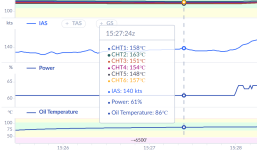
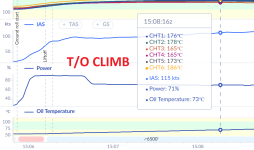
Short feedback with some data.
Now my #5 Cyl is the coolest in cruise and the temps are well within limits in climb.
1st screenshot> CRUISE Power setting: 61% LOP, Oil Damper CLOSED.
2nd screenshot> Cruise CLIMB setting shortly after T/O
EDIT: both front cylinder air dams removed.

Cruise:
RV-10 CRUISE LOP 61% PWR.png

Cruise CLIMB:
RV-10 CLIMB ROP.png
 
There is a flat pattern template over on the Husky forum…

This drawing template is identical to the one I came up with for my Rocket and published on this forum back in 2015 (photobucket pictures lost now). Either the Aviat factory has some engineers that think exactly like I do or this forum has some influence in the aviation world. (I suspect the latter).
 
Did my own template out of of cardboard, then the result on the "beast", cylinder #3 of the O-360 (before RTV treatment):

69i.jpg

and I took this picture recently, cylinder #5 on an RV-10, standard baffle feature if not mistaken, IO-540 (before final RTV treatment):

10.jpg
 
Back
Top