
Flying to breakfast at 40D I noticed my voltage was up around 16.1 volts. Not the normal 14.5 volts I normally see. Landed fine.On the flight back home I was monitoring voltage closely and voltage went to 13.1 volts and 0 amps,alternator fail light was on. Haven’t pulled the cowl yet to check for loose,broken wires yet but I’m assuming my PP alternator is cooked. Looking for options. Take it to a repair shop,new ND or B&C alternator.9A w Lycoming IO320 w dual Pmags and AFP fuel injection and EarthX battery. The alternator is an Al 12-E160/V.

Van's Air Force
You are using an out of date browser. It may not display this or other websites correctly.
You should upgrade or use an alternative browser.
You should upgrade or use an alternative browser.
Another Alternator problem
- Thread starter Future RV 9 Flyer
- Start date

BoydBirchler
Well Known Member
Did it trip the field breaker? 16.1VDC is very close to where a overvolt would likely trip and pop the breaker.Flying to breakfast at 40D I noticed my voltage was up around 16.1 volts. Not the normal 14.5 volts I normally see. Landed fine.On the flight back home I was monitoring voltage closely and voltage went to 13.1 volts and 0 amps,alternator fail light was on. Haven’t pulled the cowl yet to check for loose,broken wires yet but I’m assuming my PP alternator is cooked. Looking for options. Take it to a repair shop,new ND or B&C alternator.9A w Lycoming IO320 w dual Pmags and AFP fuel injection and EarthX battery. The alternator is an Al 12-E160/V.

Flying to breakfast at 40D I noticed my voltage was up around 16.1 volts. Not the normal 14.5 volts I normally see. Landed fine.On the flight back home I was monitoring voltage closely and voltage went to 13.1 volts and 0 amps,alternator fail light was on. Haven’t pulled the cowl yet to check for loose,broken wires yet but I’m assuming my PP alternator is cooked. Looking for options. Take it to a repair shop,new ND or B&C alternator.9A w Lycoming IO320 w dual Pmags and AFP fuel injection and EarthX battery. The alternator is an Al 12-E160/V.
Pull the unit, take it to O'Reilley's, throw it on their tester - Tell them it's from a 1998 Toyota Tercel, 60A (R110816) so they'll use the correct plug/adapter and test parameters; the belt won't match, but they can use a V-belt easily.
@BoydBirchler is correct - 16.1V is really close to when the Plane Power AL12EI60 fires the SCR/OV circtuit which *should* trip the ALT FIELD circuit breaker. However, the alternator light coming on is indicative of the alternator receiving power to the field/ign input -- so it's probably not the circuit breaker that tripped.
Breaker didn’t trip. Volts just went to battery voltage and amps to 0. 16 miles from home field so landed with battery only. 13 volts taxing in. We have an alternator shop 2 miles down the road. Going to take it to him.Pull the unit, take it to O'Reilley's, throw it on their tester - Tell them it's from a 1998 Toyota Tercel, 60A (R110816) so they'll use the correct plug/adapter and test parameters; the belt won't match, but they can use a V-belt easily.
@BoydBirchler is correct - 16.1V is really close to when the Plane Power AL12EI60 fires the SCR/OV circtuit which *should* trip the ALT FIELD circuit breaker. However, the alternator light coming on is indicative of the alternator receiving power to the field/ign input -- so it's probably not the circuit breaker that tripped.
If you want back up alternator the monkworks is a small, lightweight insurance option on the rear vac pad. It can be used as a primary as well. 30a

Those seem great. Definitely on my upgrade list.If you want back up alternator the monkworks is a small, lightweight insurance option on the rear vac pad. It can be used as a primary as well. 30a

My opinion only based on my experience. Save yourself future frustration and potential bad outcome. Buy a B&C and be happy.Flying to breakfast at 40D I noticed my voltage was up around 16.1 volts. Not the normal 14.5 volts I normally see. Landed fine.On the flight back home I was monitoring voltage closely and voltage went to 13.1 volts and 0 amps,alternator fail light was on. Haven’t pulled the cowl yet to check for loose,broken wires yet but I’m assuming my PP alternator is cooked. Looking for options. Take it to a repair shop,new ND or B&C alternator.9A w Lycoming IO320 w dual Pmags and AFP fuel injection and EarthX battery. The alternator is an Al 12-E160/V.
Took my alternator to a local alternator repair shop and he called yesterday to tell me he was unable to find a voltage regulator. Called B&C and one is on its way.

Rdog420
Well Known Member
11-1043 is the regulator P/N - you can keep as a spare or sell it if you get it fixed.Took my alternator to a local alternator repair shop and he called yesterday to tell me he was unable to find a voltage regulator. Called B&C and one is on its way.

11-1043 Plane-Power 11-1043 REGULATOR NON PMA
Plane-Power 11-1043 11-1043 REGULATOR NON PMA
After several Plane Power failures (flight and bench), I bought the Indy Alt product several months ago. Installation was straight forward and I've had no problems.has anyone tried the INDY ALT?

Did they tell you what was wrong? Or were you supposed to infer that it was a failed regulator?Took my alternator to a local alternator repair shop and he called yesterday to tell me he was unable to find a voltage regulator. Called B&C and one is on its way.

turbo
Well Known Member
https://www.northernmobile.com/rebuilding-services
these people have been the best in quick support, fair prices in getting starters and alternators brought back to new condition. i had a spare starter and alt on hand. i always traveled with the alt on all trips far from home base. good luck.
these people have been the best in quick support, fair prices in getting starters and alternators brought back to new condition. i had a spare starter and alt on hand. i always traveled with the alt on all trips far from home base. good luck.
That’s great your alternator has worked well for several months.After several Plane Power failures (flight and bench), I bought the Indy Alt product several months ago. Installation was straight forward and I've had no problems.
After several Plane Power failures (flight and bench), I bought the Indy Alt product several months ago. Installation was straight forward and I've had no problems.
Cool!

Brian Decker helped me figure out the flow of electrons, so cheers to him!
I picked up my PP alternator from the shop yesterday and he said the regulator and stator are both bad. Rdog420 has a part # from Air Power that is supposed to be the replacement voltage regulator. Not sure it’s worth it,I’d have about $350 into it after repairs
Rdog420
Well Known Member
For $300 more you could buy new. Does that alt shop do stator repairs too?I picked up my PP alternator from the shop yesterday and he said the regulator and stator are both bad. Rdog420 has a part # from Air Power that is supposed to be the replacement voltage regulator. Not sure it’s worth it,I’d have about $350 into it after repairs
Yes,he has stators.For $300 more you could buy new. Does that alt shop do stator repairs too?
How many hours did you get before it failed? Lots of these seem to die in a couple hundred hours. I would consider the B & C at $300 more. More money, but won't have to repeat the experience in a couple years.I picked up my PP alternator from the shop yesterday and he said the regulator and stator are both bad. Rdog420 has a part # from Air Power that is supposed to be the replacement voltage regulator. Not sure it’s worth it,I’d have about $350 into it after repairs
Never accept "it's bad" from a shop -- they need to show you and explain the subjective "bad." If they can't, then move on.I picked up my PP alternator from the shop yesterday and he said the regulator and stator are both bad. Rdog420 has a part # from Air Power that is supposed to be the replacement voltage regulator. Not sure it’s worth it,I’d have about $350 into it after repairs
Starting around 2014 or so, the Plane Power stators are glued into the front case, but they are replaceable -- a replacement stator (100mm O.D. IIRC, e.g. Unipoint T502109) is about $130 from various suppliers.
Last edited:
...and why NOT? Based on what data (and please don't quote some random VAF user who don't know how to even find the alternator...)?How many hours did you get before it failed? Lots of these seem to die in a couple hundred hours. I would consider the B & C at $300 more. More money, but won't have to repeat the experience in a couple years.
The stator is a chunk of steel laminate with some plastic insulators and magnet wire (@dmattmul - keep me honest) -- aside from moving electrons through it, making heat and dissipating heat, it doesn't do anything.
The "trick" is in the composition, and application of the "varnish" (again @dmattmul keep me honest) -- how well does it hold up to heat.
We have NO source for reliability data in this market. We are at the mercy of using the community posted experiences to infer that data. Far from reliable. However, the number of reports of failed PP alternators on this site is staggering. On the flipside, we almost never see similar reports on B&C's. Sure, a whole bunch more PP's sold than B&C, but again, all we have....and why NOT? Based on what data (and please don't quote some random VAF user who don't know how to even find the alternator...)?
The stator is a chunk of steel laminate with some plastic insulators and magnet wire (@dmattmul - keep me honest) -- aside from moving electrons through it, making heat and dissipating heat, it doesn't do anything.
The "trick" is in the composition, and application of the "varnish" (again @dmattmul keep me honest) -- how well does it hold up to heat.
Understand your need for evidence, but it doesn't exist. If you want to continue buying PP because there is no data to prove anything, that is your perogitive. For the rest of us, we take the data we have and formulate decisions. I hasve seen posts from folks that have gone through 3 PP's in 500 hours. I just don't understand how folks can read that and then buy one for $1600, whenh they can buy a B&C for $600, with no similar feedback.
...and why NOT? Based on what data (and please don't quote some random VAF user who don't know how to even find the alternator...)?
The stator is a chunk of steel laminate with some plastic insulators and magnet wire (@dmattmul - keep me honest) -- aside from moving electrons through it, making heat and dissipating heat, it doesn't do anything.
The "trick" is in the composition, and application of the "varnish" (again @dmattmul keep me honest) -- how well does it hold up to heat.
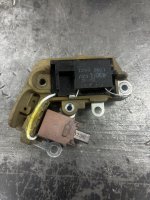
I have about 280 hrs on the engine. My B&C alternator should be delivered today. If I decide to repair it would sit on the shelf for a spare. This a picture of the regulator and brush holder....and why NOT? Based on what data (and please don't quote some random VAF user who don't know how to even find the alternator...)?
The stator is a chunk of steel laminate with some plastic insulators and magnet wire (@dmattmul - keep me honest) -- aside from moving electrons through it, making heat and dissipating heat, it doesn't do anything.
The "trick" is in the composition, and application of the "varnish" (again @dmattmul keep me honest) -- how well does it hold up to heat.
Attachments
I do wish we had real data to make decisionsWe have NO source for reliability data in this market. We are at the mercy of using the community posted experiences to infer that data. Far from reliable. However, the number of reports of failed PP alternators on this site is staggering. On the flipside, we almost never see similar reports on B&C's. Sure, a whole bunch more PP's sold than B&C, but again, all we have.
Understand your need for evidence, but it doesn't exist. If you want to continue buying PP because there is no data to prove anything, that is your perogitive. For the rest of us, we take the data we have and formulate decisions. I hasve seen posts from folks that have gone through 3 PP's in 500 hours. I just don't understand how folks can read that and then buy one for $1600, whenh they can buy a B&C for $600, with no similar feedback.

With what I do know, am I going purchase a $1600 alternator or even a $600 one? N.F.W.; cost > value. I'll go buy an N.D. clone for $150, add the over-voltage protection to the field circuit, and cooling to the electronics, and run it out to engine TBO, and use the $1450 I "saved" on 100LL.
This argument is moot now (due to the $1600 price tag), but I'll throw it out for consideration anyway and then we can discuss ad nauseam over beer (hint: I'll "buy" the first round at OSH) -- but I'll tip my hand a bit, I believe the answer was in the numbers to wit:
1. How many P-P alternators are installed, and what percentage are installed correctly?
2. How many B&C's are installed, and what percentage are installed correctly?
Totally subjective, but in my experience, I've never seen a P-P installation that was correct (per the installation instructions or AC43-13B) -- every one has been missing something subtle, or more egregious.
The "3 in 500 hour" example, while the operator will NEVER admit to it, is an example of the egregious. The same can be said for the operator with the shorted starter wire, and other wire chafing issues, or the operator with the home brew heat shield with loose screws -- ignore AC43-13B to your own detriment or peril and then blame it on the alternator...seems legit...
It's like going to a crime scene after the forensic cleaning crew has finished their work then determining the COD as "Acute Sodium Hypochlorite Ingestion."
The aforementioned non-compliant installations and operation causes the P-P to fail at a higher rate than the B&C. P-P are apples and B&C are plums -- you can't make an apple pie with plums and you can't make plum jam with apples.
Looks perfect -- no wear on the brushes even.I have about 280 hrs on the engine. My B&C alternator should be delivered today. If I decide to repair it would sit on the shelf for a spare. This a picture of the regulator and brush holder.
Rdog420
Well Known Member
Who is quoting you $1600?
SpruceWho is quoting you $1600?
and the Airpower price is just the alternator core (99-1012) not the entire kit (AL12EI60)Spruce
edit -- price drop, woo hoo ---> https://www.aircraftspruce.com/catalog/pnpages/07-01313.php

I have a PP and would be interested to take advantage of your experience to avoid installation problems. What kinds of things have you seen? I've got almost 500 hours on mine and want to get another few thousand hours.Totally subjective, but in my experience, I've never seen a P-P installation that was correct (per the installation instructions or AC43-13B) -- every one has been missing something subtle, or more egregious.
 Main mod is a 4" pulley.
Brian - have you seen problems with B&C installations as well or is there something unique about P-P alternators that makes them more prone to bad installs?Totally subjective, but in my experience, I've never seen a P-P installation that was correct (per the installation instructions or AC43-13B) -- every one has been missing something subtle, or more egregious.
Brian,you mentioned bad installations as causes for failures but I don’t see a bad installment as causing my failure. I had a heat shield on the nearest exhaust pipe and a blast tube and shroud on the back of the alternator. The shop owner said the regulator failed which then caused the stator to fail. What caused the regulator to fail?This is my first build but I don’t think installing an alternator as being the most difficult task on the plane.Brian - have you seen problems with B&C installations as well or is there something unique about P-P alternators that makes them more prone to bad installs?
Sure Mickey -- here's the list in no particular orderI have a PP and would be interested to take advantage of your experience to avoid installation problems. What kinds of things have you seen? I've got almost 500 hours on mine and want to get another few thousand hours.
1. Incorrect Belt tension - bearing wear
2. Incorrect Belt alignment - bearing wear
3. 3-pin connector missing vibration boots (to be fair, this is a screw up from Hartzell/Plane Power.) - Vibration "works" the wires, causes them to fail.
4. Undersized CB installed on the "B+" lead - nuisance trips -> load dumping the rectifier
5. No heat shielding on cross over exhausts "near" the backside of the alternator -> heat is not a friend of the SRE casting, rectifier, regulator.
6. No cooling air pointed at the backside of the alternator -> heat is not a friend of the SRE casting, rectifier, regulator.
7. Blown nose seal, case leaks -- oil on alternator "innards" -> excessive brush wear.
8. Unbalanced propellor -> vibration -> bearing wear
9. Incorrect operation -> turning the field circuit on/off while alternator is turning (this is a weak point in the regulator design)
10. 3 hold down screws of rear cover working loose -> bad grounding, recitifier gets fried.
11. Wrong hardware/Missing hardware from kit (lock washers, wrong stackup of parts, incorrect torque on fasteners)
12. Misrouted wires
Last edited:
I'll wager (a beer) that I can find the root cause of the failure and installation issue if it exists. Post some pics, and if you're willing, send me the failed unit. Happy to do an autopsy on it.Brian,you mentioned bad installations as causes for failures but I don’t see a bad installment as causing my failure. I had a heat shield on the nearest exhaust pipe and a blast tube and shroud on the back of the alternator. The shop owner said the regulator failed which then caused the stator to fail. What caused the regulator to fail?This is my first build but I don’t think installing an alternator as being the most difficult task on the plane.
Last edited:
Apples vs Plums...Brian - have you seen problems with B&C installations as well or is there something unique about P-P alternators that makes them more prone to bad installs?
Other reply has a long list of items that are bad (or worse) for a plane power alternator but won't apply to the B&C (LX60) because of electrical architecture, mounting differences....and gold paint

Amen. I have NDs on both my planes with home built OV protection. The one in my 6 has 1600 trouble free hours. I will never understand why someone would drop 1600 on ANY alternator.I do wish we had real data to make decisions
With what I do know, am I going purchase a $1600 alternator or even a $600 one? N.F.W.; cost > value. I'll go buy an N.D. clone for $150, add the over-voltage protection to the field circuit, and cooling to the electronics, and run it out to engine TBO, and use the $1450 I "saved" on 100LL.
.
In fairness these installation requirements are purely due to inherent weaknesses in the PP. my $75 ND has no forced air, no heat shielding on it or the exhaust near it, no special rubber boots on the connector, belt is 1/4” out of alignment axially, turn alt field on after engine start up religiously, etc. 1600 hours of trouble free service. I understand that hartzell likes to blame these problems on installation issues, but in reality all the other alternators are subject to the same issues, yet give long service.Sure Mickey -- here's the list in no particular order
1. Incorrect Belt tension - bearing wear
2. Incorrect Belt alignment - bearing wear
3. 3-pin connector missing vibration boots (to be fair, this is a screw up from Hartzell/Plane Power.) - Vibration "works" the wires, causes them to fail.
4. Undersized CB installed on the "B+" lead - nuisance trips -> load dumping the rectifier
5. No heat shielding on cross over exhausts "near" the backside of the alternator -> heat is not a friend of the SRE casting, rectifier, regulator.
6. No cooling air pointed at the backside of the alternator -> heat is not a friend of the SRE casting, rectifier, regulator.
7. Blown nose seal, case leaks -- oil on alternator "innards" -> excessive brush wear.
8. Unbalanced propellor -> vibration -> bearing wear
9. Incorrect operation -> turning the field circuit on/off while alternator is turning (this is a weak point in the regulator design)
10. 3 hold down screws of rear cover working loose -> bad grounding, recitifier gets fried.
11. Wrong hardware/Missing hardware from kit (lock washers, wrong stackup of parts, incorrect torque on fasteners)
12. Misrouted wires

Sure Mickey -- here's the list in no particular order
1. Incorrect Belt tension - bearing wear
2. Incorrect Belt alignment - bearing wear
3. 3-pin connector missing vibration boots (to be fair, this is a screw up from Hartzell/Plane Power.) - Vibration "works" the wires, causes them to fail.
4. Undersized CB installed on the "B+" lead - nuisance trips -> load dumping the rectifier
5. No heat shielding on cross over exhausts "near" the backside of the alternator -> heat is not a friend of the SRE casting, rectifier, regulator.
6. No cooling air pointed at the backside of the alternator -> heat is not a friend of the SRE casting, rectifier, regulator.
7. Blown nose seal, case leaks -- oil on alternator "innards" -> excessive brush wear.
8. Unbalanced propellor -> vibration -> bearing wear
9. Incorrect operation -> turning the field circuit on/off while alternator is turning (this is a weak point in the regulator design)
10. 3 hold down screws of rear cover working loose -> bad grounding, recitifier gets fried.
11. Wrong hardware/Missing hardware from kit (lock washers, wrong stackup of parts, incorrect torque on fasteners)
12. Misrouted wires
Apples vs Plums...
Other reply has a long list of items that are bad (or worse) for a plane power alternator but won't apply to the B&C (LX60) because of electrical architecture, mounting differences....and gold paint
The majority of those apply equally to any alternator whether PP, auto or B&C.
The specific PP ones are - well - specific things that could have been rectified any time in the last 15y. But haven’t been. Maybe the new owners have embarked upon an R&D drive to address them, make them cheaper and more reliable.
The only charitable thing you can say about the PP is that the large number of failures are simply just a result of a large install base because it’s been the Vans default for probably 15y+.
Maybe if they’d picked B&C as their preferred supplier for their FWF back in the day we would be seeing endless “another B&C alternator problem” threads. But I suspect not.
I’m all for nutting out the root causes of the failures and I also agree that an automotive solution is entirely viable for the attentive builder. But anyone reading these threads that just wants to go flying with high dispatch reliability and no messing about…
Again - let's compare apples to apples ...In fairness these installation requirements are purely due to inherent weaknesses in the PP. my $75 ND has no forced air, no heat shielding on it or the exhaust near it, no special rubber boots on the connector, belt is 1/4” out of alignment axially, turn alt field on after engine start up religiously, etc. 1600 hours of trouble free service. I understand that hartzell likes to blame these problems on installation issues, but in reality all the other alternators are subject to the same issues, yet give long service.
1. How many amps does your $75 ND produce and what does your electrical system consume (I'm guessing this is the RV-6)? (ND is typically a 40A unit)
2. What's the pulley diameter - engine and alternator each.
3. Plane Power and ND have each used 3 different connectors over the years - 2 pin, 3 pin (2 different versions), 4 pin. In all likelihood your ND uses the round three pin - captive spade terminals, maybe the stacked box 2 pin - again with captive spade terminals. The broken wire symptom seems to be specific to the 3 pin inline "Sumitomo" - "Toyota", small pin variant, oval connector (Plug Code 3312). As an aside - another problem is the wiring type - Plane Power provides stiff, non MIL-W-22759/16 wire. Without isolation/damping it will fracture and break -- right around 200 hours with a propellor > .5ips.
4. 1/4" out -- and you haven't smoked the belt? Wow...Must be all that clean living.
The majority of those apply equally to any alternator whether PP, auto or B&C.
The specific PP ones are - well - specific things that could have been rectified any time in the last 15y. But haven’t been. Maybe the new owners have embarked upon an R&D drive to address them, make them cheaper and more reliable.
The only charitable thing you can say about the PP is that the large number of failures are simply just a result of a large install base because it’s been the Vans default for probably 15y+.
Maybe if they’d picked B&C as their preferred supplier for their FWF back in the day we would be seeing endless “another B&C alternator problem” threads. But I suspect not.
I’m all for nutting out the root causes of the failures and I also agree that an automotive solution is entirely viable for the attentive builder. But anyone reading these threads that just wants to go flying with high dispatch reliability and no messing about…
+1 on all points.
The difference here is B&C looked at the PP and ND failures and made changes to their product (refined balancing, 2 point mounting, external regulation -> less wire to break, no blast cooling needed). In their defense, Plane Power also made changes to their product over the years but still came up short IMHO (wave washers, captive stator, through bolts) as the root causes of their failures weren't well understood or the fixes were deemed too costly and never done.
On nutting out root causes --
@rocketbob (rest in peace) carried on about how crappy the PP was, etc. I offered to perform an autopsy on one of his failed units and he agreed. After I cleaned up the oil and dirt soaked unit, installed a fresh 3 pin connector, the unit worked fine on my bench. I took the unit to the local retail auto part shop, and used their tester (D&V ALT 98 and ALT 198 -- I trained the staff on how to use it
-- the unit passed with flying colors and is now being used on an RV-10.This, and the results of other autopsies I've performed, are what led me to my conclusions about the suitability and shortcomings of the plane power unit (all generations).
My alt is 50A and typical consumption around 17A on the 6 with old school strobes. obviously post start is higher. Pulley Dia is 3-4" though never measured it. It is a lester 14158 (Ext Reg). Pulley is stock for that model. I have the old, ring gear support with smaller pulley, so my Alt spins slower than most, though probably not that much, as my Alt pulley apears smaller than what the PP ships with.Again - let's compare apples to apples ...
1. How many amps does your $75 ND produce and what does your electrical system consume (I'm guessing this is the RV-6)? (ND is typically a 40A unit)
2. What's the pulley diameter - engine and alternator each.
3. Plane Power and ND have each used 3 different connectors over the years - 2 pin, 3 pin (2 different versions), 4 pin. In all likelihood your ND uses the round three pin - captive spade terminals, maybe the stacked box 2 pin - again with captive spade terminals. The broken wire symptom seems to be specific to the 3 pin inline "Sumitomo" - "Toyota", small pin variant, oval connector (Plug Code 3312). As an aside - another problem is the wiring type - Plane Power provides stiff, non MIL-W-22759/16 wire. Without isolation/damping it will fracture and break -- right around 200 hours with a propellor > .5ips.
4. 1/4" out -- and you haven't smoked the belt? Wow...Must be all that clean living.
141598
In my experience, bearings have no issues dealing with minor axially misalignment on V belts, though agree that over tightening can burn them up. I had to fab my own mounts for the old case I have (No modern ALT boss) and when I got within a 1/4" I called it good, as my experience said it would be fine and it was.
