Van's Air Force

The definitive Van's Aircraft support community! Buying, building or flying an RV? Join our exclusive family of mentors and enthusiasts!

AMP100 Hall Effect & #2 Wire

kirkbauer

Well Known Member
I was planning on putting my AMP100 Hall Effect sensor on the #2 wire from my battery so that I could connect it to my GEA24 to read the net amount of current going out of my battery. I was also hoping it could read negative so I could see the rate at which the battery was charging but I couldn't confirm if that was possible.

Well, I received my AMP100 today and there is no way it will fit around a #2 Tefzel wire. What are other people doing here? Should I be using a different sensor or do I need to move it to a smaller wire?
 
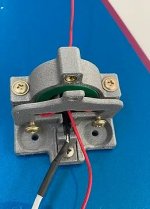
Mounting the KEY100 can be a little difficult but this will help:


Screenshot 2025-01-09 181533.jpg
 
From M22759/16, 2AWG cable max OD = 0.392". AMP100 ID = 0.29". KEY100 ID = 0.82". You need the KEY100.

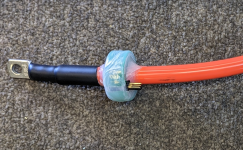
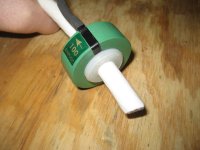
For my KEY100 installation, on 35mm2 welding cable (OD = 13.1mm), I used self-fusing silicone tape to increase cable OD to match sensor ID, positioned sensor on tape, then applied more tape over sensor to hold in place. If you try this method, you'll need a few more wraps of tape around the cable than I used.

KEY100.png
 
Is there a place where you split off the wire going to the starter and the wire going to the rest of the aircraft? That's probably going to be a much easier place to install the sensor. I installed mine on the alternator B lead, which is #4 welding cable (yes, I know it's overkill). This tells me how much current the alternator is providing, which for my installation is more important than how much is going into or out of the battery. Perhaps you plan to install multiple sensors...
 
Can anybody confirm whether or not I can connect a KEY100 to a Garmin GEA24 and read both positive and negative amps? In other words, if I put this on the #2 wire coming off of a battery, can I tell how many amps are going in (charging) or out (discharging) or will I have to pick only one direction to monitor?
 
The KEY100 on a gea24 will absolutely read positive and negative. It is what I have in my 6a and what I am putting in my 10.
 
The KEY100 on a gea24 will absolutely read positive and negative. It is what I have in my 6a and what I am putting in my 10.

Thank you! Do I need to worry about direction when wiring? I looked in the G3X install manual and I don't see anything where I can set what is positive and what is negative. So do I need to be careful about running the 2AWG wires through in the right direction?

Based on the datasheet, it looks like positive current should move out in the direction of the connector on the KEY100. I think I want positive to indicate that the battery is charging in which case I want the connector on the KEY100 pointing towards the battery positive terminal. Does that sound correct?
 
Do I need to worry about direction when wiring? I looked in the G3X install manual and I don't see anything where I can set what is positive and what is negative. So do I need to be careful about running the 2AWG wires through in the right direction?

Based on the datasheet, it looks like positive current should move out in the direction of the connector on the KEY100. I think I want positive to indicate that the battery is charging in which case I want the connector on the KEY100 pointing towards the battery positive terminal. Does that sound correct?

Yes, you need to pay attention to the orientation of the arrow on the sensor.

Convention for a battery ammeter usually has positive values indicating charge and negative values indicating discharge.
 
Awesome, thank you. I was just looking on the website and didn't even notice the arrow on the sensor. That makes sense. I'll point the arrow towards the battery so that positive indicates charging.
 
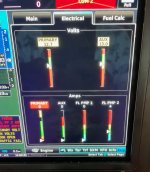
I installed 2 AMPLOC KEY100's one on each fuel pump (EFII system) wired into the GEA24. Made 10 wraps around the coil to improve sensitivity and set the scale factor appropriately. Deadband at .1 amps. Calibrated amps in config reads to +/- 0.1 amps. G3X screens only show increments of 1 amp. Is there a way I can set the display to 0.1-amp increments?

Screenshot 2025-04-15 181850.jpg
 
If not, would it be practical to wrap 100 turns of fine varnished magnet wire around the KEY100s?
Since the actual amperage measured can go up to 10 amps with a 100-amp sensor I believe 100 turns would saturate the coil.
 
I installed 2 AMPLOC KEY100's one on each fuel pump (EFII system) wired into the GEA24. Made 10 wraps around the coil to improve sensitivity and set the scale factor appropriately. Deadband at .1 amps. Calibrated amps in config reads to +/- 0.1 amps. G3X screens only show increments of 1 amp. Is there a way I can set the display to 0.1-amp increments?
No, there is not, as this is really intended for aircraft bus monitoring, not for sensing individual low-current devices. For this unusual application it would probably be better to select the "Custom Analog" configuration and enter a calibration curve based on the specifications of your sensor. Use the word "AMPS" in the name and it will be sorted in with the rest of the electrical gauges on the Engine page.
 
I installed 2 AMPLOC KEY100's one on each fuel pump (EFII system) wired into the GEA24. .......
Can I ask why? The types pumps they are (constant flow, bypass required) you'd expect very little current change regardless of engine flow required. Are you trying to catch an indication of a pending pump failure? Thx
 
Can I ask why? The types pumps they are (constant flow, bypass required) you'd expect very little current change regardless of engine flow required. Are you trying to catch an indication of a pending pump failure? Thx
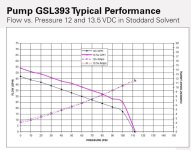
That would be one thing I believe amp sensors would catch but also post pump filter becoming clogged another. Additionally, it should give us an indicator if the pre pump filters starts to clog. Since most of us have 2 pre-filters the chance of both becoming clogged at the same time would be low but monitoring amps would be an indicator of "something" changing. I did some bench testing simulating filters becoming clogged both pre and post pump. When I simulated the pre-filter becoming clogged (Installed a valve before the pump) the amps did lower 1 - 1.5 amps almost right away and also the line pressure reduced only when the valve was almost completely closed as the fuel pressure regulator tried to maintain constant pressure. It was good to see amps dropping almost right away. These filters I am not too worried about as most have 2. The post filter is my concern since we only have 1. When I simulated a clogging post pump filter, the amps did increase as the fuel rail pressure remained the same. I did not check pressure before the simulated filter but I'm sure it increased as the valve was closed to try and maintain the same pressure and flow in the fuel rail, after the filter. It was an easy install in the new 10 and felt worth having some data on the health of the pumps. Getting better resolution in the display I feel would give an earlier indicator of an issue. Below is the pump curve for the Walbro pump:

Screenshot 2025-04-16 141822.jpg
 
Should probably clarify this data if I'm reading it correctly. I'm doubting "Flow" is pump flow as that line should be relatively flat for a fixed RPM so guessing your flow meter was downstream of the pumps. Another data point to support my suspicion is the relative linearity of the current. Guessing Flow was "system flow". Let me know if wrong. Won't be the first time today. That and theoretic pumping HP (amps here if V is constant) is linear with both pressure and flow. In my suspected scenario, the amp curve (HP) should be relatively flat. Of course, if the relief valve/pressure reg spring is crap, all bets are off. Cool data. Thx.

IF you are worried about the above scenario and IF you are using the filter canister supplied by your EFI OEM, I'd strongly consider a change. That one doesn't afford a non-destructive way to inspect the element (an upward trend in fouling at inspection time strongly warrants further investigation) and has more surface area -> Fouling margin in a filter is irrelevant until it suddenly isn't.

There are a lot of better choices at Holley, Summit, and more.

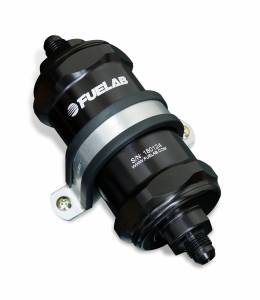
This one has a removeable/replaceable element and a whopping 60 sq inches of surface area. Has a micro-glass media option as well. Just a thought/option.

Filter Link
 
Should probably clarify this data if I'm reading it correctly. I'm doubting "Flow" is pump flow as that line should be relatively flat for a fixed RPM so guessing your flow meter was downstream of the pumps. Another data point to support my suspicion is the relative linearity of the current. Guessing Flow was "system flow". Let me know if wrong. Won't be the first time today. That and theoretic pumping HP (amps here if V is constant) is linear with both pressure and flow. In my suspected scenario, the amp curve (HP) should be relatively flat. Of course, if the relief valve/pressure reg spring is crap, all bets are off. Cool data. Thx.

IF you are worried about the above scenario and IF you are using the filter canister supplied by your EFI OEM, I'd strongly consider a change. That one doesn't afford a non-destructive way to inspect the element (an upward trend in fouling at inspection time strongly warrants further investigation) and has more surface area -> Fouling margin in a filter is irrelevant until it suddenly isn't.

There are a lot of better choices at Holley, Summit, and more.

This one has a removeable/replaceable element and a whopping 60 sq inches of surface area. Has a micro-glass media option as well. Just a thought/option.

Filter Link
Aeromotive makes an excellent filter (post and pre-pump) and I evaluated their filter along with several other manufactures. Holleys are good but I preferred filters with built in AN-6 fittings rather than use adapters. I went with this one and used their 6 micron ceramic filter cartridge.


For the wing root filter went with the Andair 62 micron stainless filter cartridge. It’s a little more compact than the Holley, FuelLab and Aeromotive.

The pump curve I attached was supplied by Walbro, the manufacture of fuel pumps for SDS and EFII. In the next week I will perform my 50 hr condition inspection and try and simulate filters clogging and how/if the amp draw responds the same as my bench testing.
 
Last edited:
Back
Top