Van's Air Force
You are using an out of date browser. It may not display this or other websites correctly.
You should upgrade or use an alternative browser.
You should upgrade or use an alternative browser.
-
- Thread starter SquawkVFR
- Start date



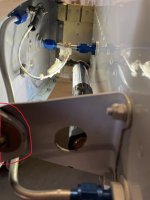
I just bought this plane. There is a mechanical constraint that caused a failure of the seal between T-708 (tank access plate) and T-703 (inboard rib). The plans in drawing 16A call for a cork gasket between these two surfaces, but no PN or material specificaiton is called out. I ordered a new T-708, and I'm hoping it includes the gasket. I also ordered MC-236-B2 just in case. Some have suggested using Form-A-Gasket #2.
I drained the tank, so I'm ready to begin the repair process.
I have two questions:
Suggestions I've been offered so far:
- How would you repair the leak?
- How would you resolve the mechanical constraint, so the seal doesn't break again after this repair?
Pics:
- Pull vacuum on the tank fill port and dose a bead of locktite around the perimeter of the access plate to stop the leak. Add elbows to the straight fittings and span a segment of steel braided fuel line between the two fittings.
- Remove, clean, and re-seal the access plate. Add a loop of 3/8 soft aluminum fuel line between the existing fittings.
- Remove the fuselage fitting and replace with grommet. Remove segment of fuel line between fuselage and fuel tank selector. Remove, clean, and re-seal the access plate. Run a new fuel line per the build plans.
View attachment 67346View attachment 67347
The third suggestion is the way to go and make it like the plans. I don't think there is enough space between the fittings in the wing root to make a looped line.
Van's current recommendation is to seal the cover plate on with tank sealant and no gasket at all.

Question = Is it per plans to have the two bulkhead fittings so close? Would have thought the line would pass through a grommeted hole in the fuse to minimize stress but I can't see the whole plan/layout.
Additionally, that short straight line is inviting stresses. Getting it placed without any preload from fitting torque or scoring the mating surfaces would be a trick. When the other work is done, consider supporting the wiring from other that the fuel line.
Additionally, that short straight line is inviting stresses. Getting it placed without any preload from fitting torque or scoring the mating surfaces would be a trick. When the other work is done, consider supporting the wiring from other that the fuel line.
You can do it in place. There was a service bulletin years ago where you needed to remove that plate to address the issue and thousands of tanks were repaired in place including removal and replacement of that plate.Do you think the pro-seal can be applied vertically in-place, or do i need to pull the tank and have it so the cover plate opening faces up?

You probably already know that the fuel line (as it is) is not only not per plans, it looks outright dangerous to me. You can either return it to “per plans” with the grommet and new fuel line on the fuselage side, or you might be able to get Tom at TS FLightlines to make a flexible hose with right-angle fittings on each end that could fit in there.
There should be an anti-rotation bracket and lock on the fuel pickup tube inside the cover plate but the rivets that normally attach the bracket are not visible in the photo, so it would be worth checking when the cover is off. The part number for the bracket is T-715.It concerned me as well. I appreciate your feedback, and my gut tells me I need to not cut corners here and just modify it, so it's compliant with the plans.
There is a Vans service bulletin that covers this:
SB 06-2-23 - Van's Aircraft Total Performance RV Kit Planes
Safetying of standard and flop-type fuel pickup tubes
 www.vansaircraft.com
The parts and materials to make the fuel lines standard are relatively inexpensive although there are a few hours of labor involved. The existing tubes between the fuel selector and the bulkhead fitting could be used as a pattern to help reduce the effort to make new ones.
Last edited:

I built my plane but also had a weep in that plate. I used the pro seal with some on the threads and under the screw head to ensure a good seal. Definitely take the opportunity to bring the assembly into compliance with Vans changes. What Paul said . . .
You might consider using hex cap screws so the screws can be easily removed in the next life of the gasket. I had some trouble with one screw removal.
You might consider using hex cap screws so the screws can be easily removed in the next life of the gasket. I had some trouble with one screw removal.
fwiw, i have had problems with hex head ''wallowing'' and allowing the allen tool to spin in the head of the screw. i have largely converted to torx where getting at a phillips head is iffy and never had a problem with torx.bits don't last forever, keep one in good shape in your tool.

I would say do what is suggested here by removing the plate, make sure the inside is up to the plans and then seal it with Proseal. In my opinion there is no need to use hex screws. Dip the standard screws in Proseal and install them. No need to tighten them to maximum. Wait for the Proseal to start settling a bit and give the screws another half turn. It will never leak again.
Also as suggested get flexible fuel lines and install the grommet suggested. Making up those line from soft alu tube is not easy.
Also as suggested get flexible fuel lines and install the grommet suggested. Making up those line from soft alu tube is not easy.

Tom made my flexible lines, and they work magnificently. I would never have anyone else make lines for me.You probably already know that the fuel line (as it is) is not only not per plans, it looks outright dangerous to me. You can either return it to “per plans” with the grommet and new fuel line on the fuselage side, or you might be able to get Tom at TS FLightlines to make a flexible hose with right-angle fittings on each end that could fit in there.
You are so blessed not to be halfway around the worldTom made my flexible lines, and they work magnificently. I would never have anyone else make lines for me.

To the OP:
As a point of curiosity when you remove the short line between the BH and fuel tank plate;
try and determine if torqueing/de-torqueing the fittings produces./relieves any tension in the fuel line. There should be zero stress in said line. Could a constant "pull" from said line contribute to the subject leak over time? Long shot but the data point would be interesting, to me at least.
As a point of curiosity when you remove the short line between the BH and fuel tank plate;
try and determine if torqueing/de-torqueing the fittings produces./relieves any tension in the fuel line. There should be zero stress in said line. Could a constant "pull" from said line contribute to the subject leak over time? Long shot but the data point would be interesting, to me at least.

Get a flexible hose with 90-fittings on each end, that will fit. It will also raise the pressure drop between the tank and the pump, which normally a thing to avoid.The third suggestion is the way to go and make it like the plans. I don't think there is enough space between the fittings in the wing root to make a looped line.
Van's current recommendation is to seal the cover plate on with tank sealant and no gasket at all.
Regarding your second question; It's standard industry practice as well as a good design principle to never run a hard line like this without at least one bend in it to account for this very thing. It's impossible to hand make and install a straight line to such a precise length that when you torque it down it doesn't pull something somewhere, and in this case, it's acting like a big rubber band, pulling the side of the fuselage and the tank toward each other. You can also see on the right hand side that the line is off center to the collar of the B nut, so it's got some side load in there as well.
As others have suggested, another option would be to change both fittings to 90's and do a loop, but a much cleaner solution would be to yank that bulkhead fitting out of the side of the fuselage replace it with the grommet that Vans calls for there and go from the fuel selector to the tank with the braided soft lines that TS flight line sells.
FYI- if you decide to replace it all the way to the valve, don't be surprised if you have to cut it into chunks to get it out it runs through two angled supports for the kick panels that bolt to the front face of the spar box
As others have suggested, another option would be to change both fittings to 90's and do a loop, but a much cleaner solution would be to yank that bulkhead fitting out of the side of the fuselage replace it with the grommet that Vans calls for there and go from the fuel selector to the tank with the braided soft lines that TS flight line sells.
FYI- if you decide to replace it all the way to the valve, don't be surprised if you have to cut it into chunks to get it out it runs through two angled supports for the kick panels that bolt to the front face of the spar box

While this is true, but more bends in the fuel lines can introduce more problems. If the airplane performs fines today with the correct fuel flow and fuel pressure, then fix the leak instead of opening up a new problem.Regarding your second question; It's standard industry practice as well as a good design principle to never run a hard line like this without at least one bend
Except that the leak is almost certainly a direct response to the installation.While this is true, but more bends in the fuel lines can introduce more problems. If the airplane performs fines today with the correct fuel flow and fuel pressure, then fix the leak instead of opening up a new problem.

That forward wing attach point (circled red below) is actually a breakaway fitting with a slot in one of the members. If you were to crash and let's say you hit a tree with a wing, that fitting lets the wing bend backward without breaching the fuel tank (in theory at least). Having that straight, short fuel line as you do now would probably rip out of the tank and cause a fuel leak. Download the drawing set for your airplane from Van's if you don't already have them and build that fuel line as specified on the appropriate drawing.