Van's Air Force

The definitive Van's Aircraft support community! Buying, building or flying an RV? Join our exclusive family of mentors and enthusiasts!

P-Mag Clocking for Angle Valve Done Wrong

DanH

Legacy Member
Benefactor
Advertiser
Mentor
Had a recent conversation with a builder who experienced high temperatures (both CHT and oil) during the first flights of his 390-powered RV-14. Apparently a technician at a well known shop had set P-Mag timing, and had clocked it the wrong way, which means timing was highly advanced. Let's be honest...it's an easy error to make.

The owner's concern was the possibility of damage due to excessive advance. Probably not, given the conditions reported, but clearly something to be avoided.

You'll find a previous explanation of how and why by clicking here.

These additional graphics simply illustrate right and wrong. They are views looking at the aft side of the ring gear carrier, with timing marks referenced to the crankcase split line.

Correct. 26.6 less 5 is 21.6, plus 9 for full advance means the maximum is about 30:
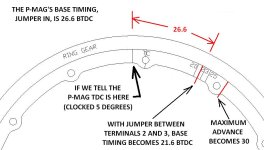
Clocked Timing Graphic.jpg

Incorrect. Positioning the ring gear carrier with the crankcase split line 5 degrees to the right of the TDC mark results in base timing of 31.6, even with the jumper installed (Remember, Lycoming specified 20). Maximum advance is about 40 BTDC....way too much.
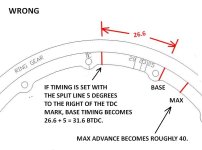
Clocked Timing WRONG.jpg
 
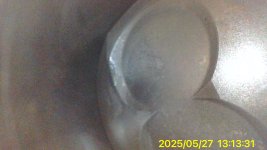
I helped troubleshoot a high oil temp issue with a 14A which had get to 235F just to the runup and the timing was set exactly like this and it was done at a RV building shop. Once the timing was changed, the temps were back to normal. Here is a picture of one of the pistons and wondering if there had been some detonation.
 

Attachments

  • Image_2025-05-27 13_13_31_421.JPG
    Image_2025-05-27 13_13_31_421.JPG
    159 KB · Views: 302
This is a great example Dan, as I'm installing the engine and this kind of check is in my "near term" future.
 
Had a recent conversation with a builder who experienced high temperatures (both CHT and oil) during the first flights of his 390-powered RV-14. Apparently a technician at a well known shop had set P-Mag timing, and had clocked it the wrong way, which means timing was highly advanced. Let's be honest...it's an easy error to make.

The owner's concern was the possibility of damage due to excessive advance. Probably not, given the conditions reported, but clearly something to be avoided.

You'll find a previous explanation of how and why by clicking here.

These additional graphics simply illustrate right and wrong. They are views looking at the aft side of the ring gear carrier, with timing marks referenced to the crankcase split line.

Correct. 26.6 less 5 is 21.6, plus 9 for full advance means the maximum is about 30:

View attachment 109546

Incorrect. Positioning the ring gear carrier with the crankcase split line 5 degrees to the right of the TDC mark results in base timing of 31.6, even with the jumper installed (Remember, Lycoming specified 20). Maximum advance is about 40 BTDC....way too much.
View attachment 109548
Thanks Dan! Very good depiction of the potential problem when P-MAGs are wrongly configured. I do have a question though:

Why would we choose to "Tell the P-MAG" that TDC is 5 degrees past TDC? Isn't the P-MAG manual saying that we put the ring at TDC and set this point as actual TDC for the P-MAG?

I assumed P-MAG automatically does the advance based on manifold pressure input.
 
I helped troubleshoot a high oil temp issue with a 14A which had get to 235F just to the runup and the timing was set exactly like this and it was done at a RV building shop. Once the timing was changed, the temps were back to normal. Here is a picture of one of the pistons and wondering if there had been some detonation.

Borescope images can fool us, but yes, detonation tends to leave two clues. It nibbles at edges on pistons, and it removes lead and carbon deposits, so everything looks nice and clean. Both are due to the loss of insulating boundary layer due to shock waves. A third clue, from the auto and motorcycle world, is hard to apply in the case of leaded fuel. If detonation is heavy enough, we start to see little tiny specs of aluminum on the spark plug center porcelain. Lead specks can look similar.

I don't think either is a serious concern in themselves, given moderation. The concerns are for possible very high temperatures (again, loss of boundary layer) and pressures (due to highly advanced timing, not the detonation).

Why would we choose to "Tell the P-MAG" that TDC is 5 degrees past TDC? Isn't the P-MAG manual saying that we put the ring at TDC and set this point as actual TDC for the P-MAG?

Set at TDC with a parallel valve engine. Set at 5 to 7 after TDC for an angle valve engine, and be sure the jumper is installed between terminals 2 and 3. Review your P-Mag manual. Angle valve heads require/desire less advance due to their configuration.
 
Borescope images can fool us, but yes, detonation tends to leave two clues. It nibbles at edges on pistons, and it removes lead and carbon deposits, so everything looks nice and clean. Both are due to the loss of insulating boundary layer due to shock waves. A third clue, from the auto and motorcycle world, is hard to apply in the case of leaded fuel. If detonation is heavy enough, we start to see little tiny specs of aluminum on the spark plug center porcelain. Lead specks can look similar.

I don't think either is a serious concern in themselves, given moderation. The concerns are for possible very high temperatures (again, loss of boundary layer) and pressures (due to highly advanced timing, not the detonation).
I have pictures of all four cylinder and they were all super clean, no carbon deposits on top of the piston as we also see in this picture. Two pistons had a bit of nick on top of it where it is detrended for the valves.
 
Thanks, Dan, this is timely. But I live at 5,400' with its reduced pressure. How would that change the desired setting?

Dave
 
Thanks, Dan, this is timely. But I live at 5,400' with its reduced pressure. How would that change the desired setting?

Dave

The base setting does not change with altitude.

For a stock parallel valve on a -3, do the set procedure with the TDC mark aligned with the crankcase split. Base timing will be 26.6, assuming you also install the 2-3 jumper. It will advance a few degrees automatically, based on the reduced manifold pressure available at Boulder. Max advance high above Leadville will be roughly 26.6 + 9 = 35.6.
 
I helped troubleshoot a high oil temp issue with a 14A which had get to 235F just to the runup and the timing was set exactly like this and it was done at a RV building shop. Once the timing was changed, the temps were back to normal. Here is a picture of one of the pistons and wondering if there had been some detonation.
I would guess mild detonation assuming they have some hours on them.. Pretty rare to see lycoming pistons that clean without water injection or mild detonation
 
An IO370 is a stroked parallel valve 360. What Dan is describing is for anIO390, an angle valve engine. Different requirements.
Actually I think not. I'm still learning about of this, but maybe because I have the high compression pistons. The data plate says the timing is : 20 degrees BTDC.
 
Actually I think not. I'm still learning about of this, but maybe because I have the high compression pistons. The data plate says the timing is : 20 degrees BTDC.
Actually I think so....

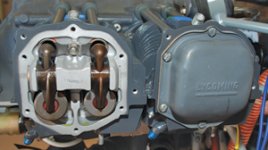
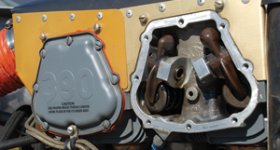
It is very easy to tell which type of engine you have. If you have a parallel valve engine (which an IOX-370 is) your valve covers will look thusly:
fwf-parallel.jpg

Whereas if you have a 360 or 390 angle-valve engine your valve covers will look like this:
fwf-angle.jpg

Two completely different cylinder designs. I know you are learning here. So as Dan mentions you will use the data plate base timing for your IOX-370. It is only the angle-valve engines that use the 5 degree offset in the retard direction. Regardless of compression ratio.

And in my opinion based on hard-knocks experience, always put in the 2-3 jumper in Pmags no matter which engine design you got. In a parallel valve engine any small efficiency gained by not having the jumper in can quickly be negated by engine damage. Angle valve engines are even more sensitive and it's asking for trouble operating without the jumper.
 
The stroked 340 (based on a normal 320 case) timing is 20⁰ (per data plate) as opposed to 25⁰ and would in fact be offset 5⁰ from "normal".

I think in Dan's image that would ve to the left of TDC mark. Then the P-Mag takes care of the rest.

At least that is what I did though I am most happy to be corrected.
 
Borescope images can fool us, but yes, detonation tends to leave two clues. It nibbles at edges on pistons, and it removes lead and carbon deposits, so everything looks nice and clean. Both are due to the loss of insulating boundary layer due to shock waves. A third clue, from the auto and motorcycle world, is hard to apply in the case of leaded fuel. If detonation is heavy enough, we start to see little tiny specs of aluminum on the spark plug center porcelain. Lead specks can look similar.

I don't think either is a serious concern in themselves, given moderation. The concerns are for possible very high temperatures (again, loss of boundary layer) and pressures (due to highly advanced timing, not the detonation).


Set at TDC with a parallel valve engine. Set at 5 to 7 after TDC for an angle valve engine, and be sure the jumper is installed between terminals 2 and 3. Review your P-Mag manual. Angle valve heads require/desire less advance due to their configuration.
@DanH , Thanks for this explanation. I went through my installation and found out that my YIO-390-EXP340 has a 20VAR recommendation on its data plate and that my PMAGs are configured with timing exactly at TDC and without jumpers in terminals 2 and 3.

I have about 50 hours total tach time and I have not experienced high CHTs. They are almost always below 360 while cruising at 2100RPM and 22Manifold @ 10000ft and burning 9.8GPH.

Do you think I should correct the configuration to 5Deg after TDC and add the jumper like the manual recommends?

(Note: My current configuration is how it came out of Thunderbolt assembly line. I haven't changed anything until now, except to wrongly verify TDC when I first installed the engine.=)
 
Actually I think not. I'm still learning about of this, but maybe because I have the high compression pistons. The data plate says the timing is : 20 degrees BTDC.
Worth some research here. The vast majority of PV engines use 25*. I would ask conti why they plated it at 20* High CR increases detonation risk, so could see why they did that. Also see other folks using 25 with 10:1. I think 20-22* at full power with that CR is wise; Lose almost no power with more margin. However, you will be giving up some power in other areas like cruise, so will want to experiment with different advance settings.

These fixed timing setups are all compromise. 25 is higher than optimal at WOT, yet a bit low for peak EGT at lower MAPs. They can get away with this because of the high octane fuel. Throw 91 octane at it and you need to be more precise.
 
The base setting does not change with altitude.

For a stock parallel valve on a -3, do the set procedure with the TDC mark aligned with the crankcase split. Base timing will be 26.6, assuming you also install the 2-3 jumper. It will advance a few degrees automatically, based on the reduced manifold pressure available at Boulder. Max advance high above Leadville will be roughly 26.6 + 9 = 35.6.
Where does everyone keep getting 26.6 from? The emag website and manuals say 25 degrees with jumper in.
 
Howdy everyone. Just as another data point: my Aero Sport Power IO-375-M1S, (parallel valve) engine is placard to use 20 deg. timing.
 
@DanH , Thanks for this explanation. I went through my installation and found out that my YIO-390-EXP340 has a 20VAR recommendation on its data plate and that my PMAGs are configured with timing exactly at TDC and without jumpers in terminals 2 and 3.

I have about 50 hours total tach time and I have not experienced high CHTs. They are almost always below 360 while cruising at 2100RPM and 22Manifold @ 10000ft and burning 9.8GPH.

Do you think I should correct the configuration to 5Deg after TDC and add the jumper like the manual recommends?

You're flying 30.8 base, 39.2 fully advanced, on an engine certified for 20 base. By doing the timing set at TDC and not installing the jumper, you're ending up in the same ballpark as the owner who clocks it wrong and does install the jumper. Yes, you should change it before you fly again.

Don't be fooled by a 360 CHT. Although a lot higher than typical for an angle valve at the 2100/22 ROP setting you state, it does not describe the underlying issues, notably very high peak pressure near TDC and increased potential for detonation.

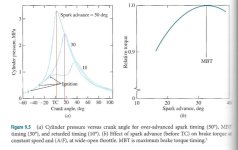
Here's an illustration from Internal Combustion Fundamentals, Heywood; a test engine in the lab. The additional red lines in (a) are mine. Note the over-advanced 50 BTDC curve reaches peak pressure very near TDC, while the 30 BTDC MBT timing (Maximum Brake Torque) reaches peak about 16 ATDC. Stop for a moment and consider the geometrical position of the connecting rod and crankshaft at these two positions. Near TDC, the crankpin is near 12 o-clock, the connecting rod is nearly vertical, and the combustion chamber is very small. Although making power requires pressure above the piston, it doesn't matter how much pressure you place there if the crank and rod geometry don't allow it to be converted to rotary motion. Peak pressure later, after the crankpin is well past TDC, allows conversion to rotary motion, and does so with a larger combustion chamber volume, so peak pressure isn't so high. Lower peak pressure relates directly to reduced mechanical stress...on everything.

There are well known empirical rules of thumb for the desired point of peak pressure; max pressure at 13 to 15 degrees ATDC, and/or about half the charge burned at around 8 degrees ATDC.

When developing cylinder heads (combustion chamber shape, port shapes and angles, valve sizes, etc), one standard check is to compare a few of them on the dyno while varying the ignition timing. The head which shows maximum engine torque with the least advance is the superior design; it has the highest combustion rate, the least negative pressure loss (pressure while the piston is rising toward TDC, after ignition), and the lowest mechanical stress.

Heywood- Timing.jpg
Where does everyone keep getting 26.6 from? The emag website and manuals say 25 degrees with jumper in.

The manual says roughly 25, and calls the max advance addition 9 degrees. The values of 26.6 and 8.4 are from Bill Repucci, right here, a decade or more ago. Bill and his partner developed the EI Commander after reverse engineering the P-mag. IIRC, the values are based on chip functions which don't allow neat divisions in whole numbers .
 
Last edited:
You're flying 30.8 base, 39.2 fully advanced, on an engine certified for 20 base. By doing the timing set at TDC and not installing the jumper, you're ending up in the same ballpark as the owner who clocks it wrong and does install the jumper. Yes, you should change it before you fly again.

Don't be fooled by a 360 CHT. Although a lot higher than typical for an angle valve at the 2100/22 ROP setting you state, it does not describe the underlying issues, notably very high peak pressure near TDC and increased potential for detonation.

Here's an illustration from Internal Combustion Fundamentals, Heywood. The additional red lines in (a) are mine. Note the over-advanced 50 BTDC curve reaches peak pressure very near TDC, while the 30 BTDC MBT timing (Maximum Brake Torque) reaches peak about 16 ATDC. Stop for a moment and consider the geometrical position of the connecting rod and crankshaft at these two positions. Near TDC, the crankpin is near 12 o-clock, the connecting rod is nearly vertical, and the combustion chamber is very small. Although making power requires pressure above the piston, it doesn't matter how much pressure you place there if the crank and rod geometry don't allow it to be converted to rotary motion. Peak pressure later, after the crankpin is well past TDC, allows conversion to rotary motion, and does so with a larger combustion chamber volume, so peak pressure isn't so high. Lower peak pressure relates directly to reduced mechanical stress...on everything.

There are well known empirical rules of thumb for the desired point of peak pressure; max pressure at 13 to 15 degrees ATDC, and/or about half the charge burned at around 8 degrees ATDC.

When developing cylinder heads (combustion chamber shape, port shapes and angles, valve sizes, etc), one standard check is to run them on the dyno while varying the ignition timing. The head which shows maximum engine torque with the least advance is the superior design; it has the highest combustion rate, the least negative pressure loss (pressure while the piston is rising toward TDC, after ignition), and the lowest mechanical stress.

View attachment 109609


The manual says roughly 25, and calls the max advance addition 9 degrees. The values of 26.6 and 8.4 are from Bill Repucci, right here, a decade or more ago. Bill and his partner developed the EI Commander after reverse engineering the P-mag. IIRC, the values are based on chip functions which don't allow neat divisions in whole numbers .
I'm heading to the hangar right now to fix this. Thank you so much! Very disappointed to receive a Thunderbolt Engine configured like that from factory.....
 
Howdy everyone. Just as another data point: my Aero Sport Power IO-375-M1S, (parallel valve) engine is placard to use 20 deg. timing.
And as another data point, my IO-360-A3B6D (angle-valve from a 1980 Mooney) is placarded to use 25 deg timing. Doesn't mean it's the ideal setting for the engine, just what Mooney and Lycoming decided to specify. Maybe that was good for an extra 1/2-kt, who knows.
 
I'm heading to the hangar right now to fix this. Thank you so much! Very disappointed to receive a Thunderbolt Engine configured like that from factory.....

You're quite welcome.

As for Thunderbolt, we should be realistic. A builder should never depend on the engine shop to set timing, idle mixture, and idle speed, or assume anything about plugs and harnesses, fluid fittings, or accessory fasteners. Those are setup items to be checked off before first flight. And the most recent P-mag manual does address the issue...although obviously I think a pictorial illustration would help ;)

And as another data point, my IO-360-A3B6D (angle-valve from a 1980 Mooney) is placarded to use 25 deg timing. Doesn't mean it's the ideal setting for the engine, just what Mooney and Lycoming decided to specify. Maybe that was good for an extra 1/2-kt, who knows.

Which was fixed timing...the most advance it would ever see.

Yes, it was for a wee bit extra cruise, the Mooney thing. I use 23 fixed.
 
Last edited:
And as another data point, my IO-360-A3B6D (angle-valve from a 1980 Mooney) is placarded to use 25 deg timing. Doesn't mean it's the ideal setting for the engine, just what Mooney and Lycoming decided to specify. Maybe that was good for an extra 1/2-kt, who knows.
That's 25 degree fixed timing for mechanical magnetos. Which is what the 1980 Mooney was delivered with and appropriate for magnetos. So if you have magnetos go with that data plate value of 25 deg. However, if you have Pmags then 5 degrees needs to be subtracted from the data plate value as depicted in the picture in Dan's first post in this thread. And in my personal opinion the Pmag 2-3 jumper always in.
 
This is a tiny thread drift. Dan's post is pretty important. Mine are set at two teeth. 4.8 degrees.
I think it's a good idea to fabricate a data terminal plug and set a few things on the "B" curve. One reason is just to know what's programmed. Another is just in case the jumper falls out. A few have posted issues with wires failing due to the terminal block cutting the wires. In the absence of a jumper, the mag starts up on the "B" curve. Hopefully someone will chime in on what to settings are available and what parameters to program so in the event the jumper fails, you won't have one mag running on an unknown advance setting.
You can buy an extra terminal block plug from Digikey and configure it for the data. Someone on here likely has Ver 3 or Ver 4. The wiring is on the web page.
Just a thought.
 
The stroked 340 (based on a normal 320 case) timing is 20⁰ (per data plate) as opposed to 25⁰ and would in fact be offset 5⁰ from "normal".

I think in Dan's image that would ve to the left of TDC mark. Then the P-Mag takes care of the rest.

At least that is what I did though I am most happy to be corrected.
I am running an original ECi IO340 (built long before Continental thought they wanted to take over for ECi). My plane first flew in 2010. Timing has always been set at 20*.
 
You're quite welcome.

As for Thunderbolt, we should be realistic. A builder should never depend on the engine shop to set timing, idle mixture, and idle speed, or assume anything about plugs and harnesses, fluid fittings, or accessory fasteners. Those are setup items to be checked off before first flight. And the most recent P-mag manual does address the issue...although obviously I think a pictorial illustration would help ;)


Which was fixed timing...the most advance it would ever see.

Yes, it was for a wee bit extra cruise, the Mooney thing. I use 23 fixed.
I agree. I take full responsibility for not understanding the issue I had in hand and for taking for granted the configuration was done properly. But we don’t know what we don’t know… If it wasn’t for your post I would probably never realize I had the configuration wrong. Again thanks!

I adjusted my page TDC w tooth after, and I did count the 149 teeth to cross check the angle per teeth. I also added the jumper in on both pmags.

I ran the engine and realized that during run up, I can now note a 40 RPM drop when turning right PMAG off and 60 on left pmag. Before that, I had barely 10 rpm drop. I also noted a slightly lower RPM. FROM 780 TO 740 at idle.

I wonder.. Would this be an expected behavior for the adjustments I did?
 
I ran the engine and realized that during run up, I can now note a 40 RPM drop when turning right PMAG off and 60 on left pmag. Before that, I had barely 10 rpm drop. I also noted a slightly lower RPM. FROM 780 TO 740 at idle.

I wonder.. Would this be an expected behavior for the adjustments I did?
Yes.
 
This is a tiny thread drift. Dan's post is pretty important. Mine are set at two teeth. 4.8 degrees.
I think it's a good idea to fabricate a data terminal plug and set a few things on the "B" curve. One reason is just to know what's programmed. Another is just in case the jumper falls out. A few have posted issues with wires failing due to the terminal block cutting the wires. In the absence of a jumper, the mag starts up on the "B" curve. Hopefully someone will chime in on what to settings are available and what parameters to program so in the event the jumper fails, you won't have one mag running on an unknown advance setting.
You can buy an extra terminal block plug from Digikey and configure it for the data. Someone on here likely has Ver 3 or Ver 4. The wiring is on the web page.
Just a thought.
I agree completely, but I would add that if you have a pmag you need to invest time in understanding the details of how it works, and include a monitor like the EngineBridge (and previously the EI Commander). Yes, it's a bit technical, and yes, it takes a bit of time to understand, but hey - you built an airplane - how hard can understanding a pmag be? And if you bought an airplane with a pmag, I would strongly urge you to make the same investment in time to understand the ignition system. This of course is valid no matter what type of ignition is installed, but particularly for any kind of "electronic" ignition. A few hours invested could prevent an off-field landing or worse. </Rant>
 
As for Thunderbolt, we should be realistic. A builder should never depend on the engine shop to set timing...
It's frightening to think Lycoming would set timing incorrectly - and then do the factory run in with it set wrong. I understand it's up to the builder to double check everything before engine start up but man, if Lycoming can't get it right....sheesh!
 
It's frightening to think Lycoming would set timing incorrectly - and then do the factory run in with it set wrong. I understand it's up to the builder to double check everything before engine start up but man, if Lycoming can't get it right....sheesh!
I've read that some engine shops don't use your ignition to test the engine - they use their own. After testing, they bolt on your ignition.
 
I've read that some engine shops don't use your ignition to test the engine - they use their own. After testing, they bolt on your ignition.
I'm not sure what Lycoming does I just hope they do it right! I have enough challenges making sure I don't screw something up. I don't need manufacturers screwing things up.
 
@lr172 , @DanH , do you guys think that an over advanced clocking would cause engine popping sounds once throttle is pulled back into idle for a steep descend?

No. Exhaust popping is typically attributed to lean mixture. I don't know if it's true or not, but it doesn't seem to hurt anything, with a Lycoming or any other engine.
 
The factory test data from my io360 M1B delivered mid 2021 lists the serial numbers of the magnetos used in the tests. They match those that were delivered. It was timed correctly
 
The manual says roughly 25, and calls the max advance addition 9 degrees. The values of 26.6 and 8.4 are from Bill Repucci, right here, a decade or more ago. Bill and his partner developed the EI Commander after reverse engineering the P-mag. IIRC, the values are based on chip functions which don't allow neat divisions in whole numbers .

My understanding is that the advance values put out by the P-mag on its serial interface are in increments of 1.4 degrees. 26.6 = 1.4 * 19 and 8.4 = 1.4 * 6, so those numbers make sense. If you're shooting for 25 degrees, the closest is 25.2 = 1.4 * 18.
 
So, question here that is sort of relevant.
I'll be installing Pmags on my freshly overhauled IO-360 parallel valve 8.5 CR sometime soon (I hope).
I'm thinking at least for break-in to set the timing about 1.5° (or about 1/2 a tooth on 149 ring gear) past TDC, and also install the jumper.
Once broken in I'll consider removing the jumper.
Does that qualify as a sound plan?
Stephen
 
So, question here that is sort of relevant.
I'll be installing Pmags on my freshly overhauled IO-360 parallel valve 8.5 CR sometime soon (I hope).
I'm thinking at least for break-in to set the timing about 1.5° (or about 1/2 a tooth on 149 ring gear) past TDC, and also install the jumper.
Once broken in I'll consider removing the jumper.
Does that qualify as a sound plan?
Stephen
I ran mine a bit retarded (two teeth) just to keep temps down till break in. Io-360-M1B. Now it's as you mentioned. Runs great. Cool as a cucumber.
 
My understanding is that the advance values put out by the P-mag on its serial interface are in increments of 1.4 degrees. 26.6 = 1.4 * 19 and 8.4 = 1.4 * 6, so those numbers make sense. If you're shooting for 25 degrees, the closest is 25.2 = 1.4 * 18.
You are correct, it uses an 8 bit processor with no floating point capability. 360/255=1.412
 
A sincere thank you Dan.

To add a wrinkle, if I may.

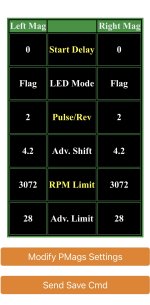
I have the same engine and ignition as the guy you spoke about in the original post. However, I have an Engine Bridge installed.

The Engine Bridge wires into terminals 2 at 3 (Rx and Tx), the same terminals as the jumper wire. In effect, the Engine Bridge acts as the jumper wire. Please, someone tell me if I'm incorrect.

The Engine Bridge has the ability to shift the Advance.

In this picture you can see that it is shifted 4.2 degrees.
IMG_3978.jpeg

Using the technique in the original post, the Engine Bridge advance shift should be set to Zero. Again, please let me know if I'm off base.
 
Last edited:
Why do you want to remove the jumper? What result are you hoping for?
Maybe my understanding is faulty (not a surprise), but I thought leaving the jumper in negated the variable timing capability while at lower MAP ie. Lean of peak. I'm learning here, so go easy. 😅
 
The Engine Bridge wires into terminals 2 at 3 (Rx and Tx), the same terminals as the jumper wire. In effect, the Engine Bridge acts as the jumper wire. Please, someone tell me if I'm incorrect.

The Engine Bridge has the ability to shift the Advance.

In this picture you can see that it is shifted 4.2 degrees.

Using the technique in the original post, the Engine Bridge advance shift should be set to Zero. Again, please let me know if I'm off base.

Hi Phil. I have no specific experience with the Engine Bridge, but it does indeed appear to act the same as a 2-3 wire jumper, retarding the base 4.2 degrees. I might wish to confirm with the vendor that "advance shift" as seen on the Engine Bridge screen is always a shift toward retard.

So, to your question, for the 390 leave the Engine Bridge 4.2 shift as it is, and clock 5 to 7 degrees when you blow in the tube.

Clocked 5, the base will be 26.6 less 5 = 21.6, which although slightly advanced compared to Lycoming's recommendation, is fine for a 390. Max advance will be 21.6 + 8.4 = 30.8. Marvin has good data on very lean operation in that ballpark. Not much value, but it's ok.

Clocked 7, the base will be 26.6 less 7 = 19.6, essentially Lycoming's base number (20). Max advance will 28, which yields a very small advantage LOP. No advantage near peak.

Maybe my understanding is faulty (not a surprise), but I thought leaving the jumper in negated the variable timing capability while at lower MAP ie. Lean of peak. I'm learning here, so go easy. 😅

Jumper connected between 2 and 3 merely shifts the base 4.2 as described above. All advance functions remain live.
 
Maybe my understanding is faulty (not a surprise), but I thought leaving the jumper in negated the variable timing capability while at lower MAP ie. Lean of peak. I'm learning here, so go easy. 😅

The jumper in or out does not alter the advance curve, it merely shifts where it begins (and ends). And as we’ve learned over the decades, it is the slope of the Pmag curve which causes issues for many engines. Manipulation of the shift (with the jumpers) and further, with the spoofing of base timing (teeth on the flywheel) is what we use to make Pmags functional on the more problematic engine configurations, but the aggressive slope of the Pmag curve is the root of the issue.

We have learned an awful lot in the decades since the Pmag curve was created, so please understand the pros and cons of what you are changing before you do it. This forum is a treasure trove of info on timing if you are willing to put in the work reading it.
 
Back
Top