Van's Air Force

The definitive Van's Aircraft support community! Buying, building or flying an RV? Join our exclusive family of mentors and enthusiasts!

The Impossible Turn...

100% agree. But I was not getting spun up as an "old head" CFI. I was getting spun up about young CFIs because I very recently went through a Part 141 CFI course because I had GI Bill $$ to burn. I figured rather than going the easy way and just getting a Mil instructor to FAA CFI equivalency ticket conversion - I'd go through the full CFI course to learn all the new ways that the FAA wants students to be taught, make sure I wasn't teaching anything wrong from the "old days", actually learn the ACS, and so on.

My experience was the school was nothing more than a "puppy mill". Outside of the ground school portion, I got absolute minimum instruction, very little plan of what we were doing that day, several were on their iphones during ground ops and in flight. We'd land, park, tie down, walk in - and the debrief was usually - "you did great, I'll see you next time" just as they are finding their next student to walk back out to the airplane. The majority of any conversations were them talking about how they are waiting for their call to a Part 135 gig or similar.

I'm sorry, I was just very unimpressed. And I've heard this from several people I know who are going through similar schools. Sure, they can quote chapter and verse of the PHAK and the FARs - but their flying skills are meh and their overall SA is average.

To your point about mentoring them.... I honestly tried with a few, gently given I've been a IP longer than most have been alive. Most didn't want to hear it or didn't have time. So..... [shrug]
I don’t disagree with most of that. It’s definitely a different breed now. There is hope though; I have been trying to mentor some of the cfis at my local field. There are a couple that I have confidence in, and they are definitely on the correct path.
 
At the risk of oversimplifying things here, in the event of an actual loss of power and you can't restore power: Don't bother trying to stop the prop (if it's controllable) below 3000 feet AGL. There is an excellent CAFE study explain that explains why. If you have control of the prop, rip it back to low RPM to reduce drag if you lose power. If it responds, great, if it doesn't, is what it is. If it's a fixed pitch prop, it will take care of itself, no brain bytes required. Simple decision matrix :cool: .

v/r,

Vac
One of the many discussions I've had on this subject - i.e. the engine failing on T/O at low altitude i.e. like 1000 AGL or less - My thought was to concentrate on flying the airplane first, make the turn, get established wings level to the chosen landing spot and THEN and only then try to troubleshoot why the engine quit/attempt a restart.

I'm curious what everyone's thoughts on this is. My thinking is that at low altitude, most people aren't going to have the brain cells available to both fly the plane through a difficult and fairly precise maneuver while simultaneously trying to switch tanks, check mags, alt air, fuel pump on, etc. I think there is a bigger risk of stalling or getting channelized attention and making the situation worse while trying to restart the motor than on just flying the plane.

I recall the BOLDFACE on a that turbine prop single in the military I flew that was:
1. GLIDE - ESTABLISH
2. LANDING SITE - SELECT
3. PROP - FEATHER (as req)

Steps 4-15. Worry about fiddling with the engine later, if even possible depending on altitude.
 
Dude, Agree steeper is better as long as you're not stalling. But I'm not sure I agree that staring at an AOA gauge around that turn is the appropriate use of your attention. I'm pretty sure that if I lost my engine on takeoff and elected to make that "impossible" turn back to the airport - my eyes are going to be out 90% of the time, while making a steep bank turn to the runway with an occasional glance in to check airspeed, AOA, or whatever.
Just to bring you up to speed on modern digital AoA indicators, if you’re doing it right, you aren’t staring at anything in the cockpit - you have a nice tone in your ear telling you exactly where you are on the AoA curve. I agree 100% with you that having to look at the indicator is a distraction that you don’t need - your eyes should be outside - and the tones are using a sense that is otherwise underutilized. You sound like a very experienced, very concerned (to get it right) IP - you owe it to yourself to give aural AoA a try!
 
At the risk of oversimplifying things here, in the event of an actual loss of power and you can't restore power: Don't bother trying to stop the prop (if it's controllable) below 3000 feet AGL. There is an excellent CAFE study explain that explains why. If you have control of the prop, rip it back to low RPM to reduce drag if you lose power. If it responds, great, if it doesn't, is what it is. NOTSO's technique of assuming worst case is probably best for practice. If it's a fixed pitch prop, it will take care of itself, no brain bytes required. Simple decision matrix .

v/r,

Vac
Is there a link to the CAFE study that you could share? My experience is that on a 14 Hartzell BA prop would stop just above the stall speed. No way around it.
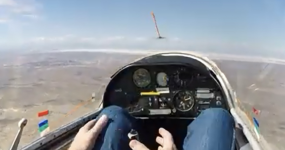
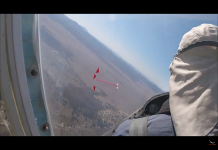
LOL, then you definitely don't want to see the videos of my "alternate" turn back method. I would get crucified here.... It worked, but I don't recommend it for the average GA pilot. And I include myself in that category. ;)
I would certainly agree that gliding in tight turns, close to the ground, at speeds in the stall departure region is something in "don't try at home" category.
The reason I post here is because I have been flying gliders for 30+ years and feel at least half competent to comment on the subject.
 
Just to bring you up to speed on modern digital AoA indicators, if you’re doing it right, you aren’t staring at anything in the cockpit - you have a nice tone in your ear telling you exactly where you are on the AoA curve. I agree 100% with you that having to look at the indicator is a distraction that you don’t need - your eyes should be outside - and the tones are using a sense that is otherwise underutilized. You sound like a very experienced, very concerned (to get it right) IP - you owe it to yourself to give aural AoA a try!
I have a G3X with AOA in my RV-8. I went through the whole calibration setup in flight setting the proper V speeds per the manual. Tried to fly the tones a couple of times and absolutely HATE HATE HATED it!!!! I turned it off after two flights of constant beeping at me on the whole approach, landing, rollout until the tail was down and turning off the runway. I honestly don’t know how you people fly like that. I have a friend with an RV-7 I fly right seat occasionally and it drives me cray cray! Like ON SPEED should be nothing. Silence is golden. Beep at me if I’m too slow or too fast. But F me, so much for a “Sterile cockpit” on final.
 
Is there a link to the CAFE study that you could share? My experience is that on a 14 Hartzell BA prop would stop just above the stall speed. No way around it.

I would certainly agree that gliding in tight turns, close to the ground, at speeds in the stall departure region is something in "don't try at home" category.
The reason I post here is because I have been flying gliders for 30+ years and feel at least half competent to comment on the subject.
IMHO, if you’re doing tight turns low to the ground in the stall departure region - then you’re doing it very wrong. If you go back and look at my videos, you’ll notice that I was always well above stall speed during the tight turns. Typically in the 80 to 85 kn indicated range. No way would I get any slower during that relatively aggressive maneuver.
 
One of the many discussions I've had on this subject - i.e. the engine failing on T/O at low altitude i.e. like 1000 AGL or less - My thought was to concentrate on flying the airplane first, make the turn, get established wings level to the chosen landing spot and THEN and only then try to troubleshoot why the engine quit/attempt a restart.

I'm curious what everyone's thoughts on this is. My thinking is that at low altitude, most people aren't going to have the brain cells available to both fly the plane through a difficult and fairly precise maneuver while simultaneously trying to switch tanks, check mags, alt air, fuel pump on, etc. I think there is a bigger risk of stalling or getting channelized attention and making the situation worse while trying to restart the motor than on just flying the plane.

I recall the BOLDFACE on a that turbine prop single in the military I flew that was:
1. GLIDE - ESTABLISH
2. LANDING SITE - SELECT
3. PROP - FEATHER (as req)

Steps 4-15. Worry about fiddling with the engine later, if even possible depending on altitude.
If you are at low altitude you don't have time to figure out why the engine quit, you should just fly the plane and not thinking about anything else.
 
if you’re doing tight turns low to the ground in the stall departure region - then you’re doing it very wrong.
I'm sorry, but that's the only way to make a 180 deg turn within a limited space using a minimum amount of energy
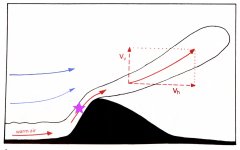
Imagine a glider trying to climb on a slope of a mountain using a buble of rising air. The purple star on the drawing. There is a narrow band of lift and in order to climb you have to circle within it. That means high turns. At the same time you have to keep the sink rate of the glider below the lift rate, otherwise you face forced landing. Low sink rate means low speed.
Putting it all together: tight turns, close to the ground at a very low speed. Depending on jurisdiction, it might be illegal and is certainly nerve racking. If one makes an error results are fatal.
 

Attachments

  • 1.jpg
    1.jpg
    173.2 KB · Views: 12
Dude, Agree steeper is better as long as you're not stalling. But I'm not sure I agree that staring at an AOA gauge around that turn is the appropriate use of your attention. I'm pretty sure that if I lost my engine on takeoff and elected to make that "impossible" turn back to the airport - my eyes are going to be out 90% of the time, while making a steep bank turn to the runway with an occasional glance in to check airspeed, AOA, or whatever.

It isn’t staring, it is outside-inside scan. And, as you’re doing it, you can kinda get a general stick position for it as you’re likely only rough order of magnitude trim toward it, but once you’re kinda a there forearm on thigh with position set, it is also kinda self holding. I don’t know where this “staring at it” is coming from.
 
I have a G3X with AOA in my RV-8. I went through the whole calibration setup in flight setting the proper V speeds per the manual. Tried to fly the tones a couple of times and absolutely HATE HATE HATED it!!!! I turned it off after two flights of constant beeping at me on the whole approach, landing, rollout until the tail was down and turning off the runway. I honestly don’t know how you people fly like that. I have a friend with an RV-7 I fly right seat occasionally and it drives me cray cray! Like ON SPEED should be nothing. Silence is golden. Beep at me if I’m too slow or too fast. But F me, so much for a “Sterile cockpit” on final.

Not sure how you set your AOA up but my garmin g3x is silent if I am on speed, and only starts chirping in the flare…
 
I'm sorry, but that's the only way to make a 180 deg turn within a limited space using a minimum amount of energy... That means high turns... Low sink rate means low speed.

And therefore you want AOA information else you want a more conservative higher cutoff altitude defining availability to be able to execute with a lesser turn. Gliders aren’t changing weight much sortie to sortie hence get away with a speed though they do need to multiply that min sink rate speed by 1.2 (pilot math for 1.189) for the 45 AOB (though they really should get side strings).
 

Attachments

  • 1769867667278.png
    1769867667278.png
    2.6 MB · Views: 20
  • IMG_0318.png
    IMG_0318.png
    2.5 MB · Views: 18
  • IMG_3762.jpeg
    IMG_3762.jpeg
    3.6 MB · Views: 19
Not sure how you set your AOA up but my garmin g3x is silent if I am on speed, and only starts chirping in the flare…

With Vac’s the idea is using both frequency of tone and pulse repetition so as to get you more information; with this the fast tone can be more soothing less distracting and the PRF works to solid tone at onspeed of this soothing tone such that it is giving awareness with less distraction cost, when you get slow, however, the tone is more harsh while just a little slow has long PRF but slower faster PRF more annoying till right before stall is screaming at you. It also comes with indexer for the dash such that color can be seen in peripheral vision though you can make quicker inside scans for the inside outside for better precision at less time than other scans.
 
And therefore you want AOA information else you want a more conservative higher cutoff altitude defining availability to be able to execute with a lesser turn. Gliders aren’t changing weight much sortie to sortie hence get away with a speed though they do need to multiply that min sink rate speed by 1.2 (pilot math for 1.189) for the 45 AOB (though they really should get side strings).
Look, I have no idea where are you coming from with this. Gliders do change weight sortie to sortie, because they carry water ballast in the wings. Some types carry more balast then their empty weight.
The cut-off altitude is when the tip of your wing grabs leafs from the trees ;)
 
With Vac’s the idea is using both frequency of tone and pulse repetition so as to get you more information; with this the fast tone can be more soothing less distracting and the PRF works to solid tone at onspeed of this soothing tone such that it is giving awareness with less distraction cost, when you get slow, however, the tone is more harsh while just a little slow has long PRF but slower faster PRF more annoying till right before stall is screaming at you. It also comes with indexer for the dash such that color can be seen in peripheral vision though you can make quicker inside scans for the inside outside for better precision at less time than other scans.

Yes, I am aware. As a side note, both system come with unintended consequences. When you use these tools, your brain gets accustomed to them. The problem occurs when the system is not available for some reason, such as flying an unequipped aircraft.

Perfect example is the radar altimeter call outs. I was part of a crew flying an aircraft that counts down 50,40,30,20,10. The pilot flying had more than 6000 hours in type. Due to an inflight maintenance issue, the aural alert was disabled. Everyone knew that it wasn’t going to count and yet the PF never flared the aircraft. Needless to say, it was a “firm” landing. It wasn’t intentional, and it was a known issue but with all of his experience, his brain was still waiting for those callouts…
 
Look, I have no idea where are you coming from with this. Gliders do change weight sortie to sortie, because they carry water ballast in the wings. Some types carry more balast then their empty weight.
The cut-off altitude is when the tip of your wing grabs leafs from the trees ;)

Ballast is a singular shift; you either have it or you dumped it. I mean your performance speeds don’t change throughout a singular sortie so they only need to adjust for g. I’m saying it is one less thing you need to consider in a glider vs plane. Though it is one thing AOA handles so a plane with AOA need not worry while a plane without can get bit.

I’m looking to undercut before anyone raises it a point that most gliders do their 200 ft rope breaks on speed not AOA (when really the gliders should be using side strings for AOA) and planes should be using AOA as it is the only safe way to max perform else planes should avoid max performing to increase margin. Note here speed also requires more inside of the inside outside scan and more effort to process.
 
I’ve been working on the turn back for several years, very good discussion. I’ve been an instructor for 61 years, both military and civilian. Over the last several months I’ve been flying with new private pilots with various time up to 250 hours. Yes, they can pass the check ride and go cross country with GPS, but they are a long way from aviators. I have found the same thing with their instructors, some have never done an accelerated stall or spin. Doing things by rote works until something out of the ordinary happens.
 
I have a G3X with AOA in my RV-8. I went through the whole calibration setup in flight setting the proper V speeds per the manual. Tried to fly the tones a couple of times and absolutely HATE HATE HATED it!!!! I turned it off after two flights of constant beeping at me on the whole approach, landing, rollout until the tail was down and turning off the runway. I honestly don’t know how you people fly like that. I have a friend with an RV-7 I fly right seat occasionally and it drives me cray cray! Like ON SPEED should be nothing. Silence is golden. Beep at me if I’m too slow or too fast. But F me, so much for a “Sterile cockpit” on final.
Wow…two whole flights - And you condemn the entire concept!

Anyone who has read my stuff knows I am a huge AoA advocate - and there is a whole lot of data to back that up. So yeah…I am biased. But I’d admit that when Vac’s system fist came out, I thought the idea of an “on-speed” tone was daft - the last thing I wanted was a constant tone in my ear on final. Now Vac knows that I still prefer the graduated tone system with very slow beeps when I am on speed (personal preference) but at the same time, but once you have spent a little time with it, your brain processes the tones in the background and you can still hear radio calls and anything else you need. Try turning the volume down on the AoA tones (in the G3X). The don’t need to be loud. And if you don’t want the tones on rollout, adjust the minimum cut-off speed.
 
LOL, then you definitely don't want to see the videos of my "alternate" turn back method. I would get crucified here.... It worked, but I don't recommend it for the average GA pilot. And I include myself in that category. ;)
Are you kidding? In one of those videos Vac is pulling G at 60 degrees (looks like 90 in the video) at 300' with the AOA screaming at him. I thought- 1. This guy has balls and 2. he's clearly done this a bazillion times at altitude and knows his airplane.

It's inspirational, really. More stuff to mess with when I'm out in the practice area and tired of egg shaped loops and nose high rolls.

I also find your thoughts on mentoring to be interesting. Mentoring has become a big focus at my airline, where we hired many young pilots with what I would call "extremely limited" experience, and quickly had several close calls. Mentoring is all good, as long as the person is open to it. Otherwise you're just the boomer captain who won't stop talking.
 
I’ve been working on the turn back for several years, very good discussion. I’ve been an instructor for 61 years, both military and civilian. Over the last several months I’ve been flying with new private pilots with various time up to 250 hours. Yes, they can pass the check ride and go cross country with GPS, but they are a long way from aviators. I have found the same thing with their instructors, some have never done an accelerated stall or spin. Doing things by rote works until something out of the ordinary happens.
Technically, EVERY CFI has done spins as it is a requirement for the rating. That said, I agree with what you are saying. There ARE some flight schools that are pushing candidates and instructors to actually BE aviators, though.

Cub Air, located at KHXF in southern Wisconsin is one of those...
 
Yes, I am aware. As a side note, both system come with unintended consequences. When you use these tools, your brain gets accustomed to them. The problem occurs when the system is not available for some reason, such as flying an unequipped aircraft.

Perfect example is the radar altimeter call outs. I was part of a crew flying an aircraft that counts down 50,40,30,20,10. The pilot flying had more than 6000 hours in type. Due to an inflight maintenance issue, the aural alert was disabled. Everyone knew that it wasn’t going to count and yet the PF never flared the aircraft. Needless to say, it was a “firm” landing. It wasn’t intentional, and it was a known issue but with all of his experience, his brain was still waiting for those callouts…

Perfection is the enemy of good.

We also have serious issue with rejecting things that generally work when we find rare holes. (Note I am using holes as opposed to corner cases.) Consider “the serial monogamy of solutions” in which we rob ourselves of good barriers because they’re not perfect yet together they may have worked. And previously they have worked though we tend to discount the times they’ve worked as we don’t note non-events.


And we blame to singular points when really multiple factors contribute while such blame leads to casting out a reasonably good and completely functional “failed part.”


I do love how once it gets to decision making we can study from fields afar:


Perfection is the enemy of good.

We also have serious issue with rejecting things that generally work when we find rare holes. (Note I am using holes as opposed to corner cases.) Consider “the serial monogamy of solutions” in which we rob ourselves of good barriers because they’re not perfect yet together they may have worked. And previously they have worked though we tend to discount the times they’ve worked as we don’t note non-events.


And we blame to singular points when really multiple factors contribute while such blame leads to casting out a reasonably good and completely functional “failed part.”


I do love how once it gets to decision making we can study from fields afar:


Who said anything about rejecting things?

All I said was that these systems come with unintended consequences.

That is a pretty far reach to suggest rejection. Maybe you just like the arguments...
 
Ballast is a singular shift; you either have it or you dumped it. I mean your performance speeds don’t change throughout a singular sortie so they only need to adjust for g. I’m saying it is one less thing you need to consider in a glider vs plane. Though it is one thing AOA handles so a plane with AOA need not worry while a plane without can get bit.

I’m looking to undercut before anyone raises it a point that most gliders do their 200 ft rope breaks on speed not AOA (when really the gliders should be using side strings for AOA) and planes should be using AOA as it is the only safe way to max perform else planes should avoid max performing to increase margin. Note here speed also requires more inside of the inside outside scan and more effort to process.
Nope
I can have full ballast now and dump 3/4 of it in 10 minutes. Wing loading and CG would change dramatically.
There is no practical difference in flying technique between any low performance glider and RV14 engine off.
AOA of course helps to optimise the airspeed
 
Nope
I can have full ballast now and dump 3/4 of it in 10 minutes. Wing loading and CG would change dramatically.
There is no practical difference in flying technique between any low performance glider and RV14 engine off.
AOA of course helps to optimise the airspeed

And you’re ok with the ballast sloshing?

Further, to be fair, we should note this is a high performance glider with an extra concern that does not apply to most gliders as most don’t do ballast in the fluid form (they might have minor metal ballast to secure cg but that isn’t changing within a flight). Such is a discussion add to competitive soaring not a baseline glider concern.
 
The 360 turn following EFATO is certainly a "competitive" manoeuvre. Not a baseline glider concern,
because gliders have airbrakes + they have mechanically operated flaps which can be used for steering
Airbrakes + flaps allow for a quick dissipation of energy and landing straight ahead.
No such luxuries in the aircraft we fly,
 
Technically, EVERY CFI has done spins as it is a requirement for the rating. That said, I agree with what you are saying. There ARE some flight schools that are pushing candidates and instructors to actually BE aviators, though.

Cub Air, located at KHXF in southern Wisconsin is one of those...
Cub Air is owned by Steve Krog who also writes a monthly column in Sport Aviation. I consider it the best writing in SA. It is the first thing I read every month. However I must say that we disagree about turnbacks. Part of the reason for that is that a J3 Cub is NOT a good airplane for a turnback maneuver.
 
Cub Air is owned by Steve Krog who also writes a monthly column in Sport Aviation. I consider it the best writing in SA. It is the first thing I read every month. However I must say that we disagree about turnbacks. Part of the reason for that is that a J3 Cub is NOT a good airplane for a turnback maneuver.

Two thoughts here, one each way:

Is it that it isn’t a good for turn back candidate or that it needs a higher altitude wicket for its turn back capacity?

If, as with a cub, you can really slow your forward flight especially if into the wind hence relative to the ground, how much less is a deliberate crash going to hurt?
 
Two thoughts here, one each way:

Is it that it isn’t a good for turn back candidate or that it needs a higher altitude wicket for its turn back capacity?

If, as with a cub, you can really slow your forward flight especially if into the wind hence relative to the ground, how much less is a deliberate crash going to hurt?
The problem with the Cub is the low performance. Unless the runway is really long you will not be in a position for a turnback.
My new base with the Wittman Tailwind is a 3700' runway. Solo with half fuel, temperature 70 F, I am at 500' AGL at end of runway. I can turnback at 300' but I use 500' for pre takeoff planning.
 
A Cub is not a very crashworthy airplane, especially the front seat. Many have no shoulder harness. The plus is the 38 m/h stall speed, maybe less groundspeed. Best not to do a turnback.
 
Cub Air is owned by Steve Krog who also writes a monthly column in Sport Aviation. I consider it the best writing in SA. It is the first thing I read every month. However I must say that we disagree about turnbacks. Part of the reason for that is that a J3 Cub is NOT a good airplane for a turnback maneuver.

My comment was more directed at the quality of student and young instructors and not so much with reference to the impossible turn.
 
Steve Krog has made detailed comments about new flight Instructors. On a separate issue he did a more recent column on "knowing the airport and the surrounding area". I take that a step further, especially West of central Nebraska in the hot weather. I choose airports with long runways that mostly do not have significant close in obstacles. I also have at least one and sometimes two alternates for VFR. One is short of the planned destination/fuel stop. The second is for surface winds, runway closures, crosswinds etc.
Some of my typical fuel stops in the high country: SAF,LVS,INW and AEG. All 7000' plus runway length and all are two or more runways.
 
I’ve been working on the turn back for several years, very good discussion. I’ve been an instructor for 61 years, both military and civilian. Over the last several months I’ve been flying with new private pilots with various time up to 250 hours. Yes, they can pass the check ride and go cross country with GPS, but they are a long way from aviators. I have found the same thing with their instructors, some have never done an accelerated stall or spin. Doing things by rote works until something out of the ordinary happens.
DING DING DING!!
 
Wow…two whole flights - And you condemn the entire concept!

Anyone who has read my stuff knows I am a huge AoA advocate - and there is a whole lot of data to back that up. So yeah…I am biased. But I’d admit that when Vac’s system fist came out, I thought the idea of an “on-speed” tone was daft - the last thing I wanted was a constant tone in my ear on final. Now Vac knows that I still prefer the graduated tone system with very slow beeps when I am on speed (personal preference) but at the same time, but once you have spent a little time with it, your brain processes the tones in the background and you can still hear radio calls and anything else you need. Try turning the volume down on the AoA tones (in the G3X). The don’t need to be loud. And if you don’t want the tones on rollout, adjust the minimum cut-off speed.
"Condemn the whole concept"??? I don't know where you read that. I just personally do not like the tones. ESPECIALLY in the flare. Like I KNOW I'm getting close to a stall in the flare...... like that's the entire point of the fricken flare!! But condemn the whole AOA concept?? Not even close. If you guys need the aural tones as a crutch to land - more power to you. I'm (mostly) joking about the "crutch". But if you like it and it works, then great. I just personally do not.

And as I said before - I love AOA and flew by AOA almost exclusively in military jets for 20 years. But I didn't need a tone beeping in my helmet constantly to hold my hand. We had a single "minimum AOA" tone that we could easily set to alert you if you were getting above a certain AOA. Sometimes during a BFM fight, you WANTED to be that slow. But it certainly didn't beep at you during landing.

I wish the AOA visual display on the G3X was more user friendly or easier to see. I find it very "busy"/. I'd prefer something simpler like this:

1769895221270.png
 
"Condemn the whole concept"??? I don't know where you read that. I just personally do not like the tones. ESPECIALLY in the flare. Like I KNOW I'm getting close to a stall in the flare...... like that's the entire point of the fricken flare!! But condemn the whole AOA concept?? Not even close. If you guys need the aural tones as a crutch to land - more power to you. I'm (mostly) joking about the "crutch". But if you like it and it works, then great. I just personally do not.

And as I said before - I love AOA and flew by AOA almost exclusively in military jets for 20 years. But I didn't need a tone beeping in my helmet constantly to hold my hand. We had a single "minimum AOA" tone that we could easily set to alert you if you were getting above a certain AOA. Sometimes during a BFM fight, you WANTED to be that slow. But it certainly didn't beep at you during landing.

I wish the AOA visual display on the G3X was more user friendly or easier to see. I find it very "busy"/. I'd prefer something simpler like this:

View attachment 108703
Notso - I wasn’t saying that you condemned AoA in its entirety - the post of yours that I quoted was entirely about the tones - and yup, if you read what you wrote, with three “hates”, I think that was a condemnation of the tones. You said several times in several different posts that you embrace AoA - and that’s great! The thing that I would ask you to recognize is that one size does not fit all, and if you teach your students that Aural AoA is that bad, they’ll never get a chance to try it for themselves.

I ran across a DPE that I know at a big flight school a couple of years ago. I was there consulting with the Chief Instructor of the school on how they could better use their AoA systems that were installed - he really wanted to do that, so I helped. Meanwhile, the DPE said that if his examinees used it, he’d fail them. He wanted to turn it off. THAT is the attitude we’re fighintg - not guys like you that know its benefits. If you don’t like tones, great - do away with them - but give others the chance to find what works best for them.
 
I joined the (semi) impossible turn club today - on my first flight in my -7. Heres my post. Still processing the whole flight, but just wanted to share my experience. Reading through this thread the last few days (and many others) in preparation for my first flight, turned out to be a blessing. Thanks to everyone on the forums!
 
Last edited:
I'm happy things worked out for @N890GF! Watching the turnback videos by @Notso I can tell this would be beyond my skill level by far. Attempting a return from 300 feet with > 45 degree banks by feel just doesn't seem realistic for me. At 600-700 feet *with* the properly calibrated AOA instrumentation - may be there is a chance to avoid making a hole in the ground.
 
Totally agree. Eventually, with technology, if the engine stops the automatic landing system will take over, ignore inputs from the pilot, and land in the safest place. We all know this is possible, but for various reasons, it won't happen any time soon.

I am highly skeptical computers will ever know “the safest place.” They’ll readily optimize from a list of “sufficiently safe,” which should include all the runways and any nearby runways, some fields are really on top of other fields, the computer is always going to do a poor job assessing the off field landing sites in terms of suitability. The computer may try to pull areas of off field for the list but the computer won’t know how suitable they actually are. The computer will also be just as susceptible to Kahneman WYSIATI. Also makes me think for the humans Klein first fit pattern matching and recognition primed decisions. Don’t need optimum, just good enough. Automatic landing system automatically taking over doesn’t appeal to me. Various reasons are legitimate reasons. Complexity vs complication, computers don’t do complexity.

Reminds me of Operation Verbal Image: https://www.marines.mil/Portals/1/Publications/MCDP 6.pdf?ver=2019-07-18-093633-990
 
I am highly skeptical computers will ever know “the safest place.”

It seems like the computers are trying to convince me that you are right, and that they will never be quite ready - I googled WYSIATI to ensure that we're talking about the same thing, and here's what I got:

1769962990356.png

I have no idea why it decided to give me this in Polish.

Even though the AI bots don't seem to be ready or optimistic, I've become more optimistic that good software can perform many tasks better than humans. I think in a system we're discussing, autoland in case of pilot incapacitation, I have no doubt that good software can perform better than a panicky non-pilot passenger while their pilot is slumped over the yoke.


This is a great read, and the adoption of this philosophy by one side is why one of the active conflicts on the globe is going the way it is. The number of variables in a military engagement is going be much higher than what it will take an autoland system to find a few hundred meters of obstacle-free terrain within an aircraft's glide range.
 
Even though the AI bots don't seem to be ready or optimistic, I've become more optimistic that good software can perform many tasks better than humans. I think in a system we're discussing, autoland in case of pilot incapacitation, I have no doubt that good software can perform better than a panicky non-pilot passenger while their pilot is slumped over the yoke.


This is a great read, and the adoption of this philosophy by one side is why one of the active conflicts on the globe is going the way it is. The number of variables in a military engagement is going be much higher than what it will take an autoland system to find a few hundred meters of obstacle-free terrain within an aircraft's glide range.
Auto-land for pilot incapacitation, definitely! My concern is the too many variables to which we don’t even know what the variables are let alone their value meaning neither can the computer know so as to optimize. Software will do much better at optimizing known knowns and resolving and optimizing unknown knowns; it also will be good at eliminating known unknowns or those variables you forgot to check but really should know not as a variable but a presently hard value… where it will fall short, and we humans often fall short though less so than the computers, are unknown unknowns and unknowable.

Example: the cross runway is NOTAM closed. We don’t know why it is closed, the computer doesn’t know why. Will the computer consider or reject the cross runway as a suitable emergency landing for when we don’t yet have energy for a full reversal? If there be an earth mover on the runway, we’d see that and reject it. If, however, the cross were merely no longer being supported and on its way to being hard closed, it is still a clear suitable emergency and even abnormal landing strip. I’d even consider it still to eliminate excessive crosswind components “accepting at pilot risk.” As it is winter, what if the airport only plows one runway? Wouldn’t want to use the unplowed one normally, though if you have skis… anyway, would the AI consider that NOTAMed closed runway as suitable for auto-land emergency? For this matter, what sort of auto-land emergency is it solving. Now assume this field had few options off field, but recently they “clear cut” a large section of forest generally upwind. But this “field” still has two foot tall stumps all throughout. Would the AI see clear field or hazardous field? If sufficient energy for both the unplowed runway and this field but not the reversal, how would it differentiate “safest?” Imagine you have imaging capacity so the AI incorporates, but that field with the stumps is covered in a blanket of snow hence doesn’t recognize the stumps.

Complex v complicated, Cynefin is a valuable thing for adding to our understanding of decision making.

The software to which Vac is working will definitely do better than me in terms of saying I can make it. Without such software, I’m either going to go too early with consequences or more likely with experience and practice set a trip wire that is conservative ceding some portion of turn around possibility. This may be ok depending on surrounding circumstances, or it may lead me to less optimal decisions. But I recognize the software won’t catch all these other sorts of concerns that may more readily open options yet again could close some such that I may need to reject an AI provided recommendation.

It is a bit like we need to take “children of the magenta” yet combine the AI into CRM. View AI as part pilot monitoring, part pilot flying, but really 3PC or “third officer” behind PIC and SIC.
 
Notso - I wasn’t saying that you condemned AoA in its entirety - the post of yours that I quoted was entirely about the tones - and yup, if you read what you wrote, with three “hates”, I think that was a condemnation of the tones. You said several times in several different posts that you embrace AoA - and that’s great! The thing that I would ask you to recognize is that one size does not fit all, and if you teach your students that Aural AoA is that bad, they’ll never get a chance to try it for themselves.

I ran across a DPE that I know at a big flight school a couple of years ago. I was there consulting with the Chief Instructor of the school on how they could better use their AoA systems that were installed - he really wanted to do that, so I helped. Meanwhile, the DPE said that if his examinees used it, he’d fail them. He wanted to turn it off. THAT is the attitude we’re fighintg - not guys like you that know its benefits. If you don’t like tones, great - do away with them - but give others the chance to find what works best for them.
I've never ONCE "taught" anyone that tones are bad. I was attempting to be perfectly clear here in this thread that I personally do not like them and find them distracting at a critical phase of flight. I know others that use the tones and they like it and I'm 100% fine with that. I have encouraged my students to find what works best for them. In no way does anyone have to do it "my way" as long as it works and its safe and effective.
 
I'm happy things worked out for @N890GF! Watching the turnback videos by @Notso I can tell this would be beyond my skill level by far. Attempting a return from 300 feet with > 45 degree banks by feel just doesn't seem realistic for me. At 600-700 feet *with* the properly calibrated AOA instrumentation - may be there is a chance to avoid making a hole in the ground.
To be clear - in my videos - that was absolutely NOT all by feel. Or even Mostly by feel. I was very deliberately flying the entire maneuver by constantly checking my airspeed and flying to a target airspeed (80-85kts). Listen to my narration and you'll hear me talk about speed constantly and what I'm doing to try to fix it. Absolutely ZERO difference than looking inside to reference an AOA gauge around the turn.

There was nothing cosmic about those maneuvers other than being slightly aggressive to bank harder than most people fly in the pattern down low AND be diligent to not let yourself get slow. Its hard for a lot of people to force yourself to put the nose DOWN when you're at 100 ft to get back on target airspeed or AOA.
 
This is a great read, and the adoption of this philosophy by one side is why one of the active conflicts on the globe is going the way it is. The number of variables in a military engagement is going be much higher than what it will take an autoland system to find a few hundred meters of obstacle-free terrain within an aircraft's glide range.
Like @Fffflats, I'm EXTREMELY skeptical of autoland systems being able to make the sort of emergency landing engine out or partial loss of thrust like you describe. Without active sensors on the aircraft like radar/Optics or such - what is it going to use to decide if those several hundred meters are actually "obstacle free"?? What if it tries to land you on a road at rush hour with bumper to bumper cars in both directions. Or land in a supposedly open field based on months or years old google map data?

All of the "autoland" systems I've dealt with in the military were for normal day/average conditions/normal systems functions. When Crosswinds were out of limits - the human pilot had to fly it. When the engine failed, the human pilot had to fly it, when certain other systems didn't work like GPS jamming, certain flight control malfunctions, etc were present - it would kick off and say good luck.

And the Double-Whammy with that was once the Auto-Takeoff and Land systems were commonly adopted across the community - the majority of the pilots got lazy and used it most of the time and only did the min manual landings to check their currency tick boxes. So when an actual condition arose when the conditions for the Auto System was out of limits or a true emergency where the Auto system wasn't designed to handle - the human pilot was at his/her lowest proficiency with landing it manually because they only did the mins for currency.
 
All of the "autoland" systems I've dealt with in the military were for normal day/average conditions/normal systems functions. When Crosswinds were out of limits - the human pilot had to fly it. When the engine failed, the human pilot had to fly it, when certain other systems didn't work like GPS jamming, certain flight control malfunctions, etc were present - it would kick off and say good luck.

Jets can auto-land on a carrier air night and in weather, but it isn’t optimizing choices, it is single focus. Not AI either, just a number crunching coupled system with the “target” already designated. What I’ve heard second (third?) hand is the original automated carrier landing system was too precise and they had to introduce deliberate error such that hooks wouldn’t wear out a hole in the deck… would love to know the veracity of that. Think of it similar to cat II/III ILS capable of zero/zero but needing that pilot interaction to engage and confirm. Unlike what we would ask an AI to do. Using the system was extremely rare, it took a ballsy pilot to actually engage it.

I watched the carrier suitability team once, they did lots of these coupled passes. On the ship from which I was observing, there was an issue that the “glide slope” curved low then flattened out. They would audible what they were seeing on the radio open mic, “one ball high, on, on, half low, one low, two low, red ball, red ball, two low, one low” translating to “a little high, on, on, a little low, low, Low, LOW, LOW, low flattening, low ‘climbing’” they said it all calm and collected, no thank you. You can have that. Calm and collected letting it ride while staring the dragon in the eye. The catapult was even worse, kept shooting off progressively lowering the umpf relative to aircraft launch weight, went from jets springing up to them flying out flat a bit before climbing to sinking a moment before climbing. On the go end, they’d read the altitude at which they bottomed out. They cried uncle well after what I would accept. Letting it settle down to thirty feet. No thank you, you can have that. Granted, the go is strictly aircraft trim, power, and catapult force so not the same as the auto-land.

Outside of the carrier suitability test team, only time I’ve witnessed the autoland were clear calm full moon nights. Why night? Because those are straight-ins. I’ve done it twice to the field to prove I knew the system, never did it to the boat myself. You can question my courage now. I’m ok with it.

They did manage to reduce the curve on that particular boat, but it was never straight. You’d definitely see an opening between ICLS and ACLS that would close back up as you got closer. Fresnel agreed with the ICLS. Yet ACLS used manually not coupled is the preferred system. Probably because ACLS is the preferred on all the other boats. ACLS is the system to which you’d couple for that auto-land. With that boat, I used the ICLS. ICLS is just like civilian ILS but different frequencies. ACLS is actually like a PAR but with the controller cut out. Boat sends a radar out, gets the return, computer processes it, sends a radio signal out telling the jet where it is. From a pilot perspective, however, it is also an ILS. Coupled it is optimizing, performing tighter than any human could, but it isn’t making larger decisions.

 
I think one of the things I'm going to do now is go experiment with doing the same turns back to the runway but doing it strictly by AOA and flying "On-Speed" as others have suggested. My gut says its going to result in a much shallower turn and end up too far from the runway to make it back. But I definitely want to see how the AOA technique works.

And just to be clear @Vac @Fffflats etc - you suggest flying the entire turn at the ON SPEED AOA number, right? I want to make sure I do the test parameters correctly. Thanks.
 
I was very deliberately flying the entire maneuver by constantly checking my airspeed and flying to a target airspeed (80-85kts). Listen to my narration and you'll hear me talk about speed constantly and what I'm doing to try to fix it. Absolutely ZERO difference than looking inside to reference an AOA gauge around the turn.
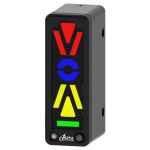
Just wanted to clarify i don’t stare at the AoA indicator, except to verify that the On-speed tone is functional. This usually happens during takeoff. In a pattern eyes are outside and just listening for the aural alert in the headset. some more info about "onspeed" parameters: https://www.flyonspeed.org/onspeed-101
 
I think one of the things I'm going to do now is go experiment with doing the same turns back to the runway but doing it strictly by AOA and flying "On-Speed" as others have suggested. My gut says its going to result in a much shallower turn and end up too far from the runway to make it back. But I definitely want to see how the AOA technique works.

And just to be clear @Vac @Fffflats etc - you suggest flying the entire turn at the ON SPEED AOA number, right? I want to make sure I do the test parameters correctly. Thanks.

You can do onspeed turns steep-ish, you’re trading that potential for angles instead of distance. Think about your turns with instantaneous turns being like zooms while sustained turns are like climbs. In this way, you’re changing energy for positional gain. Yes, the entire turn is onspeed though onspeed in this case is proxy for minimum sink AOA aka minimum power required AOA. Which brings the point, think about your power required vs power available curve in powered flight, as you load it up, you pull the curves together to meet where? Minimum power required AOA at forty-five AOB gives you the most angles through the turn you can get for the least altitude loss in a glide. We’re using onspeed as proxy, so use 45 AOB at onspeed while letting the nose down as needed to maintain onspeed. You’re balancing turn rate vs VVI. Caveat, you might not actually need the max performance, especially true in your lineup counter-reversal turns. Make the initial turn steep at forty-five biasing any error toward fifty as opposed to forty but not more than fifty while you may not need more than thirty resolving lineups after the fact.


For anyone using speed as lacking AOA indication, bias stall margin safety over maximizing performance, hence 45 AOB becomes a no steeper than limit and you only get up to 45 if Vref be equal to or greater than 1.2 Vs. Yes, letting the nose drop helps reduce turn load, but even so, make a turn bank limit based on margin stall to Vref.

Note you may want to compare best glide speed to Vs and best glide speed to Vref. If best glide be roughly 1.2 Vref, then constant speed will make for best L/D in the straights and min power required in a 45 degree bank turn. This is a weird case where constant speed turn may actually serve better than constant AOA turn, but you have to check to know it. And if you realize the AOAs and have AOA indications for them, they’re still easier to use. Meanwhile, some planes have best glide speeds that are rather slow compared to stall margin.
 
Last edited:
@Notso

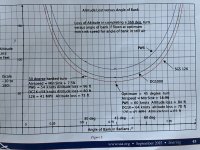
@glider_rider gave us a radius vs sink graph, which is nice for a glider trying to stay inside a thermal, but we really want to see turn rate v sink here. The other graphs show bank vs altitude loss through 360 degrees total turn, which show consequence of the rate turn v VVI, though if you have your data to pull, perhaps you could make your own turn rate v sink aka turn rate v VVI plots?

Such would be at altitude work with repeat points doing a set amount of turn noting time to turn and altitude loss in the turn. Probably good to start at thirty AOB increasing each repeat 30, 35, 40, 45, 50, 55, 60 and as you’re not likely refueling between, go backwards 60 down to thirty and then afterward hopscotch 30, 60, 40, 50, 45, 55, 35. Dealer’s choice full 360s, 180s, or 90s. But look for calm air so as to avoid external factors skewing. You’ll want to do these constant AOA. Same AOA for all AOBs. Onspeed AOA would be good as it becomes useful to you though for purposes of turn rate v sink, any AOA choice will do.
 
Last edited:
being a commercial helicopter pilot has greatly helped with the oh crap what just happened moment. After years of 135 check rides and yearly sim training the oh crap moment is just a second or two. In my -6a I practice monthly, and I get my wife to "surprise me" in the pattern. I set the altimeter at 0' and tell her any time after 400' pull the power to idle.( the black knob, not the red one)
When she does I pitch for 73 mph and turn back into the wind and will end up slipping to get it on the ground by the 1000' markers. She has surprised me early a couple of times and I have made it and late a couple of times and I have added power to make the pavement, but 9 out of 10 times i hit the 1000' marker or float just past it. Normal take off I'm turning back if I'm over 400'. If under 400', I'm landing off somewhere. That's the plan. Just mt 2 cents
 
NOTSO, that's correct--just fly everything on speed. I know I'm preaching to the choir, but here's the "long answer" on why for others that are following along:

The debate over “best glide speed” versus “best turn speed” largely misses the point during a turnback. The maneuver is short, dynamic, and workload is high. What matters is proper energy management with adequate stall margin, not chasing multiple target airspeeds. That condition exists at on-speed angle of attack, or—when AOA is not available—at a Vref-style speed for the current configuration. In normal operations, Vref is tied to a predictable margin above stall for a given flap setting; after takeoff, that same concept applies with the airplane clean or with takeoff flaps set. Practically, this means flying a steady reference speed that preserves a consistent stall margin in the flaps-up/takeoff flaps configuration (often close to about 1.3 times stall speed, but airplane-specific as Flats points out). On speed AOA corresponds to a constant percentage of available lift, so it automatically accounts for changes in weight and density altitude and helps keep the airplane at a predictable margin above stall. In a 45-degree banked glide, that Vref-style reference provides enough margin (about 1.5 to 2 degrees actual body angle [AOA]) to maneuver without sacrificing turn performance. It is not the speed that maximizes glide distance. It is the speed that minimizes workload and preserves control. A single, stable reference improves precision and survivability when time and altitude are limited.

I certainly can't refute a pedal-shaker turn (dating myself there, but maximum instantaneous--right at the stall warning/buffet [if there is one]), followed by a well-executed "extension" (think BFM "hooks and lines") at L/Dmax, followed by a smooth transition to touchdown speed with landing flaps applied just before landing. I'm just not that good a pilot to do that when I'm sucking up the seat cushion. I think of the scenario as more time/fear constrained than distance constrained if that makes any sense, and I like a simple game plan: do whatever it takes, maintain on speed. Technique only!

Cheers,

Vac
 
Last edited:
Just wanted to clarify i don’t stare at the AoA indicator, except to verify that the On-speed tone is functional. This usually happens during takeoff. In a pattern eyes are outside and just listening for the aural alert in the headset. some more info about "onspeed" parameters: https://www.flyonspeed.org/onspeed-101
Yeah, nor did I stare at the airspeed during my tests earlier. But I was definitely keeping it in my crosscheck throughout the maneuver to make sure I was on my target airspeed.

I miss my HUD....
 
Back
Top